
The executive coaching process is a contracted, one-to-one development relationship that moves through a clear sequence: a first conversation and agreement, assessment and feedback, goal setting, a stretch of focused sessions with real work in between, measurement, and a planned ending. Most engagements run six to twelve months. Below is what happens at each point, what you and your coach each do, and how to tell the process is working.
TL;DR
- Executive coaching is formally contracted, tailored and goal-oriented, delivered through focused sessions over time, according to the Institute of Coaching.
- The usual stages: relationship building, contracting, assessment, development planning, facilitating change, and a planned transition to long-term development.
- Assessment (interviews, instruments, 360-degree feedback) sets the baseline; each goal needs its own measurement and follow-up.
- Engagements typically last 6 to 12 months, and the real change happens in the work between sessions.
- A good ending leaves you owning the next phase of your development, not dependent on the coach.
Table of Contents
- What the executive coaching process actually is
- The stages of executive coaching at a glance
- Stage 1 and 2: Fit, needs and the coaching agreement
- Stage 3: Assessment and feedback
- Stage 4: Turning insight into a development plan
- Stage 5: The sessions themselves
- How long executive coaching takes
- How progress is measured
- How the engagement ends
- Our perspective
- Work with us on your next chapter
- How to get the most from the process
- FAQ
- Sources
What the executive coaching process actually is
The Institute of Coaching describes executive coaching as one-to-one, tailored, goal-oriented and formally contracted, delivered through focused sessions over time, with follow-through, accountability and lasting self-development. Each of those words does work.
One-to-one means the agenda is yours, not a curriculum built for a cohort. Contracted means goals, confidentiality, schedule and measures are agreed in writing before the real work begins. Over time means a single insight is not the point. The point is a changed pattern of behavior that holds after the coach is gone.
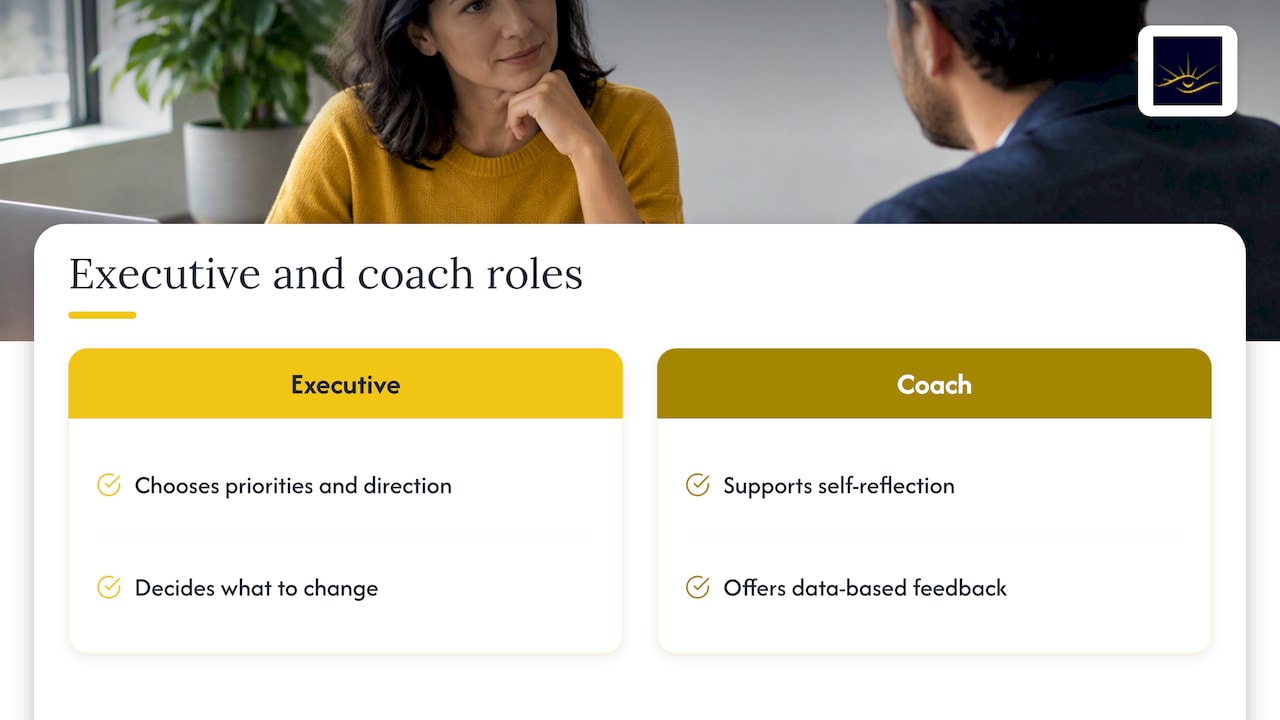
There is also a research view of the relationship. An American Psychological Association journal article on the U.S. Department of Veterans Affairs coaching model describes a collaborative, process-consultation relationship: the client chooses priorities and direction, and the coach supports self-reflection and offers feedback grounded in data and observation. In other words, the coach does not hand you answers. The coach helps you see your situation more clearly and then holds you to what you decide.
When the organization pays, the Institute of Coaching’s handbook frames the work as a partnership among the executive, the coach and the organization, designed to align individual development with organizational objectives. When you pay personally, as many of our clients do, the same shape applies, with one difference: the only objectives to align are yours and the role or life you want.
The stages of executive coaching at a glance
There is no single universal model, and the stage names change from one coach to the next. The Institute of Coaching handbook gives a useful reference sequence: relationship building, contracting, assessment, development planning, facilitating development and change, and ending formal coaching with a transition to long-term development. It also offers a shorter operational version: needs analysis, contracting, data gathering, goal setting and planning, implementation, measurement and reporting, and transition.
Here is how those map to what you will experience.
| Stage | What happens | What you do | Typical output |
|---|---|---|---|
| 1. Relationship and needs | Exploratory conversation, fit check, clarity on the trigger for coaching | Say honestly what is not working and what you want | A decision to proceed |
| 2. Contracting | Goals, schedule, confidentiality, measures and roles agreed | Review and sign the agreement | Written coaching agreement |
| 3. Assessment | Interviews, instruments, observation, possibly 360-degree feedback | Complete assessments, nominate stakeholders | Baseline picture of strengths and gaps |
| 4. Development plan | Feedback is interpreted and turned into priorities | Choose what matters most | Written plan with measures and deadlines |
| 5. Implementation | Regular sessions plus experiments in your real work | Practice, report back, adjust | Observable behavior change |
| 6. Measurement | Progress checked against the baseline and the plan | Gather evidence, ask for feedback | Progress report |
| 7. Transition | Review, documentation of gains, plan for what is next | Take ownership of continued growth | Development plan beyond coaching |
If you searched for “the five stages of the coaching process,” you have probably seen condensed versions that fold these seven into five or four. The substance is the same: understand, agree, act, check, close.
Stage 1 and 2: Fit, needs and the coaching agreement
The first conversation is not a sales pitch and not yet coaching. It answers three questions. What is the situation that made you look for a coach? Is this a coaching problem, or does it need something else, such as a change of role, a medical conversation, or therapy? And do you and this coach work well together?
Fit matters more than credentials on a slide. You will be telling this person things you may not have said to your board, your spouse or your team. If the conversation feels like being processed rather than heard, trust that signal.
Contracting follows. The handbook says the executive, coach and organization decide coaching goals, and that a written plan should specify deadlines and appropriate measurements, including follow-up and feedback reports. A solid agreement covers:
- The goals in your own words, and what “better” will look like
- Session frequency, length and format
- Total engagement length and how it can be extended or ended
- Confidentiality: what stays between you and the coach, and what, if anything, is shared with a sponsor
- What you are expected to do between sessions
- How progress will be measured and reviewed
If you are choosing among coaches, our guide to selecting an executive coach lays out what to measure first and what to ask before you sign.
Stage 3: Assessment and feedback
Assessment gives the engagement a starting line. Without it, “I feel more effective” is the only evidence you will ever have. The handbook says the coach may use interviews, observation, instruments and 360-degree feedback from managers, peers, direct reports and other stakeholders.
The handbook also stresses what happens after the data arrives. You and the coach interpret the feedback together, agree on priorities and behavioral goals, and later use stakeholder input to check whether change is occurring. Two guardrails matter here:
- Confidentiality. People give honest feedback only when they trust how it will be used. Ask the coach how responses are aggregated and who sees them.
- Development, not evaluation. Coaching feedback is meant to help you grow. It is not a performance review, and a good coach keeps the two apart.
A self-report instrument can be a powerful complement to others’ views. We use the Energy Leadership Index (E.L.I.) assessment with clients as one way to look at how you habitually respond under pressure, since that pattern shapes decisions, relationships and burnout risk. If you want to understand what such a tool does and does not tell you before committing, this overview of what an Energy Leadership Index assessment reveals is a good place to start.
Expect this phase to take a few weeks, depending on how many stakeholders are involved and how quickly you complete the instruments.
Stage 4: Turning insight into a development plan
Feedback without a plan is just information. The planning stage converts what you learned into a short list of priorities, usually two or three, not ten. More goals dilute attention and make progress impossible to see.
A workable plan has, for each goal:
- A specific behavior or outcome (“delegate approval of routine contracts under a set threshold,” not “be a better delegator”)
- A measure that someone other than you could verify
- A deadline or review point
- A named source of follow-up feedback, such as your manager, a peer or a direct report
That last element is what the handbook means by follow-up and feedback reports attached to each goal. It is also the answer to a question executives often raise: how will I know this is not just pleasant conversation? You will know because the plan told you in advance what evidence would count.
Stage 5: The sessions themselves
This is the part people picture when they think of coaching, and it is the smallest part of the total effort. A session is typically a focused conversation, and the coach follows some structure, even when it feels free-flowing.
Common session frameworks
The Association for Talent Development presents GROW as a common structure: clarify the Goal, examine Reality, identify Options, and agree the Will and Wrap-Up, including action steps and commitment. In practice a session might go like this:
- Goal: “What do you want from today, and what would make it worth your time?”
- Reality: “What happened in the board meeting? What did you do, and what did others do?”
- Options: “What else could you have done? What are you not letting yourself consider?”
- Will: “What will you do before we meet again, and how will I know you did it?”
The same ATD piece describes Gerard Egan’s skilled-helper sequence: Current Picture, Preferred Picture and Forward Picture. You move from understanding where you are, to defining where you want to be, to testing practical change. Different labels, same arc.
That arc, from reflection to a committed next step, is what separates coaching from a good chat. If you want to see how coaching conversations are structured from reflection through commitment, that write-up walks through the logic from a systems angle.
What happens between sessions
Sessions are where you think. The weeks between them are where you change. A typical cycle: you leave with one or two experiments, run them in real meetings and real conversations, notice what happened, and bring the evidence back. A coach who only talks during the session and assigns nothing is leaving most of the value on the table.
Session length and frequency vary by coach and by engagement. Many executive engagements use sessions every two to four weeks, but your contract is the authority, not a rule of thumb.
How long executive coaching takes
The Institute of Coaching says executive coaching engagements typically run six to twelve months. That span makes sense when you look at the stages: assessment and planning take weeks, and behavior change needs enough time to be tested in many real situations and noticed by other people.
Our own engagements are individualized private packages, typically three to twelve months, depending on whether you are testing a direction or going through a full transition. Shorter formats exist for focused questions: a 4 to 6 session career clarity engagement is built to test a direction, while a 3 to 12 month career transition engagement suits a bigger move.
On cost, the range varies widely by coach and scope. We have put the numbers and the variables that drive them in our executive coaching cost playbook, so you can budget before any conversation.
How progress is measured
The handbook’s principle is simple: each goal should have appropriate measurements, follow-up and feedback reports. Here are examples of measures that hold up:
- Stakeholder pulse checks. Your manager or team answers the same two or three questions at the start, midpoint and end.
- Behavioral counts. How many decisions did you delegate this month? How many one-to-ones did you hold?
- Outcome markers. Retention on your team, delivery against a deadline, a promotion decision, a role change.
- Self-ratings against the baseline. Useful, but weaker alone because they reflect mood.
- Energy and recovery signals. For burnout-related work, sleep, boundaries held and how often you recover between demanding weeks.
The same stakeholder input used during assessment is reused during implementation to check whether change is happening. That loop is the difference between coaching that feels good and coaching that can be shown to work. For a deeper look at tying results to numbers, see how to calculate executive coaching ROI with the E.L.I. assessment.
How the engagement ends
A good ending is planned from the start, not improvised in the last session. According to the handbook, it includes a progress review, reflection on learning, documentation of gains and remaining priorities, and a plan for continued development. Ownership then shifts to you, often with your manager or another stakeholder supporting and reviewing progress. The coach may recommend internal or external resources and agree on future check-ins or a reassessment.
This matters because the aim is capability, not dependency. If you finish coaching and cannot name what you do differently, how you will keep doing it, and who will notice if you slip, the ending was not finished.
Our perspective
Most people come to us when the usual fixes have stopped working. They are successful on paper and exhausted in practice, or they have outgrown a role and cannot yet say what comes next. The process described above is sound, and I would add one thing: the stages are the scaffolding, not the work.
The work is identity. When an executive is burned out or in transition, the problem is rarely a missing skill. It is a story about who they have to be to stay worthy of the job. A tidy plan does not shift that story. A deep coaching relationship, with honest questions and accountability outside the scheduled hour, can.
That is why we combine deep transformational coaching with practical career and life strategy, and why we use Energy Leadership principles to look at how you respond under pressure. We have supported over 600 transformations, and what I see again and again is that the clients who change most are the ones who treat the weeks between sessions as the real engagement.
If you are going to invest in this process, choose a coach who will be as rigorous about your life as about your calendar.
Junna Liao
Work with us on your next chapter
If you are weighing a coaching engagement, the next step is a conversation about where you are and which format fits. We work one-to-one with executives, professionals and leaders through burnout, career transitions and identity shifts, combining deep coaching with practical planning and accountability between sessions.
You can start with 1:1 career coaching with Junna, explore life coaching if the question is bigger than your role, or begin with the Energy Leadership Index assessment to get a baseline. Pricing is discussed with you directly, as each engagement is tailored.
How to get the most from the process
A few habits make a visible difference, whoever your coach is.
- Arrive with a real problem. “Improve my leadership” is too broad. “My direct reports escalate everything to me and I am working until midnight” is a coaching agenda.
- Tell the truth early. The assessment and the first sessions only help if they reflect reality, including the parts you are not proud of.
- Do the between-session work. Ten minutes of honest reflection after each experiment is worth more than an hour of polished discussion.
- Involve one stakeholder. Ask a trusted manager or peer to give you feedback at the midpoint. It sharpens the plan and builds support for your change.
- Plan the ending at the beginning. Ask in the first month what you want to be able to do on your own at the end.
If your situation is about performance at the top level, our page on executive coaching for high performers goes into the specifics. If you are weighing what coaching can realistically deliver, the evidence on executive coaching benefits and hiring signals is a useful companion.
FAQ
What are the stages of the executive coaching process?
The Institute of Coaching handbook lists relationship building, contracting, assessment, development planning, facilitating development and change, and ending coaching with a transition to long-term development. Some coaches compress these into four or five stages, but the sequence is the same: understand, agree, act, measure, close.
How long does executive coaching last?
The Institute of Coaching says engagements typically run 6 to 12 months. Shorter formats exist for focused questions such as testing a career direction, while larger transitions often use the longer end of the range.
How is an executive coaching session structured?
Most sessions follow a simple arc, such as GROW: set the goal, examine the current reality, explore options, then commit to specific actions. The session ends with what you will do before the next meeting and how it will be checked.
Is executive coaching confidential?
It should be, and the terms are set in the coaching agreement. When feedback is gathered from colleagues, a careful coach protects confidentiality and keeps developmental feedback separate from performance evaluation. Ask exactly what, if anything, is shared with a sponsor before you sign.
What happens when coaching ends?
You and the coach review progress, document your gains and remaining priorities, and agree a plan for continued development. You then own the next phase, often with a manager or another stakeholder reviewing progress, and you may schedule a later check-in.
Sources
- Introduction to Leadership and Executive Coaching, Institute of Coaching
- Executive Coaching Handbook, 6th edition, Institute of Coaching
- Executive Coaching: New Framework for Evaluation, American Psychological Association
- A Closer Look at the Executive Coaching Process, ATD
- Willpower Is Not a System: What ADHD Coaching Actually Does, theNeedle
Recommended
- Measure First: Executive Coach Selection, Script & Metrics for Leaders
- Leaders: Use the E.L.I. Assessment to Calculate Executive Coaching ROI
- Leaders: Evidence First Executive Coaching Benefits and Hiring Signals
- Executive Coaching for High Performers: Mastering the Alchemy of Leadership
This blog is for educational and inspirational purposes only. It is not medical, legal, financial, or mental health advice. Your journey is unique; please seek qualified professional support for decisions that affect your health, finances, or wellbeing.