

Article by
Junna Liao
Junna Liao is the Founder of MMDC Alchemy, an ICF Professional Certified Coach and Energy Leadership Index Master Practitioner. With more than 2,200 coaching hours and 600 leaders empowered, she helps high achievers reinvent their careers and lives with greater clarity, confidence, and purpose. Guided by a deep love for humanity, Junna is committed to creating one miracle a day for the world and inspiring others to Remember Their Miracles.
What if the ceiling you’ve hit isn’t a limit of your capability, but a necessary signal for a total identity shift? Stagnation. It’s the silent weight that settles in when your proven strategies no longer yield the exponential growth they once did. You’ve reached the peak of your current mountain, yet you feel less like a conqueror and more like a fraud waiting to be unmasked. Understand that overcoming leadership plateaus is rarely about working harder; it’s about shifting the internal energy that drives your external results.
It’s exhausting to maintain a facade of success when you feel a growing disconnect between your professional role and your personal purpose. We’ll help you transform this stagnant performance into a catalyst for profound professional evolution and purposeful impact. This guide explores an alchemical approach to growth, utilizing the Energy Leadership Index (ELI) to reveal the hidden patterns holding you back. You’ll learn to move beyond the cycle of burnout, find clarity on your next level of identity, and achieve a state of sustainable mastery.
Key Takeaways
- Awareness. Recognize that overcoming leadership plateaus is a call for an internal identity shift rather than a simple increase in external effort.
- Transformation. Discover the “Alchemy of Leadership” framework to dissolve outdated habits and coagulate a more purposeful, high-impact presence.
- Resonance. Learn how the Energy Leadership Index (ELI) identifies the hidden attitudinal blocks that create diminishing returns on your hard work.
- Alignment. Define the path toward sustainable performance by bridging the gap between your executive role and your ontological truth.
Defining the Leadership Plateau: When Success Becomes a Ceiling
Stagnation. It is the quiet, persistent realization that the strategies which fueled your rapid ascent are now the very things holding you back. You have reached a state where external performance remains stable, yet your internal growth and sense of inspiration have leveled off. This is not a temporary lull in your schedule. It is a structural plateau that signals a need for a profound identity shift. This is the first step in overcoming leadership plateaus: acknowledging that your current tools are insufficient for the next stage of your journey.
Expertise. Many high achievers find themselves caught in the “Expertise Trap,” where their technical brilliance prevents their strategic evolution. You are likely operating at a level of competence that mirrors the Peter principle, having risen through the ranks based on skills that are no longer the primary drivers of success in your current role. True leadership mastery requires you to look beyond what you do and examine who you are being as you lead.
The Anatomy of Stagnation
Pulse. A plateau is defined by diminishing returns on effort. You push harder, yet the incremental impact of your work shrinks. This creates an emotional landscape of boredom and restlessness. Unlike organizational plateaus dictated by markets, individual ceilings are internal boundaries. Overcoming leadership plateaus requires shifting focus from external task management toward an internal exploration of your leadership energy and presence.
Why High Achievers are Most at Risk
Paradox. Your greatest strengths often become your most rigid constraints. The meticulous control that once set you apart now prevents you from cultivating team autonomy. When you feel stuck, your instinct is to work harder. This response is damaging, reinforcing a “Doer” mindset that leads to burnout. True mastery requires releasing tactical output to embrace the ontological presence of a leader, allowing for sustainable performance without the exhaustion of constant effort.
The Alchemy of Growth: Why Your Strengths Must Evolve
Transformation. Overcoming leadership plateaus is not about adding new skills to an already crowded arsenal. It is about the alchemy of your existing essence, transforming the leaden weight of past habits into the gold of future impact. Many leaders attempt to solve stagnation by attending more seminars or reading more books, but these are often just distractions from the deeper work of identity evolution. We approach this through a specific framework designed for the high-level executive:
- Lead: Identifying the dense, heavy patterns of your current success that have become stagnant.
- Dissolve: Breaking down the old identities and behaviors that have become constraints.
- Coagulate: Forming a new, more refined leadership presence that resonates with your current role.
Vision. The shift from tactical execution to visionary presence requires a fundamental change in how you perceive your value. You are no longer the primary “doer” in the room. Your role has evolved into a catalyst for the potential of others. This transition is less about what you do and more about the energy you project, moving from the noise of constant activity into the clarity of strategic stillness. If you find yourself at this crossroads, individual leadership coaching can help you navigate the delicate process of coagulating your new professional identity.
Dissolving the Old Identity
Ego-dissolution in a leadership context is the intentional shedding of a self-image based solely on past achievements and technical dominance. It is the most painful part of the alchemical process because it requires you to release the very traits that earned you your current seat. You might fear that without your “expert” status, you’ll become irrelevant. Yet, as Career Plateaus Explained suggests, these stagnant periods are often the result of outgrowing your operational model. You must identify the “expired” parts of your style, such as the need for absolute control, and allow them to dissolve.
Coagulating New Mastery
Mastery. New leadership mastery is defined by influence rather than control, and by resonance rather than volume. You move from being the “Problem Solver” to becoming the “Space Creator” for your team. This stage relies heavily on intuition and ontological awareness, which is the practice of observing your internal state and its impact on the collective. When you lead from this place of deep awareness, you create an environment where sustainable performance occurs naturally without the need for constant, high-effort intervention.
Energy Leadership: The Hidden Driver of Professional Stagnation
Resonance. Your leadership is not merely a collection of tactical maneuvers or strategic decisions; it’s the energetic frequency you project into every room and every interaction. This unseen driver often determines whether your team feels inspired or merely managed. When you find yourself in a state of stagnation, the issue is rarely a lack of skill but a misalignment of energy. Overcoming leadership plateaus requires you to move beyond the surface level of “doing” and into the deeper realm of “being.”
Rationalization. The most common energetic state of a plateau is Level 3 energy. In this state, you’ve learned to cope with stress by rationalizing away your dissatisfaction. You tell yourself that the current results are “good enough” or that the lack of inspiration is just a natural part of senior leadership. This energy is functional, but it lacks the transformative power needed for the next level of mastery. It keeps you safe, but it also keeps you stuck.
Catabolic vs. Anabolic Leadership
Contrast. Leadership energy falls into two broad categories: catabolic and anabolic. Catabolic energy is stress-based and reactive, often fueled by a need for control or a fear of failure. This energy creates a “ceiling” because it triggers a defensive response in your team, stifling creativity and autonomy. In contrast, anabolic energy is constructive and opportunity-based. It acts as the solvent for a leadership plateau, dissolving the barriers to growth. For example, a leader operating at Level 5 energy views a market downturn not as a crisis to be managed, but as a unique opportunity to innovate and capture new value.
The ELI Assessment as a Catalyst
Clarity. The Energy Leadership Index (ELI) Assessment serves as a sophisticated mirror for your internal state. It moves beyond personality tests to measure how you perceive and approach your work, especially when under pressure. This reveals your “Energetic Stress Reaction,” the default pattern of behavior that often triggers plateau-inducing habits like micromanagement or withdrawal. By identifying these hidden drivers, you gain the awareness necessary to consciously shift your energy. Engaging with the Energy Leadership Index (ELI) Assessment through MMDC ALCHEMY is the first step in this alchemical transformation, providing the data-driven insight needed to unlock your next level of professional impact.
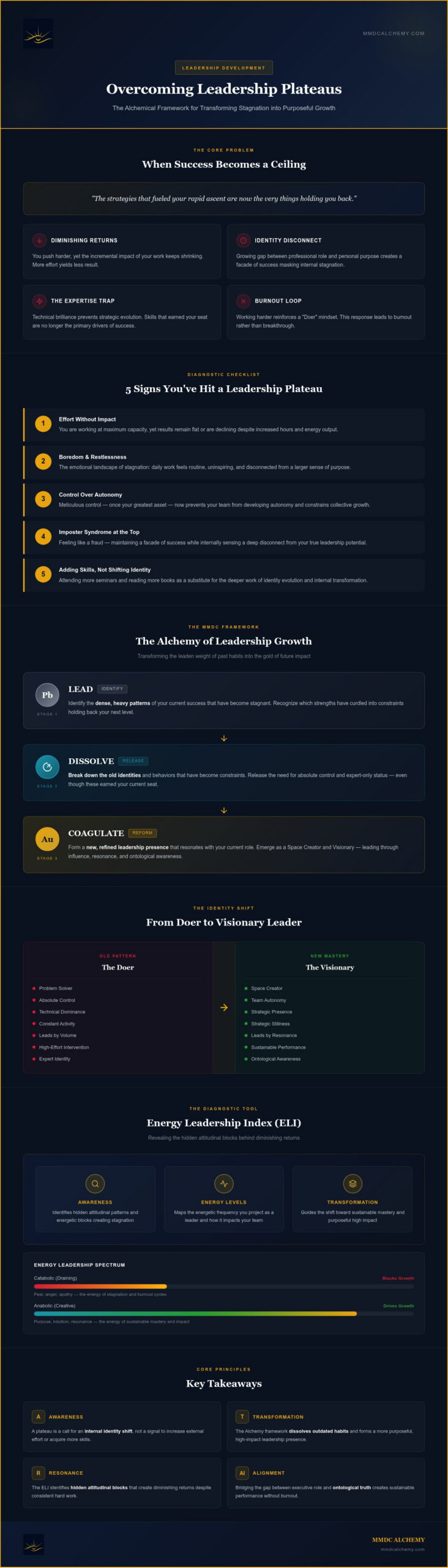
Checklist: 5 Signs You Have Hit a Leadership Plateau
Clarity. Use this diagnostic framework to determine if your current frustration is a signal for evolution. A plateau is not a failure of character, but a natural boundary of your current operating system. Recognizing these signs is the essential first step in overcoming leadership plateaus.
- The “Same Problems, Different Day” Loop: You find yourself solving the same operational or interpersonal issues repeatedly. There is a lack of systemic change because your current perspective cannot see the root cause.
- Diminishing Returns on Effort: You are working 20% harder just to achieve a 2% increase in impact. The sheer volume of your output no longer correlates to the quality of your results.
- Lack of “Flow” or Joy: Leadership has transitioned from a creative act of vision into a heavy weight of obligation. You feel a persistent sense of disconnect between your daily tasks and your deeper purpose.
- Team Stagnation: Your direct reports have stopped growing. They have reached the ceiling of your current leadership style, reflecting back the very limitations you are experiencing internally.
- The “Safe” Strategy: You have begun making decisions designed to avoid losing rather than to win. Your focus has shifted from bold expansion to the preservation of your current status.
Self-Diagnostic Questions for Executives
Honesty. True transformation requires a ruthless look in the mirror. Ask yourself: “Am I leading from my past successes or my future potential?” If you are relying on what worked five years ago, you are already standing on a plateau. Consider what you would do differently if you weren’t afraid of losing your current status or reputation. This internal inquiry creates the friction necessary to spark change.
The Immediate Next Steps
Pause. The first step to overcoming a plateau is often doing less, not more. You cannot solve a structural identity issue with more activity. Seeking an external, sophisticated catalyst is vital because you cannot see your own blind spots from inside the jar. A partner who understands both the boardroom and the soul can help you navigate this transition. If you’re ready to move beyond these signs, exploring individual leadership coaching is the most direct path to reclaiming your mastery and purpose.
Mastering the Shift: Alchemy with MMDC
Alchemy. True leadership mastery requires a partner who understands the nuances of both the boardroom and the soul. At MMDC ALCHEMY, our approach is insight-driven, ontological, and deeply transformational. We don’t merely offer advice; we facilitate a fundamental shift in how you perceive your role and your impact. This is the essence of overcoming leadership plateaus, moving from the exhaustion of tactical management to the resonance of visionary presence.
Transformation. Our 1:1 Individual Leadership Coaching process is a deliberate journey from “Coping” to “Creating.” While many executives spend their days reacting to fires and managing stress, we guide you toward a state of intentional creation. This evolution is supported by the Energy Leadership Index (ELI) Assessment, which integrates into the coaching journey to provide a data-driven roadmap for your evolution. It identifies the specific energetic blocks that have kept you tethered to your current plateau, allowing for a targeted and efficient shift in perspective. Choosing the right individual leadership growth program is itself a transformational decision that shapes the depth and sustainability of your evolution.
The MMDC ALCHEMY Partnership Model
Catalyst. In high-stakes environments, a coach acts as a sophisticated catalyst for your internal growth. We focus on cultivating purposeful impact and sustainable confidence, ensuring that your performance isn’t just high, but also healthy and enduring. We work with high achievers to unlock their extraordinary potential by focusing on three core pillars:
- Awareness: Identifying the unseen drivers of your current behaviors and results.
- Authenticity: Aligning your leadership style with your deepest ontological truths.
- Impact: Translating internal shifts into tangible, systemic changes within your organization.
Commencing Your Evolution
Becoming. Leadership is not a destination you reach but a continuous process of becoming. If you’ve recognized the signs of stagnation in your own journey, it’s time to seek the clarity that only an external perspective provides. We invite you to book a discovery session to explore the specific nuances of your plateau and determine the most effective path forward. This conversation is the first step in reclaiming your passion and refining your identity as a master of your craft. It’s time to move beyond the ceiling and into the extraordinary potential that awaits.
Experience the Alchemy of Leadership Mastery
Stepping Into Your Next Evolution of Mastery
Mastery. The plateau you face today is not a permanent ceiling but a sacred threshold waiting for your permission to cross. It marks the pivotal moment where your existing expertise must dissolve to make room for a more resonant, visionary presence. We’ve explored how stagnation is often an energetic misalignment rather than a lack of effort. You’ve identified the signs of structural plateaus and discovered how the Alchemy of Leadership framework turns stress-based reactions into creative opportunity.
Transformation. Overcoming leadership plateaus requires more than tactical adjustments; it demands a data-driven shift in your internal state. Through our PCC-certified coaching mastery and the deep insights of the ELI Assessment, we provide a transformational roadmap specifically tailored for high-achieving executives. It’s time to bridge the gap between your professional role and your soulful purpose, moving from the weight of obligation into the clarity of purposeful impact.
Unlock your next level of leadership with a discovery session
You possess the potential for extraordinary impact. Step forward with clarity and trust the process of your own becoming.
Frequently Asked Questions
What is the most common cause of a leadership plateau?
Expertise. The most common cause is the “Expertise Trap,” where a leader relies on technical skills rather than evolving their strategic presence. You’ve reached a level where your “doing” mindset has hit its limit. To move forward, you must shift your internal identity. This evolution is necessary because the very strategies that fueled your initial ascent often become the rigid constraints that prevent further growth. It’s about who you’re being, not just what you’re doing.
How do I know if I am plateauing or just going through a busy season?
Duration. A busy season is characterized by a temporary increase in external volume with a clear end date. In contrast, a plateau is a structural state where your effort remains high but your impact and inspiration have leveled off. You feel a persistent sense of disconnect and boredom despite your achievements. If your daily tasks feel like a heavy obligation rather than a creative act, you’re likely facing a plateau rather than a temporary rush.
Can a leadership plateau lead to executive burnout?
Exhaustion. Yes, a leadership plateau is a significant precursor to executive burnout. When your proven strategies stop yielding results, your natural instinct is to work harder. This “Success Paradox” creates a cycle of high effort and low reward, leading to physical and emotional exhaustion. Overcoming leadership plateaus requires breaking this cycle by shifting from reactive catabolic energy to constructive anabolic energy. This shift protects your well-being while restoring your capacity for purposeful impact and sustainable performance.
What is the difference between leadership coaching and traditional management training?
Ontology. Traditional management training focuses on the acquisition of external skills and tactical tools. Leadership coaching, specifically the alchemical approach used at MMDC ALCHEMY, focuses on the leader’s internal state and “way of being.” We don’t just teach you what to do; we help you evolve who you are. This process addresses the deep-seated patterns and energetic blocks that training programs often overlook, facilitating a more sustainable transformation that resonates through every level of your organization.
How long does it typically take to overcome a leadership plateau?
Persistence. The timeline for overcoming leadership plateaus varies based on your commitment, but most leaders experience a significant shift within three to six months. This duration allows for the “dissolving” of old identities and the “coagulation” of new mastery. True transformation isn’t a quick fix; it’s a methodical journey. It requires consistent reflection, energetic awareness, and the guidance of a sophisticated catalyst to ensure the internal changes translate into lasting, tangible results in your professional life.
How does the Energy Leadership Index (ELI) help in breaking a plateau?
Awareness. The Energy Leadership Index (ELI) acts as a sophisticated mirror, revealing the hidden energetic drivers of your stagnation. It measures how you perceive and approach your work, especially when under pressure. By identifying your default “Energetic Stress Reaction,” the ELI provides a data-driven roadmap for shifting from reactive, catabolic energy to creative, anabolic energy. This clarity allows you to intentionally choose a more resonant leadership presence that dissolves the plateau and unlocks your extraordinary potential.
Is it possible to overcome a plateau without changing my role or company?
Internalization. It’s absolutely possible to overcome a plateau without changing your environment because the ceiling is primarily internal. By shifting your identity and energetic presence, you change how you interact with your current organization. This transformation often reveals new opportunities and strategic paths that were previously invisible. You don’t always need a new company to find growth. Instead, you need a new way of leading from within that reanimates your current role and impact.
Disclaimer
This content is for educational purposes only and does not constitute medical, mental health, legal, tax, investment, or financial advice. Individual results vary, and no specific outcome is guaranteed.

