Healthcare specialists, skilled trades, cybersecurity and cloud roles, senior leadership, creative strategists, and licensed therapists top the list of jobs least likely to be automated. Each resists AI for a specific reason: legal accountability, physical unpredictability, or judgment that can’t be reduced to a pattern. If you want an ai-proof career, the move right now is simple: audit which of your daily tasks are pattern matching versus judgment calls, then start stacking AI fluency onto whatever expertise you already have.
TL;DR:
- Roles with legal, physical, or judgment-based accountability, such as healthcare providers, skilled trades, and leadership, are highly resistant to automation.
- AI adoption currently targets routine, codifiable tasks like data entry or basic process execution, leaving judgment-heavy responsibilities intact in certain careers.
- Building an AI-proof career involves stacking domain expertise with adjacent technical skills and continuously auditing the task split between floor and ceiling work.
- Job growth in healthcare and skilled trades is supported by legal and physical accountability, with strong projections for employment expansion in these fields.
- Success in future-proofing depends on ongoing skill stacking, real-world portfolio projects, and evaluating industry and regional factors impacting AI’s adoption.
Table of Contents
- What Makes a Career AI-Proof: The Top Resilient Categories
- What the Labor Data Actually Says About AI-Resistant Careers
- The Detailed List: Roles, Pay, Growth, and Why They Hold Up
- How to Build an AI-Proof Career: Frameworks and a 90-Day Plan
- How to Choose Between AI-Resistant Career Paths
- The Emotional Skills That Make You Harder to Replace
- Will Today’s AI-Resistant Careers Stay That Way?
- Continuous Learning as the Real AI-Proofing Strategy
- Why Geography and Industry Change the AI-Resilience Equation
- Real Transitions: How Professionals Are Repositioning Around AI
- Why We Built MMDC Alchemy Around This Exact Problem
- Ready to Move From Plan to Practice?
- Primary Sources and Further Reading
- Sources
What Makes a Career AI-Proof: The Top Resilient Categories
There’s no such thing as a job that’s 100% immune to automation. But there’s a real, measurable difference between roles built on repeatable patterns and roles built on judgment, presence, or liability. The categories below cluster around six traits that AI still can’t replicate at scale: hands-on physical work in unpredictable environments, legal or ethical accountability, deep interpersonal trust, and tacit expertise built over years rather than downloaded in a weekend.
Here’s the shortlist worth evaluating first if you’re trying to future-proof career decisions over the next five years.
- Advanced healthcare practice. Nurse practitioners, physician assistants, and nurse anesthetists diagnose, prescribe, and make real-time clinical calls under license. AI can flag an anomaly on a scan; it can’t take legal responsibility for a treatment plan. Best for people who already have clinical training or are willing to invest in one.
- Skilled trades. Electricians, plumbers, HVAC technicians, and elevator mechanics work in physical spaces that change every job site. A robot can’t rewire a 1920s house it’s never seen before. Best for people who want strong pay without a four-year degree.
- Cybersecurity and cloud infrastructure. Security engineers, cloud architects, and AI operations leads defend systems against adversaries who are actively trying to outsmart the defense. Best for technically curious people who like adversarial, high-stakes problem-solving.
- Senior leadership and accountable management. General managers, compliance officers, and operations directors carry legal and reputational risk that can’t be delegated to software. Best for experienced professionals ready to move from execution into ownership.
- Creative and strategic direction. Creative directors, brand strategists, and UX leads use AI as a production tool but still own the taste, positioning, and client relationship that make creative work sellable. Best for creatives who’ve already mastered a craft and want to move upstream.
- Counseling, therapy, and human-facing care. Licensed therapists, social workers, and career coaches rely on trust built over repeated sessions. Best for people with high empathy and patience for slow, relational work.
Within those six categories, roles worth putting on your shortlist include:
- Nurse practitioner
- Physician assistant
- Nurse anesthetist
- Electrician
- Plumber
- HVAC technician
- Cybersecurity engineer
- Cloud solutions architect
- AI operations lead
- Creative director
- Brand strategist
- Licensed clinical therapist
- Career or executive coach
- Compliance officer
- Skilled trades instructor
- Physical therapist
- Occupational therapist
Growth signals back most of these up. Forbes’ 2026 review of AI-resistant careers puts healthcare and other judgment-heavy fields at the top of the low-automation-risk list, largely because these jobs combine physical presence with legal accountability, a combination that’s expensive and risky to automate even when the underlying task is technically learnable by a model.
Notice what’s missing from this list: no purely administrative, purely data-entry, or purely first-draft-writing roles. That’s not an oversight. Those tasks are exactly the ones getting absorbed first, which is why the categories above lean so heavily on judgment, touch, and liability instead of throughput.
What the Labor Data Actually Says About AI-Resistant Careers
The most quoted AI labor statistic gets misread constantly. The World Economic Forum’s Future of Jobs Report projects that automation and related technology shifts will displace roughly 92 million jobs globally by 2030, while creating around 170 million new ones, a net gain of about 78 million roles. That’s not a story about AI wiping out employment. It’s a story about employment reshuffling faster than most career plans account for.
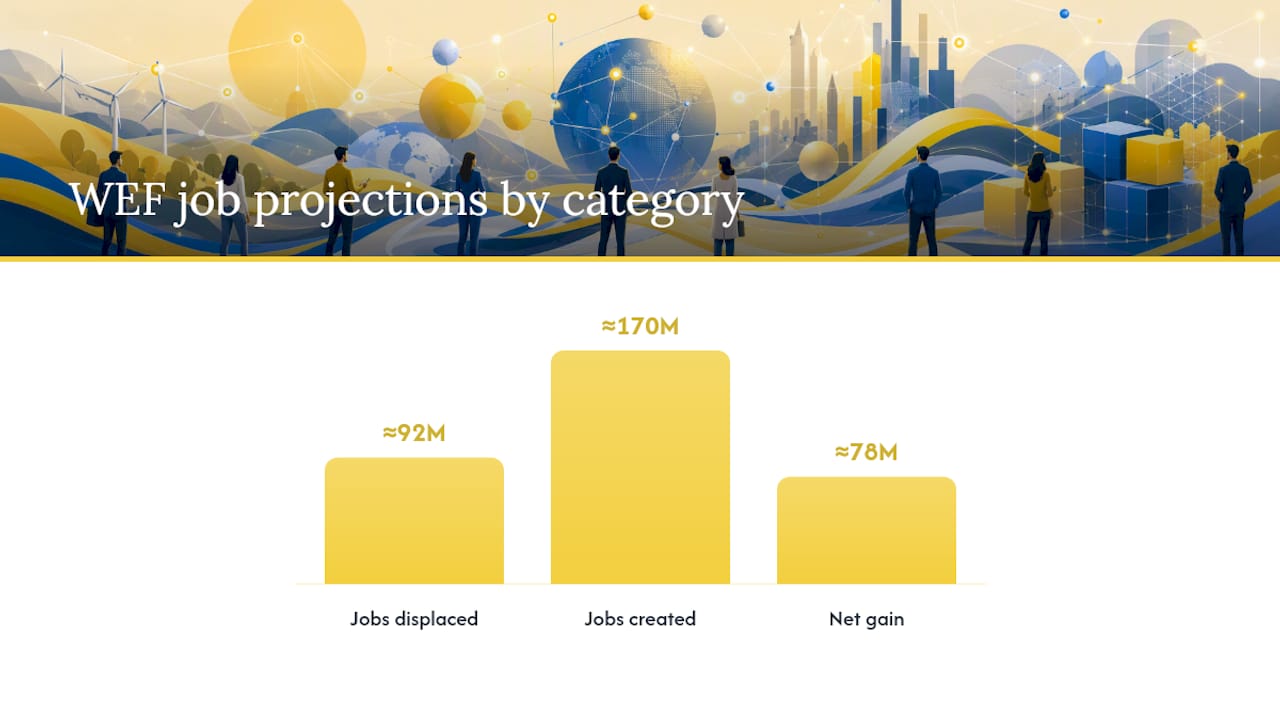
The catch: displaced jobs and created jobs aren’t the same jobs. A displaced data-entry clerk doesn’t automatically become a cloud architect. The net-positive number is real, but it assumes workers can retrain into the categories where growth is concentrated, which is exactly why skill stacking matters more than sitting still.
Key figures worth anchoring your decisions to:
- WEF projects a net gain of roughly 78 million jobs globally by 2030, even as automation displaces nearly a third of current task volume in some sectors.
- BLS data on nurse practitioners shows this occupational group among the fastest growing in the country, driven by expanded scope-of-practice laws and primary care shortages.
- BLS data on physician assistants shows similarly strong projected growth, tied to the same primary care gap.
Here’s the distinction that actually matters when you’re picking a career path: task-level exposure versus whole-job risk. AI can absorb a task, say, drafting a first-pass clinical note, without absorbing the job around it. A nurse practitioner who uses an AI scribe still owns the diagnosis, the patient conversation, and the legal signature. The job survives even when specific tasks inside it get automated. This is the single most useful lens for evaluating any role you’re considering: what percentage of the job is task versus judgment, and who’s accountable when it goes wrong?
One more caveat worth sitting with: AI adoption lags theoretical capability by a wide margin. A model demonstrating a skill in a lab doesn’t mean your employer has deployed it, trained staff on it, or trusted it with real decisions yet. CNN’s reporting on AI-driven workforce restructuring found that companies cutting headcount tend to target codifiable middle tasks first, while investing more heavily in roles closer to revenue and judgment. Watch what employers actually do with AI tools in your industry, not what vendors claim the tools can theoretically do.
The Detailed List: Roles, Pay, Growth, and Why They Hold Up
This is where the shortlist gets specific. Each entry below covers what the role actually involves day to day, what it pays, how fast it’s projected to grow, the exact trait that makes it automation-resistant, and the realistic first step if you’re starting from outside the field.
-
Nurse practitioner. NPs diagnose conditions, order and interpret tests, and prescribe medication, often with full practice authority depending on the state. BLS data places this among the fastest-growing occupations tracked, with median pay well into six figures. The resilience trait: licensed clinical judgment carries legal liability that can’t be transferred to software, and the physical exam itself requires touch. Getting started means an MSN or DNP program, typically after RN experience, plus board certification.
-
Physician assistant. PAs diagnose illness, develop treatment plans, and often perform procedures under physician collaboration agreements. BLS projections show strong growth and solid median pay, driven by the same primary care shortage pushing NP demand. The resilience trait: same as NPs, accountable diagnosis plus hands-on procedural work. Entry path: a master’s-level PA program, usually two to three years, following a science-heavy undergraduate track.
-
Nurse anesthetist. CRNAs administer anesthesia and monitor patients through surgery, a role combining split-second clinical judgment with direct physical responsibility for a patient’s vital functions. Pay sits among the highest in nursing, with growth tracked alongside the broader advanced practice nursing category. The resilience trait: real-time physiological monitoring under anesthesia has zero tolerance for error and full legal accountability. Entry path: RN experience in critical care, followed by a doctoral-level CRNA program.
-
Electrician. Residential and commercial electricians troubleshoot wiring in buildings that were never built to a standard blueprint, every job site is a different puzzle. Median pay is solid and rising as the trade faces a persistent worker shortage. The resilience trait: unpredictable physical environments and safety-code accountability. Entry path: a paid apprenticeship, typically four years, no student debt required.
-
Plumber. Similar logic to electrical work: pipes hidden inside walls built decades apart, code variations by municipality, and physical troubleshooting that resists remote diagnosis. Demand stays steady because buildings age regardless of economic cycles. The resilience trait: physical dexterity in constrained, unpredictable spaces. Entry path: apprenticeship through a trade union or contractor, four to five years to journeyman status.
-
HVAC technician. Heating and cooling systems fail in ways that depend on climate, building age, and equipment brand, a genuinely messy diagnostic problem. Growth is tied to both new construction and the ongoing retrofit of older buildings for energy efficiency. The resilience trait: on-site diagnostic judgment across inconsistent equipment. Entry path: trade school certificate plus apprenticeship, often under two years to entry-level work.
-
Cybersecurity engineer. Security teams defend against attackers who actively adapt to evade automated defenses, which makes this one of the few technical fields where the adversary itself resists automation. Demand remains high across every industry that touches sensitive data. The resilience trait: adversarial, adaptive problem-solving. Entry path: a security certification (like Security+ or a cloud security credential) plus a home-lab portfolio demonstrating real incident response.
-
Cloud solutions architect. Architects design the infrastructure that AI tools themselves run on, translating business needs into system design decisions with real cost and security tradeoffs. Growth here tracks enterprise cloud migration, which hasn’t slowed. The resilience trait: architectural judgment involves tradeoffs (cost, latency, compliance) that require business context AI doesn’t have. Entry path: hands-on cloud certification (AWS, Azure, or Google Cloud) plus a documented project migrating or designing real infrastructure.
-
AI operations lead. Someone has to own the AI systems companies are deploying: monitoring outputs, catching hallucinations, managing vendor tools, and translating technical performance into business risk. This role barely existed three years ago and is growing fast precisely because AI adoption creates its own oversight demand. The resilience trait: meta-judgment over AI itself, ironically one of the most durable niches available. Entry path: build a portfolio project auditing or improving an AI workflow at your current job, then pitch the role internally.
-
Creative director. Creative directors set the vision, taste, and strategic direction behind campaigns, even when AI tools generate the first-draft assets. Clients pay for a point of view, not just output volume. The resilience trait: taste and client trust built over a portfolio of proven work. Entry path: build a portfolio showing AI-augmented creative work with your own strategic direction layered on top.
-
Brand strategist. Strategists translate business goals into positioning decisions that require reading a market, a competitor set, and a company’s internal politics simultaneously. AI can draft a brand brief; it can’t navigate the internal buy-in required to launch one. The resilience trait: cross-functional judgment and stakeholder trust. Entry path: case studies from real client or employer work, even informal ones, published publicly.
-
Licensed clinical therapist. Therapists build trust across dozens of sessions, reading tone, hesitation, and context that go far beyond words on a transcript. Demand keeps climbing alongside rising demand for mental health services. The resilience trait: sustained relational trust and licensed accountability for patient wellbeing. Entry path: a master’s in counseling or clinical psychology, supervised hours, and state licensure.
-
Executive or career coach. Coaches guide people through identity-level change, career pivots, burnout recovery, and leadership transitions that require reading a client’s unspoken fears, not just their stated goals. The resilience trait: deep interpersonal pattern recognition built over real client relationships. Entry path: a recognized coaching certification (such as iPEC) paired with a track record of client results.
-
Compliance officer. Compliance roles carry direct legal exposure for the organization; someone has to sign off on regulatory decisions and own the consequences if they’re wrong. The resilience trait: legal accountability that can’t be outsourced to a model. Entry path: domain expertise in a regulated industry (finance, healthcare, energy) plus a compliance certification.
-
Physical or occupational therapist. Both roles require hands-on assessment of movement, strength, and pain response that varies patient to patient and session to session. Growth is steady as the population ages. The resilience trait: physical assessment and hands-on treatment adjustment in real time. Entry path: a doctoral program (DPT or OT), followed by licensure.
Notice the pattern across all fifteen: none of them are pure information-processing jobs. Every single one pairs a technical or clinical skill with either physical presence, legal accountability, or sustained human trust. That combination is what “ai-proof career” actually means in practice, not immunity from AI tools, but a job structure where AI becomes an assistant rather than a replacement.
How to Build an AI-Proof Career: Frameworks and a 90-Day Plan
Two frameworks make the abstract idea of “future-proofing” concrete. The first is floor-and-ceiling thinking, borrowed from practitioner writing on AI-proofing your career: your “floor” is the repeatable, codifiable part of your job (scheduling, first-draft writing, basic data pulls), and your “ceiling” is the judgment-heavy, relationship-heavy, or accountable part. AI should absorb your floor. Your job is to spend the time that frees up climbing your ceiling.

The second is operational density: the idea that the most durable professionals combine deep domain expertise with adjacent technical or operational skills, so their value isn’t reducible to any single task an AI could isolate and copy. A nurse who also understands data dashboards. An electrician who also manages job-site logistics. A coach who also understands organizational psychology. Stack skills instead of specializing narrowly.
Here’s how to put both into motion over the next 90 days.
- Week 1 to 2: Audit your task list. Write down everything you do in a typical week and sort each task into “floor” (repeatable, pattern-based) or “ceiling” (judgment, relationship, accountability). Most people find 30 to 50% of their week is floor work they didn’t realize was automatable.
- Week 3 to 4: Pick one AI tool and go deep. Not five tools, one. Whether it’s a scribing tool, a coding assistant, or a research tool relevant to your field, spend two weeks actually integrating it into your floor tasks rather than just testing it once.
- Week 5 to 8: Run a focused experiment. Use the time you’ve reclaimed from automating floor work to take on one ceiling-level responsibility you haven’t had before, leading a client conversation, owning a diagnostic decision, mentoring someone junior. Track how it goes.
- Week 9 to 12: Build one visible proof point. Turn the experiment into a portfolio piece: a case study, a write-up, an internal presentation. This is the evidence that gets you promoted, hired, or referred, not a certificate.
Pro Tip: Certificates prove you sat through a course. Portfolio projects prove you can do the work. If you only have time for one, skip the credential and build the case study, especially in fields like AI operations or cloud architecture where employers are hiring on demonstrated ability, not credentials.
Measure progress with three concrete signals: the percentage of your week now spent on ceiling work versus floor work, whether you have one public case study you didn’t have 90 days ago, and whether you’ve secured a new responsibility, title, or client relationship that didn’t exist at day one. If none of the three moved, the plan needs adjusting, not abandoning.
How to Choose Between AI-Resistant Career Paths
Picking a direction from fifteen options is its own problem. Run each candidate path through this checklist before committing time or money to it.
Fit and feasibility checklist:
- Does this path build on domain expertise you already have, or does it require starting from zero?
- What’s the realistic time-to-entry: months (a certification), years (a degree or apprenticeship), or somewhere between?
- What’s the actual earning ceiling once you’re five years in, not just the entry-level pay band?
- Is there a real apprenticeship, residency, or mentorship pathway, or will you be learning entirely on your own?
- Does the role carry legal, clinical, or financial accountability that AI genuinely can’t absorb?
Questions worth asking employers or mentors directly:
- Which parts of this role have you already automated with AI tools, and which parts have you tried to automate and abandoned?
- How has the day-to-day composition of this job changed over the last two years?
- What separates the people in this role who got promoted from those who got automated out of adjacent positions?
Watch for one red flag above all: if a mentor or employer struggles to name anything in the role that requires judgment, physical presence, or legal accountability, and instead describes it purely as process execution, that role is more codifiable than the job posting suggests. AI vendors move fast on process-only work.
The Emotional Skills That Make You Harder to Replace
Technical skill stacking gets most of the attention, but the psychological traits underneath AI-resistant work matter just as much and get discussed far less. Empathy, critical thinking, and ethical reasoning aren’t soft extras bolted onto a resume. They’re the actual mechanism behind why judgment-heavy roles resist automation in the first place.
Empathy shows up concretely: a therapist reading hesitation in a client’s voice, a nurse practitioner noticing a patient is downplaying pain, a coach sensing when someone’s stated goal isn’t their real one. These read on cues that don’t reduce cleanly to data, which is exactly why they’re hard to automate.
Critical thinking matters differently. It’s the ability to notice when an AI output is subtly wrong, a hallucinated citation, a misread X-ray pattern, a plausible-sounding but flawed financial model. The professionals who thrive alongside AI tools aren’t the ones who avoid them; they’re the ones sharp enough to catch what the tool missed.
Ethical reasoning closes the loop. Every accountable role, compliance, clinical care, executive leadership, eventually hits a decision with no clean rulebook answer. That’s precisely the moment AI can’t help, and precisely the moment your judgment becomes the whole job.
Will Today’s AI-Resistant Careers Stay That Way?
Nothing on this list is permanently safe, and pretending otherwise would be dishonest. AI capability keeps advancing, and roles that look automation-resistant today could see meaningful task absorption within five to ten years as models get better at nuance, and as regulation catches up to allow AI more decision-making authority in fields like medicine and law.
What’s more durable than any single job title is the underlying trait that makes a role resistant: accountability, physical unpredictability, and relational trust don’t disappear as models improve, they just shift which specific tasks sit on the floor versus the ceiling. A nurse practitioner in 2030 will likely delegate more diagnostic drafting to AI than one does today. The diagnosis itself, and the license behind it, stays human because the liability structure isn’t going anywhere.
The practical implication: don’t pick a career and assume it’s locked in forever. Pick a category built on a durable trait, then keep re-auditing your own floor-and-ceiling split every year or two as tools improve. The people who get caught off guard aren’t in the wrong careers, they’re the ones who stopped watching where the line moved.
Continuous Learning as the Real AI-Proofing Strategy
Skill stacking only works if it’s ongoing, not a one-time pivot. The professionals who stay ahead of automation treat learning as a standing weekly habit tied directly to their floor-and-ceiling audit, not a credential they complete once and file away.
The most effective version of this looks narrow and applied, not broad and theoretical. Rather than taking a general “AI for business” course, a nurse practitioner might specifically learn how AI-assisted diagnostic tools work in their specialty so they can evaluate output critically instead of trusting it blindly. An electrician might learn building-automation systems that increasingly integrate with smart-home AI platforms. The learning stays tethered to the domain expertise that makes the person valuable in the first place.
Practical guidance on future-proofing careers consistently points to the same conclusion: employers care far more about demonstrated, applied use of AI within a domain than about a stack of certificates. A single well-documented project, automating one workflow, catching one AI error that mattered, tends to carry more weight in a hiring conversation than a certification listing.
Why Geography and Industry Change the AI-Resilience Equation
AI’s impact on jobs isn’t evenly distributed, and treating it as a single global trend misses how differently it plays out by region and sector. Regulatory environments shift the timeline dramatically: healthcare AI adoption moves slower in heavily regulated markets because clinical liability rules require human sign-off, while less regulated sectors like retail or logistics see faster task automation.
Industry structure matters just as much. Fields with strong licensing bodies, law, nursing, skilled trades, tend to build in structural delay before AI can touch core tasks, simply because someone accountable has to certify the work regardless of what tool produced it. Industries without that licensing backstop, like content production or customer support, see automation move faster because there’s no legal gatekeeper slowing adoption.
Local labor market conditions add another layer. A shortage of electricians or nurse practitioners in a given region makes those roles resistant almost by supply-and-demand default, regardless of what AI can theoretically do. Before assuming a role is universally safe or at risk, check the regulatory and labor conditions in your specific market rather than relying on national averages alone.
Real Transitions: How Professionals Are Repositioning Around AI
The pattern in successful career pivots toward AI-resistant work rarely looks like starting over. It looks like professionals recognizing which piece of their existing expertise was already judgment-heavy, then doubling down on that piece while letting AI absorb the rest.
Consider the shape Allwork.Space describes as career agency: acting early, apprenticing with senior practitioners, and building visible proof rather than waiting for a perfect forecast of which jobs will survive. That pattern shows up repeatedly in real transitions, a marketing generalist who repositions as a brand strategist by taking on client-facing strategy work nobody else wanted, or an administrative professional who moves into compliance by volunteering for regulatory projects at their current employer.
The common thread across these moves: the person didn’t wait for a title change to start doing ceiling-level work. They found judgment-heavy tasks inside their existing job, volunteered for them before anyone assigned them, and built a track record that made the eventual title change a formality rather than a leap of faith. That’s a slower, less dramatic story than a total career reinvention, and it’s also the one that actually holds up.
Why We Built MMDC Alchemy Around This Exact Problem
Junna Liao founded MMDC Alchemy after years of watching high-achieving professionals hit the same wall: they had the skills to future-proof their careers on paper but couldn’t move because the resistance was internal, not tactical. As a certified executive and life coach, she’s guided clients from organizations including Google, NASA, and Tesla through exactly the kind of identity-level change a floor-and-ceiling audit demands but can’t complete on its own.
Tactical plans tell you what to do. They rarely explain why someone stays stuck in floor-level work for years despite knowing better, and that gap is usually identity, not information. Clients who work through this kind of coaching typically leave with clarity on what they actually want their ceiling work to look like and the confidence to claim it, rather than another 90-day plan they’ll shelve. If you’ve read this far and recognize the plan but not the follow-through, that’s the specific gap coaching closes.
— Miss
Ready to Move From Plan to Practice?
A 90-day skill-stacking plan gets you moving, but plenty of capable professionals stall exactly at the identity shift the plan requires, claiming ceiling-level work they’ve never officially held before. That’s the specific gap MMDC Alchemy’s career coaching is built to close: one-on-one coaching for mid-to-senior professionals who already have the domain expertise and need help navigating the harder part, the leadership shift, the burnout underneath it, or the identity change that comes with reinventing a career path.

The coaching integrates directly with the frameworks covered above. Where the 90-day plan tells you to audit your floor-and-ceiling split, coaching helps you work through why you’ve been avoiding the ceiling work in the first place, often tied to burnout, imposter feelings, or an identity still anchored to an old role. If you’re navigating a layoff or restructuring tied to AI adoption specifically, Mmdcalchemy’s guidance on leading through uncertainty addresses that transition directly. For a fuller picture of how the coaching methodology works and the leaders it’s guided, see more on Junna Liao’s approach. The next step is a conversation: book an initial session through the career coaching page and bring your floor-and-ceiling audit with you.
Primary Sources and Further Reading
- 20 AI-Resistant Careers With The Lowest Automation Risk In 2026 — Forbes: the primary ranking behind this article’s shortlist of low-automation-risk occupations.
- The Future of Jobs Report — World Economic Forum: source of the 170 million created versus 92 million displaced jobs projection through 2030.
- Nurse anesthetists, nurse midwives, and nurse practitioners — BLS: median pay and growth data for advanced practice nursing roles.
- Physician assistants — BLS: median pay and growth projections for physician assistants.
- U.S. workers’ attitudes toward AI — Pew Research Center: survey data on worker sentiment toward AI in the workplace.
- How to AI-proof your job — CNN: reporting on which roles employers cut versus augment during AI restructuring.
- The Best Way To Future-Proof Your Career When AI Keeps Moving The Goalposts — Allwork.space: guidance on apprenticeship and career agency as durable strategy.
Sources
- 20 AI-Resistant Careers With The Lowest Automation Risk In 2026 — Forbes
- The Future of Jobs Report — World Economic Forum
- Nurse anesthetists, nurse midwives, and nurse practitioners — BLS
- Physician assistants — BLS