AI leadership coaching, in the sense that matters for a senior executive today, is bespoke, human-delivered one-on-one coaching that helps leaders stay clear-headed, decisive, and psychologically intact while AI reshapes their role. It is not a chatbot or an automated coaching app. It exists to restore judgment, prevent burnout, and guide identity-safe transitions for mid-to-senior leaders whose jobs are changing faster than their sense of self can keep up.
TL;DR:
- Effective AI leadership coaching addresses the rise in decision volume caused by AI, not workload reduction, by restoring judgment and identity alignment.
- Successful engagements typically last 3 to 12 months, starting with diagnostic phases and milestone reviews around day 90, focused on identity work and decision frameworks.
- Coaches should have recent senior executive experience, measurable outcomes, and a flexible, personalized methodology that emphasizes identity and judgment over fixed curriculums.
- Confidentiality and ethical use of AI tools are critical, with transparency about data practices and strict limits on AI analysis within coaching sessions.
- Leadership styles are shifting towards delegation of judgment and trust-building, with coaching helping leaders navigate ambiguity and develop explicit criteria for decision escalation.
Table of Contents
- What Is AI Leadership Coaching, and When Should You Seek It?
- What Outcomes Should You Expect, and How Do You Measure Them?
- How Long Does an Engagement Typically Last?
- What Frameworks Do Coaches Use for AI-Era Leadership?
- How Do You Choose the Right Coach?
- What Are the Ethical and Privacy Considerations Around AI Tools in Coaching?
- How Is AI Changing Leadership Styles, and How Does Coaching Adapt?
- What Tools Support AI Leadership Coaching Sessions?
- What Training Do Coaches Need to Specialize in This Work?
- MMDC Alchemy: Programs, Proof Points, and How to Start
- A Coach’s Closing Note
- Sources
What Is AI Leadership Coaching, and When Should You Seek It?
AI leadership coaching, as covered here, means a real coach working with a real executive, one on one, over months, not an algorithm dispensing tips on demand. That distinction matters because the two solve different problems. An automated tool can suggest a communication framework. It cannot help a VP of engineering figure out who they are when a model can draft the code review they used to pride themselves on.
The triggers that send executives looking for this kind of support tend to cluster around a few patterns. AI has not reduced the workload for most senior leaders. It has changed what the workload demands.
- AI-driven overload: more decisions land on your desk because AI accelerates the input pipeline, not because your judgment capacity grew to match it
- Identity anxiety: a felt loss of relevance when tools now do the analysis, drafting, or synthesis a leader once used to define their value
- Role or function transition: moving into a bigger seat, a new function, or an AI-transformed division with no map for what “good” looks like
- Chronic burnout: months of sustained overextension that tactical time-management advice has stopped fixing
The mechanism behind that first trigger is worth naming plainly. AI can increase the volume of decisions flowing to a leader’s desk while human decision-making capacity stays exactly where it was. The bottleneck has not disappeared. It has simply moved from the machine to the person, and most leadership training was never built to address that shift.
What Outcomes Should You Expect, and How Do You Measure Them?
The honest answer is that outcomes split into two timelines. Some show up in weeks. Others take the full engagement.
Early wins tend to look like this: sharper prioritization within the first month, a noticeable drop in the “everything is urgent” feeling, and at least one stakeholder relationship that stops feeling like a source of dread. Deeper shifts, the kind tied to identity and long-term decision quality, usually take longer to surface and longer to hold.
- Strategic clarity: a leader can name their top three priorities without hedging
- Reduced decision fatigue: fewer decisions get made reactively, late, or by default
- Regained identity alignment: a leader’s sense of value stops being tied exclusively to output
- Improved stakeholder outcomes: direct reports and peers report clearer direction, not just a “better mood”
- Transition readiness: measurable confidence entering a new role, function, or chapter
Pro Tip: Ask a prospective coach how they would structure a 90-day milestone plan for your specific situation before you sign anything. If they cannot sketch one in the first conversation, that is useful information.
Coaching around executive transitions works best when it treats the emotional processing and identity work as seriously as the practical planning. Forbes Coaches Council research on executive transitions points to exactly this: leaders who skip the identity work tend to relapse into old patterns within the new role.
How Long Does an Engagement Typically Last?
Executives asking about virtual leadership coaching or in-person work usually want a straight answer on time and structure before they commit. Here is the shape most credible engagements take.
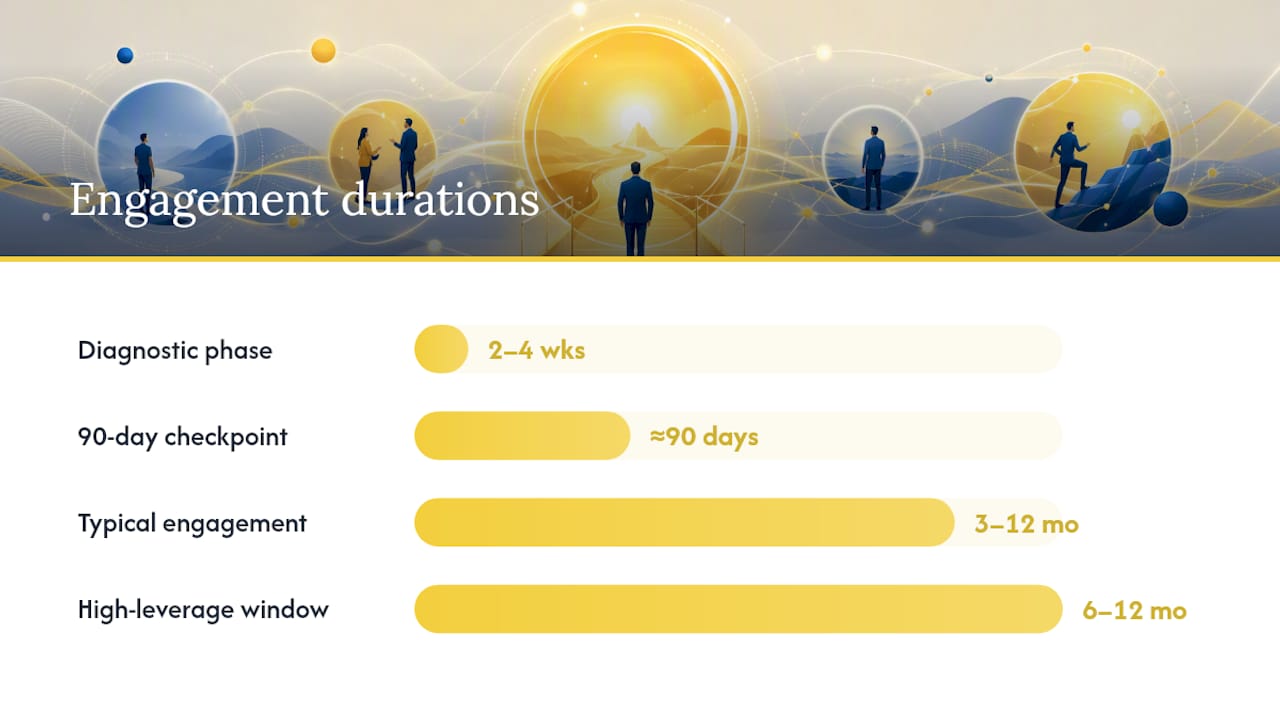
- Diagnostic phase (first 2 to 4 weeks). An initial deep-dive session, sometimes an intensive or private retreat day, establishes where the leader actually stands versus where they think they stand.
- Cadence. Standard engagements run bi-weekly, 60-minute sessions. Leaders in acute transition or burnout recovery often shift to weekly sessions for the first month, then taper.
- Length of engagement. Most substantive work runs 3 to 12 months. Anything shorter tends to produce insight without behavior change; anything without a defined end tends to drift.
- Milestone checkpoint (around day 90). A formal review of the original plan against what actually happened, with adjustments made in the open rather than assumed.
- Deliverables. Expect a personalized framework document, a decision calendar, a stakeholder map, and often async access between sessions for real-time situations that cannot wait two weeks.
Longer minimums are common for a specific reason: identity work does not resolve on a fixed schedule. A leader can learn a new decision framework in three sessions. Rebuilding how they see their own value after a role gets restructured around them usually takes longer, and coaches who promise otherwise are usually overselling. Industry estimates on executive transition coaching put the highest-leverage window at 6 to 12 months, with the first 90 days doing a disproportionate share of the work.
The initial diagnostic matters more than most leaders expect going in. It is where the coach and the leader agree on what success actually looks like, in specific and measurable terms, rather than vague language like “feeling better about work.”
What Frameworks Do Coaches Use for AI-Era Leadership?
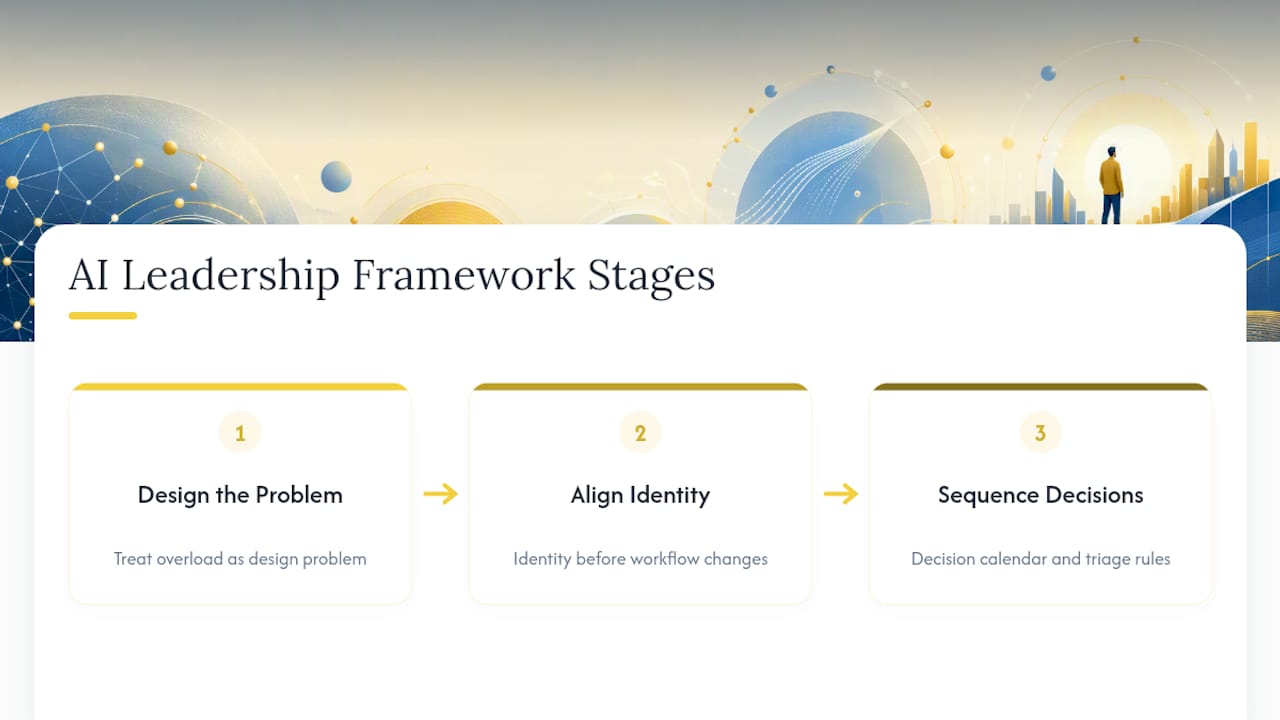
The frameworks that hold up under AI-era pressure share a common starting point: they treat overload as a design problem before they treat it as a personal-resilience problem.
Identity alignment comes before workflow changes. A leader whose sense of worth is tied to being the smartest person doing the analysis will fight every AI-driven efficiency gain, consciously or not. Decoupling personal value from personal output has to happen before any new workflow sticks, a point Forbes’ reporting on human leadership in the AI era makes directly: tactical AI skills only take hold once the identity question is settled.
Decision sequencing reduces cognitive load. A decision calendar, paired with clear triage rules for what needs the leader’s judgment versus what can be delegated or automated, does more for burnout than any breathing exercise.
Distributed judgment replaces the instinct to review everything. Effective coaching helps a leader define exactly who validates what, and builds governance windows so oversight happens on a schedule instead of constantly.
AI should reduce coordination load, not multiply validation tasks. This is the design principle most leaders get backwards: adopting more AI tools without redesigning who checks what just adds a new layer of things to supervise.
Restoring the human filters that used to sit between a leader and the flood of information, the executive assistant who screens, the deputy who triages, matters as much as any new software. Coaching that ignores this and focuses only on personal resilience is treating a structural problem as a mood problem.
Practices that support this work include agenda-free intensives where no topic is off-limits, small behavior experiments tested over a week or two, and feedback loops sourced directly from stakeholders rather than self-reported.
How Do You Choose the Right Coach?
Evaluate fit on five criteria before you evaluate anything else: whether the coach has genuine senior-executive experience, whether their methodology is transformational rather than a fixed curriculum, whether they can point to real outcomes, how they handle confidentiality, and what access looks like between sessions.
- Have they coached leaders at your level, in a comparable function, recently?
- Is their approach adaptable to you, or is it a program everyone gets?
- What does a typical 90-day plan look like for someone in your situation?
- How do they define and measure success by the end of the engagement?
- Can you speak with a past client at a similar seniority level?
- What is confidential, and what, if anything, gets shared with your organization?
- What access do you have between scheduled sessions?
- What is the minimum engagement length, and why?
Pro Tip: Treat the discovery call itself as a test. A coach who spends the whole call talking about themselves is showing you exactly what the engagement will feel like.
Red flags are usually easy to spot once you know to look: a one-size-fits-all curriculum, vague answers about commitment terms, or no senior references available on request.
What Are the Ethical and Privacy Considerations Around AI Tools in Coaching?
Confidentiality is the foundation of transformational coaching, and that foundation gets tested the moment AI tools enter the picture. A leader working through identity anxiety, a pending layoff, or a strained board relationship needs absolute certainty that nothing discussed ends up training a model or sitting in a vendor’s data warehouse.
The practical rule most credible coaching relationships follow is simple: any AI tool used for scheduling, note synthesis, or session logistics should be disclosed upfront, and raw session content should never be fed into a third-party AI system without explicit, informed consent. Some coaches use AI for administrative work like transcription cleanup. Few, if any, should be using it to analyze what a client actually says in session.
There is also a subtler issue: AI-generated insights can carry a false sense of objectivity. A leader might trust a pattern an algorithm surfaces about their behavior more than they’d trust the same observation from a human coach, simply because it came from a machine. Good coaching pushes back on that instinct rather than leaning into it. The relationship, not the tool, is where judgment gets built.
Leaders should ask directly what a coach’s data practices look like: where notes are stored, who can access them, and what happens to that information after the engagement ends.
How Is AI Changing Leadership Styles, and How Does Coaching Adapt?
Command-and-control leadership was already fading before AI arrived. AI has accelerated its decline by exposing exactly where it fails: a leader who insists on reviewing every output personally cannot keep pace once AI multiplies the volume of outputs to review.
The leadership styles gaining ground instead lean on delegation of judgment, not just delegation of tasks. That is a harder skill than it sounds. Delegating a task means handing off work. Delegating judgment means trusting someone else’s threshold for what counts as “good enough” or “needs escalation,” and that trust has to be built deliberately.
Coaching adapts to this shift by working directly on the muscle most leaders never had to develop before: tolerance for ambiguity at scale. A leader managing five direct reports could personally verify most decisions. A leader overseeing an AI-augmented team of fifty cannot, and the anxiety that gap produces is one of the most common things that shows up in coaching sessions right now.
This is also where distributed judgment as a framework earns its place. Coaching helps leaders build explicit criteria for what gets escalated and what does not, then practice living with the discomfort of not knowing everything in real time. That discomfort, left unaddressed, is a direct path to the kind of burnout that has pushed even high-profile tech leaders to step back from roles they once thrived in.
What Tools Support AI Leadership Coaching Sessions?
The tools involved here are mostly unglamorous, and that is by design. Video platforms like Zoom carry the core sessions for virtual leadership coaching. Secure messaging apps or shared documents handle async check-ins between scheduled meetings, giving a leader a place to flag something urgent without waiting two weeks for the next call.
Beyond that, the useful technology is diagnostic rather than conversational: structured assessments that map a leader’s current decision patterns, stakeholder-feedback surveys, and simple tracking documents for the decision calendar and stakeholder map built during the engagement. None of this replaces the coaching conversation. It supports it.
What matters more than any specific platform is how a coach uses these tools to protect, rather than fragment, a leader’s attention. A coaching relationship that pings a client constantly through five different apps is working against the exact goal it claims to serve. The best setups are quiet: one primary channel for sessions, one lightweight system for tracking progress against the 90-day plan, and enough restraint to avoid turning coaching itself into another source of digital noise.
What Training Do Coaches Need to Specialize in This Work?
Coaching credentials in this space come from a mix of established certifying bodies, most commonly the International Coach Federation (ICF) or the Institute for Professional Excellence in Coaching (iPEC), which trains coaches in Energy Leadership methodology. Neither credential is AI-specific because the discipline itself is still young enough that no single standard body owns it.
What separates a coach genuinely equipped for AI-era leadership work from one simply rebranding a general practice is direct exposure to senior executive environments: prior corporate leadership experience, a track record with clients navigating real organizational disruption, and fluency in how decision volume and judgment fatigue actually show up at that level. A credential proves training. It does not prove someone has sat across from a burned-out VP at 6 AM before a board call.
The strongest signal to look for is a coach who can speak concretely about identity work, not just tactical frameworks, because that is the layer general leadership training routinely skips.
MMDC Alchemy: Programs, Proof Points, and How to Start
Everything covered so far, the identity work, the decision sequencing, the 90-day milestone structure, is the actual work MMDC Alchemy does with clients every day. This is not a course or a curriculum applied uniformly. It is a deep transformational 1:1 partnership, often opening with a private intensive that gives a leader room to stop performing and actually diagnose where they stand.
Founder Junna Liao built her practice on certified executive and life coaching training, and her client list includes leaders from Google, NASA, and Tesla who came in carrying exactly the pressures this article describes: AI-driven overload, identity anxiety, and burnout that generic advice had already failed to fix. You can read more of her perspective and background on the MMDC Alchemy insights page, and her own story is detailed in her feature with iPEC.
Engagements typically run 3 to 12 months, structured around the same cadence and milestone approach outlined earlier in this piece, and every partnership starts with a conversation, not a sales pitch. If you are navigating a layoff, a restructuring, or a role that AI has quietly reshaped underneath you, the layoffs and uncertainty program addresses that specific transition directly.
Book a complimentary discovery conversation through the career coaching page to talk through where you stand and whether this kind of partnership fits your situation right now.
A Coach’s Closing Note
The leaders who get the most out of this work are rarely the ones who arrive with a tidy list of problems to solve. They arrive tired, a little defensive, and not entirely sure what they are looking for beyond the vague sense that something has to change. That uncertainty is not a weak starting point. It is usually the most honest one.
A first discovery call should feel like a real conversation, not an intake form. Expect questions about what is actually happening day to day, what you have already tried, and what timeline feels realistic for you, not for a generic program. A good coach will tell you plainly whether they think there is a fit before you have to ask.
Confidentiality is not a footnote in this work. It is the entire container the work happens inside.
— Miss
Sources
- Executive career transition: 5 coaching practices to support the pivot — Forbes Coaches Council
- AI gave every CEO more capacity. Why are they more overwhelmed than ever? — CEO Today Magazine
- AI exposed how leaders hit human limits — Business Insider