Yes, changing careers at 40 is not only possible, it is common. The fastest path runs through five moves: audit your skills and motivation, model your finances, test the new direction before committing, retrain where a real credential is needed, and reposition how you present yourself. Start this week with a one-hour skills-and-finances audit.
TL;DR:
- Reassess your transferable skills by documenting specific accomplishments and mapping them to targeted roles, focusing on outcomes rather than duties.
- Ensure your financial runway accounts for three to six months of expenses for stable income, or nine to twelve months if expecting a pay cut or transition costs.
- Test your new career idea through informational interviews, small projects, or internal pilots before quitting your current job to reduce risk.
- A lateral move may take three to six months, while a significant industry pivot generally requires nine to twelve months, including training and job search.
- Structured coaching shortens the transition timeline by clarifying your identity, addressing fears, and aligning your goals with your skills and values.
Table of Contents
- Is 40 Too Late to Change Careers?
- How Do You Audit Your Transferable Skills and Motivation?
- How Much Financial Runway Do You Need for a Career Change?
- What Should You Learn, and How Long Does It Take?
- How Do You Test a New Career Before Quitting?
- How Do You Reposition Your Resume and Interview Story?
- What Timeline Should You Actually Expect?
- How Coaching Accelerates a Midlife Career Pivot
- Your Six-Month Career Change Checklist
- A Note on the Emotional Weight of Reinvention
- How MMDC Alchemy Supports Your Career Pivot
- Sources
Is 40 Too Late to Change Careers?
No. The data does not support that fear, and neither does the way hiring actually works today. The average worker holds a long string of jobs across a lifetime, according to the Bureau of Labor Statistics, which tracks employment patterns showing job changes are the rule, not the exception, well past the age of 40. Career mobility does not stop at midlife. It shifts in character, from lateral moves early on to more deliberate, values-driven pivots later.
The OECD has been blunt about where labor markets are heading: as working lives stretch longer, continuous reskilling becomes a structural necessity rather than a personal indulgence. Governments and employers are already planning around workers who retrain multiple times. You are not swimming against that current. You are in it.
The bigger shift is how hiring managers evaluate you. Employers increasingly favor skills-based hiring over pure credential-matching, according to Harvard Business Review, which means demonstrable outcomes and project work often outweigh a perfectly matched résumé history. That works in your favor if you can show what you have actually done, not just what your last title said.
Three mindset shifts change how the whole process feels:
- Stop apologizing for your years of experience. It is leverage, not baggage.
- Reframe “starting over” as “starting from a higher floor.” You already know how to manage a project, a budget, or a team.
- Treat age bias as a real but narrow obstacle. It shows up most in entry-level, youth-branded roles, and least in roles that value judgment and domain knowledge.
How Do You Audit Your Transferable Skills and Motivation?
Before you touch a job board, spend an hour with a notebook. Skipping this step is why so many midlife job searches drift for a year without landing anywhere.
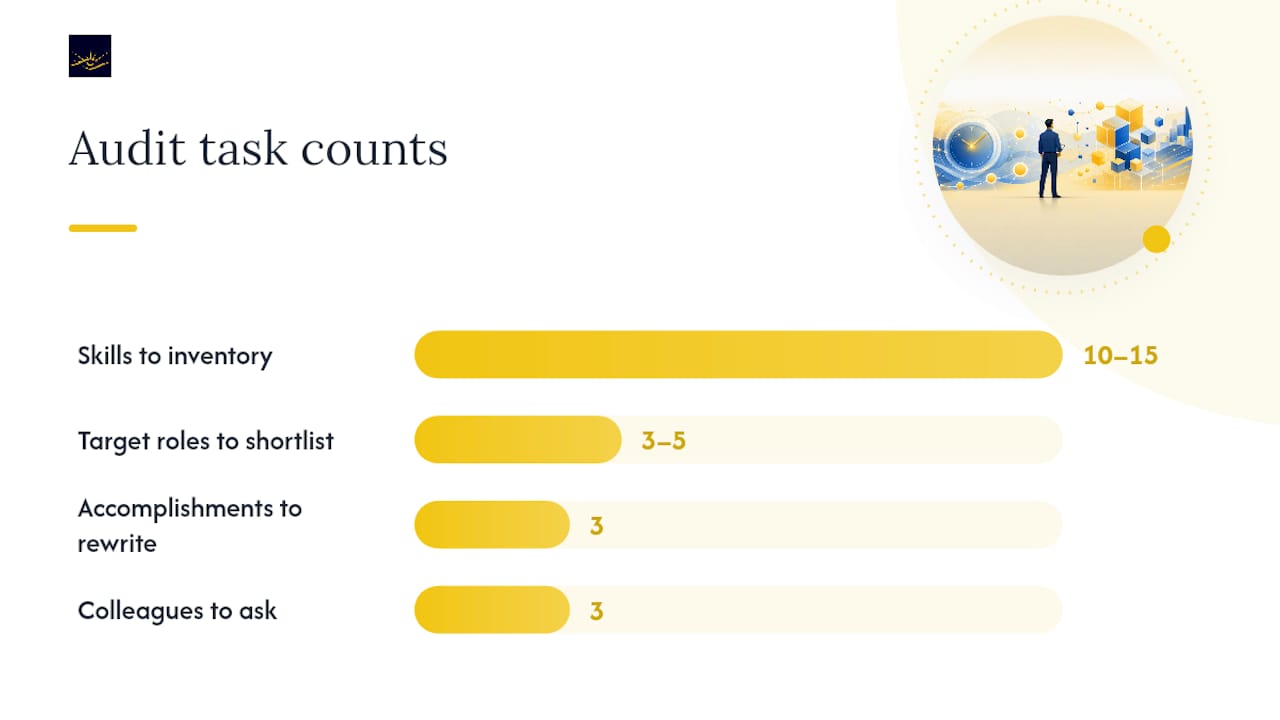
- Write your motivation checklist first. List your non-negotiables: minimum acceptable pay, remote or in-office preference, travel tolerance, and the values you want your work to reflect (autonomy, mission, stability, creative control).
- Inventory 10 to 15 skills from your current and past roles. Go granular: not “management” but “ran cross-functional budgets of $2M+,” not “communication” but “presented quarterly results to a board.”
- Map each skill to a job family, not a job title. A skill like stakeholder negotiation maps to project management, client success, consulting, and program operations, all at once.
- Rewrite three of your strongest accomplishments in target-role language. If you managed a retail team, “supervised 12 employees” becomes “led a distributed team through seasonal demand swings, cutting turnover by [X]%.”
- Shortlist three to five target roles where at least 70% of your mapped skills overlap.
Pro Tip: Ask three former colleagues what they’d hire you for tomorrow, without prompting them. Their answers usually surface transferable strengths you have stopped noticing in yourself.
The rephrasing step trips people up the most. A hospital administrator moving toward operations consulting shouldn’t write “managed patient scheduling.” Write “optimized resource allocation across a 40-person clinical team under regulatory constraints.” Same experience, different lens.
How Much Financial Runway Do You Need for a Career Change?
Money is where most career-change plans quietly die, not because the new path was wrong, but because nobody modeled the real cost of getting there.
Start with a runway rule: three to six months of expenses saved if your income stays roughly flat, and nine to twelve months if you expect a pay cut during retraining or an entry-level restart. Consulting and recruiter resources echo a similar buffer as a baseline for midlife career transitions, though your number should flex with your dependents, mortgage, and how fast your target field typically hires.
Fidelity’s guidance on this is the piece most people skip: the real cost of leaving a job is rarely just the salary gap. It is the loss of employer-provided benefits, including 401(k) matches, subsidized health coverage, and unvested stock or bonus pools.
Before you make any move, check these:
- 401(k) vesting schedule. If you are six months from full vesting on employer contributions, that date matters more than you think.
- Health insurance replacement cost. COBRA and marketplace premiums often run $500 to $1,000+ a month for a family, and that gap needs to be in your runway math.
- Outstanding bonus or equity cycles. Know your payout dates before you hand in notice.
- Severance or notice-period pay, if a layoff or negotiated exit is part of your plan.
Once the math is on paper, you have four ways to lower the risk instead of jumping cold:
- Internal moves. Ask about a lateral transfer inside your current company before looking outside. You keep your salary and benefits while you build new-domain experience.
- Phased exit. Negotiate reduced hours or a consulting arrangement with your current employer as you ramp into the new field.
- Side income first. Freelance, consult, or moonlight in the target field before quitting, so your first invoice lands before your last paycheck does.
- Contract or temp work. Short-term assignments let you earn while you prove fit, often converting to permanent roles once you’re in the door.
What Should You Learn, and How Long Does It Take?
Not every pivot needs a new degree. Most successful midlife changes lean on a targeted certificate plus real project experience, layered on top of skills you already have.
Several career clusters are structured to welcome experienced entrants rather than filter them out, and MeritAmerica’s rundown of accessible fields is a useful starting map:
- Project management. Your organizational and stakeholder-management experience transfers almost directly. A PMP certification typically takes three to six months of study alongside work.
- Cybersecurity. Analytical thinking and risk awareness from prior roles carry over well. CompTIA Security+ is a common entry credential, often completed in two to four months.
- Data analytics. If you have ever built a spreadsheet model or run a P&L, you have instincts this field rewards. Programs like Google’s Data Analytics Certificate run roughly three to six months part-time.
- HR and people operations. People-management experience from any industry translates directly. SHRM-CP certification prep generally takes three to four months.
- UX and product. Client-facing or customer-service backgrounds map surprisingly well to product thinking. Bootcamp-style UX certificates run eight to twelve weeks.
- Healthcare administration. Operations or logistics experience transfers cleanly; many programs offer certificates in six to nine months.
The World Economic Forum’s most recent jobs analysis flags data and technology skills as the fastest-growing hiring priority, so weighting your first credential toward that cluster tends to shorten your job search regardless of which field you land in. Check whether your current employer offers tuition assistance before paying out of pocket. Many mid-size and large companies fund exactly this kind of retraining, even for employees planning to eventually leave.
How Do You Test a New Career Before Quitting?
The riskiest way to change careers is to quit first and figure it out second. The safer sequence is to prove fit while your paycheck still lands on schedule.
- Run five informational interviews before you apply to a single job. Ask what a typical week looks like, what skill gap they see most often in new hires, and what they wish someone had told them before switching in. Resources like SNHU’s career guidance offer solid starter frameworks if you have never run one of these conversations.
- Take on a small contract, consulting project, or internal pilot in the target field. Even 10 hours a month gives you a portfolio artifact and a real story for interviews.
- Ask your current manager about a stretch assignment that borrows skills from the new direction. It costs you nothing and builds a track record inside a company that already trusts you.
- Consider a specialized or “reverse” recruiter once you have a portfolio piece or credential in hand. These recruiters work the hidden job market and are especially useful for pivots into project management, consulting, or operations roles.
Pro Tip: End every informational interview with one question: “What would make you hesitate to hire someone with my background?” The honest answer tells you exactly what to fix before you start applying.
How Do You Reposition Your Resume and Interview Story?
Your resume’s job is no longer to prove years of experience. It is to prove relevance.
- Lead with a summary statement, not a chronological job list. Two to three sentences naming your target function and your strongest transferable proof point.
- Rewrite bullets around outcomes, not duties. “Managed vendor contracts” becomes “cut vendor costs 18% while improving delivery reliability.”
- Cut or compress roles that predate your last decade. Depth matters more than a full 20-year timeline.
- Update LinkedIn’s headline and About section first. Recruiters search by keyword before they read a full profile.
- Build a one-sentence pivot story and practice it out loud. Something like: “I spent 12 years managing operations under pressure; now I want to apply that same discipline to product delivery.” Say it until it stops sounding rehearsed.
What Timeline Should You Actually Expect?
A lateral move into an adjacent field, same seniority, related skills, often closes in three to six months. A significant pivot into a new industry or function usually runs nine to twelve months once you include training time.
- At 30 days, you should have completed your skills audit and run at least three informational interviews.
- At 90 days, you should be enrolled in or finishing a targeted credential, with one test project or contract underway.
- At 180 days, you should have an active interview pipeline or a validated consulting income stream.
If none of those checkpoints are hitting on schedule, that is your signal to accelerate outreach, pause and reassess the target field, or bring in outside help.
How Coaching Accelerates a Midlife Career Pivot
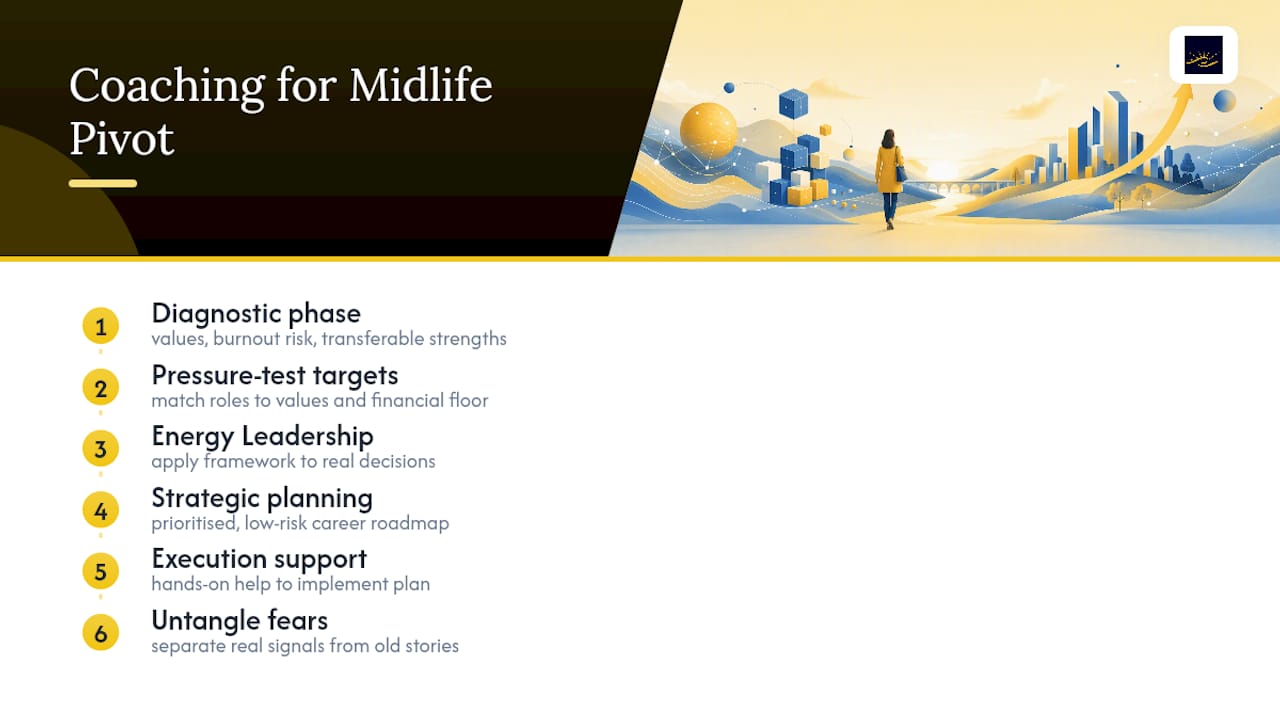
Most delays in a career change aren’t skills gaps. They’re clarity gaps, indecision about which direction is even worth the risk. That is where structured coaching earns its cost back quickly. A trained coach shortens the timeline by pressure-testing your target roles against your actual values and financial floor before you spend months chasing the wrong one.
MMDC Alchemy’s approach pairs a diagnostic phase (values, burnout risk, transferable strengths) with strategic planning and hands-on execution support, an Energy Leadership framework applied to real career decisions, not abstract theory.
The hardest part of a midlife pivot is rarely the market. It’s untangling which fears are real signals and which are just old identity stories asking to be renegotiated.
That untangling work is difficult to do alone, precisely because you are too close to your own narrative to see its blind spots.
Your Six-Month Career Change Checklist
- Weeks 1 to 4: Complete your skills-and-finances audit, run three informational interviews, and refresh your resume and LinkedIn headline.
- Month 2: Enroll in a targeted credential or micro-course; begin outreach to five target companies or contacts weekly.
- Month 3: Take on a test assignment, contract, or internal pilot project; keep outreach running.
- Month 4: Push outreach into a formal interview pipeline; track which conversations convert to next steps.
- Months 5 to 6: Negotiate offers, finalize your exit plan, or scale your consulting income if you’re building toward independence instead of a new employer.
A Note on the Emotional Weight of Reinvention
Changing careers at 40 is never just a logistics problem. It’s an identity one, and pretending otherwise is why so many plans stall at the finish line. Give yourself permission to grieve the version of your career you thought you’d have.
Test before you leap, and protect your runway like it’s sacred, because it is. If the fear feels louder than the financial math justifies, or the identity questions keep circling without resolution, that’s the moment to bring in a coach or a financial planner. Reinvention rewards people who plan for it, not people who wait for certainty that never quite arrives.
— Junna Liao
How MMDC Alchemy Supports Your Career Pivot
Running the skills audit and financial model yourself gets you most of the way there. What it rarely fixes is the indecision loop, the weeks lost circling the same three options without committing to one. That’s the gap MMDC Alchemy closes: a structured coaching engagement that pairs the practical steps in this article with the identity and clarity work that usually stalls a solo career change.
MMDC Alchemy works with mid-to-senior professionals navigating exactly this kind of transition, executives from organizations like Google, NASA and Tesla have used the process to move from burnout or ambiguity to a concrete plan within months, not years. The career coaching program combines a diagnostic phase with strategy and execution support, so your target-role shortlist and financial runway plan get pressure-tested by someone outside your own head. If your pivot was triggered by a layoff rather than a choice, the Layoffs: Leading Yourself Through Uncertainty program addresses that specific identity shock directly. Book an initial conversation to find out which path fits your situation.
Sources
- 6 tips for a career change at 40 or 50 | Fidelity
- Bls
- 9 Best Careers to Start at 40 (No Degree Needed)
- 4 strategies to prepare for a late-career shift | Harvard Business Review
- Promoting better career choices for longer working lives | OECD
Recommended
Made with BabyLoveGrowth to create better content
This blog is for educational and inspirational purposes only. It is not medical, legal, financial, or mental health advice. Your journey is unique; please seek qualified professional support for decisions that affect your health, finances, or wellbeing.