
Coaching reduces the grip of imposter thoughts and helps leaders act on their values instead of their doubts. Up to 82% of people experience imposter feelings at some point, and many clients have been walked through this pattern in coaching. Effective coaching blends fact-based evidence review, psychological flexibility work, and measurable goals, not motivational pep talks.
TL;DR:
- Achievement logging is most effective when clients regularly record and review facts about their successes, helping combat selective memory and self-doubt.
- Behavioral experiments like deliberately submitting imperfect work challenge clients to observe that failure is rarely catastrophic, reducing avoidance behaviors.
- Coaching techniques should be adapted to cultural and gender contexts, for example, separating family sacrifices from personal achievement for first-generation professionals.
- Progress is best tracked by measuring the frequency of imposter thoughts, behavioral markers, and specific goals aligned with values, not vague confidence boosts.
- Coaching is limited to evidence-based strategies; persistent clinical issues require referral to mental health professionals for effective treatment.
Table of Contents
- What Does Imposter Syndrome Coaching Actually Involve?
- How Do You Recognize Imposter Syndrome in a Client?
- What Is the Coach’s Role, and Where Does It End?
- How Do You Measure Whether Coaching Is Working?
- What Mistakes Undermine Imposter Syndrome Coaching?
- A Between-Session Practice Plan That Builds Real Evidence
- What Makes MMDC Alchemy’s Approach to This Work Different?
- What Is Imposter Syndrome, and How Common Is It Among Professionals?
- What Psychological Theories Explain Imposter Syndrome?
- Does Imposter Syndrome Look Different Across Gender and Culture?
- How Should Coaching Adapt to Different Clients?
- What Do Successful Coaching Engagements Actually Look Like?
- What Leaders Gain When They Commit to This Work
- Ready to Work Through This With Direct Coaching Support?
- Sources
What Does Imposter Syndrome Coaching Actually Involve?
A coach working on imposter syndrome does three things a friend or a self-help article can’t: track evidence, run structured behavioral experiments, and hold you accountable to values-based action over weeks or months. The goal isn’t to eliminate self-doubt. It’s to shrink its influence over your decisions.
Here’s the toolkit that shows up most often in effective sessions.
- Achievement logging. Clients keep a running record of concrete wins, separating documented facts from the feelings attached to them. Cleveland Clinic recommends this as a first-line strategy because imposter syndrome thrives on selective memory. You forget the client email that praised your work and fixate on the one typo.
- Cognitive reframing. Coaches ask clients to review specific evidence of competence rather than accept a vague, negative self-assessment. This isn’t positive thinking. It’s closer to a lawyer building a case file.
- Psychological flexibility, borrowed from Acceptance and Commitment Therapy. Rather than fighting the thought “I don’t belong here,” clients learn to notice it, let it pass, and act anyway. Contextual Consulting’s ACT framework treats the imposter voice as noise to coexist with, not a threat to eliminate.
- Behavioral experiments. A “strive to fail” exercise asks a client to deliberately submit imperfect work, then observe what actually happens. Usually, nothing catastrophic does.
- Self-compassion and mindfulness. Lowering emotional reactivity makes the other four techniques stick.
Pro Tip: Pair the achievement log with a Friday five-minute review. Reading the week’s wins out loud, even alone in your car, works better than just writing them down and forgetting they exist.
How Do You Recognize Imposter Syndrome in a Client?
The pattern rarely announces itself as “I feel like a fraud.” It shows up sideways.
- Discounting wins with phrases like “I got lucky” or “anyone could have done that.”
- Overworking to preempt being exposed as unqualified, or the opposite: procrastinating to avoid the test altogether.
- Physical discomfort when receiving praise, including deflecting compliments immediately.
- Chronic fear that a mistake will reveal them as a fraud, even after years of strong performance reviews.
- Comparing internal doubt to others’ external confidence, then losing the comparison every time.
Coaches also watch for five recognizable variants: the perfectionist who treats any flaw as failure, the expert who won’t act without total mastery, the soloist who refuses help to prove self-sufficiency, the natural genius who panics when something takes real effort, and the superperson who measures worth by how much they can juggle. A senior VP who won’t delegate and a new manager who over-prepares for every one-on-one are often running the same script with different props.
Good intake questions include: “When was the last time you accepted a compliment without deflecting it?” and “What would you attempt if you knew you couldn’t fail?”
What Is the Coach’s Role, and Where Does It End?
A coach normalizes the feeling, examines the evidence against it, then designs an experiment to test the distorted belief. ICF’s practitioner guidance frames this as identifying root causes and applying targeted strategies, not simply cheerleading a client into confidence.
A typical session arc looks like this:
- Intake: surface the specific triggers and variant pattern at play.
- Pattern mapping: connect recent incidents to the underlying belief (“I’ll be exposed as incompetent”).
- Focused intervention: choose one technique, achievement log, reframing, or an ACT exercise, and apply it to a live situation.
- Homework and measurement: assign a between-session task and define how progress gets tracked.
Coaching has limits. If imposter feelings coexist with clinical anxiety, depression, or functional impairment, that’s a referral, not a coaching plan. Cleveland Clinic is explicit that persistent, impairing symptoms need clinical support. A good coach knows the difference between “this client needs a behavioral push” and “this client needs a therapist,” and doesn’t pretend otherwise.
How Do You Measure Whether Coaching Is Working?
Progress on imposter syndrome is easy to feel and hard to prove without some structure. A handful of low-effort metrics fix that.
- Frequency tracking: how often the imposter thought shows up per week, rated on a simple 1 to 10 intensity scale.
- Behavioral markers: volunteering for a stretch assignment, accepting a compliment without deflecting, dropping a “safety behavior” like over-preparing for routine meetings.
- SMART goals tied to values: not “feel more confident,” but “speak first in three team meetings this month.”
- Qualitative evidence: actual feedback emails, performance review language, peer comments saved in the achievement log.
Given that most people experience imposter feelings at some point in their lives. The realistic goal isn’t zero doubt. It’s faster recovery when doubt shows up, and fewer decisions made in service of it.
What Mistakes Undermine Imposter Syndrome Coaching?
Well-meaning coaching goes wrong in predictable ways.
- Reassurance without evidence. Telling a client “you’re great” changes nothing if it isn’t backed by specific, documented proof.
- Treating the problem as purely personal when the workplace itself is the driver. The APA’s coverage of impostor phenomenon points out that toxic culture, bias, and unclear feedback loops often manufacture the very doubt coaches are asked to fix.
- Drifting into therapy territory. Processing childhood-rooted shame is clinical work, not a coaching agenda.
- Turning the fix into another performance metric. A client who starts grading their own “confidence progress” the way they graded their old KPIs has just relocated the perfectionism, not resolved it.
Pro Tip: If a client’s homework compliance starts to feel like one more thing they might fail at, drop the structure for a session and just talk about what “enough” would look like.
A Between-Session Practice Plan That Builds Real Evidence
Homework works when it’s specific enough to actually complete. Six steps cover most cases:
- Log three factual wins daily, no interpretation, just what happened.
- Review the log once a week and note any pattern of dismissal.
- Pick one small exposure task: send the email without three rounds of edits, speak up once in a meeting you’d normally sit out.
- Write a two-line reflection on what actually happened versus what you predicted.
- Take one values-aligned action, something that matters to you regardless of outcome.
- Ask one trusted colleague for specific feedback, then log the response as evidence.
| Practice | Frequency | What it targets |
|---|---|---|
| Achievement log | Daily | Selective memory, discounting wins |
| Exposure task | Weekly | Avoidance, safety behaviors |
| Values-aligned action | Weekly | Motivation disconnected from fear |
| Feedback request | Biweekly | Fear of exposure |
Pace this. A client drowning in overwork doesn’t need five new tasks; they need one that fits inside a week they can actually survive.
What Makes MMDC Alchemy’s Approach to This Work Different?
This coaching practice centers on transformational coaching that pairs deep identity work with practical career strategy rather than surface-level confidence tips. The MMDC Alchemy approach to limiting beliefs in leadership applies the same fact-versus-feeling discipline covered above, but ties it to a client’s broader career and identity questions.
Many client engagements have followed this pattern: surface the limiting belief, test it against real evidence, then rebuild decisions around what the client actually values rather than what fear demands. Some clients report revitalized careers and a break from the beliefs that had quietly capped their ambition for years. The MMDC Alchemy insights library and its imposter syndrome archive go deeper into how that plays out across different career stages.
What Is Imposter Syndrome, and How Common Is It Among Professionals?
Imposter syndrome, more precisely called imposter phenomenon in clinical literature, describes the persistent belief that your competence is a fluke destined to be discovered, despite consistent external evidence of skill. It was first named in 1978 by psychologists studying high-achieving women, though later research found it crosses gender, industry, and seniority lines without much respect for résumé strength.
The scale is larger than most people assume. Reviews of the research put lifetime prevalence as high as 82%, spanning students, physicians, executives, and everyone between. That figure matters for one reason: it strips the shame out of the conversation. A leader who feels like a fraud in the boardroom isn’t experiencing a personal defect. They’re experiencing one of the most common psychological patterns among people who take on responsibility.
Prevalence doesn’t map neatly to competence, either. Some of the highest scorers on imposter measures are people objectively excelling by every external metric, promotions, awards, glowing reviews. The mismatch between internal experience and external evidence is the entire phenomenon. That gap is also exactly where coaching does its work: closing the distance between what a client feels and what the record actually shows.
What Psychological Theories Explain Imposter Syndrome?
Three frameworks shape most effective coaching for this pattern, and each pulls in a different direction.
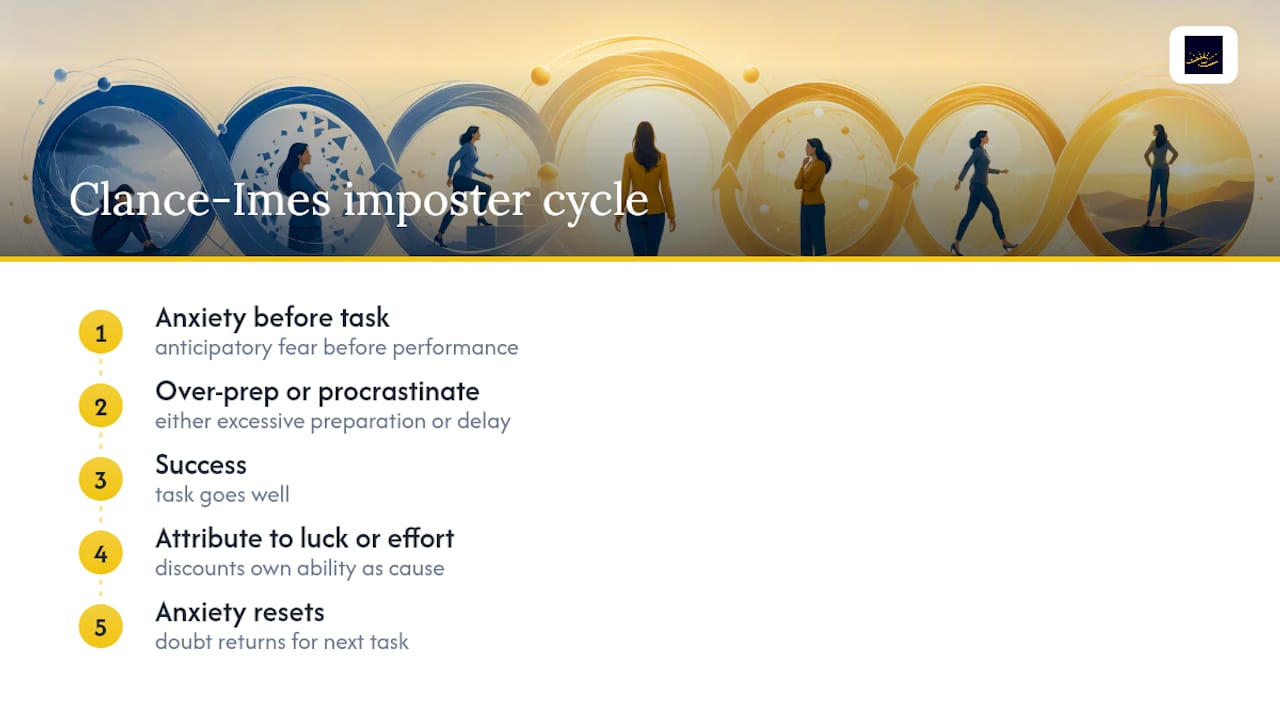
The original clinical model, developed by Pauline Clance and Suzanne Imes, framed imposter feelings as a cycle: anxiety before a task, followed by either over-preparation or procrastination, followed by success, followed by attributing that success to luck or effort rather than ability, which resets the anxiety for the next task. Coaches use this cycle to help clients spot exactly where they’re stuck rather than treating the whole experience as one undifferentiated fog of doubt.
Acceptance and Commitment Therapy offers a different lens entirely. Instead of asking “how do we make the thought go away,” ACT asks “how do we act well even while the thought is present.” ACT-informed coaching treats psychological flexibility, the capacity to hold a difficult thought loosely and still move toward what matters, as the actual skill being built, not confidence itself.
Cognitive-behavioral theory contributes the reframing piece: imposter feelings persist because of a specific distortion, discounting evidence that contradicts the “I’m a fraud” belief while overweighting evidence that confirms it. Coaches trained in this model spend real time simply cataloging the discounted evidence back into view.
A less discussed idea worth naming directly: many clients believe their anxiety is functionally protective, that losing the worry would mean losing their edge. Addressing that belief head-on, rather than assuming the client wants the anxiety gone, often unlocks progress faster than any technique on its own.
Does Imposter Syndrome Look Different Across Gender and Culture?
Imposter syndrome doesn’t discriminate in who it targets, but it does show up differently depending on context. Women in male-dominated fields often report imposter feelings tied specifically to visibility, the sense that any misstep will be read as evidence against their whole gender’s competence, not just their own. Men, by contrast, more frequently report imposter feelings tied to authority and decision-making, worrying less about being seen and more about being wrong in front of people who report to them.
Cultural background adds another layer. Professionals from collectivist cultures sometimes experience imposter feelings less as individual fraud and more as fear of letting down a family or community that sacrificed for their success. First-generation professionals, immigrants navigating a new country’s workplace norms, and people who are the first in their family to hold a given title often describe a specific flavor of doubt: not “am I good enough” but “do I actually belong in this room at all.”
None of this changes the core coaching techniques. It changes how a coach frames them. An achievement log for a first-generation executive might need to explicitly separate “what my family sacrificed” from “what I personally earned,” two facts that are both true but easy to conflate. The APA’s coverage of workplace and systemic contributors makes the same point from a different angle: bias, exclusion, and unequal feedback aren’t imagined. A coach who ignores that context and treats every case as pure internal distortion is missing half the picture.
How Should Coaching Adapt to Different Clients?
No two clients need the identical mix of techniques, even when their surface symptoms match. A perfectionist variant needs behavioral experiments that deliberately introduce small imperfections. A soloist variant needs practice asking for help long before achievement logging becomes useful, because the resistance to input is the actual blocker.
Seniority changes the calculus too. A first-time manager benefits from straightforward competence evidence: specific instances where their decisions worked. A twenty-year executive facing imposter feelings during a role transition, say, moving from operator to strategist, needs less “proof you’re competent” and more identity-level work about what competence even means in the new role. That’s a career transition conversation as much as a confidence one, closer to what MBA graduates entering consulting face when their expertise suddenly needs to look different than it did in their last job.
Pacing has to flex too. A client in active burnout can’t absorb five new exercises; they need one, executed consistently, before anything else gets added. A client who thrives on structure might actually want the full six-step plan on day one. Reading which client is in front of you, rather than running a fixed script, is most of what separates coaching from a self-help worksheet.
Context matters as much as personality. A leader navigating a layoff or restructuring is processing identity disruption on top of imposter feelings, and treating the two as separate problems usually slows things down rather than speeding them up.
What Do Successful Coaching Engagements Actually Look Like?
The clearest pattern across effective engagements isn’t a single dramatic breakthrough. It’s a series of small, testable proofs stacking up until the old belief can’t hold its ground anymore.
A common arc: a senior leader enters coaching convinced a recent promotion was a mistake the company will eventually realize. Early sessions focus purely on achievement logging, because there’s usually no shortage of evidence, just a shortage of attention paid to it. Midway through, a behavioral experiment gets introduced: presenting an idea in a meeting without over-qualifying it first. The result is rarely catastrophic. Usually it’s just… fine, which is itself the data point that starts shifting the belief.

By the later sessions, the work shifts from proving competence to deciding what to do with it: which opportunities to pursue, which limiting patterns to leave behind, what a career built on evidence rather than anxiety actually looks like. That’s the shape of engagements described across the MMDC Alchemy imposter syndrome archive, where the throughline is consistently less about eliminating doubt and more about changing what a client does while doubt is present.
What Leaders Gain When They Commit to This Work
Coaching doesn’t erase the imposter voice permanently. What changes is how fast you recover when it shows up, and how much power it has over the next decision you make. Leaders who commit to this work regain agency in moments that used to feel paralyzing. Expect the feeling to recur. Expect your response time to it to shrink. Treat that shrinking gap as the actual measure of career resilience, not the absence of doubt itself.
— Junna Liao
Ready to Work Through This With Direct Coaching Support?
Reading about achievement logs and behavioral experiments is useful. Having someone design them around your actual career, your actual triggers, and hold you to the follow-through is a different level of progress entirely. 1:1 transformational coaching is offered for high-achieving professionals whose external results and internal doubt have stopped matching up.

A typical engagement starts with a discovery call to map your specific variant, such as perfectionist or soloist, against your career stage and current pressures. From there, sessions combine the fact-based techniques covered in this guide with deeper identity and values work, since imposter feelings rarely travel alone and usually show up alongside a bigger question about direction. If you’re navigating a layoff or role change on top of the self-doubt, the layoffs and uncertainty coaching program addresses both at once. For a full look at program structure and what a coaching engagement covers month to month, visit MMDC Alchemy’s coaching programs or book a career coaching discovery call directly.
Sources
- A psychologist explains how to deal with impostor syndrome | Cleveland Clinic
- Impostor Phenomenon (overview) | NCBI Bookshelf
- Overcoming impostor phenomenon | APA Monitor
Recommended
This blog is for educational and inspirational purposes only. It is not medical, legal, financial, or mental health advice. Your journey is unique; please seek qualified professional support for decisions that affect your health, finances, or wellbeing.