
Self-awareness for a leader is the habit of seeing your thoughts, emotions, values and strengths clearly, and also seeing how your words, status and decisions land on other people. Then you use what you see to change what you do. Insight that never touches behavior is just a good story about yourself. This guide covers what the research says, where leaders go wrong, and a practical process you can start this week.
TL;DR
- Self-awareness has more than one part: how you see yourself, how others see you, and how your group identity shapes your influence. Introspection alone covers only the first.
- Most people overrate it. Tasha Eurich’s research found that 95% of people believe they are self-aware, while only about 10 to 15% really are.
- The method that works: get a baseline, name one blind spot, run one behavioral experiment in real work, then review it with someone who will be honest with you.
- Over-analysis is a trap. Useful awareness leads to action and recalibration, not endless rumination.
- Under heavy stress, awareness of your own state is a form of resilience, for you and for your team.
Table of Contents
- What self-awareness means for a leader
- Why it matters more as you move up
- The gap between how you see yourself and how you are seen
- A six-step practice that changes behavior
- When self-awareness goes too far
- Self-awareness and emotional resilience under pressure
- When identity shifts, awareness has to shift too
- A note on the “5 Cs” of leadership development
- Our perspective
- Working with a coach on self-awareness
- FAQ
- Sources
What self-awareness means for a leader
Yale’s graduate leadership program describes self-awareness as recognizing your thoughts, emotions, values, strengths, limitations and actions, and how you affect others, then using that information to direct your behavior, invite feedback and keep developing. Notice how much of that definition points outward.
An Annual Review paper on developing self-awareness frames it as how we see ourselves and the effects we have on our environment. A review in the Academy of Management Annals goes further and cautions against treating it as one simple thing. It has several targets and processes, so development works best when reflection is combined with feedback, coaching and tracking of behavior.
In practice, three kinds of awareness matter for leaders:
| Type | The question it answers | Example of a miss |
|---|---|---|
| Internal | What am I feeling, wanting and assuming right now? | You say you are calm while your jaw is clenched and your replies get shorter. |
| External | How do others experience me? | You think of yourself as decisive. Your team experiences you as unreachable. |
| Collective | What does my role and group identity signal? | A casual remark from a senior leader is treated as a directive. |
The third row is the one most leaders skip. Scott Nolan Taylor’s work on redefining leader self-awareness argues that the field has focused on one component and that leaders also need to anticipate their influence on others, not only inventory their own strengths and weaknesses.
Why it matters more as you move up
The higher you go, the less honest feedback you get. People soften their message, and your title amplifies everything you say. That is a structural problem, not a character flaw, and it is why awareness has to be built on purpose.
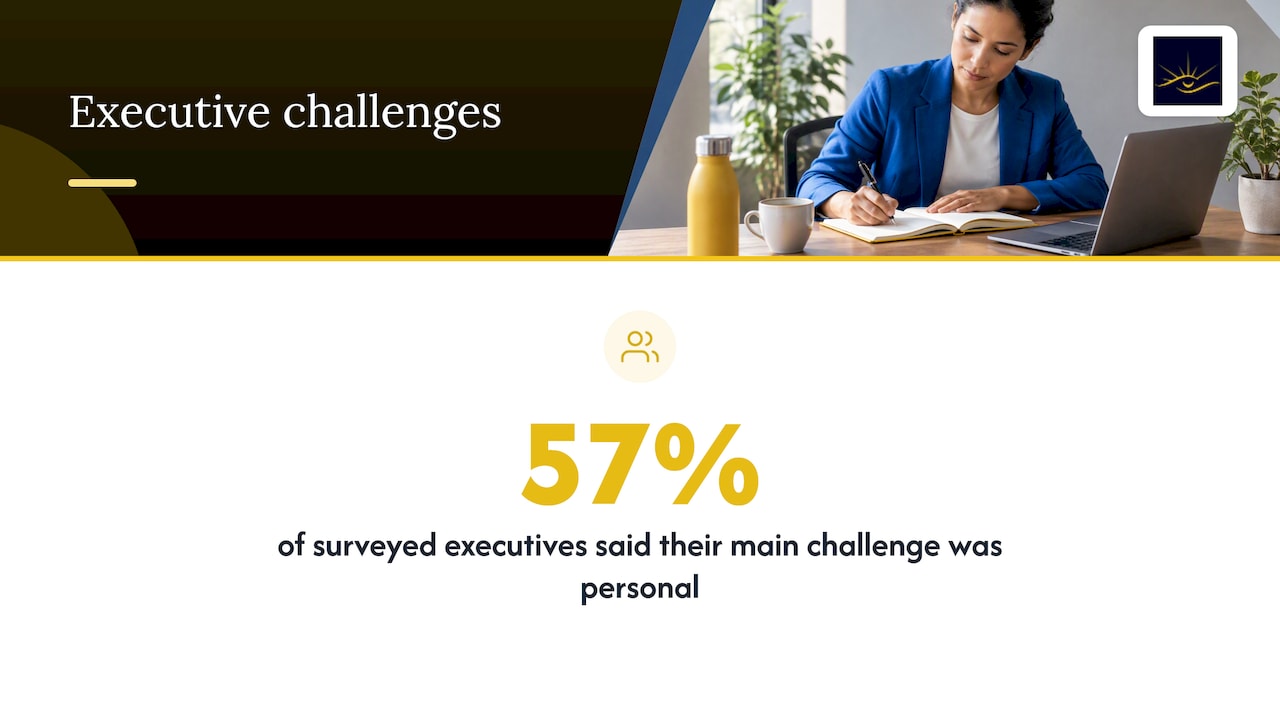
McKinsey, drawing on years of advising CEOs and senior government leaders, observes that most of them wrestle less with what to do and more with who to be. In the same piece, 57 percent of surveyed top executives said their primary leadership challenge was personal rather than technical or strategic.
The research on identity points the same way. A 2021 study in The Leadership Quarterly found that personal and collective self-awareness both matter. Personal self-awareness had a somewhat stronger effect on perceived authentic leadership, while collective self-awareness had a stronger effect on whether people endorsed the leader. Knowing yourself helps people trust you. Knowing the group you belong to and speak for helps them follow you.
Goleman and Cherniss add the emotional layer. In a 2024 article, they describe emotional intelligence as accurately perceiving, understanding and managing your own emotions and those of others, and link emotionally intelligent leadership with better performance, higher job satisfaction, lower turnover and stronger morale. They also note that it is a practitioner synthesis, not a single causal trial, so treat it as a strong signal rather than proof.
The gap between how you see yourself and how you are seen
Eurich’s finding, that only a small fraction of people are truly self-aware, should make any leader a little curious. In the same conversation she explains that those who are self-aware do not get there through introspection alone. They get there through the feedback of what she calls loving critics: people who care about you enough to tell you the truth.
Yale’s guidance lists similar practices: journaling, mindfulness, listening, personal reflection, goal-setting and feedback from trusted critics. Notice that half of those are solo and half involve another person. You need both.
Common blind spots we see in high-performing leaders:
- The strength that overextends. Drive becomes pressure. Candor becomes bluntness. Responsiveness becomes an inability to delegate.
- Impact blindness. You intend to brainstorm, and your team hears a decision.
- Stress signatures. Everyone around you can read your tells under pressure, and you cannot.
- Identity fusion. Your sense of worth is tied so tightly to the role that any threat to it feels personal.
If you want a structured way to look for these, our leadership blind spot assessment page walks through what to look at and how to read it.
A six-step practice that changes behavior
A common failure is treating an assessment or a 360-degree feedback report as the whole intervention. UNC’s executive development team makes this point in its piece on leveraging leadership self-awareness: leaders gain more when they convert one insight into a specific behavioral experiment, rehearse it, and review the result with a coach, mentor or trusted peer.
Here is a process built on that principle. It matches the structure that formal programs, such as Harvard’s Managing Yourself and Leading Others, combine: guided reflection, case discussion, communication work and an action plan.
- Set a baseline. Write down how you think you show up in meetings, in conflict and in delegation. Then ask three people for their view. Pick at least one who reports to you and one who is a peer or mentor.
- Name the pattern. From the answers, list your values, strengths, triggers and blind spots. Keep it to a page. Look for themes that appear in both your view and theirs, and for gaps between them.
- Choose one observable behavior. Not “be more empathetic”. Something a colleague could see: “In the first ten minutes of the weekly staff meeting, I will ask a question and wait before giving my view.”
- Practice it in live work. Pick a real, moderately stakes-heavy setting. Rehearsal in your head is useful, but the learning happens in the room.
- Review. After each attempt, note what you felt, what you did and what happened. Ask one person for a direct read. “Did that land the way I intended?”
- Adjust and repeat. Keep what worked, change what did not, and only then add a second behavior.
The sources do not establish a universal duration for this process. It depends on the leader, the scope and the support around them.
A worked example
Imagine a vice president who prides herself on speed. Her baseline feedback shows that her direct reports stop offering ideas after she has responded once. Her chosen behavior is simple: in one-on-ones, she will ask “What would you do?” before offering her own answer. She tries it for four weeks, notes how often she wants to interrupt, and asks a trusted peer to watch two meetings. The insight (speed shuts people down) was not new. The change came from rehearsing a specific behavior and checking the result.
When self-awareness goes too far
There is a dark side. The Annual Review paper notes that the goal is not endless rumination or a perfectly accurate self-image. It is useful awareness followed by action, feedback and recalibration. A leader who spends weeks analyzing why a meeting went badly has not become more self-aware. They have become more anxious.
A few guardrails:
- Set a time limit for reflection, then do something.
- Ask “What will I do differently?” more often than “Why am I like this?”
- Treat feedback as data, not a verdict. One person’s opinion is a hypothesis, a pattern across several people is information.
Impostor feelings are a related trap. A 2025 qualitative study of seven leaders linked impostor phenomenon with a need for reflexive awareness and described social support, coaching and mentoring as potentially relevant supports. It is a small study. It is not a prevalence estimate, and it does not prove coaching works for every leader. If this is your pattern, our six-step impostor syndrome coaching plan goes deeper.
Self-awareness and emotional resilience under pressure
Resilience is often misread as endurance. Literature reviews describe it differently. A 2024 literature review of leadership and psychological resilience synthesized 164 empirical studies and frames resilience as learning from adversity, adapting to challenge and using resources well. It also stresses that leaders must support the people they lead while coping themselves. A systematic review in Leadership & Organization Development Journal similarly finds that resilience can benefit performance, engagement, well-being and leadership capability.
Self-awareness is the early-warning system. Goleman and Cherniss point out that in stressful moments, a leader who manages their own feelings and communicates calm confidence can help followers function, while unmanaged panic can amplify strain. You cannot manage a state you do not notice.
Signs that your awareness is slipping under load:
- You stop noticing what you eat, when you sleep or when you last took a real break.
- Small requests feel like personal attacks.
- You feel numb in moments that used to matter.
- You default to control, or you withdraw.
When these persist, the issue is no longer a communication tweak. It may be burnout, and that deserves a different response. Our pages on burnout resilience skills for leaders and on telling burnout from depression explain the distinction. If you are struggling with persistent low mood, loss of interest or thoughts of self-harm, please speak with a licensed physician or mental health professional. In the US you can call or text 988, the Suicide & Crisis Lifeline, at any time.
When identity shifts, awareness has to shift too
Self-awareness gets tested hardest at transitions: a promotion, a reorganization, a succession, a burnout recovery or a career pivot. The old answer to “who am I at work?” stops fitting, and the leader keeps acting from it anyway.
This is also why some capable people get passed over. They know their craft but have not examined how they come across or what level of presence the next role asks for. If that sounds familiar, this piece on being overlooked for leadership roles looks at the pattern from the hiring and promotion side. Pair it with honest feedback from people who have seen you at your best and your worst.
If you are in a larger move, our seven-step career transformation guide for midcareer leaders starts with identity before tactics, which is the same logic as everything above.
A note on the “5 Cs” of leadership development
Readers often ask about the five Cs. There is no single universal answer, and models vary. A UC San Diego handout lists Capable, Committed, Connected, Communicative and Caring. Other frameworks use different words. Whichever model your organization favors, self-awareness sits underneath it: you cannot be reliably caring or communicative if you do not notice your own state or your effect on people.
Our perspective
We work with executives and high achievers who are good at their jobs and quietly exhausted by them. Almost none of them lack information. They have read the books, taken the assessments and know what they should do differently.
What we see is that insight on its own rarely holds. The change comes from what happens between sessions: the small experiment in Tuesday’s meeting, the honest conversation with a team member, the moment you catch yourself and choose differently. That is why our coaching includes substantial work and accountability outside scheduled sessions, and why we treat career, identity and energy as one picture rather than separate topics.
We also think leaders are too hard on themselves about self-awareness. It is not a verdict on your character. It is a skill, and like any skill it gets better with specific practice, real feedback and someone in your corner who is not impressed by your title.
— Junna Liao
Working with a coach on self-awareness
If you want structure, honest feedback and accountability, this is what we do. Our 1:1 career coaching with Junna is private, individualized work for executives and senior professionals navigating burnout, career transitions or identity shifts. We also offer the Energy Leadership™ Index assessment, which gives you a concrete starting point for how you respond under pressure, and you can read what an Energy Leadership Index assessment reveals before deciding. Pricing is not published, so reach out through the site to talk about fit.
FAQ
Why do good leaders need to be self-aware?
Because you have to manage yourself before you can lead anyone else. Your values and emotions shape your decisions, and your status magnifies your impact on others. McKinsey reports that 57 percent of surveyed top executives named their main leadership challenge as personal.
How can I tell whether I am actually self-aware?
Compare your self-view with what trusted others report. If the two rarely differ, or you have never asked, that is worth examining. Eurich’s research suggests most people overestimate themselves, so seek out a few honest voices and ask specific questions about specific moments.
Is self-awareness the same as emotional intelligence?
They overlap but are not identical. Emotional intelligence, as Goleman and Cherniss describe it, includes perceiving and managing your own emotions and those of others. Self-awareness is the foundation of that, and it also covers values, strengths and your impact on people.
Can too much self-awareness hurt a leader?
Yes, when it turns into rumination or perfectionism. The aim is useful awareness followed by action, feedback and adjustment. If reflection leaves you stuck or anxious, bring it to a coach, mentor or licensed professional rather than looping alone.
Sources
- Self Awareness Seminar, Yale Engineering
- How to Become More Self-Aware, Harvard Business Review podcast
- Developing Self-Awareness, Annual Reviews
- Disentangling the Process and Content of Self-Awareness, Academy of Management Annals
- Redefining leader self-awareness, Journal of Leadership Studies
- How to be an authentic leader, McKinsey
- Knowing me, knowing us, The Leadership Quarterly
- Emotional intelligence and leadership, Leader to Leader
- Leadership Self-Awareness: Leveraging Strengths, UNC Executive Development
- Managing Yourself and Leading Others, Harvard DCE
- Impostor phenomenon and leaders, study of seven leaders
- Integrating Research on Leadership and Psychological Resilience
- Building-up resilience and being effective leaders, Emerald
- Five Cs of Leadership, UC San Diego
Recommended
- Leadership Blind Spot Assessment for Clearer Growth
- Mindful Leadership Coaching: Mastering the Alchemy of Presence and Energy
This blog is for educational and inspirational purposes only. It is not medical, legal, financial, or mental health advice. Your journey is unique; please seek qualified professional support for decisions that affect your health, finances, or wellbeing.