
Adaptive leadership is what you do when the problem in front of you has no known fix, and the people who must change include you. The clearest examples are a leader pacing a multi-year culture shift, a manager calming a team without rushing to false answers, and an executive handing a hard decision back to the people who own it. Below are eight examples, the skills behind them, and how adaptive leadership differs from transformational leadership.
TL;DR
- Adaptive leadership applies to problems with no simple, painless solution, where people must change habits, attitudes and values, not just follow a new procedure.
- The most useful examples share a pattern: regulate distress, pace the change, give the work back to the people who own it, and step back to see the bigger picture.
- Transformational leadership leans on a leader’s vision and inspiration. Adaptive leadership leans on the work the group has to do and the learning it has to go through.
- The same skills apply to your own career: burnout, identity shifts and mid-career transitions are adaptive challenges too.
Table of Contents
- What adaptive leadership means
- Eight adaptive leadership examples
- The skills behind the examples
- Adaptive vs. transformational leadership
- Our perspective: the leader is part of the problem
- Applying adaptive leadership to a career transition
- Where coaching fits
- Common mistakes when trying to lead adaptively
- FAQ
- Sources
What adaptive leadership means
The idea comes from Ronald Heifetz and colleagues. In their words, adaptive leadership mobilizes people to face problems that have no simple, painless solutions. It is less about having the answer and more about getting a group to do the learning that the answer requires.
The key distinction is between two kinds of problems. Technical problems can be solved by authorities using existing procedures. Adaptive challenges require the people involved to learn new ways and change their habits, attitudes and values. A broken server is technical. A team that has stopped trusting each other after a reorganization is adaptive.
One public-administration explainer describes the shift this way: adaptive leadership disperses power and responsibility, moving away from top-down models toward cooperative activity that builds collective capacity.
| Technical problem | Adaptive challenge | |
|---|---|---|
| Example | Payroll system fails after an update | Two merged teams refuse to share work |
| Who solves it | An expert or authority | The people living the problem |
| Typical response | Apply a known procedure | Experiment, learn, adjust |
| What changes | Process | Behavior, beliefs, loyalties |
| Time frame | Days or weeks | Months or years |
Most real situations mix both. The first adaptive skill is noticing which part is which, because treating an adaptive challenge as a technical one is the most common leadership error.
Eight adaptive leadership examples
Example 1 is a documented case. Examples 2 to 8 are illustrative scenarios built to show each behavior in practice. They are composites, not accounts of specific named people.
1. Pacing a culture shift over years
The best-known documented example is British Airways. According to Heifetz and Laurie, the airline moved toward a customer focus over four or five years, phasing in issues so that employees at every level could learn what to change and how.
The lesson is in the sequencing. Leadership did not announce a new culture and demand it. It released the change in digestible pieces so people could absorb each one. A leader who tries the same thing in a department of 40 might pick one visible behavior per quarter instead of rolling out ten at once.
2. Holding people steady through uncertainty
Imagine a director whose division just learned it will be restructured. People want certainty she does not have. A technical response is to invent a timeline. An adaptive response is to say what is known, what is not, and when the next update will come, then keep that rhythm.
This is what Heifetz and Laurie call creating a holding environment: adaptive tasks include regulating distress so people feel enough pressure to engage but not so much that they panic or shut down. Too little heat and nothing changes. Too much and people fight or flee.
3. Giving the work back
A vice president of operations keeps receiving escalations that her managers should resolve. Each time she solves one, the pattern deepens. Her adaptive move is to ask, “What do you think we should do, and what is stopping you from doing it?” and to tolerate the discomfort that follows.
That is the principle of giving the work back to people. It slows things down at first. It also builds the capacity that makes the organization less dependent on one person.
4. Getting on the balcony
A product lead is stuck in a weekly fight between engineering and sales. Instead of picking a winner, she watches the next three meetings as an observer: who speaks first, who goes quiet, which topic keeps resurfacing. She notices that the argument is never really about the feature. It is about who gets credit for the quarter.
Heifetz and Laurie call this getting on the balcony: moving from the field of action to observe broader patterns. The skill is switching between dancing and watching, without losing either.
5. Deciding what to keep and what to let go
A founder-led company of 200 people is scaling. The informal, everyone-in-one-room decision style that built it is now causing delays. A rigid leader either defends it or throws it out. An adaptive leader asks which parts of the culture carry the real value (candor, speed of trust) and which are only habits.
That is the skill of distinguishing what to preserve from what to change, and of recognizing the losses people feel when something familiar goes. Naming those losses openly makes resistance easier to read as grief rather than obstruction.
6. Running experiments instead of issuing plans
A hospital operations head wants to cut patient wait times but does not know which fix will work. Rather than commissioning a single big redesign, she approves three small pilots on different units, with a review date and permission to fail.
MindTools frames this as a core trait: in fast-changing environments, leaders should move beyond command-and-control tactics and foster experimentation, self-correction and learning from failure. The same source lists navigating the business environment, leading with empathy, learning through self-correction and creating win-win solutions as the main behaviors.
7. Protecting voices from below
A new analyst questions a long-standing pricing assumption in a meeting, and the room goes cold. The senior leader present says, “Let’s hear the whole argument,” and later makes sure the analyst is not penalized. Adaptive challenges often surface first from people with the least authority, and the leader’s job includes protecting leadership that comes from below.
8. Leading your own transition
The hardest example is the leader who realizes the challenge is personal. A senior executive finds that what once energized her no longer does, and that her title has become the main way she defines herself. Nobody can solve this technically. It calls for the same adaptive moves, aimed inward: get on the balcony, regulate your own distress, decide what to preserve, and run small experiments.
This matters because leadership fatigue is rising. The 2025 Global Leadership Forecast, as reported by CNBC, found that 71% of leaders reported increased stress, up from 63% in 2022. We come back to this below.
The skills behind the examples
When readers search for adaptive leadership skills, they usually want a checklist. A more useful way to see it is as five capacities that show up across all eight examples:
- Observation. Seeing patterns from the balcony, not only your own position in the room.
- Emotional regulation. Staying steady enough to keep others in the productive zone of discomfort.
- Diagnosis. Telling technical problems from adaptive ones, and the technical part of an adaptive problem from the rest.
- Experimentation. Treating decisions as tests and learning from the results.
- Delegation of the real work. Resisting the pull to rescue people from problems they need to own.
The four principles often cited in popular explainers, emotional intelligence, organizational justice, development and character, are a reasonable shorthand for the character side of these skills: recognizing feelings, fostering honest and respectful exchange, learning new strategies and acting transparently. Different authors group the ideas differently, so treat any numbered list as a teaching device, not a fixed standard.
Adaptive vs. transformational leadership
The two overlap, and both are about change. The difference is where the work sits.
Transformational leadership typically centers on the leader: a compelling vision, inspiration, and the energy that moves followers toward it. Academic work on stability and volatility notes that transactional leadership can provide a foundation for daily routines, while transformational leadership is critical to managing change.
Adaptive leadership starts from a different question. Not “How do I inspire people to follow?” but “What must these people learn and give up for this to work?” The title of Heifetz and Laurie’s paper, Beyond Visionary Leadership, signals that a vision alone is not enough when the change requires people to alter deeply held habits.
| Transformational | Adaptive | |
|---|---|---|
| Center of gravity | The leader’s vision | The group’s learning |
| Main tool | Inspiration and example | Diagnosis, pacing, experiments |
| Leader’s role | Show the way | Keep people productively engaged with the hard question |
| Risk | Dependence on one charismatic person | Slow progress, frustration with ambiguity |
| Best fit | A direction exists and needs energy | The direction itself must be discovered |
In practice, strong leaders use both. A vision can give people a reason to endure the discomfort that adaptive work brings.
Our perspective: the leader is part of the problem
Most adaptive leadership content is written for organizations. In our coaching, we see the other side: leaders who apply these ideas to everything except themselves.
The executives who come to us are rarely short of strategy. They are often high performers who have outgrown a role, or who have quietly emptied out inside it. They treat their own exhaustion as a technical problem: more time off, a better calendar, a new tool. It almost never is. It is adaptive. It asks them to change what they believe about their worth, their role and what they owe other people.
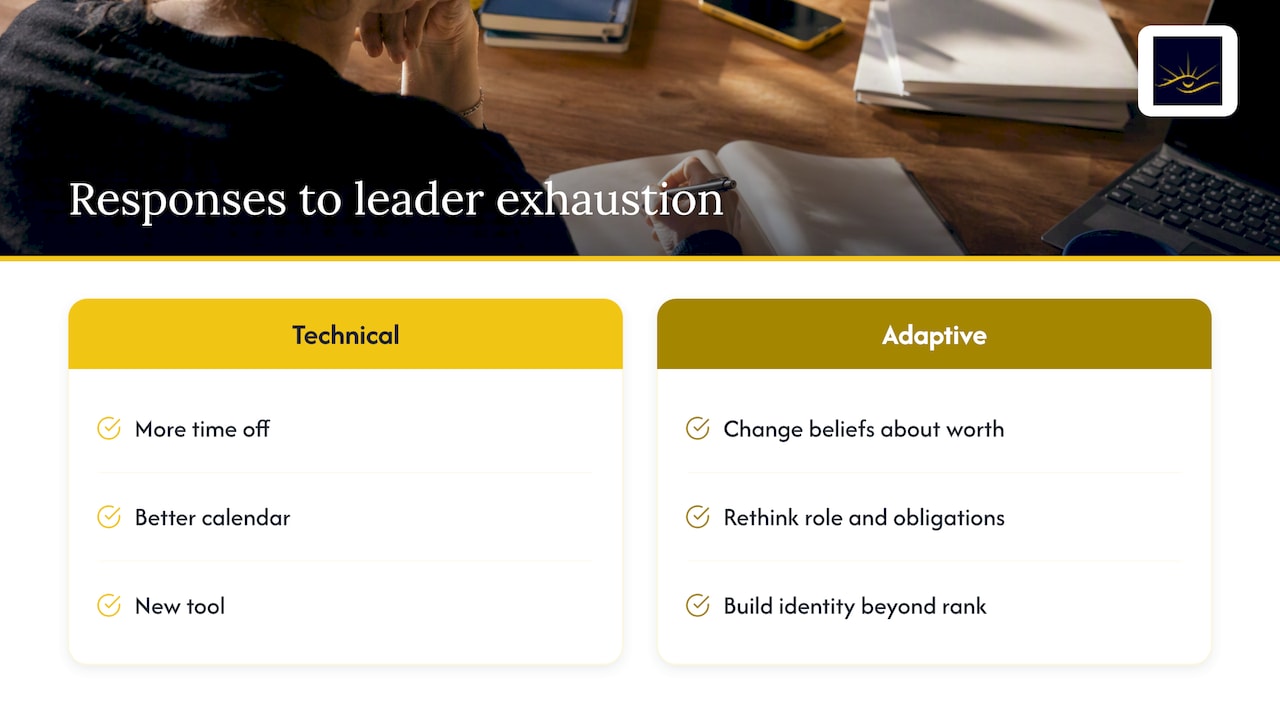
Research points in the same direction. A 2026 Army University Press piece argues that cultivating identity, meaning and purpose beyond rank or role can reduce burnout and support endurance for senior leaders. A 2026 professional article on mid-career work suggests treating career movement as reinvestment, recognizing that identity and capability evolve, and normalizing transitions instead of waiting for burnout or dissatisfaction to force them.
That is why our work starts with identity before strategy, and why it includes substantial work between sessions. Insight alone does not change behavior. People do the adaptive work in their actual week, with actual stakes. If you recognize yourself in the “still performing, but numb” pattern, our page on high-achiever burnout explains how we approach it, and the executive burnout recovery page describes how recovery can happen without leaving your role.
— Junna Liao
Applying adaptive leadership to a career transition
The eight examples translate directly to your own working life.
Get on the balcony. Look at the last year as a pattern. When did you feel most engaged? Which tasks do you postpone? Which meetings drain you regardless of topic?
Name what to preserve. Your skills, your relationships and your values do not need to be thrown out because your role has changed. Separate what is core from what is merely familiar.
Regulate your own distress. Transitions bring loss, even good ones. Physician executives facing job loss, for instance, are advised to strengthen external networks and to view termination as an occupational hazard rather than an individual failure. That reframing lowers the heat enough to think.
Run small experiments. Before a leap, test a direction: a conversation with someone in the field, a short project, a speaking opportunity. If you want a structured way to do this, our seven-step career transformation approach for midcareer leaders puts identity first and strategy second.
Build a safety net. The same physician-executive research notes that maintaining core professional skills can give a professional safety net, reducing fear-driven decision-making. The principle applies beyond medicine: leaders who keep their craft sharp make calmer choices.
Where coaching fits
Seeing the balcony view of your own life is hard, which is the reason most people need someone else to hold the mirror. If you are weighing a transition, our 1:1 career coaching is built for executives and senior professionals who want deep work on identity and direction, with accountability outside the sessions. If you want a data point on how you currently respond under pressure, the Energy Leadership™ Index assessment is a starting place. For more reading, browse our insights.
Common mistakes when trying to lead adaptively
- Rescuing too quickly. Solving the problem for people feels helpful and keeps them dependent.
- Turning up the heat too fast. Raising several hard issues at once overwhelms people. British Airways phased them in over years.
- Ignoring loss. People resist change less out of stubbornness than out of what they stand to lose.
- Mistaking a technical fix for the cure. A new tool or reporting line may help, but if beliefs and habits stay the same, the problem returns.
- Exempting yourself. The leader’s own habits are often part of the pattern. Adaptive work includes looking at them.
FAQ
What are some examples of adaptive leadership?
A documented one is British Airways, which shifted toward a customer focus over four or five years by phasing in issues. Everyday ones include a manager who gives decisions back to her team, a director who stays steady and honest during a reorganization, and an executive who tests ideas in small pilots before committing to a large plan.
What does it mean to be an adaptive leader?
It means mobilizing people to do the learning that hard, unclear problems demand, instead of handing them ready-made answers. You diagnose the situation, manage the level of discomfort, pace the change and keep the responsibility with those who own the problem.
What are the main skills of an adaptive leader?
Observation from the balcony, emotional regulation, diagnosing technical versus adaptive problems, running experiments, and giving work back to others. Sources also stress recognizing loss and defensive responses to change, and distinguishing what to preserve from what to change.
How is adaptive leadership different from transformational leadership?
Transformational leadership relies on a leader’s vision and inspiration to move people. Adaptive leadership focuses on the learning and behavior change the group must go through, especially when no one yet knows the answer. Strong leaders often combine them.
Can adaptive leadership help with burnout or a career change?
Yes, because both are adaptive challenges: no procedure fixes them, and they involve identity and values. Stepping back to see patterns, testing small changes and building identity beyond your title are all adaptive moves. If burnout is severe or affects your health, talk to a physician or licensed mental health professional as well.
Sources
- Mobilizing Adaptive Work: Beyond Visionary Leadership
- The Work of Leadership
- What is adaptive leadership?
- The Theory Behind the Practice
- Adaptive Leadership (MindTools)
- The Four Principles of Adaptive Leadership
- Leadership of Stability and Leadership of Volatility
- Sustaining Senior Leaders Beyond the Rank
- Research: As Careers Get Longer, Midcareer Work Needs to Change
- Preparing for the End: Job Loss and Resilience
- Executives are burning out and they don’t know how to cope
Recommended
- Leadership Blind Spot Assessment for Clearer Growth
- Lead Calm Teams in 2–4 Quarters: Trauma Informed Leadership Roadmap
- Values-Based Leadership: Managers Turn Values Into Decisions This Week
This blog is for educational and inspirational purposes only. It is not medical, legal, financial, or mental health advice. Your journey is unique; please seek qualified professional support for decisions that affect your health, finances, or wellbeing.