Burnout comes from too much: too much pressure, too many demands, too little recovery. Boreout comes from too little: work that is under-challenging, empty or meaningless, for months on end. Both can leave you tired, cynical and detached, which is why so many people misread one as the other. The fix differs, so the diagnosis matters.
This guide explains how the two differ, where their symptoms overlap, how to check which one fits your situation and what to do about it. It is written for executives and senior professionals who feel flat and cannot tell whether they need less work, better work or a different life.
TL;DR
- Burnout is the result of overload. Boreout is the result of chronic understimulation, where you feel unchallenged and your work lacks meaning.
- Both can cause exhaustion, cynicism and stress symptoms, so how you feel is not enough. The cause is what separates them.
- Boreout is often misread as a lack of commitment, but research points to organizational factors, not a character flaw.
- Rest fixes overload. Boreout needs more meaningful challenge, honest conversations and sometimes a change of role.
- Persistent or severe symptoms deserve a health care or mental health professional, not just a career fix.
Table of Contents
- Boreout vs burnout at a glance
- What burnout actually is
- What boreout looks like
- Where the symptoms overlap
- What causes each one
- Which one is it? Questions to ask yourself
- Our perspective: it is rarely just about the job
- What to do about burnout
- What to do about boreout
- When coaching helps, and when it does not
- When to seek professional help
- FAQ
- Sources
Boreout vs burnout at a glance
| Burnout | Boreout | |
|---|---|---|
| Root cause | Overload, constant pressure, emotional strain | Underload, boredom, lack of challenge or meaning |
| What it feels like | Drained, overwhelmed, running on empty | Empty, restless, stuck, disengaged |
| Relationship to workload | Too much to do | Too little that matters, or work below your ability |
| Typical thought | “I can’t keep this up.” | “What is the point of this?” |
| Common overlap | Exhaustion, cynicism, stress symptoms | Exhaustion, cynicism, stress symptoms |
| What helps first | Reducing load, recovery, boundaries | Meaningful challenge, role redesign, direction |
The American Society of Employee Assistance professionals’ summary puts it plainly: burnout involves feeling overworked, while boreout involves feeling unfulfilled because of mental underload and insufficient or inadequate work.
What burnout actually is
Burnout has a formal definition, and it is narrower than people assume. According to the ICD-11, burnout is an occupational phenomenon, not a medical condition or an actual disease. That does not make it trivial. It means the problem is tied to the work context, and the response has to look at that context too.
The Mayo Clinic lists signs that include feeling removed from work, little satisfaction, doubts about your skills, changed sleep habits and unexplained physical complaints such as headaches or stomach problems.
In our coaching work, the classic burnout client is the high performer who said yes to everything. Their calendar is full, their recovery is empty and their sense of competence has started to erode. If that sounds familiar, our guide to spotting chronic stress at work is a good next read.
What boreout looks like
Boreout is characterized as a state of chronic workplace boredom arising from mental underload, from insufficient quantitative or qualitative work, where an employee feels unchallenged. Note the two kinds of underload. You can have too little to do, or you can have plenty to do that is far below your ability and has no real purpose.
The second kind is common among seniors. A director who has outgrown the role, a specialist who now spends their days in status meetings, a leader whose company has plateaued: all of them can be busy and bored at once. Busy does not mean engaged.
Boreout also hides well. Because people fear being seen as idle, many pretend to be occupied. That performance is its own drain, and it adds to the tiredness that people then blame on something else.
Where the symptoms overlap
This is the part that causes the confusion. Psychologists Sharon Parker and Lotta Harju, speaking with the American Psychological Association, describe boreout and burnout as arising from opposite ends of the stimulation spectrum that can both involve pervasive fatigue and stress symptoms that harm performance and personal health. Boreout can involve disengagement, frustration and unfulfillment, and exhaustion and cynicism can show up in either state.
So two people can report identical feelings of exhaustion and cynicism, and need opposite treatment. One needs to take weight off. The other needs something worth carrying.
A few clues help separate them:
- Rest test. After a real week off, does your energy come back and then drain within days of returning? That points toward overload being relieved and then resumed. If you feel just as flat on day three of vacation, or dread Monday for reasons of emptiness rather than volume, look at meaning.
- Interest test. When a genuinely interesting problem lands on your desk, do you feel a spark, even a small one? Burned-out people often cannot muster interest at all. Bored-out people often come alive.
- Time test. Do you wish for more hours in the day, or do you watch the clock and stretch out simple tasks?
None of this is a diagnosis. It is a way to start a more accurate conversation with yourself.
What causes each one
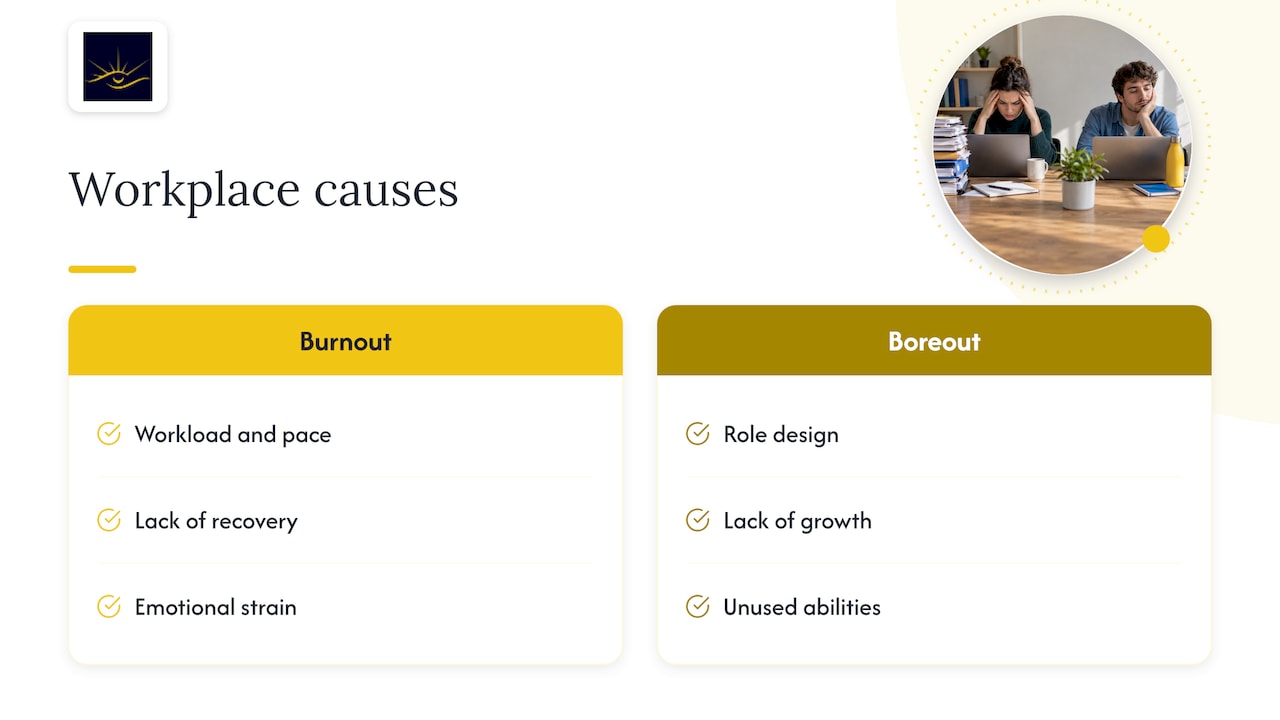
Burnout builds from workload, pace, lack of recovery and emotional strain over long stretches. Boreout builds from role design, lack of growth and work that does not use your abilities.
One point deserves emphasis: boreout is not laziness. A 2025 French academic thesis by Lexane Martin found that workplace boredom is often stigmatized, producing shame, guilt and self-censorship because it is read as a lack of personal commitment, when it stems from organizational factors. Dr. Harju makes a related point in the APA conversation: when boredom is widespread, it is a systemic workplace experience, not just an individual’s responsibility.
The same logic applies to burnout. CDC and NIOSH documentation stresses that organizational-level interventions, not only individual ones, are necessary to manage chronic work-related stressors effectively. You can improve your own habits, and you should, but a broken job design will not be fixed by a morning routine.
There is a cost to organizations too. Research from 2022 suggests boreout can cause financial losses, increased turnover and reduced human resource capacity.
Which one is it? Questions to ask yourself
No test replaces a professional assessment, but these questions help you see the pattern. Write your answers down rather than thinking them through. Patterns show up on paper.
- Volume. In a typical week, do I finish work feeling depleted by how much I handled, or by how little of it mattered?
- Challenge. When did I last feel stretched in a good way? What was I doing?
- Control. Do I have a say in what I work on and how? Or do I either drown in demands or sit waiting for assignments?
- Meaning. If my work vanished tomorrow, who or what would notice?
- Recovery. Does time off restore me, or does the emptiness come along on vacation?
- Body. Am I sleeping differently, getting headaches or stomach trouble, or noticing mood changes that I cannot explain?
- Mixed signals. Am I overloaded on tasks I do not care about while starved of the work I do?
That last one matters. Many leaders have both at once: too much administrative load and too little real challenge. If your answers split between overload and emptiness, the honest label is a mismatch between your capacity and what the role asks of you. Our article on four questions to separate burnout from emotional exhaustion can sharpen the picture.
Our perspective: it is rarely just about the job
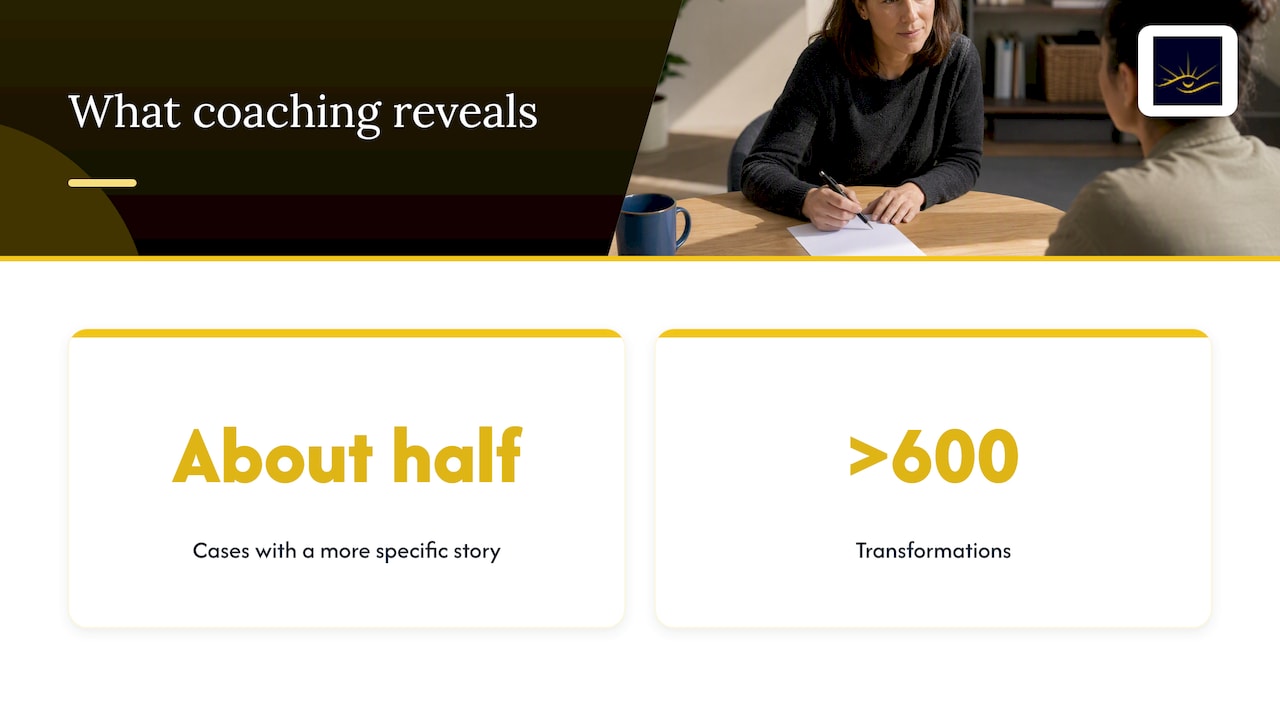
We work with executives and senior professionals who arrive saying they are burned out. About half the time, when we dig in, the story is more specific. Some are depleted by overload. Others are running a role that no longer fits who they have become, and the fatigue is the cost of acting out an identity they have outgrown. From the outside, both look like a tired leader. From the inside, they need different things.
Our approach combines deep coaching with practical life and career strategy, and it begins with the cause rather than the label. We use the Energy Leadership™ framework to look at where your energy goes and what drains or fuels it. Whether the answer is more rest, a redesigned role or a different direction, the work happens in sessions and between them, because change that lives only in a one-hour conversation does not hold.
After more than 600 transformations, one thing stands out. People rarely need to be fixed. They need to be accurately seen, then given a structure for acting on what they find.
— Junna Liao
What to do about burnout
Start by lowering the load and protecting recovery. The aim is not to push through, but to create enough room to think clearly.
- Cut cognitive load. Block protected time for deep work and reduce context-switching. Our guide to protecting 60 to 90 minutes against cognitive load shows how.
- Have an honest conversation. Burnout rarely resolves silently. Talk to your manager or board about deadlines and workload.
- Rebuild gradually. Recovery is a process, not a weekend. Our pieces on the burnout recovery timeline and on returning to work after burnout without relapsing cover what to expect.
If you lead people, set the tone. The Ara Foundation’s workplace playbook suggests that leaders should model rest, including not checking in with the office while away.
What to do about boreout
Boreout needs the opposite medicine. Rest alone will not fix an empty role. The American Society for… professional guidance lists these moves: communicate with managers, consider workplace adjustments, use confidential resources and set achievable short-term challenges to help restore purpose and accomplishment.
In practice, that looks like this:
- Name the gap. Be specific: not “I’m bored” but “I have not made a real decision in six months” or “I use about a third of my skills.”
- Ask for a stretch. Propose a project, a new responsibility or a cross-functional assignment. Bring a concrete proposal, not a complaint.
- Set small challenges. A new skill, a mentoring commitment or a problem outside your normal remit can restart a sense of progress while you work on bigger moves.
- Stop performing busyness. Pretending to be occupied costs energy. Being honest about your capacity is uncomfortable, but it is the only route to better work.
- Test the larger question. If the role cannot grow, ask whether the field, the company or the career itself has stopped fitting. Our guide to a seven-step career transformation for midcareer leaders starts from identity rather than job titles.
If you manage someone who might be bored out or burned out
Managers are often the most influential person in an employee’s experience of work. The Ara Foundation playbook recommends short, 15-minute check-ins in which managers listen without judgment and offer concrete next steps, such as adjusting deadlines or workloads. Training helps: one reported finding shows that supportive conversation training can reduce the desire to leave from 35% to 18%. For a look at the same principle with technical teams, see this piece on managing remote developer productivity, which shows why activity is a poor stand-in for real contribution.
When coaching helps, and when it does not
Coaching is a good fit when the question is direction: whether to stay, reshape the role or move on, and who you want to be next. It is not a substitute for medical or mental health care.
If you want a structured partner for that decision, we offer 1:1 career coaching and life coaching, both with Junna. Many clients begin with the Energy Leadership™ Index assessment, which gives you a concrete picture of how you respond under pressure and where your energy goes.

If you want to talk through whether coaching suits your situation, you can book a call.
When to seek professional help
Both states can overlap with clinical conditions. The Mayo Clinic advises that if you answer yes to any of its job burnout questions, you should consider talking to a health care or mental health professional, since the symptoms can also be linked to conditions such as depression.
CDC and NIOSH advise against dismissing serious mental health symptoms as burnout and encourage counseling or other mental health services, including the 988 Lifeline in the United States. Call or text 988 if you are in crisis. If you have persistent low mood, loss of interest in everything (not just work), trouble sleeping or thoughts of self-harm, see a doctor or licensed therapist first. Our article on burnout versus depression explains how coaching and clinical care relate.
FAQ
Is it burnout or boreout?
Look at the cause rather than the feeling. If you are depleted by too much pressure and too little recovery, it points toward burnout. If you are drained by emptiness, lack of challenge and work that does not use your abilities, it points toward boreout. Many people have a mix, and the symptoms overlap.
What are the common symptoms of boreout?
Boreout can involve disengagement, unfulfillment, frustration, cynicism, exhaustion and stress symptoms, according to psychologists speaking with the APA. Exhaustion and cynicism can also appear with burnout, which is why the cause matters more than the symptom list.
Is boreout worse than burnout?
Neither is clearly worse, and they can both harm physical and mental health. Boreout can be easier to dismiss because it carries stigma and looks like a lack of commitment, so people often suffer longer before acting. Treat either one seriously.
Can I have burnout and boreout at the same time?
Yes. A common pattern is overload on low-value tasks combined with starvation for meaningful work. The answer there is to remove the empty load and add real challenge, rather than simply resting.
Should I quit if I think I have boreout?
Not as a first move. Start by naming the gap, asking for a stretch assignment and testing small challenges. If the role truly cannot grow, a planned transition beats an escape. Coaching can help you make that call deliberately.
Sources
- Is it Burnout or Boreout? (American Society of Employee Assistance Professionals)
- What burnout is and is not (NIOSH, CDC)
- Module 2 outline, archived (NIOSH, CDC)
- Are you burned out or bored out? (APA)
- Job burnout: How to spot it and take action (Mayo Clinic)
- From boredom at work to bore-out (Lexane Martin, 2025)
- Organizational interventions for work-related stress (NIOSH, 2008)
- Workplace Mental Health Playbook 2.0 (The Ara Foundation)
- Rise of Boreout Syndrome (Forbes)
- Remote Developer Productivity
Recommended
- Four Questions to Spot Burnout vs. Emotional Exhaustion for Leaders
- 2–12 Weeks to 12+ Months: Burnout Recovery Timeline and Weekly Steps
- How to Return to Work After Burnout Without Relapsing
- 6 Weeks–4 Months to Rebuild Capacity: Burnout Resilience for Leaders
This blog is for educational and inspirational purposes only. It is not medical, legal, financial, or mental health advice. Your journey is unique; please seek qualified professional support for decisions that affect your health, finances, or wellbeing.