
The best thing to do after a layoff is to secure your finances and health coverage first, give yourself a short window to absorb what happened, and only then decide what you want next. A career reset is not a rush to replace the old job. It is a deliberate sequence: stabilize, reflect, test directions, then search with focus. This guide walks through each stage, with the deadlines that matter in the U.S. and the questions worth asking before you send a single application.
TL;DR
- Handle the clock-driven items in the first two weeks: unemployment filing, health coverage, severance paperwork, and any employer counseling benefit.
- Take a short, intentional pause to process the loss before you make big career decisions.
- Clarify what you want through a skills and values inventory, then test a direction with small experiments before committing.
- Prepare a two-sentence, forward-looking explanation of the layoff and refresh your resume and profile for the roles you actually want.
- If the layoff has shaken your sense of who you are professionally, working with a coach can shorten the reset.
Table of Contents
- What a career reset actually means
- The first two weeks: handle the deadlines
- Process it before you plan it
- Work out what you want next
- Test a direction before you commit
- Build a search you can sustain
- How to explain the layoff and the gap
- A realistic timeline
- Our perspective: leading yourself through a layoff
- Working with a coach through the reset
- FAQ
- Sources
What a career reset actually means
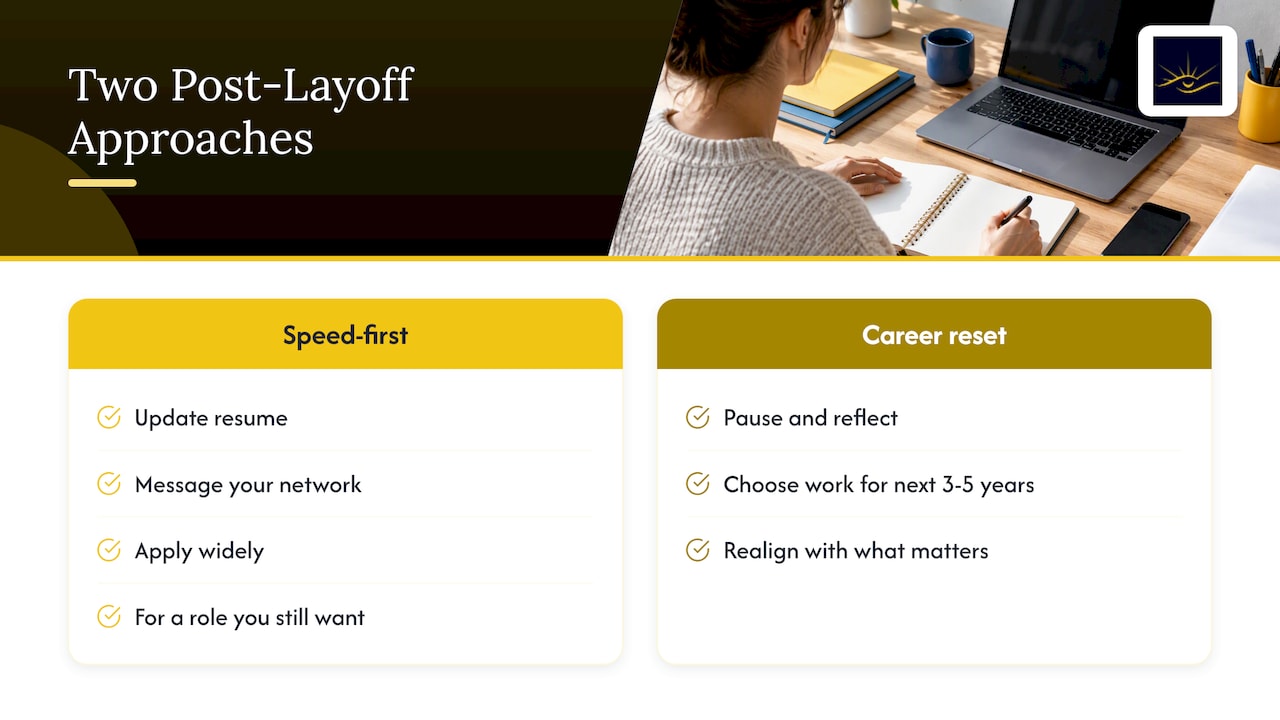
Most advice after a layoff is about speed: update the resume, message everyone you know, apply widely. That works when the role you lost was the right one and only the employer changed. It works poorly when the layoff exposes a question you have been postponing for years: is this the work I want to keep doing?
A reset treats the layoff as a forced checkpoint. You still look for work, but you first decide what kind of work deserves your next three to five years. For executives and senior professionals this matters more than for most, because a title and a company often carry a large part of how you see yourself. When both disappear on one afternoon, the loss is practical and personal at once.
University career services say much the same thing in plainer terms. The University of Washington’s professional education team advises you to pause, reflect and realign your career with what matters to you rather than jumping straight into the next listing.
The first two weeks: handle the deadlines
Before any reflection, take care of the items that have clocks attached. Missing them costs real money, and clearing them gives your mind room to think.
File for unemployment insurance
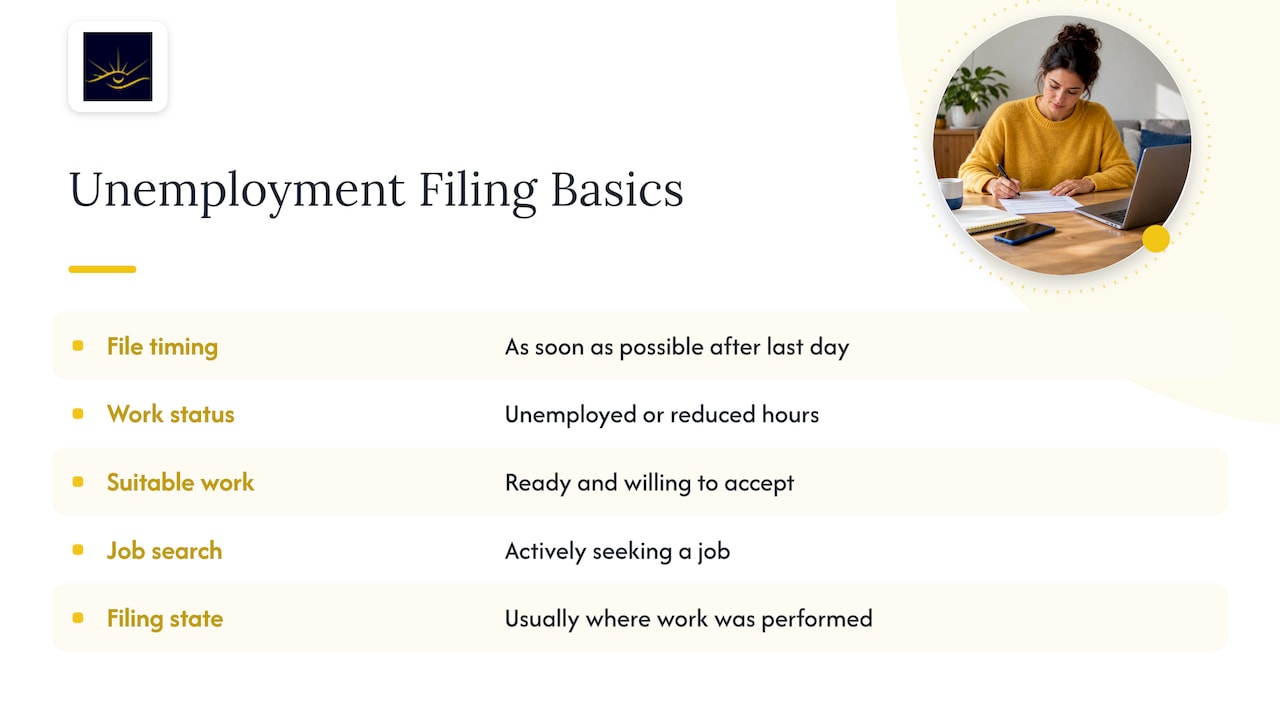
File as soon as you can after your last day. To qualify, the U.S. Department of Labor says you must be unemployed or have reduced hours, be ready and willing to take suitable work, and be actively seeking a job. The same page notes that most states expect you to file in the state where you performed the work, even if your employer is headquartered elsewhere. That matters for remote workers, so check where your employer registered your wages.
Benefit amounts and waiting rules differ by state, so use your state workforce agency’s page for the current figures. Severance can affect timing in some states, so read your separation agreement and ask the agency how it treats severance before you assume anything.
Decide on health coverage
If your employer plan ends with your job, you have two main routes, and both have windows.
- COBRA lets you temporarily keep your employer-provided coverage after job loss. The Department of Labor’s COBRA guidance says you generally have a 60-day election window and then 45 days to make the first payment once you elect. You usually pay the full premium yourself, so get the monthly figure from your plan administrator before deciding.
- A Marketplace plan is the alternative. HealthCare.gov states that you can apply within 60 days of losing job-based coverage and qualify for a Special Enrollment Period, with coverage able to start the first day of the month after your job coverage ends.
Compare the monthly cost, your doctors’ network status and any deductible you have already met this year. If you have a planned procedure or ongoing treatment, that detail often decides the choice.
A layoff also changes other coverage you may have tied to the job, such as life or disability insurance. A guide to life events that require insurance policy updates is a good way to check which of your policies need a second look.
Read your separation paperwork
Before you sign anything, note the severance amount and schedule, the date benefits end, what happens to unvested equity or bonuses, and any non-compete or non-disparagement terms. If the package is substantial or the terms are unclear, an employment attorney can review it before you sign. A short consultation costs little compared with a clause that restricts your next move.
Use the support you already have
Many employers keep their employee assistance program counseling available for a period after your last day. One layoff-support resource reports that access commonly runs from 30 days to 6 months, so ask HR in writing what applies to you. If you are struggling beyond ordinary stress, the 988 Suicide & Crisis Lifeline (call or text 988) and the Crisis Text Line (text HOME to 741741) are free and available in the U.S.
Process it before you plan it
There is a temptation, especially among high achievers, to turn grief into a project plan within 48 hours. Productivity can be avoidance in disguise. Allow yourself a defined stretch, a week or two for most people, in which the job is to absorb what happened.
UC Berkeley’s HR guidance frames job loss as a temporary setback, not a personal failure, and recommends protecting sleep, exercise, relaxation and nutrition, plus taking scheduled breaks from the job search. Those are not soft extras. A search run on four hours of sleep produces weaker conversations and worse decisions.
A few practical ways to process:
- Tell the story out loud to one or two people you trust, not to a hundred. Choose people who listen rather than rush to fix.
- Separate the event from the verdict. Write down what the layoff was (a budget decision, a restructuring, a closed business line) and what it was not (a ruling on your ability).
- List what you will not miss about the role, along with what you will. Both lists become useful data later.
- Set a rhythm. Fixed wake-up time, a daily walk, two or three anchored work blocks. Structure keeps drift from becoming despair.
Confidence returns through action more than through waiting. Forbes contributor Lorraine K. Lee notes that confidence is rebuilt by staying visible through small, low-pressure habits such as thoughtful networking and sharing professional insights. You do not need to feel ready first.
Work out what you want next
This is the stage that separates a reset from a replacement. Before you target roles, answer three questions.
Take a skills and values inventory
Colorado State University’s business career team suggests you reflect on your skills and values and on how much change you are ready for, and consider whether you would change industry, function, or both. The University of Washington adds a skills inventory to clarify strengths and goals and the advice to seek a career mentor.
Make it concrete. For each of your last three roles, write:
- The projects where time disappeared because you were absorbed.
- The tasks you did well but dreaded.
- The people whose problems you were most useful to.
- What you were rewarded for versus what you valued.
The gap between the last two lines is often where the next direction hides.
Use free official tools to widen the map
CareerOneStop, sponsored by the U.S. Department of Labor, offers a guide to changing occupation or industry. It points to its Skills Matcher and mySkills myFuture tools to generate occupations that fit your existing skills, and recommends reviewing career reports and industry information to see which fields are growing or declining. Spend an evening with these before you fall in love with an industry that is shrinking.
Think about identity, not just job titles
Research on vocational identity describes it as a stable, clear picture of your goals, interests and talents, and treats it as an important factor in career development and pursuing meaningful work. That study focused on people with psychiatric disabilities, but the principle travels: when your picture of yourself was built around a single employer, a layoff asks you to rebuild it deliberately.
Test a direction before you commit
The lowest-risk way to decide is to run small experiments. Colorado State’s guidance suggests exploring through meetups, short courses, volunteering or freelancing before you commit to a pivot. In practice, that can look like this:
| Question you are testing | Low-cost experiment | What you learn |
|---|---|---|
| Do I like this field’s daily work? | Three informational conversations with people doing it | What the job is really like, not the job description |
| Can I do this work? | A small freelance or advisory project | Whether your skills transfer and what gaps exist |
| Do I want to learn this? | A short course or certificate module | Whether the material holds your attention |
| Does this field value my background? | A volunteer or board role | How people react to your experience |
Set a time box, such as four to six weeks, and decide in advance what result would count as “yes, keep going” and what would count as “no, cross it off.” Without that, experiments turn into endless exploring.
Build a search you can sustain
Once you have a direction, or two, narrow your search to match it.
Refresh your materials for targeted roles
CareerOneStop advises you to create or update your resume for your targeted occupations and update your social media profiles to reflect your search goals. A resume built for a role you are leaving behind will undersell you for the role you want. Lead with the results that transfer and cut what only made sense inside your old company.
How you signal availability matters too. This walkthrough on what to post with a LinkedIn Open to Work banner covers wording choices for your profile after a layoff.
Set weekly targets, not daily panic
A manageable job search runs on a small number of repeatable actions. A reasonable weekly rhythm for a senior professional:
- Two or three conversations with people in your target field.
- Five to eight carefully tailored applications, fewer if you are networking into roles.
- One piece of visible professional activity, such as a thoughtful post or a comment on someone’s work.
- One block for learning or a side project.
- At least one full day off.
Senior roles often come through relationships and referrals more than postings, so weight your time toward conversations.
Use the gap productively
Volunteering, freelance work or a course keeps you productive and building skills while you search, and each one gives you something concrete to say when asked what you have been doing.
How to explain the layoff and the gap
You will be asked about it, so prepare. Career experts quoted by Forbes advise concise, forward-looking language that acknowledges a broader organizational shift without over-explaining or minimizing your contributions.
A structure that works in two or three sentences:
- The fact: “My role was eliminated when the company restructured its [function/division].”
- The value: “Before that, I [one concrete result].”
- The direction: “I am now looking for [specific role or problem] where I can [what you want to do].”
Then stop. Do not apologize, do not criticize your former employer, and do not narrate the whole story unless asked. Practice it aloud until it sounds like an ordinary sentence.
A realistic timeline
There is no standard length for a reset, and anyone who promises one is guessing. A useful frame:
| Phase | Typical focus |
|---|---|
| Weeks 1 to 2 | Unemployment filing, health coverage, severance review, rest |
| Weeks 2 to 4 | Processing, skills and values inventory, first conversations |
| Weeks 4 to 10 | Experiments in one to three directions, materials refreshed |
| Week 10 onward | Focused search and interviews, with experiments continuing if useful |
Treat these as a loose guide. A person returning to the same field may move faster. A person changing industry will probably take longer and should plan finances accordingly.
Our perspective: leading yourself through a layoff
We work with executives and senior professionals, and the pattern we see after a layoff is consistent: the logistics are the easy part. The hard part is that the person who built a career on competence suddenly cannot answer a simple question, which is “what do I want?”
Too many people answer it under pressure. They take the first offer that resembles the old job, and eighteen months later they feel the same dissatisfaction they had before, only with a new logo on the email signature. A layoff is an unwelcome, but real, chance to choose differently.
Our approach combines deep coaching with practical career and life planning. We start with identity: what you value, how you show up under stress, and which parts of your old role were you and which were just the costume. We use the Energy Leadership Index assessment to see the patterns that drive your reactions, because a person operating from fear and a person operating from curiosity run very different searches, even with the same resume.
Then we move to action, with substantial work between sessions: experiments, conversations, decisions with deadlines. We built this as high-touch, one-to-one support because your circumstances are specific, and a generic playbook rarely survives contact with them. Across more than 600 client transformations, the clients who reset well did not move fastest. They moved deliberately, and they stopped treating the layoff as a verdict.
If you take only one thing from this guide, let it be this: give yourself permission to ask the bigger question before you answer the smaller one.
Junna Liao
Working with a coach through the reset
If you are weighing a real change of direction, or the layoff has shaken your confidence more than you expected, one-to-one coaching can give you structure and an honest outside view. We offer 1:1 career coaching with Junna for professionals and leaders in transition, combining identity work with a practical plan. If you want a lighter first step, the Career Clarity Coach program is built around a short run of sessions to test a direction.

We also offer the Energy Leadership Index assessment to help you see how you respond under pressure. To talk through your situation, you can book a call. For more on leading yourself through this period, read our piece on leading yourself through layoff uncertainty, and if you are thinking about a bigger pivot, see our seven-step career transformation.
FAQ
What should I do first after a layoff?
Handle the deadlines first: file for unemployment, choose between COBRA and a Marketplace plan, and read your severance terms before signing. Both COBRA and the Marketplace special enrollment period run on roughly 60-day windows, so do not let them slide. After that, give yourself a short, deliberate pause before making large career decisions.
Should I change careers or find the same job elsewhere?
It depends on whether the role or the employer was the problem. A skills and values inventory helps you tell the difference, and small experiments such as informational conversations, a short course or a freelance project let you test a pivot cheaply. If most of what you dreaded was the work itself, a pivot deserves serious thought.
How do I explain a layoff to employers?
Keep it short, factual and forward-looking. State that your role was affected by a company-wide change, name one concrete result you delivered, and say what you want to do next. Avoid blaming your former employer or over-explaining, and practice the answer aloud.
Can I collect unemployment while I explore a new direction?
You generally must be able and available to work and actively seeking a job to qualify, according to the Department of Labor. Rules on what counts as a work search, and how part-time or freelance income is reported, vary by state, so ask your state agency before you start a side project.
How long does a career reset take?
There is no fixed length. Someone returning to the same field may be searching seriously within weeks, while someone changing industry usually needs several months to test options and build connections. Plan your finances for the longer case.
Sources
- 5 Ways to Recover from a Layoff, University of Washington Professional & Continuing Education
- Layoff: Managing the Stress, UC Berkeley People & Culture
- How To Rebuild Confidence And Momentum After A Layoff, Forbes
- Seven tips for navigating a career pivot after a layoff, Colorado State University
- Change Your Occupation or Industry user guide, CareerOneStop
- Vocational identity article, Psychiatric Rehabilitation Journal
- Initial application instructions, U.S. Department of Labor
- FAQs on COBRA Continuation Health Coverage for Workers, U.S. Department of Labor
- See Your Options If You Lose Job-Based Health Insurance, HealthCare.gov
- Support for the hard part, Got Pink Slipped
Recommended
- Layoffs: Leading Yourself Through Uncertainty
- Seven Step Career Transformation for Midcareer Leaders: Identity First
- Career Change at 40: Six Month Finance First Plan. Start in One Hour
- How to Return to Work After Burnout Without Relapsing
This blog is for educational and inspirational purposes only. It is not medical, legal, financial, or mental health advice. Your journey is unique; please seek qualified professional support for decisions that affect your health, finances, or wellbeing.