
Purpose is your enduring why; mission is the current, actionable how that guides this chapter of your life. Purpose rarely changes across a career, while mission should shift every one to three years as your role, priorities, and context shift. Confuse the two and you end up with a statement too vague to act on and too rigid to revise. Get them straight, and mission becomes a filter you run every decision through.
TL;DR:
- Purpose remains stable over time, while mission should be revised every one to three years based on role and context shifts.
- Separating purpose and mission helps leaders make more focused decisions and avoid moral compromises during role changes or crises.
- Effective purpose statements are based on past satisfying moments and core values, avoiding job titles and industry terms, and should be tested for longevity across industries.
- Missions need clear constraints such as timeframe, audience, and measurable behaviors, and should be revisited whenever roles or markets change significantly.
- Regularly running your mission through decision filters prevents mission statements from becoming decorative or disconnected from actual work.
Table of Contents
- Purpose vs Mission: What Actually Separates Them
- Why Separating Purpose From Mission Actually Matters
- How to Write a Purpose Statement That Actually Holds Up
- Building a Mission for Your Current Chapter
- Purpose and Mission Examples for Leaders
- Turning Mission Into a Weekly Decision Filter
- The Coaching Method Behind This Framework
- Where the Purpose and Mission Distinction Actually Came From
- The Misconception That Keeps Leaders Stuck
- Why This Distinction Changes Culture and Engagement
- Case Studies in Living Purpose and Mission Separately
- Treat Your Mission Like an Experiment, Not a Verdict
- Ready to Turn Reflection Into a Working Mission
- Sources
- FAQ
Purpose vs Mission: What Actually Separates Them
Purpose is a stable internal orientation. It answers why you get out of bed for work at all, and it tends to hold steady whether you’re running a division or starting over after a layoff. Mission is different: it’s a time-bound, actionable filter for the next one to three years, built around a specific role, audience, or set of constraints. Purpose asks who you are. Mission asks what you’re doing about it right now.
The most common error mid-career leaders make is writing one hybrid sentence meant to cover both jobs. It usually reads well and guides nothing, because it’s too abstract to test a real decision against. Tomorrow University’s breakdown frames purpose as the compass and mission as the actual route, a distinction that matters because a compass never tells you which street to turn down.
That’s the core of Melody Wilding’s argument for executives: a mission has to originate as an internal commitment or it collapses the first time things get hard. Academic work backs the split further. Fitzsimmons, Qin, and Heffron’s analysis treats purpose, mission, and vision as distinct communicative tools, each with its own time horizon and persuasive logic. Three separate jobs, not one blended paragraph.
- Purpose: enduring, identity-level, rarely rewritten
- Mission: current, behavior-level, revised on a cadence
- Vision: forward-looking picture of an end state, distinct from both
Why Separating Purpose From Mission Actually Matters
A clear mission does something purpose alone can’t: it limits your options. When you know your mission for this chapter, you stop relitigating every opportunity that lands in your inbox, and decision fatigue drops because most choices get filtered out before they reach your calendar.
Purpose carries a different payload. It’s the thing that keeps you steady when a title gets cut, a reorg lands badly, or a business you built gets sold out from under you. Purpose doesn’t move when your job does.
A sense of purpose is linked to measurable resilience and wellbeing outcomes, according to research summarized in coaching literature on personal mission statements, which is one reason executive coaches treat purpose work as more than a branding exercise.
Leaders who keep the two separate also avoid a specific trap: moral compromise dressed up as strategic flexibility.
- A mission tied to a role can end when the role ends, without touching your identity
- A purpose statement gives you grounds to say no to a lucrative move that violates who you are
- Separating them lets you renegotiate mission constantly while purpose stays load-bearing
How to Write a Purpose Statement That Actually Holds Up
Purpose work starts with pattern recognition, not inspiration. Look backward before you look forward.
- List three moments across your career that felt genuinely satisfying, independent of pay or title, and find the common thread.
- Name the values you’d defend even if they cost you a promotion.
- Ask what you’d want people to say you contributed to, years after you’ve left a role.
- Notice where your energy consistently returns, even after burnout, layoffs, or a bad year.
From those answers, draft one or two sentences: “I exist to [verb] so that [enduring outcome].” Test it by asking whether the sentence would still hold if you switched industries entirely. If it only makes sense inside your current job title, it’s mission material, not purpose.
Pro Tip: Write your purpose statement, then delete every noun that’s a job title, company name, or industry term. If nothing meaningful survives, keep revising.
Revisit purpose only when you feel a sustained pull toward work that contradicts it, not every time a project gets hard.
Building a Mission for Your Current Chapter
A mission needs constraints or it turns into a slogan. Set a timeframe (one to three years works for most leaders), name the specific audience you serve, and define scope tightly enough to exclude things.
- Write the timeframe first: “For the next 18 months…”
- Name who you serve in that window: a team, a client base, a specific market.
- Define three to five measurable behaviors that prove you’re living it, not aspiring to it.
- Draft the mission using the formula: “I will [specific action] for [defined audience] by [method], measured by [behavior].”
An executive’s mission might read: “For the next two years, I will build a team that can run without me, measured by how few decisions still route through my inbox.” An individual contributor’s might be: “This year, I will become the person my department calls first on pricing strategy, measured by three cross-team projects I lead.”
- Use mission to accept work that fits the timeframe, audience, and behaviors
- Use it to decline work that technically pays well but sits outside all three
- Rewrite it the moment your role, team, or market changes meaningfully
Purpose and Mission Examples for Leaders
Short pairs make the abstraction concrete. Each example below shows purpose (stable) followed by mission (current chapter).
- Turnaround executive: Purpose: “I exist to help organizations recover their footing without losing their people.” Mission: “This year, stabilize the operations team’s turnover rate through weekly one-on-ones and a redesigned onboarding path.”
- Policy leader: Purpose: “I exist to make institutions more honest with the people they serve.” Mission: “For the next 18 months, rebuild one flagship program’s transparency reporting from scratch.”
- Creative director: Purpose: “I exist to help people see what they couldn’t articulate.” Mission: “This year, mentor three junior designers into lead roles on client work.”
- Nonprofit founder: Purpose: “I exist to close the gap between good intentions and real outcomes.” Mission: “For the next two years, move the organization from grant dependent to a more balanced revenue model including earned income.”
- Entrepreneur, second act: Purpose: “I exist to build things that outlast my involvement in them.” Mission: “This year, document every process so the business runs without daily input from me.”
- Executive coach: Purpose: “I exist to help capable people stop underestimating themselves.” Mission: “This quarter, take on five clients navigating identity-level career transitions.”
Fill-in template: “I exist to [verb] so that [enduring outcome].” Then: “For the next [timeframe], I will [specific action] for [audience], measured by [behavior].”
| Statement type | Time horizon | Question it answers | Revision frequency |
|---|---|---|---|
| Purpose | Career-length | Why do I do this work at all? | Rarely, only after major identity shifts |
| Mission | 1 to 3 years | What am I doing about it right now? | Annually or when context changes |
| Vision | 3 to 10 years | What does the end state look like? | Every few years |
Turn the mission line into a weekly heuristic: before saying yes to anything, check it against the audience and behaviors named in that sentence.
Turning Mission Into a Weekly Decision Filter
Mission only earns its keep if you run it against real decisions, not just quarterly retreats.
- Start each week by rereading your mission sentence for 30 seconds before opening your calendar.
- Before accepting a meeting, project, or new commitment, run it through three questions: Does this fit my timeframe? Does this serve the audience I named? Does it produce one of my defined behaviors?
- If a request fails two of three, decline it with language tied to mission, not personality: “This falls outside what I’m focused on this year, but I’d point you toward [colleague].”
Pro Tip: Keep a running list of everything you decline for a month. If nothing makes the list, your mission isn’t specific enough to filter anything out.
Revisit mission when your role changes, when a behavior on your list hasn’t moved in two full quarters, or when you notice yourself saying yes to everything again.
The Coaching Method Behind This Framework
An executive coach developed this framework from work with leaders navigating burnout, identity shifts, and career reinvention rather than from theory alone.
- MMDC Alchemy has guided over 600 client transformations using a combined approach: deep coaching paired with practical, actionable strategy
- The method treats purpose as something tested against lived experience, not decided in a single afternoon of journaling
- Mission gets built with the same rigor as a business plan: timeframe, audience, measurable behavior
DIY reflection works for a first pass. Professional MBA programs earn their cost when you’re stuck between two identities, when burnout has clouded your judgment about your own values, or when the stakes of a wrong move (a leadership exit, a business pivot) are high enough that an outside perspective changes the outcome.
Where the Purpose and Mission Distinction Actually Came From
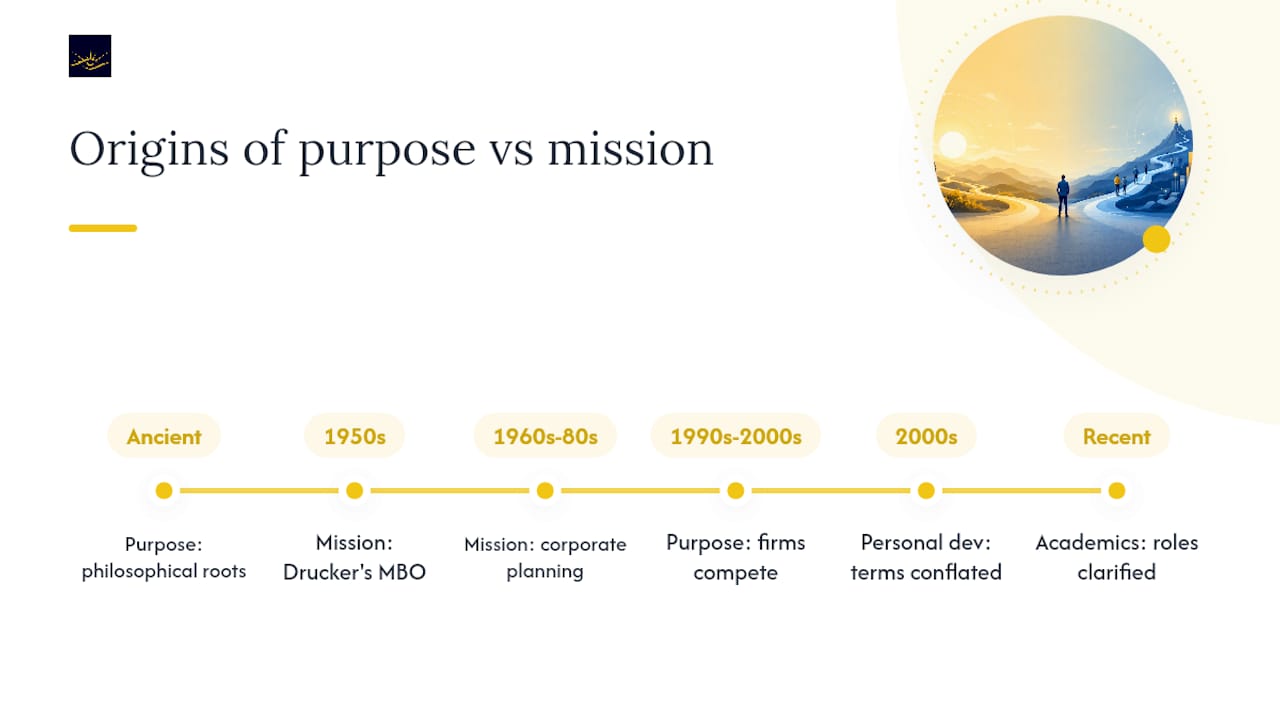
The language leaders use today didn’t start in personal development. It came from strategic planning theory in the mid-20th century, when organizations needed a way to separate their founding rationale from their operating plan. Peter Drucker’s work on management by objectives in the 1950s pushed “mission” into corporate vocabulary as a near-term operating question, distinct from the more philosophical “purpose” that religious and civic institutions had used for centuries.
“Purpose” carries older roots. Philosophers and theologians used it to describe a fixed reason for existing, something closer to vocation than strategy. Corporations borrowed the term decades later, largely in the 1990s and 2000s, as businesses started competing on meaning as much as margin. Mission statements, by contrast, proliferated earlier and faster, because businesses needed a working document for quarterly planning long before they needed an existential one.
The personal-development world inherited both words from that corporate lineage and, for a long time, treated them as interchangeable. That’s part of why so many professionals still default to one combined “purpose and mission statement” instead of two separate tools. Academic framing that treats purpose, mission, and vision as three distinct communicative appeals is a relatively recent correction to decades of loose usage, and it maps directly onto how individuals should think about their own careers: one word for identity, one for the current plan, and a third for where it’s all headed.
The Misconception That Keeps Leaders Stuck
The single most common mistake is writing one statement and asking it to do two jobs. A sentence broad enough to feel permanent is almost never specific enough to guide a Tuesday morning decision, and a sentence specific enough to guide decisions usually won’t survive a role change intact.
A second misconception treats mission as something you write once and frame on a wall. Mission is a working document. If yours hasn’t changed in three years, it’s either exceptionally well calibrated or, more likely, it’s become decorative rather than functional.
A third mistake conflates mission with goals. A goal is a finish line: launch the product, hit the revenue number, land the promotion. A mission is the ongoing orientation that generates goals, not a goal itself. You can hit every goal on your list and still feel adrift if the mission behind them was never clear.
The fix is mechanical, not mystical: separate the documents. Write purpose once and test it rarely. Write mission every year or two and test it constantly against real decisions. If you catch yourself trying to cram audience, timeframe, and enduring identity into one sentence, split it into two.
Why This Distinction Changes Culture and Engagement
Leaders who model a clear split between purpose and mission tend to produce teams that operate the same way, and the effect shows up in how people talk about their work, not just in engagement survey scores. A team whose leader can articulate a specific mission for the next year, tied to concrete behaviors, gives employees something to measure their own contribution against. Vague inspirational language does the opposite: it sounds good in an all-hands meeting and evaporates by Wednesday.
Purpose plays a different role at the culture level. It’s the thing that survives reorganizations, leadership changes, and strategy pivots, because it’s tied to why the work matters rather than what the org chart says this quarter. Teams that understand the organization’s purpose tend to tolerate mission changes better, because they can see the through line even when the specific plan shifts.
The practical upshot for a leader managing a team: state mission often, in specific and revisable terms, and state purpose rarely, in stable and durable ones. Mixing the registers, being vague about mission while overspecifying purpose, tends to produce the confusion that shows up later as disengagement.
Case Studies in Living Purpose and Mission Separately
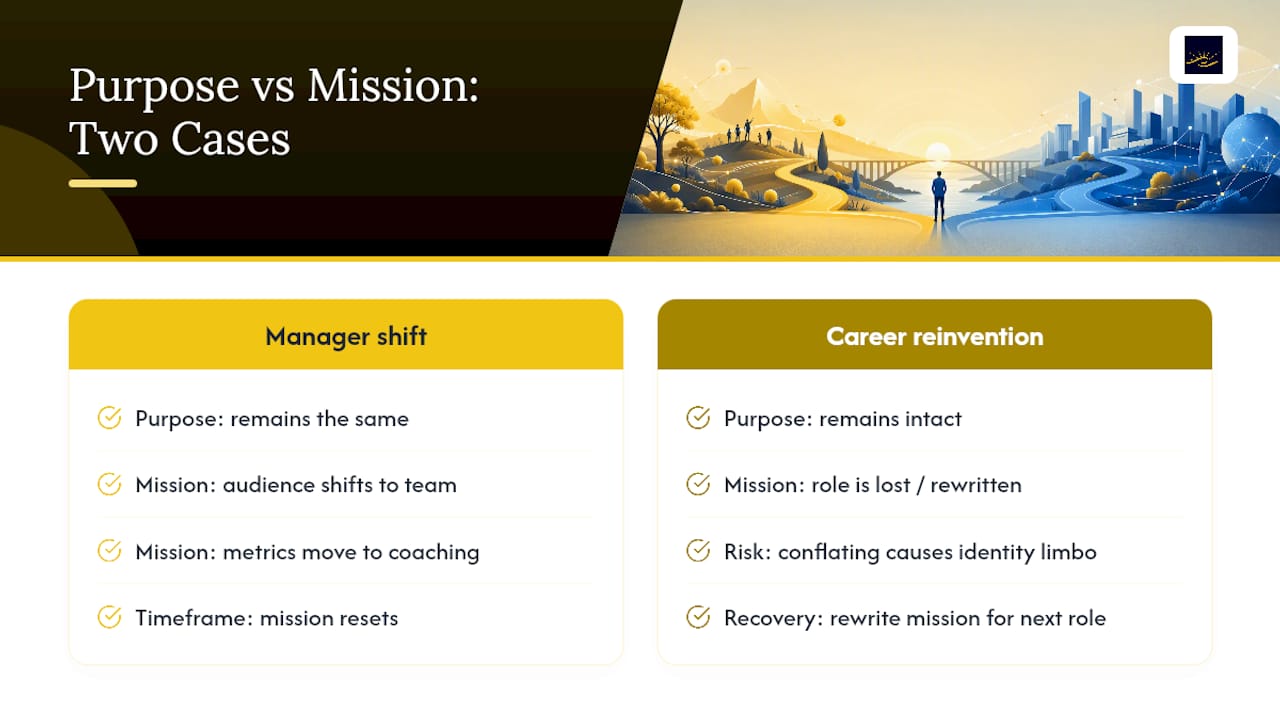
A useful pattern shows up repeatedly among leaders who successfully separate the two: they treat a role change as evidence that mission needs revision, not proof that purpose was wrong all along.
Consider a common trajectory among mid-career professionals moving from individual contributor to people manager. Their purpose (something like “I exist to make complex problems simple for the people around me”) often doesn’t change at all. What changes is the mission: the audience shifts from clients or projects to a team of direct reports, the measurable behaviors shift from output to coaching effectiveness, and the timeframe resets. Leaders who understand this shift ahead of time move faster into the new role, because they’re not searching for a new identity. They’re updating a working document.
A second pattern shows up during career reinvention after burnout or a layoff. Professionals who conflate purpose with their former job title often spend months in identity limbo, because losing the mission (the role) feels like losing the purpose (the why). Those who had already separated the two tend to recover faster: purpose stays intact, and only the mission needs to be rewritten for whatever comes next.
The through line in both patterns is the same discipline this article has walked through: keep purpose stable, keep mission current, and treat every transition as a mission rewrite rather than an identity crisis.
Treat Your Mission Like an Experiment, Not a Verdict
The mission statements that hold up over time were never perfect on the first draft. Write yours down, run it against a few weeks of real decisions, and expect to correct it. Small, disciplined revisions beat one polished sentence you’re too attached to change.
— Junna Liao
Ready to Turn Reflection Into a Working Mission
Reading about purpose and mission gets you halfway there. Actually drafting language that survives contact with a hard week, a tempting job offer, or a burnout spiral usually takes a second perspective in the room. MMDC Alchemy’s career coaching works directly with mid-to-senior professionals on exactly this: translating a vague sense of “why” into a mission statement specific enough to filter real decisions.
If your work is less about the job title and more about who you’re becoming, life coaching with Junna addresses identity shifts and reinvention directly, alongside the career-facing work. For a diagnostic starting point before either engagement, the Energy Leadership Index Assessment gives you a read on where your current energy and decision patterns actually sit, which makes the purpose and mission drafting work faster and more accurate. A short engagement typically produces a written mission statement, a decision filter you can use immediately, and accountability for revisiting it on schedule. Book a call to start.
Sources
- Purpose Statement vs Mission Statement: How They Differ | Tomorrow University
- Why Every CEO Should Have A Personal Mission Statement | Chief Executive (Melody Wilding)
- Purpose vs mission vs vision: Persuasive appeals and components in corporate statements (Fitzsimmons et al.)
FAQ
Is Purpose the Same as Mission?
No. Purpose is your stable, enduring reason for doing the work, while mission is the specific, time-bound plan guiding your current chapter. Tomorrow University describes this as the difference between a compass and a route.
How Often Should I Rewrite My Mission Statement?
Most leaders should revisit their mission every one to three years, or immediately after a significant role change. Purpose rarely needs rewriting; mission does, on a regular schedule.
What Comes First, Purpose or Vision?
Purpose comes first because it’s the identity-level why that doesn’t shift with role or market. Vision follows as the multi-year picture of an outcome, while mission sits in between as the near-term plan that moves you toward that picture.
Can a Mission Statement Feel Wrong Even If It Sounds Good?
Yes, and that’s usually a sign it was written to please someone else rather than reflect a real commitment. Melody Wilding’s litmus test for executives is simple: if the mission feels imposed rather than chosen, it isn’t authentic yet.
Does MMDC Alchemy Help With Both Purpose and Mission Work?
Yes. MMDC Alchemy’s career coaching and life coaching programs address both layers, pairing reflective purpose work with concrete mission drafting and accountability. Current pricing is available directly on each service page.
Recommended
- The Alchemy of Mastery: Choosing the Right Individual Leadership Growth Program
- Mindful Leadership Coaching: Mastering the Alchemy of Presence and Energy
- Coaching for Limiting Beliefs in Leadership
- Overcoming Leadership Plateaus: An Alchemical Guide to Sustainable Mastery
This blog is for educational and inspirational purposes only. It is not medical, legal, financial, or mental health advice. Your journey is unique; please seek qualified professional support for decisions that affect your health, finances, or wellbeing.