
A portfolio career for executives means replacing or supplementing one full-time job with several paid roles, such as board seats, fractional leadership, advisory work, or consulting, run as a deliberate income mix rather than a side hustle. It suits senior leaders who already carry transferable expertise and a strong professional reputation. The first move is not quitting: it is validating one repeatable, paid offer before anything else changes.
TL;DR:
- Securing three to five consistent, paid clients before scaling confirms that your offer is repeatable and sustainable over time.
- Building a portfolio career involves choosing a business entity, separate banking, and bookkeeping to avoid tax and liability surprises early on.
- The 12-month milestone includes establishing proof of demand, three to five paying clients, and a basic operational setup before scaling further.
- Effective time management requires strict role-based time blocking and setting weekly hour limits to prevent burnout and overcommitment.
- Personal branding should focus on clear positioning, case studies, and consistent visibility rather than a polished website or broad marketing efforts.
Table of Contents
- What a portfolio career looks like for senior executives
- Income expectations and tax setup for portfolio work
- How to build and validate a first revenue path
- When a portfolio career is the right choice
- Timeline and the reputation threshold for scaling
- How coaching accelerates a confident portfolio launch
- Strategies for effective time management and prioritization
- Personal branding and marketing for a portfolio career
- Tools and technologies for managing multiple engagements
- Networking strategies for a sustained portfolio career
- Mental health and work-life balance across varied commitments
- Why the real work is readiness, not inspiration
- How we support a confident portfolio transition
- FAQ
- Sources
What a portfolio career looks like for senior executives
An executive portfolio is built from a handful of recognizable components, each with its own time and income profile. Board seats pay modestly but compound reputational capital over years. Fractional C-suite roles, typically two to three days a week with one or two companies, replace a chunk of a full salary while keeping you close to operating decisions. Paid advisory work and short consulting projects convert specific expertise into fast, flexible income. Teaching, whether a university course or a corporate workshop series, builds visibility and a pipeline of referrals. Angel investing adds upside but requires capital and patience, not monthly cash flow.
Executives tend to combine these into a few recognizable shapes:
- The operator-advisor: one fractional C-suite role anchoring 60% of income, plus two or three advisory retainers.
- The board-and-consult mix: two to three board seats for reputation and governance exposure, paired with project-based consulting for cash flow.
- The teach-and-build model: a teaching appointment or cohort-based course for steady income, combined with selective advisory work and early-stage investing.
Each block feeds the others. A board seat opens doors to consulting clients who want governance-level thinking applied to their own strategy problems. A teaching role keeps your thinking current and visible, which matters more once you no longer have a company title doing the introducing for you. Building a portfolio career around these combinations works best when you think of them as one operating system, not four separate jobs competing for your calendar.
Income expectations and tax setup for portfolio work
Year one income from a portfolio career is usually uneven and often lower than a prior executive salary unless you have pre-sold at least one engagement before leaving. A conservative frame: assume six to nine months of ramp-up before income stabilizes, and treat the first year as proof-of-concept rather than peak earning. What moves a portfolio from pilot to sustainable is not more roles, it is recurring revenue from the roles you already have: retainer renewals, repeat project requests, and referrals that arrive without you asking.
A practical validation benchmark is securing three to five paying clients, which signals that an offer is repeatable rather than a one-off favor from your network, according to practitioner guidance on building a portfolio career.
Before the first invoice goes out, a short operational checklist protects you from tax and liability surprises:
- Choose a business entity, often an LLC, registered in your home state.
- Obtain an Employer Identification Number (EIN) from the IRS.
- Open a dedicated business bank account separate from personal finances.
- Set up bookkeeping and invoicing before the second client, not after the fifth.
On the tax side, U.S. self-employed individuals generally report business income on Schedule C of Form 1040, and entity choice, sole proprietor, partnership, S corporation, or LLC, affects which forms apply. When you mix W-2 income from a fractional role with self-employed consulting income, you will likely need to adjust withholding through Form W-4 and make estimated payments using Form 1040-ES, since neither employer is withholding for your full combined income. Skipping this step is the single most common cause of an unexpected tax bill in year one.
How to build and validate a first revenue path
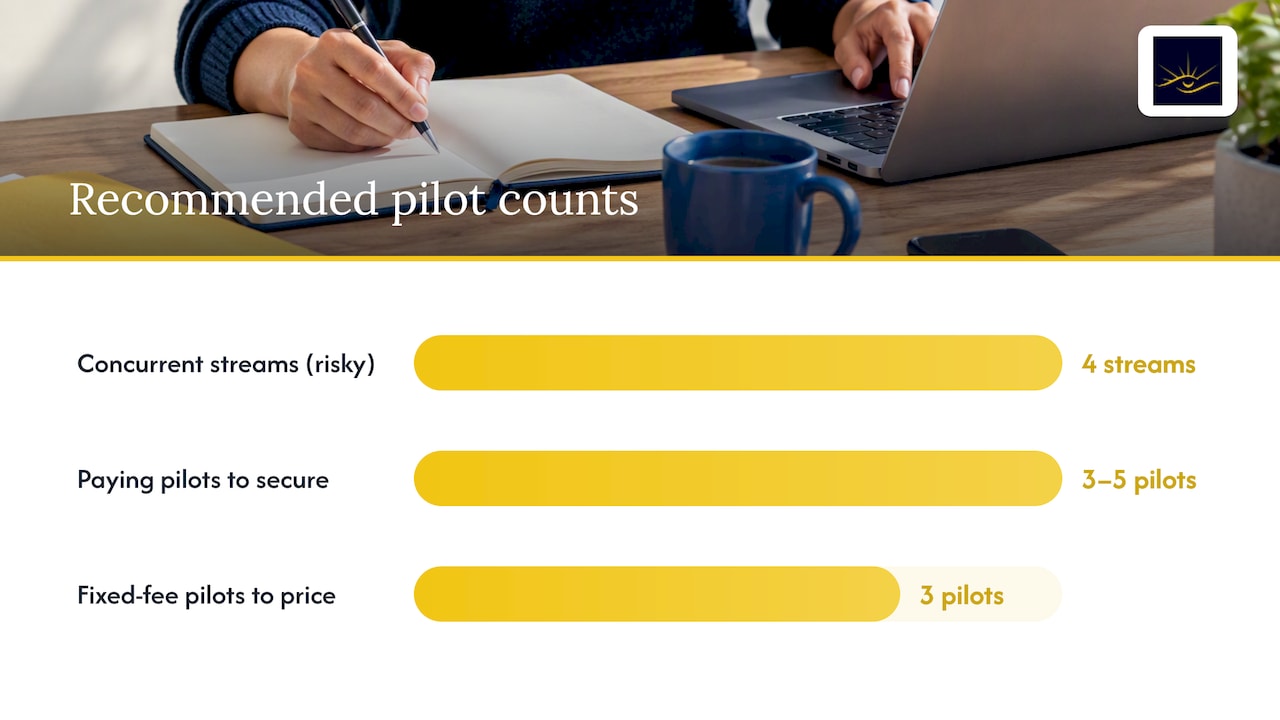
The safest way into a portfolio career is sequential, not simultaneous. Trying to launch four income streams at once multiplies the chance that none of them get enough attention to prove themselves.
- Identify a recurring friction you have solved repeatedly in your career and package it as a narrow, named offer rather than general “consulting.”
- Secure three to five paying pilots, even at a discount, and collect specific outcomes and references from each one.
- Operationalize the back end: contracts, invoicing, and scheduling, and set explicit boundaries on hours and whether you price by retainer or by project.
- Watch for scale signals: clients renewing without being asked, referrals arriving unprompted, and demand exceeding the hours you have available.
Pro Tip: Price your first three pilots as fixed-fee projects, not hourly, so you learn your true effort cost before you negotiate a retainer.
This sequence matters because early pricing mistakes are hard to unwind once a client anchors on a number. It also keeps you from scaling an offer nobody actually wanted, just one person was polite enough to try. Once you see the same request coming from unrelated clients, that is your signal to formalize the offer, not before.
When a portfolio career is the right choice
A portfolio career fits best when demand for your expertise is already repeatable, your network is active rather than dormant, and you have a track record in governance or strategic delivery that clients can verify. Tolerance for income variability matters as much as skill: a portfolio career smooths out over a year but rarely produces the predictable paycheck of a single employer.
The trade-offs are real. Income becomes variable month to month. Employer-sponsored benefits, health insurance, retirement matching, disability coverage, disappear unless you plan around them. Multiple clients can create conflicts of interest, particularly across competing companies in the same sector, and your personal brand now carries risk that used to sit with a single employer’s name.
Mitigations are practical, not aspirational:
- Keep one part-time or fractional role with benefits while building the rest of the portfolio.
- Budget explicitly for individual health coverage and retirement contributions.
- Put a written conflict-of-interest policy in place before you take a second client in the same industry.
- Carry errors-and-omissions insurance once you are giving paid strategic advice.
Timeline and the reputation threshold for scaling
Most executives underestimate how long validation takes and overestimate how fast word of mouth travels. A realistic 12-month milestone set: proof that your offer works, three to five paying clients, and a basic operational stack (entity, banking, invoicing) in place by month twelve.
By month 24 to 36, the markers shift toward durability: repeatable revenue without constant prospecting, referrals arriving from past clients rather than your direct outreach, documented case studies you can show a new prospect, and at least one fractional commitment that has renewed past its original term.
Before committing fully, a short reputation checklist is worth running against yourself:
- Governance experience or measurable strategic outcomes you can describe in specific numbers or results.
- Named references willing to speak to a prospective client.
- At least one repeat buyer, someone who paid you twice for distinct engagements.
Rising interest in this model is not just anecdotal. Forbes reporting links growing interest in portfolio careers with market volatility and AI-related disruption, framing the model as a form of career risk management rather than a lifestyle choice.
How coaching accelerates a confident portfolio launch
The hardest part of building a portfolio career is rarely the operational setup. It is the identity shift, from “I run this company” to “I run several engagements,” and the scope confusion that follows: which roles to take, which to decline, and how to source clients without a company business-development team behind you.
In our coaching work, we use readiness diagnostics to make that shift concrete rather than abstract: reputation mapping to surface where a client’s credibility already travels, and a client-sourcing map to identify which relationships are likely to convert into paid work first. We also use the Energy Leadership™ Index (E.L.I.) Assessment as a readiness check, surfacing where a leader’s energy patterns support a confident transition and where old assumptions about status or control are quietly holding them back.
Across many coaching engagements, a common pattern emerges: executives who get clarity on their offer and their energy patterns before launching move faster than those who start with ambition alone. Our executive coaching approach is built around that sequence: identity first, then offer, then operations.
Strategies for effective time management and prioritization
Managing several paid roles at once breaks down fast without explicit rules, because no single client can see how your week is actually structured. The most reliable fix is time-blocking by role rather than by task: dedicate specific days or half-days to each engagement so context-switching happens once a week instead of six times a day.
Protect a weekly planning block where you review which roles are producing disproportionate return relative to time spent. A board seat that takes four hours a quarter and opens two consulting conversations a year earns its place. A consulting client that eats fifteen hours a week for a fee that no longer matches your rate needs renegotiating or ending.
Set a hard ceiling on total weekly hours across all roles before you add a new one. Executives who skip this step tend to discover the ceiling only after burnout forces the question. Decline politely rather than squeezing in “one more” engagement: a portfolio career fails less often from too few clients and more often from too many accepted at once.
Personal branding and marketing for a portfolio career
Without a company title doing the introducing, your name becomes the brand, and that requires more intention than most executives expect on day one. A clear, narrow positioning statement, what you do, for whom, and the specific outcome you deliver, matters more than a polished website.
Case studies carry more weight than credentials once you are self-employed. Document outcomes from each engagement in specific, client-approved language you can reuse across proposals and a LinkedIn profile. Public-facing portfolio and case study formats built for senior consultants can help structure how you present cross-role impact without overstating results.
Consistency matters more than volume. A short, monthly point of view shared with your network, built from what you are actually seeing across your current engagements, builds more durable visibility than frequent but generic posting. Your reputation now compounds across every role simultaneously, so a weak engagement in one area can quietly undercut referrals in another.
Tools and technologies for managing multiple engagements
Running several client relationships at once requires lighter, more flexible systems than a corporate operating cadence ever demanded. A single shared calendar with color-coded roles prevents the double-booking that erodes client trust fastest. A simple CRM, even a spreadsheet for the first year, tracks where each relationship stands and when you last followed up.
Invoicing and contract tools matter more once you are the one chasing payment. Template contracts, reused and lightly customized per engagement, save hours compared to drafting from scratch each time. For client-facing materials, tools that speed up deck assembly, such as those used to build branded client presentations, reduce the hours spent formatting slides instead of thinking through the client’s actual problem.
Bookkeeping software kept current weekly, not quarterly, prevents the tax-season scramble that catches many first-year portfolio executives off guard. The goal across all of these tools is the same: spend your limited hours on the work clients are paying for, not on administrative friction that a $20-a-month tool could absorb.
Networking strategies for a sustained portfolio career
Networking for a portfolio career looks different from corporate networking, because you are not building toward one promotion, you are maintaining several relationship threads that each need periodic attention. Former colleagues, board peers, and past clients are a stronger source of new work than cold outreach, since they can vouch for outcomes they have seen directly.
A practical habit is reaching out to three or four dormant relationships a month, not to sell, but to share something useful or ask a genuine question about their business. This keeps your name present without the transactional feel that makes people stop responding.
Peer groups of other portfolio executives, whether informal or structured, offer something a single-employer network cannot: people who understand the specific pressures of variable income and multiple client relationships. Referrals from other independent executives are often warmer than referrals from people still inside a single company, because they understand exactly what you are offering and to whom it fits.
Mental health and work-life balance across varied commitments
The variety that makes a portfolio career appealing can also become its biggest strain if boundaries are not explicit from the start. Without a single employer setting the pace, the responsibility for pacing falls entirely on you, and that responsibility is easy to underestimate until the first month where every client needs something at once.
Protecting non-negotiable time, evenings, a full weekend day, exercise, matters more here than in a single-employer job, precisely because no manager or company calendar will protect it for you. Build it into your schedule before client commitments, not after.
Isolation is a less obvious risk. A single employer provides built-in colleagues; a portfolio career often does not, especially for executives working largely alone across several client relationships. Deliberately maintaining peer relationships, whether through a coach, a mastermind group, or simply regular calls with former colleagues, offsets that isolation before it becomes a problem rather than after.
Why the real work is readiness, not inspiration
Most advice on portfolio careers leans on inspiration: freedom, flexibility, being your own boss. That framing undersells the actual difficulty, which is operational and psychological, not motivational. The executives who succeed are the ones who treat the first six months as a controlled experiment: a validated offer, three to five paying clients, and tax and entity paperwork handled before scaling, not after a crisis forces the question.
Where conventional advice falls shortest is on identity. Leaving a single title behind is harder than any spreadsheet captures, and leaders who skip that internal work tend to either underprice themselves out of old habit or overcommit because saying no still feels unfamiliar. The reader’s first priority should not be building a brand or a website. It should be proving, with real paying clients, that one offer works, and getting honest with themselves about what they are actually trying to replace: income, identity, or both.
— Junna Liao
How we support a confident portfolio transition
We help executives move from “should I do this” to a validated first offer, with less guesswork and fewer false starts, by combining identity work with practical client-sourcing strategy. A discovery call typically leads into either 1:1 career coaching to build and test your first portfolio offer, or the Energy Leadership™ Index Assessment to clarify what is driving the transition before you commit.
If you are weighing a portfolio career against staying in a single executive role, start with a conversation: book a 1:1 career coaching session and leave with a concrete next step rather than another list of options to consider.
FAQ
Can you give me some examples of portfolio careers?
A typical executive portfolio combines board seats, a fractional C-suite role, paid advisory work, consulting projects, teaching, and angel investing in varying mixes. One common configuration pairs a fractional operating role with two or three advisory retainers; another pairs board service with project-based consulting for cash flow.
What is an executive portfolio?
An executive portfolio is a set of paid, part-time professional roles, such as board seats, fractional leadership, and advisory work, that together replace or supplement a single full-time executive job. It is built deliberately around income, reputation, and time, rather than accumulated as a series of unrelated side gigs.
What career path leads to CEO?
There is no single defined path to CEO, but strong governance experience, measurable strategic outcomes, and broad operating exposure across functions are common markers in executives who reach that level. A portfolio career involving board seats and fractional leadership can actually build some of these same credentials outside a traditional single-company track.
What are the 16 career clusters?
Career clusters are a framework used mainly in U.S. secondary and career education to group occupations by field, such as business management, health science, or information technology. They are not a standard reference point for executive-level portfolio career planning, which centers more on specific role types like board work, advisory, and consulting than on broad occupational categories.
Sources
- Self-employed individuals tax center | Internal Revenue Service
- How to Build a Portfolio Career | Built In
- You don’t have to be one thing: A portfolio career from day one | Forbes
Recommended
- Executive Coaching for High Performers: Mastering the Alchemy of Leadership
- Career Coaching
- Coaching Programs
This blog is for educational and inspirational purposes only. It is not medical, legal, financial, or mental health advice. Your journey is unique; please seek qualified professional support for decisions that affect your health, finances, or wellbeing.