
Decision-making coaching helps you get unstuck on a specific choice by pairing structured frameworks with accountability, not by handing you an answer. It works for executives weighing a leadership move, professionals facing a job offer, or anyone stuck in analysis paralysis over a major life decision. The right coach gives you clarity and a concrete next step. Below, you will find the frameworks coaches actually use and how to pick one who fits.
TL;DR:
- Decision coaching emphasizes structured frameworks and accountability to help clarify the real decision and move beyond analysis paralysis.
- Frameworks like weighted matrices, 10-10-10, and decision rehearsals are commonly used to prioritize options and explore long-term feelings.
- Coaches assess your specific dilemma and only serve as guides, not advisees, ensuring the decision remains yours without providing direct answers.
- Successful coaching can lead to a clear decision statement, prioritized criteria, and concrete actions with accountability checks in place.
- Choosing the right coach involves verifying experience, understanding their process, and avoiding vague promises or high-pressure tactics.
Table of Contents
- What Is Decision-Making Coaching, Exactly?
- Who Benefits from Decision Coaching?
- What Frameworks Do Decision Coaches Actually Use?
- What Happens in a Coaching Session, and What Do You Get Out of It?
- How Do You Choose the Right Decision Coach?
- How MMDC Alchemy Applies These Frameworks
- Why Most Decision Coaching Advice Undersells the Emotional Layer
- Ready to Stop Circling the Same Decision?
- Sources
What Is Decision-Making Coaching, Exactly?
Decision-making coaching is a focused practice where a coach helps you work through a specific choice using structured questions, frameworks, and follow-through checkpoints, rather than open-ended emotional exploration. That is the key difference from therapy, which typically addresses mental health and past experience, and from mentoring, which leans on someone else’s personal path as a template.
A decision coach does not tell you what to choose. Instead, the coach helps you define the real decision underneath the surface question, surface the assumptions driving your hesitation, and commit to a next action within a set timeframe. Consulting, by contrast, often hands you a recommendation built from external data. Coaching keeps the decision yours.
The practical differences show up fast:
- Therapy processes emotion and history; coaching targets a specific present-day choice.
- Mentoring offers “here’s what I did”; coaching builds your own decision-making process.
- Consulting delivers an answer; coaching delivers a method you can reuse.
Measurable outcomes tend to look like less decision regret, a written action plan, and a clear sense of what you are optimizing for.
Who Benefits from Decision Coaching?
Three groups show up most often in coaching practices: executives facing high-stakes trade-offs (promote this person or that one, restructure a team, take the new role or stay), mid-career professionals weighing a pivot, and people navigating a major life fork where the “right” answer keeps shifting depending on who they ask.
Common scenarios include:
- Deciding whether to accept a job offer that pays more but demands more.
- Choosing between staying in a stable role or leaving during a layoff or reorganization.
- Balancing a leadership promotion against family or health priorities.
- Untangling a relationship-versus-career trade-off that has no obvious right answer.
You are likely ready for coaching if you have been circling the same decision for weeks, you can list the options but can’t commit, or you keep asking other people to decide for you. Coaching is the wrong fit if you are in crisis and need clinical support, or if you already know the answer and are just avoiding the discomfort of acting on it.
What Frameworks Do Decision Coaches Actually Use?
Most decision coaching sessions follow a version of the same five-move sequence: define the decision, surface your assumptions, generate real options, weigh them against your actual values, and commit to a next step. This progression, outlined in Mind Tools’ decision-making framework, exists specifically to stop the loop where you keep gathering information instead of choosing.
Leadership coaches frequently layer in the Assess, Challenge, Support (ACS) model. A coach first assesses where you actually stand, separate from where you think you stand. Then the coach challenges the assumptions keeping your option list artificially small, often the ones you did not know you were making. Finally, the coach supports the follow-through with an accountability structure, a documented pattern the Center for Creative Leadership ties directly to sustained behavior change.
Beyond ACS, three techniques come up constantly:
- Weighted pros/cons matrix. List criteria, weight them by importance, and score each option, which makes tradeoffs explicit instead of vague.
- 10-10-10. Ask how you will feel about this choice in 10 minutes, 10 months, and 10 years, a heuristic that Mind Tools recommends for cutting through short-term panic.
- 5-5-5 or decision rehearsal. Picture five ways each option unfolds over five months, then rehearse the conversation or action out loud before you commit.
Pro Tip: Before your first session, write one sentence answering “What decision am I actually trying to make?” Most people discover the real decision is smaller, or completely different, from the one they walked in with.
What Happens in a Coaching Session, and What Do You Get Out of It?
Formats vary by need. Some coaches run a single, intensive session built around one urgent decision, often two hours long. Others run multi-session packages over four to twelve weeks for bigger transitions like a career change or leadership shift.
Whatever the format, a solid engagement produces:
- A clearly written decision statement (not “should I leave my job,” but the specific trade-off underneath it).
- A short list of decision criteria ranked by what actually matters to you.
- Concrete next actions with dates attached.
- Scheduled accountability checkpoints, sometimes tracked through tools like ClickCoach’s accountability software, so intentions do not quietly evaporate.
Pricing shapes vary widely based on session length, coach experience, and whether you buy a single session or a full program. What most clients report afterward is less circling: more confidence in the choice made, and a written plan they actually follow instead of a decision they keep silently relitigating.
How Do You Choose the Right Decision Coach?
Vet a coach the way you would vet any professional making a real claim on your money and time. Start with hard criteria: relevant certification, direct experience with your decision type (career, leadership, life transition), and a willingness to share client outcome examples or references.
Then watch behavior, not marketing copy. A strong coach explains their framework plainly, asks structured questions instead of generic ones, and proposes an accountability plan before you ask for one.
Seven questions worth asking in a first conversation:
- “What framework do you use, and why that one?”
- “Can you walk me through a recent client decision, without names?”
- “How do you handle a client who can’t commit?”
- “What does a typical engagement look like, session by session?”
- “How do you measure whether coaching worked?”
- “What happens if I don’t follow through on an action step?”
- “What kind of decisions are you not the right fit for?”
Red flags are easy to spot once you know to look: guaranteed outcomes (“you’ll definitely make the right choice”), a vague process with no named method, or high-pressure sales tactics before you have even described your situation. A coach who cannot explain their own process clearly is asking you to trust a black box with a decision that matters.
How MMDC Alchemy Applies These Frameworks
MMDC Alchemy was founded by executive coach Junna Liao, built around a belief that career and life decisions are rarely just logistical. They are usually tangled up with identity, burnout, or a limiting belief about what you’re allowed to want.
The methodology blends the structured frameworks above (defining the real decision, challenging assumptions, building an action plan) with deeper work on what is actually driving the hesitation. That combination is why many clients report significant transformations across career pivots, burnout recovery, and leadership transitions.
In practice, that might look like:
- Using an ACS-style conversation to separate a client’s real career decision from the fear underneath it.
- Applying a values-weighted matrix to a leadership trade-off instead of a generic pros/cons list.
- Pairing frameworks in executive coaching engagements with identity and burnout work when the decision is really about who the client is becoming, not just what they choose.
Why Most Decision Coaching Advice Undersells the Emotional Layer
Most guidance on decision-making treats it as a logic problem: better frameworks, cleaner matrices, sharper criteria. That is not wrong, it’s just incomplete. The Mind Tools and Coursera research on decision skills backs the frameworks. What that research does not fully capture is how often the “wrong” decision is actually a symptom of an unexamined assumption about what you are allowed to want.
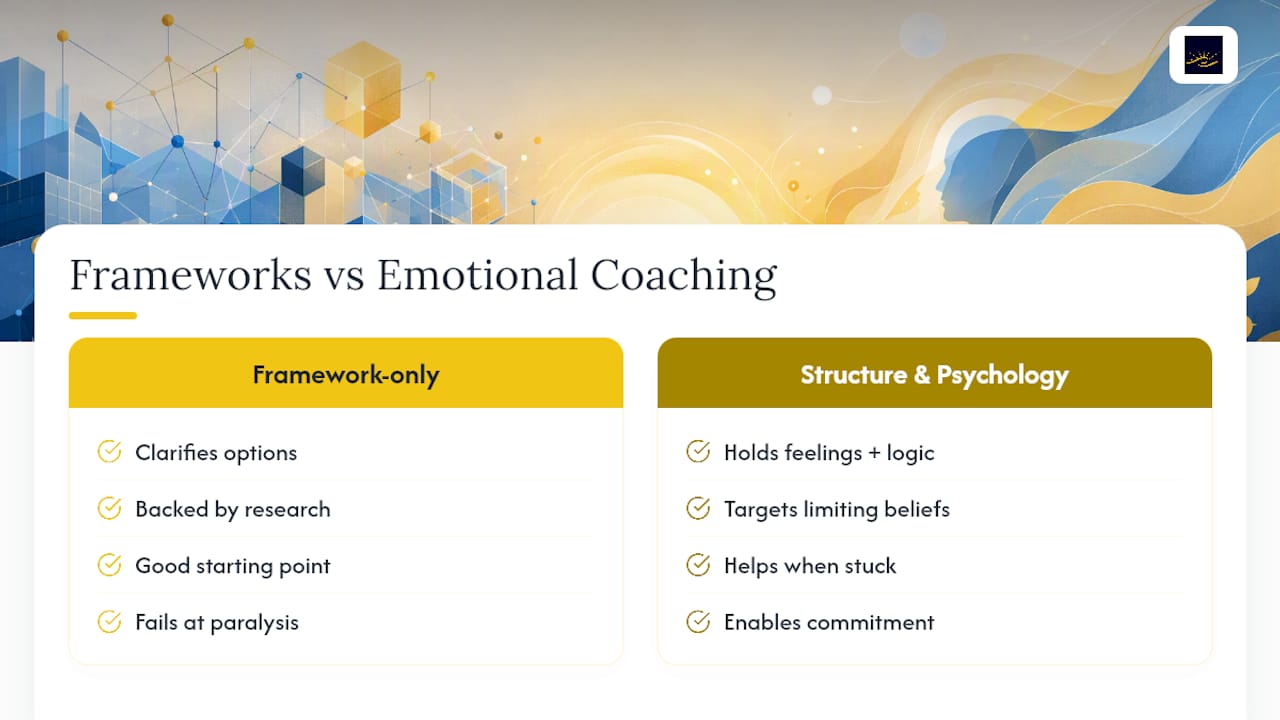
I think the conventional advice fails people at exactly the moment frameworks stop working: when someone has run the 10-10-10 exercise three times and still cannot commit. That is not a framework problem. That is usually a limiting belief wearing a decision-paralysis costume. A pros/cons matrix cannot fix that; it can only reveal that you already knew the answer and were afraid of it.
My take: prioritize the coach who can hold both threads at once, structure and psychology, over one who only offers a clever framework. Frameworks are a starting point. The follow-through is where transformation actually happens.
— Junna Liao
Ready to Stop Circling the Same Decision?
If you have read this far, you are probably not looking for another matrix to fill out. You already have the frameworks. What you need is someone to sit across from you and push past the polished version of your dilemma to the real one underneath it. That is the gap MMDC Alchemy’s coaching engagements are built to close, especially for professionals whose stuck decision is tangled up with burnout, identity, or a career transition.
If your decision centers on a job offer, promotion, or career pivot, career coaching is the direct entry point built for exactly that. If you are navigating a layoff or organizational shakeup, there is a dedicated program for leading yourself through that uncertainty. For a broader look at formats and packages, review the coaching programs overview. The next step is simple: pick a page that matches your situation and book a discovery conversation.
Sources
- How to make decisions (Mind Tools)
- The six principles of leadership coaching (Center for Creative Leadership)
Recommended
This blog is for educational and inspirational purposes only. It is not medical, legal, financial, or mental health advice. Your journey is unique; please seek qualified professional support for decisions that affect your health, finances, or wellbeing.