Short, repeatable mindfulness micro-practices reliably improve an executive’s focus, emotional regulation, and decision quality. Start with this: before your next call, take one breath in for four counts, hold for four, and exhale for six, while naming one thing you see and one thing you hear. That 60-second reset, repeated daily, builds the same attentional muscle the research below documents in far more detail.
TL;DR:
- Short mindfulness practices like breathing resets and sensory check-ins, when performed daily or during transitions, significantly improve executive emotional regulation and focus.
- Attending to specific signals such as repeated distraction, rising frustration, or misaligned actions can help leaders gauge progress in attention, awareness, and authenticity.
- Embedding micro-practices into existing routines and modeling them encourages team adoption without demanding extra calendar space, enhancing organizational consistency.
- Deepening mindfulness skills involves increasing sensitivity to emotional signals and extending pauses, supported by regular accountability rather than merely increasing practice duration.
- Structural issues like toxic work environments or excessive workload limit mindfulness effectiveness, emphasizing the need for support from systemic organizational changes alongside individual practices.
Table of Contents
- Mindfulness for Executives: What the Evidence Actually Shows
- The Three Pillars of Mindful Leadership
- Micro-Practices That Fit Between Meetings
- How to Fit This Into an Already-Full Calendar
- Is It Actually Working? How to Measure the Impact
- Why Executives Struggle to Stick With It
- Mindfulness Versus Other Cognitive Tools for Leaders
- Sustaining the Practice Over Years, Not Weeks
- Bringing Mindfulness Into Corporate Culture Responsibly
- MMDC Alchemy’s Perspective on Applying This in Practice
- When Micro-Practices Aren’t Enough on Their Own
- Sources
Mindfulness for Executives: What the Evidence Actually Shows
The case for mindfulness in leadership isn’t built on wellness slogans. A semi-systematic literature review of mindfulness and leadership research identifies three qualities that mindful leaders consistently develop: attention, awareness, and authenticity. Each links to measurable gains in resilience and decision-making under pressure, which is precisely the terrain executives operate in daily.
Workplace data backs this up outside the lab. A study of Search Inside Yourself, a short, applied corporate mindfulness program, found significant increases in mindfulness and in the “awareness of emotion” component of emotional intelligence just four weeks after the course ended. You don’t need a silent retreat to shift how your brain processes stress. You need a structured, brief program and the discipline to run it.
Statistic Callout: Executive burnout is accelerating. Reporting on rising workplace strain notes that 71% of leaders reported increased stress in 2025, with experts recommending short, recurring practices, exercise, and sleep as the core recovery prescription.
What executives gain from consistent practice:
- Sharper focus during high-stakes meetings and negotiations
- Faster recovery from acute stress spikes
- Better-calibrated decisions under time pressure
- A calmer, more legible presence that steadies teams during volatility
Practitioner analysis in Forbes frames this directly as a competitive advantage. Leaders who can shift from reactive to intentional under duress simply make fewer costly mistakes than those who can’t.
The Three Pillars of Mindful Leadership
Attention, awareness, and authenticity form a usable framework, not just an academic label. Each pillar maps to a specific leadership behavior, and each has a quick signal you can watch for in yourself or your team.
Attention is the capacity to direct and sustain focus deliberately, rather than letting notifications and anxiety hijack it. In practice, it shows up as a leader who finishes one thought in a meeting before jumping to the next fire. Watch for it in how often you catch yourself mid-distraction and return to the conversation without prompting.
Awareness is noticing your internal state (emotions, tension, fatigue) as it happens instead of hours later. An aware executive feels frustration rising during a tense negotiation and names it internally before it leaks into tone. The indicator here: can you identify what you’re feeling right now, without pausing to think about it?
Authenticity means acting from your actual values under pressure rather than defaulting to performance or people-pleasing. It looks like giving hard feedback honestly instead of softening it into vagueness. Track whether your private opinions and your public statements are converging or drifting apart.
- Attention: sustained focus, fewer context-switching errors
- Awareness: faster emotional recognition, less reactive communication
- Authenticity: values-aligned decisions, more trusted feedback
Pro Tip: Pick one pillar per month to track deliberately. Trying to strengthen all three at once usually means none of them stick.
Micro-Practices That Fit Between Meetings
You don’t need 30 minutes of silence to get the benefits. Micro-presence techniques are high-leverage precisely because they fit inside your existing meeting cadence instead of demanding new calendar space.
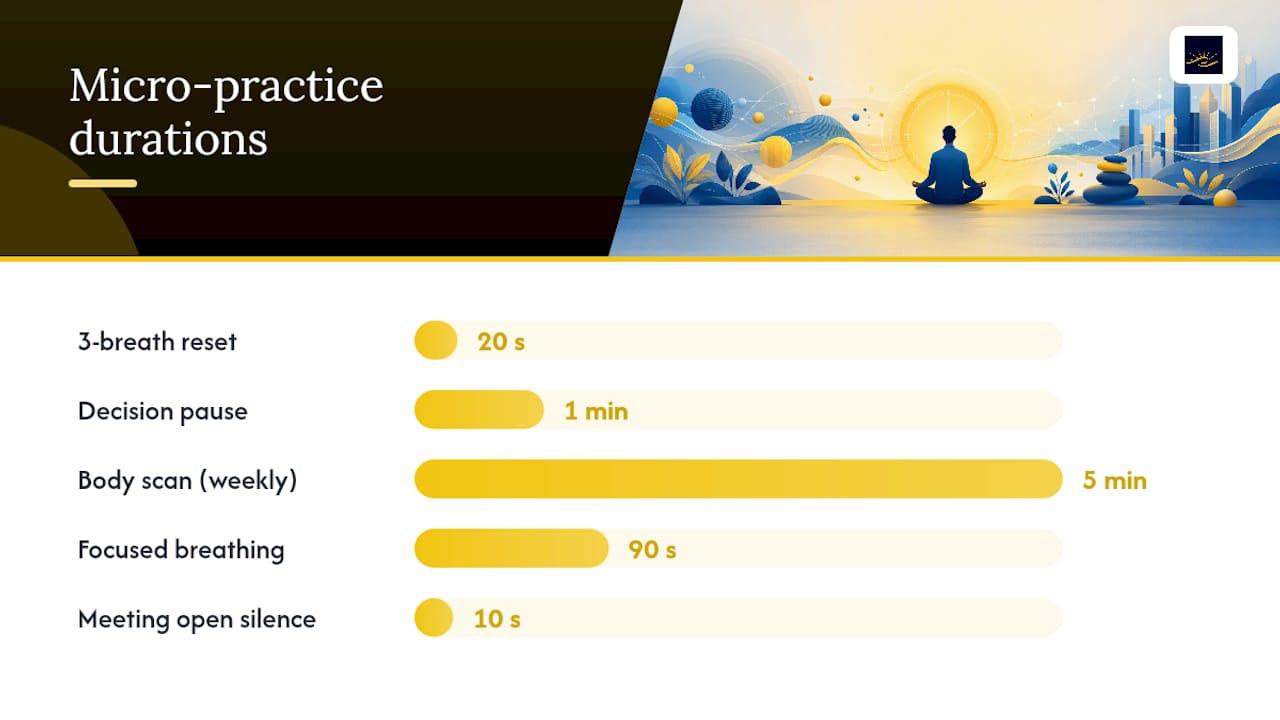
- The 3-breath reset. Before opening your laptop after a call, take three slow breaths. It costs 20 seconds and interrupts the momentum of reactivity.
- The sensory check-in. Name one thing you see, hear, and feel in your body. This pulls attention out of rumination and into the present room.
- The 60-second decision pause. Before sending a charged email or making a snap call, wait one minute. Most bad executive decisions are made in the first surge of adrenaline.
- The abbreviated body scan (5 minutes). Once a week, before a high-stakes decision, scan from head to feet noticing tension. Release what you can.
- Focused breathing before board meetings. Ninety seconds of slow nasal breathing lowers physiological arousal before you need to think clearly under scrutiny.
For meetings specifically, open with 10 seconds of silence before speaking, pause fully before responding to a challenge instead of interrupting, and use visible listening cues (nodding, brief verbal acknowledgment) to signal presence to the room.
Pro Tip: Frequency beats duration. Five one-minute practices scattered through a day outperform one 20-minute session for most executives, because the goal is training a reflex, not achieving a state.
How to Fit This Into an Already-Full Calendar
The habit design problem for executives isn’t motivation, it’s structure. Anchor micro-practices to transitions you already make, rather than adding new blocks to a calendar that’s already overbooked.
A CEO might place a 3-breath reset before every board call and a body scan on Sunday evening before the week’s first strategic review. A VP juggling back-to-back meetings might use the sensory check-in during the 90 seconds walking between conference rooms. A director managing a team through change might build a 60-second pause into the top of every one-on-one, using it to actually listen instead of mentally drafting the next agenda item.
- Attach practices to existing transitions (before calls, after commutes, before sleep)
- Use environmental cues (a sticky note, a calendar block labeled simply “reset”) instead of relying on memory
- Ritualize meeting openings and closings so the team learns the pattern too
If you want your team to adopt similar habits, invite rather than mandate. Model the practice yourself first, and frame it around performance, not wellness culture, so it doesn’t read as a psychological demand. Preserving psychological safety matters more here than compliance.
Is It Actually Working? How to Measure the Impact
Skip the vague sense of “feeling calmer” and look for specific signals instead. Subjectively, track whether you leave meetings with clearer next steps, whether you’re sending fewer reactive messages late at night, and whether direct reports mention you seem more present.
Objectively, three proxies are worth watching:
- Meeting length and decision latency. Do decisions get made faster with less circular discussion?
- Recovery signals. If you track HRV or sleep, note whether stress recovery improves, since physiological research on executives shows workplace stress commonly bleeds into off hours without deliberate boundary-setting.
- Team-reported presence. Ask a trusted colleague, quarterly, whether your reactivity in tense moments has changed.
Statistic Callout: The SIY workplace study recorded measurable shifts in emotional awareness within four weeks. Run your own 30-day mini-experiment: pick two micro-practices, apply them daily, and compare your subjective and objective signals against your first week’s baseline.
Why Executives Struggle to Stick With It
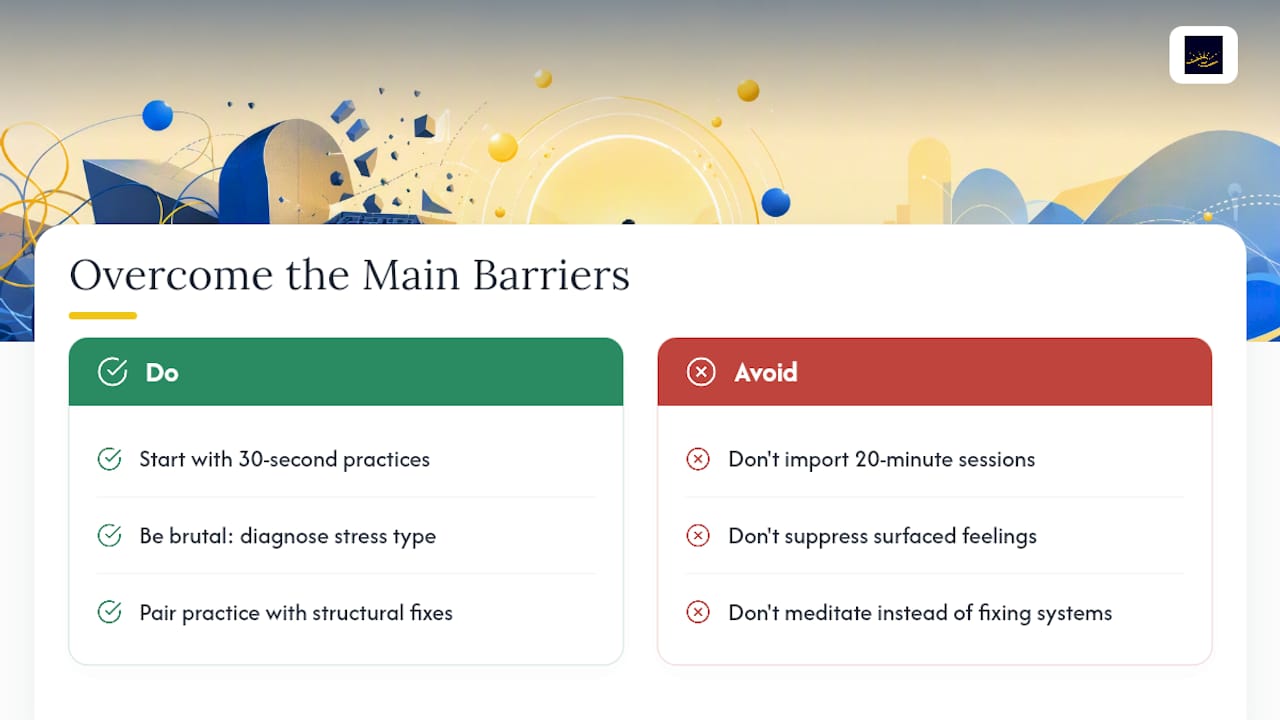
The most common barrier isn’t skepticism about mindfulness, it’s the assumption that it requires time you don’t have. Executives who quit early usually tried to import a 20-minute daily meditation habit into a calendar built for 15-minute meetings back-to-back. It fails within a week, and they conclude the practice doesn’t work for people like them.
A second barrier is emotional discomfort. Awareness practices surface feelings some leaders have spent years learning to suppress in order to project control. This can feel counterproductive at first, even destabilizing, before it becomes clarifying.
A third barrier is misdiagnosing the type of stress you’re facing. Not every pressure point responds to an internal coping tool. The see-sort-solve framework sorts executive stress into categories, schedule, suspense, social, sudden, and system, and argues that some of it needs structural fixes like delegation or process redesign, not another breathing exercise.
The fix for all three barriers is the same: start smaller than feels meaningful. A 30-second practice you actually do beats a 20-minute practice you abandon by Thursday. Pair it with brutal honesty about which stressors are personal versus structural, so you’re not meditating your way around a problem that actually needs an org chart change.
Mindfulness Versus Other Cognitive Tools for Leaders
Executives have plenty of other levers for managing stress and sharpening cognition: exercise, sleep optimization, nootropics, therapy, executive coaching, and structured delegation. Mindfulness doesn’t replace any of these. It complements them, and it’s usually the cheapest and fastest to deploy.
Exercise reliably improves mood and cardiovascular resilience but takes 30 to 60 minutes you may not have mid-workday. Sleep optimization addresses recovery but operates on a 24-hour cycle, not a mid-meeting one. Therapy and coaching provide depth and personalized strategy but happen weekly at best, leaving the other 167 hours uncovered. Mindfulness fills that gap: it’s the only tool on this list you can deploy in the 30 seconds before a tense negotiation starts.
The strongest approach treats these as a stack rather than a menu. CEO interviews on stress management consistently describe combining brief meditation with regular exercise and firm sleep boundaries, not choosing one over the others. Mindfulness is the layer that works in real time, while the others build the underlying capacity it draws on.
Sustaining the Practice Over Years, Not Weeks
Most executives who adopt mindfulness successfully in year one let it fade by year three, not because it stopped working, but because it stopped evolving. A practice that felt novel at 90 seconds a day eventually needs to deepen or it becomes rote, and rote practices are the first thing cut when a crisis hits.
Deepening doesn’t mean adding time. It means increasing precision: noticing subtler emotional signals, extending the pause before reacting from one second to five, or applying the same attention you’ve trained in meetings to harder domains like performance reviews or layoff conversations. Periodically revisiting energy and presence work helps surface where the practice has plateaued.
The other maintenance lever is accountability. Solo practice tends to erode under pressure precisely when you need it most, which is the irony of executive stress. Building in a check-in, whether a peer, a coach, or a quarterly self-audit against the three pillars, catches the drift before it becomes a full lapse. Leaders who sustain the practice longest tend to treat it the way they treat physical fitness: something reviewed and adjusted, not set once and forgotten.
Bringing Mindfulness Into Corporate Culture Responsibly
Rolling mindfulness into a corporate program raises questions that a personal practice doesn’t. The first is consent. Mindfulness touches emotional and sometimes spiritual territory for some employees, and mandating it, even with good intentions, can read as coercive rather than supportive.
The second is cultural fit. Mindfulness has roots in specific contemplative traditions, and secularized corporate versions should acknowledge that lineage rather than presenting the practice as a purely modern management invention. Leaders introducing programs should stay alert to how framing lands across a culturally diverse team, since comfort with introspective practices varies widely by background and personal history.
The third is honesty about limits. Mindfulness helps individuals regulate their response to stress. It does not fix a toxic reporting structure, chronic understaffing, or a culture that punishes boundary-setting. Presenting it as a substitute for structural fixes, rather than a complement to them, risks putting the burden of a systemic problem onto individual employees. The most credible programs are opt-in, transparent about what the practice can and can’t do, and paired with real attention to the working conditions generating the stress in the first place.
MMDC Alchemy’s Perspective on Applying This in Practice
Junna Liao built MMDC Alchemy around a simple observation: executives don’t lack information about what helps. They lack a structure that makes the helpful thing stick under real pressure. Across many client transformations, the pattern repeats: leaders who treat mindfulness as one input into a broader identity and energy shift sustain it far longer than those who treat it as an isolated wellness habit bolted onto an unchanged life.
The integration matters more than the technique itself. A breathing exercise disconnected from a leader’s deeper sense of what they actually want from their career rarely survives the next crisis. Client testimonials and case studies illustrate this pattern across the leaders who have worked with the coaching practice.
— Junna Liao
When Micro-Practices Aren’t Enough on Their Own
Micro-practices change how you respond in the moment. They don’t automatically resolve the identity questions underneath chronic executive stress, the sense that you’ve outgrown your role, or the burnout that’s been building for years despite doing everything “right.” That deeper work is where MMDC Alchemy’s coaching engagements come in.
The coaching practice works with senior leaders navigating burnout recovery, career transitions, and identity shifts, particularly those who’ve already tried the surface-level fixes and know they need something more structural. Engagements typically run several months and combine deep coaching with practical life and career strategy, so the mindfulness habits you build actually connect to a bigger shift rather than sitting isolated on a to-do list. If the challenges and barriers described above sound familiar, explore MMDC Alchemy’s coaching programs or visit the main site to inquire about a coaching engagement built around where you are right now.
Sources
- The mindful leader: a review of leadership qualities derived from mindfulness meditation – PMC
- Executive Clarity: Why Mindfulness Is A CEO’s Competitive Advantage — Forbes
- Executives are burning out, just like their employees—and they don’t know how to handle it — CNBC
Recommended
This blog is for educational and inspirational purposes only. It is not medical, legal, financial, or mental health advice. Your journey is unique; please seek qualified professional support for decisions that affect your health, finances, or wellbeing.