
If you feel misaligned at work, start with a focused self-assessment that identifies whether the problem is the job itself or a poor fit between the role and who you are now. From there, pick one small, low-risk experiment to test a new direction before you make any big moves. The seven-step roadmap below walks through that process from diagnosis to execution.
TL;DR:
- Growth occupations like wind turbine technicians, nurse practitioners, and data scientists offer strong median pay but require careful alignment with personal values and skills.
- Interest in the work enhances job satisfaction more than pay, making realistic entry paths and personal motivation crucial to successful career change.
- Building three to six months of financial runway is essential, with longer periods needed for industry shifts or retraining requirements.
- Testing the new career through low-risk experiments such as freelancing, volunteering, or shadowing helps avoid premature quitting and gathers essential evidence.
- Addressing burnout and identity shifts often requires high-touch coaching and structural support to manage slow, uneven reinvention processes effectively.
Table of Contents
- Assess yourself: values, strengths, and burnout mismatches
- Research target roles and market signals
- Skills audit and gap-closing plan
- Financial plan and timeline scenarios
- Test the waters before you commit
- Rebrand and tell a coherent story
- Execute, collect feedback, and adapt
- When coaching helps: an executive’s approach to reinvention
- Identity, reinvention, and what actually sustains change
- MMDC Alchemy: coaching options and how to start
- FAQ
- Sources
Assess yourself: values, strengths, and burnout mismatches
Before you touch a resume or browse job boards, figure out what is actually broken. Three exercises help: rank your top five values and compare them against how you spend your workweek, track your energy for a week by noting which tasks drain you and which ones give you a lift, and list transferable skills you use outside your job title.
Christina Maslach’s research frames burnout as a response to chronic job stressors, showing up across six mismatch areas: workload, control, reward, community, fairness, and values. Mapping your symptoms to one or two of these areas tells you whether to repair the current role or plan a pivot.
- A workload or control mismatch often responds to boundary-setting or a role change within your company.
- A values or reward mismatch usually signals a deeper misfit that points toward a career change.
- Persistent exhaustion across multiple areas suggests you need recovery before any major decision.
Pro Tip: If you cannot tell whether you are burned out or genuinely misaligned, give yourself two weeks of real rest before deciding anything permanent.
Research target roles and market signals
Once you know what you are solving for, translate your values into real occupations. The Bureau of Labor Statistics offers a useful starting point: current occupational employment projections show wind turbine service technicians among the fastest growing occupations, alongside nurse practitioners and data scientists, each with strong 2024 median pay figures attached.
Growth and pay matter, but they are not the whole picture. Survey evidence on job changers finds that an increase in interest in the work corresponds to a 27 percentage point higher likelihood of reporting the new job as better overall, a stronger predictor than pay alone.
- Pull daily task lists from O*NET and check them against your energy audit.
- Cross-reference growth and pay data with your values ranking.
- Narrow your list to two or three roles with a realistic entry path from where you stand today.
Skills audit and gap-closing plan
Map what you already know against what your target roles actually require. Most professionals overestimate how far they are from a new field once they list transferable skills honestly: project management, stakeholder communication, data interpretation, and process design show up in far more job descriptions than people expect.
- List every skill your current role requires, then mark which ones also appear in your target role postings.
- Separate the gaps into must-have skills (ones listed in nearly every posting) and nice-to-have skills (ones mentioned occasionally).
- Close must-have gaps first through the cheapest viable route: a short course, a certificate, a mentor, or a small volunteer project.
- Treat nice-to-have gaps as ongoing learning rather than blockers to applying.
Pairing a core skill with an adjacent one, sometimes called skill stacking, can make you a stronger candidate than chasing a brand-new credential from scratch, according to guidance on the approach.
Financial plan and timeline scenarios
Money is usually the real constraint on a career change, not ambition. A common rule of thumb is to build three to six months of runway before leaving a stable paycheck, longer if you are retraining for a field with a formal certification or degree requirement.
Budget for three categories: training or certification costs, a temporary income gap if you reduce hours to study or network, and a buffer for the job search itself, which frequently runs longer than expected.
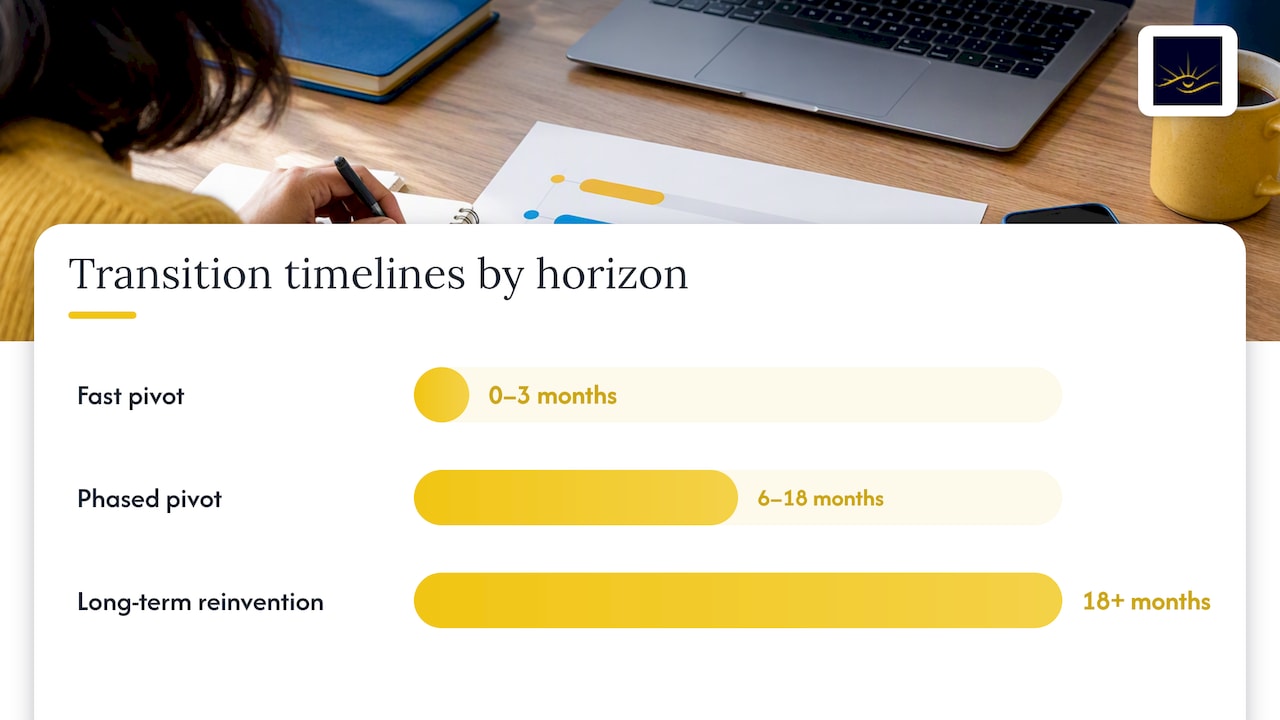
- Fast pivot (0 to 3 months): you have transferable skills and just need positioning and outreach.
- Phased pivot (6 to 18 months): you need a credential or a track record built through side projects.
- Long-term reinvention (18 months or more): you are shifting industries entirely and need structured study.
Interest in the work is one of the strongest predictors of reporting a better job after a change, according to survey evidence from job changers, which is worth weighing against pay alone when you set your financial triggers for moving forward.
Test the waters before you commit
Do not quit before you know the new path fits. Low-risk experiments let you gather real evidence instead of guessing.
- Take on a freelance project in the target field for a defined period, with one clear deliverable.
- Volunteer for a nonprofit or community group doing work close to your target role.
- Shadow someone in the role for a day or ask for a working session rather than a generic chat.
- Run three to five informational interviews and ask specifically about the parts of the job that drain or energize people.
Give each experiment a time box and a defined question to answer, then set a rule in advance for what counts as enough evidence to scale up or walk away, a practice reinvention guidance describes as a core part of structured, iterative reinvention.
Pro Tip: Write down your hypothesis before the experiment starts, not after, so you cannot rationalize a bad result.
Rebrand and tell a coherent story
Your resume and LinkedIn need to answer one question fast: why does your background make sense for this new direction? A simple narrative structure works well: state the context you came from, name the transferable impact you created, then point to a proof project that shows you can do the new work.
- Rewrite your resume summary around outcomes in the target field, not your old job title.
- Swap generic duty-based bullets for results framed in the new field’s language.
- Add a portfolio section or case study page showing one or two proof projects.
- Update your LinkedIn headline to reflect where you are going, not just where you have been.
If you are using AI tools to speed up drafting your materials, keep the final narrative honest and specific to your own experience rather than generic, a distinction guidance on ethical AI use in career tools calls out as important for authentic positioning.
Execute, collect feedback, and adapt
A career transformation needs a rhythm, not just a plan. Set a weekly routine: one networking touchpoint, one hour of skill-building, one application or pitch, and ten minutes of reflection on what worked.
- Treat rejection and silence as data, not verdicts, and look for patterns across multiple attempts before changing your approach.
- Weigh feedback that comes from people actually doing the target job more heavily than generic advice.
- If three or more signals point the same direction, whether toward a pivot or away from it, trust the pattern over a single data point.
Pro Tip: Review your experiment results monthly, not daily, so you have enough signal to act on.
If exhaustion or self-doubt start to outweigh momentum, that is often the point where outside support, through coaching or a structured recovery period, makes the difference between stalling and moving forward.
When coaching helps: an executive’s approach to reinvention
Burnout tends to erode the very judgment you need for a career change, an effect described in research linking burnout to lowered perceived marketability and weaker career decision-making. That is often when structured coaching accelerates a safer pivot instead of a reactive one.
Executive coach Junna Liao founded MMDC Alchemy to address the gap between knowing something is wrong and having a concrete plan to fix it. Our coaching combines deep identity work with practical career strategy, helping clients achieve meaningful transformations.
- Coaching helps most when burnout, identity confusion, or high stakes make solo decision-making risky.
- A structured assessment, like our Energy Leadership Index, can clarify values and energy patterns before you choose a direction.
- High-touch support works well for leaders managing a pivot alongside existing responsibilities, including involuntary transitions like layoffs.
Identity, reinvention, and what actually sustains change
Career transformation is rarely just a logistics problem. Most of the professionals I work with discover that the hardest part is not finding a new job title but letting go of an old identity that no longer fits who they have become. Expect the process to feel slower and more uneven than a checklist suggests, because real reinvention asks you to rebuild your sense of self alongside your resume.
— Junna Liao
MMDC Alchemy: coaching options and how to start
Mid-to-senior professionals and leaders carrying a demanding role rarely have the bandwidth to navigate burnout, identity shifts, and a career pivot alone, and that is exactly who our coaching is built for.

A first engagement typically starts with a conversation about where you are stuck and what stability or momentum would look like, followed by a tailored plan that combines deep coaching with concrete career strategy. If you are ready for guided, high-touch support rather than figuring it out solo, explore 1:1 career coaching with Junna and book a first conversation.
FAQ
What is the happiest job, according to research?
There is no single agreed-upon “happiest job,” since satisfaction depends heavily on individual fit between a role and a person’s values and energy. Research on job changers suggests interest in the work predicts satisfaction more strongly than job title or pay, so the better question is which roles align with your own interests and strengths.
What are signs it’s time to change jobs?
Common signs include chronic exhaustion, a persistent values mismatch, feeling disconnected from the work’s purpose, dreading routine tasks, lack of growth, unfair treatment, and a sense that your strengths go unused. Mapping these against Maslach’s six burnout mismatch areas, workload, control, reward, community, fairness, and values, helps clarify whether the fix is role repair or a full change.
What jobs pay well without a four-year degree?
Several fast-growing occupations tracked by the Bureau of Labor Statistics, such as wind turbine service technicians, do not require a four-year degree and still offer strong growth and pay potential. Specific income levels vary widely by location, experience, and employer, so research the current median pay for any role before relying on a general income claim.
Which jobs are expected to stay in demand after 2030?
Current BLS projections point to continued strong growth in occupations like nurse practitioners and data scientists, reflecting demand tied to health care needs and data-driven decision-making across industries. Long-range forecasts carry uncertainty, so pair any projection with your own research into local demand and entry requirements.
How long does a career transformation usually take?
Timelines vary widely: a fast pivot built on existing transferable skills can take a few months, while a full industry change requiring new credentials often takes a year and a half or more. Building in a financial runway, commonly three to six months of expenses, and testing your direction through small experiments first helps you move at a pace that matches your actual readiness.
Sources
- Industry and occupational employment projections overview (BLS, 2026)
- What makes a job better? Survey evidence from job changers (BLS Monthly Labor Review, 2026)
- Burnout (APA podcast / Christina Maslach)
- How to reinvent yourself (Southern New Hampshire University, 2025)
Recommended
This blog is for educational and inspirational purposes only. It is not medical, legal, financial, or mental health advice. Your journey is unique; please seek qualified professional support for decisions that affect your health, finances, or wellbeing.