
Transformational coaching is a development approach that targets a person’s identity, core beliefs, and mental frameworks rather than just their skills, aiming for durable shifts in mindset and behavior. It draws on transformative learning theory and aligns with updated ICF core competencies, which frame coaching as a partnership that evokes awareness rather than hands out advice. The goal is change that holds, not a temporary boost in performance.
TL;DR:
- Transformational coaching typically lasts several months, focusing on reshaping core beliefs and identities through reflection, experimentation, and accountability.
- It is most effective for clients at inflection points, such as career transitions, burnout recovery, or identity shifts, especially when practical fixes have failed.
- The approach is grounded in transformative learning theory, which emphasizes disorienting dilemmas, critical reflection, and rational dialogue to produce durable change.
- Coaches trained under ICF standards and with a focus on deep reflection and assumption excavation are best suited to practice this method.
- It is not a substitute for therapy, and clients with clinical mental health issues need licensed professional support instead.
Table of Contents
- What transformational coaching looks like in practice
- The theory behind why this works
- How transformational coaching differs from therapy and consulting
- What a transformational coach actually does in sessions
- Who this type of coaching actually helps
- What to realistically expect and when
- How MMDC Alchemy practices transformational coaching
- Where transformational coaching came from
- What qualifies someone to practice this kind of coaching
- Where transformational coaching runs into limits
- What successful transformational coaching looks like in practice
- How transformational coaching fits with other approaches
- When this kind of coaching is worth the investment
- How MMDC Alchemy can support your next step
- Sources
- FAQ
What transformational coaching looks like in practice
Incremental coaching helps someone get better at a specific skill: public speaking, delegation, time management. Transformational coaching asks a different question: what belief or self-concept is producing the pattern in the first place? A leader who avoids conflict, for example, might work for months on communication scripts without change, because the real driver is an old belief that disagreement equals rejection. Transformational work goes after that belief directly.
Engagements typically run over several months, often with sessions spaced approximately every one to two weeks and structured reflection between them. Clients usually leave sessions with something to sit with: a journaling prompt, a conversation to try differently, a pattern to notice in real time.
A few features distinguish this kind of coaching from lighter-touch development work:
- Identity work: sessions explore who the client believes they are, not only what they want to achieve.
- Assumption excavation: the coach helps surface beliefs the client has never examined because they seemed like fact.
- Meaning-making: clients reinterpret past experiences, which changes how those experiences shape present decisions.
- Sustained accountability: change is tracked across the full engagement, not just within a single session.
The pace is slower than skills coaching, but the changes tend to generalize across a client’s career and personal life rather than staying confined to one behavior.
The theory behind why this works
The clearest explanation for how transformational coaching produces lasting change comes from Transformative Learning Theory, developed by Jack Mezirow and expanded since. The model describes three linked phases: a disorienting dilemma (an experience that does not fit a person’s existing worldview), critical reflection on the assumptions that dilemma exposes, and rational dialogue that tests and revises those assumptions with another person, as WGU’s overview of the theory explains. A skilled coach does not manufacture crisis. Instead, they design small, low-risk experiments that surface a client’s hidden assumptions without destabilizing them, then hold space for the reflection that follows.
This matters because insight alone rarely changes behavior. What makes the shift durable is the reinterpretation of meaning: once a client sees an old belief as a choice rather than a fact, they gain room to choose differently, and that new choice tends to repeat itself without ongoing coaching support.
A 2026 meta-synthesis of 35 peer-reviewed studies covering healthcare, education, executive leadership, and sport found that transformational coaching consistently activates reflective meaning-making and supports intentional behavior change across sectors. That range matters: the mechanism is not specific to one industry or job type.
The same body of research describes these engagements as typically unfolding over months, combining structured reflection with behavioral experiments and accountability, which is what connects a moment of insight to a lasting change in how someone leads or lives.
- Disorienting dilemma opens the door to questioning an assumption.
- Critical reflection examines where that assumption came from.
- Rational dialogue with a coach tests whether the assumption still serves the client.
How transformational coaching differs from therapy and consulting
The three professions share a surface resemblance (structured conversations aimed at change) but differ sharply in role and scope. ICF’s competency model describes coaching as a partnership that expands a client’s own capacity, distinct from consulting’s prescriptive stance and therapy’s clinical mandate.
- Coaching partners with a client to help them find their own answers; the coach rarely tells the client what to do.
- Consulting diagnoses a problem and prescribes a solution, often without requiring the client to change internally.
- Therapy addresses clinical diagnosis and treatment, working with mental health conditions that fall outside a coach’s scope.
A leader stuck in a pattern of overcommitting because of a belief that saying no makes them replaceable is a strong fit for transformational coaching. Someone needing a new financial reporting system is better served by a consultant. Someone experiencing clinical depression needs a licensed therapist, not a coach. Choosing the right support type matters more than any single technique.
What a transformational coach actually does in sessions
Session work centers on a small set of techniques, used deliberately rather than as a fixed script. Powerful questioning opens space rather than steering the client toward an answer. Disciplined silence gives the client room to sit with discomfort instead of rushing to resolve it. Assumption excavation helps a client trace a belief back to its source. Somatic noticing brings attention to what the body registers before the mind has language for it. Metaphor often surfaces an insight faster than direct analysis.
A typical arc looks like this:
- The coach asks a question designed to surface an unexamined belief.
- The client notices resistance, discomfort, or a strong reaction, which is often the signal that a real assumption has been touched.
- The coach holds silence rather than filling the gap, letting the client reach their own articulation.
- The pair design a small real-world experiment to test the belief outside the session.
- The client reports back, and the coach helps them extract the meaning from what happened.
Pro Tip: Notice which questions from a coach make you want to change the subject. Those are usually the ones worth sitting with longer.
Progress is tracked less by checklist and more by shifts in language, decision patterns, and how a client describes themselves over time, which lines up with the ICF’s emphasis on evoking awareness as a core competency rather than giving answers. Coaches trained in surfacing limiting beliefs often build this measurement directly into how they design each session.
Who this type of coaching actually helps
Transformational coaching tends to draw people at inflection points rather than those looking for a quick performance fix. Common profiles include:
- Executives and senior leaders whose old strategies for success have stopped working as their role has grown.
- High performers facing burnout after years of pushing through without examining why.
- People navigating career transitions, including layoffs, industry changes, or a pull toward work that feels more aligned.
- Professionals experiencing identity shifts, such as a promotion, a return from parental leave, or a major life change that reshapes how they see themselves.
The clearest signal of readiness is a pattern that keeps recurring despite the person’s best efforts to fix it through willpower or new tactics alone. If someone has already tried the practical fixes and the same issue resurfaces in a new form, that is usually a sign the driver is identity-level rather than skill-level, which is where executive coaching for high performers tends to add the most value.
What to realistically expect and when
Most transformational coaching engagements run several months, often structured in phases: an early period of surfacing patterns and assumptions, a middle stretch of experimentation and discomfort, and a later phase where new ways of thinking start to feel automatic rather than effortful.
Early wins are often situational: a hard conversation handled differently, a moment of pausing instead of reacting. The deeper identity shift, the kind that changes how someone approaches their career or relationships by default, tends to show up later and requires ongoing practice to hold. Coaches typically build in reflection habits designed to outlast the engagement itself.
Pace and depth vary with how ready the client is to sit with discomfort, how much support exists around them outside sessions, and how entrenched the pattern being addressed has become. A newer pattern tied to a recent role change often shifts faster than one rooted in decades of professional habit.
How MMDC Alchemy practices transformational coaching
A coaching practice combines deep transformational coaching with practical life strategy, working with leaders and high achievers navigating burnout, career transitions, and identity shifts. The practice offers 1:1 career coaching and life coaching, along with the Energy Leadership Index assessment as a diagnostic starting point for clients who want a clearer read on their current patterns before engaging.
The practice reports numerous successful client transformations, with participants often describing revitalized careers and breakthroughs from limiting beliefs. The approach mirrors the theory covered earlier: surfacing assumptions, sitting with discomfort rather than rushing past it, and connecting insight to action outside the session, consistent with the reflective, awareness-evoking stance the ICF competency model describes.
Where transformational coaching came from
Transformational coaching grew out of adult education research rather than the business world. Its theoretical backbone traces to Jack Mezirow’s work on transformative learning in the 1970s, which studied how adults, particularly women returning to education after time away, revised deeply held assumptions about themselves and their capabilities. Mezirow’s framework of disorienting dilemma, critical reflection, and rational dialogue gave later practitioners a structured way to understand how adults change their minds about themselves, not just their skills.
Coaching as a distinct profession developed alongside this research through the 1980s and 1990s, drawing also from humanistic psychology, adult development theory, and organizational leadership practice. As executive coaching matured into a recognized field, some practitioners noticed that clients who only worked on tactics and skills often reverted to old patterns once the pressure that prompted coaching passed. That gap pushed a subset of the coaching field toward the deeper, identity-level work that transformative learning theory had already mapped out academically.
The founding of professional bodies, including what became the International Coaching Federation, helped formalize standards across the coaching field generally, and those standards now shape how transformational coaching is practiced and credentialed today. The result is a discipline with academic roots in education research and practical roots in decades of coaching practice, now converging on a shared set of methods.
What qualifies someone to practice this kind of coaching
There is no single license required to call oneself a transformational coach, which makes credentials and training the clearest signal of quality. The ICF’s core competency framework sets the closest thing to an industry standard, outlining specific skills coaches are expected to demonstrate: establishing trust, maintaining coaching presence, evoking awareness, and facilitating client growth among them. Credentialed coaches typically complete a training program accredited against this framework and log supervised coaching hours before earning a credential.
Beyond the credential itself, the qualities that matter most in transformational work are harder to certify directly. A coach needs the discipline to stay quiet when a client is working through discomfort, rather than filling silence with advice. They need enough self-awareness of their own biases to avoid projecting their own assumptions onto a client’s situation. And they need training in how to design the kind of low-risk experiment that opens a disorienting dilemma without causing real harm.
Given the lack of a single licensing body, readers evaluating a coach are generally better served by asking about specific training, credentialing body, and the structure of past engagements than by titles alone. A coach’s own track record and the depth of their intake process often tell you more than the certificate on the wall.
Where transformational coaching runs into limits
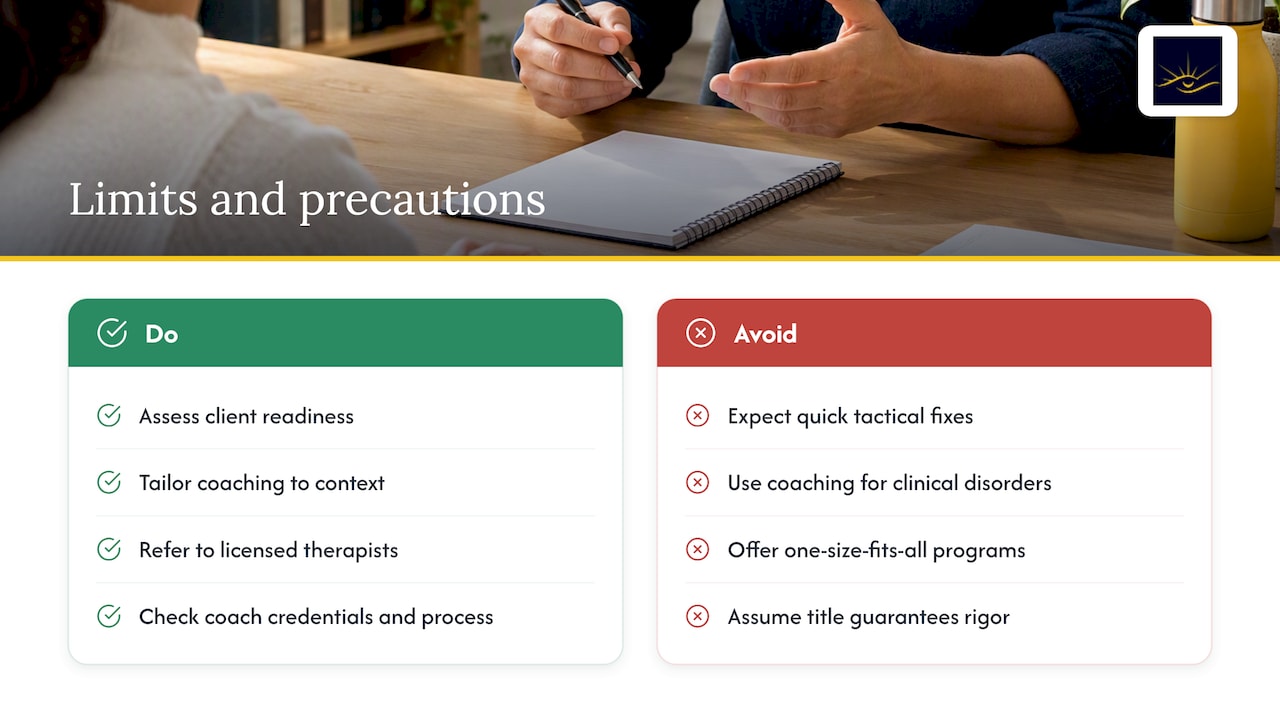
The approach is not a fit for every problem or every person. Because it works by surfacing and revising deep beliefs, it demands more time and more emotional tolerance for discomfort than skills-based coaching, and clients who want a fast, purely tactical fix often find the pace frustrating. A multi-month engagement is also a bigger investment of time and money than a single workshop or a short-term consulting engagement.
The approach has clear limits around clinical mental health. Transformational coaching is not therapy, and a client working through trauma, clinical depression, or another diagnosable condition needs a licensed therapist rather than a coach, regardless of how skilled that coach is at facilitating reflection. Reputable coaches recognize this boundary and refer out when a client’s needs cross into clinical territory.
Results also depend heavily on client readiness. Someone who is not genuinely willing to question long-held assumptions will get limited value even from a highly skilled coach, since the method relies on the client doing real reflective work between sessions, not just showing up. The meta-synthesis research notes that mechanisms behind transformational coaching appear consistent across sectors, but implementation still needs to be tailored to the client’s specific context, which means a generic, one-size-fits-all program tends to underperform compared with individualized work.
Finally, because there is no single licensing requirement, the field includes a wide range of training quality, and readers need to evaluate a coach’s credentials and process carefully rather than assuming the title alone guarantees rigor.
What successful transformational coaching looks like in practice
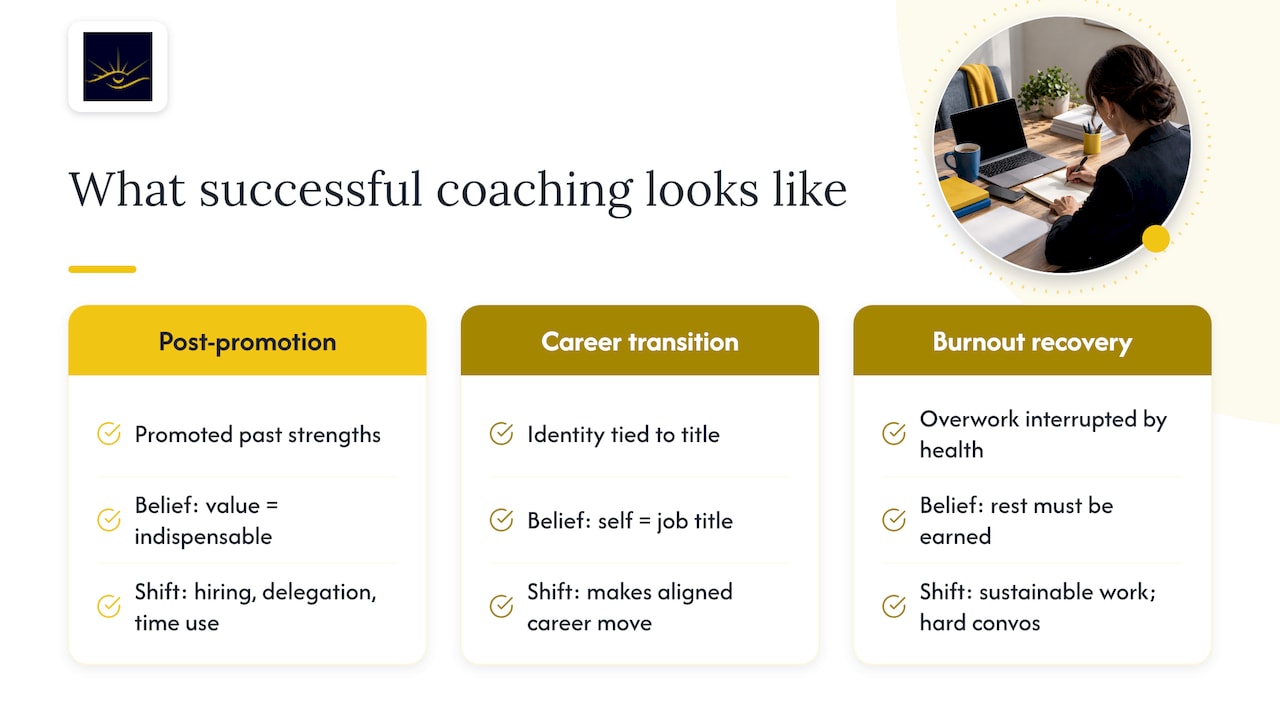
The clearest examples of successful transformational coaching share a common shape: a client stuck in a recurring pattern, a period of surfacing the belief driving that pattern, and a shift that shows up in decisions rather than just in how the client talks about their goals.
A common scenario involves a senior leader who has been promoted past the point where their original strengths still serve them. Someone who built a career on being the most hands-on person in the room can struggle badly once their job requires delegation and trust in others, and the block is rarely a skills gap. It is usually a belief that their value depends on being indispensable. Coaching that surfaces and revises that belief tends to produce a shift that shows up in hiring, delegation, and how the leader spends their time, not just in a self-assessment score.
Career transitions provide another common pattern. Someone leaving a stable, high-status role for work that feels more aligned often carries an unexamined belief that their identity is tied to their title or employer. The coaching work in these cases usually centers on separating self-worth from job title, which then frees the person to make the career move without the identity crisis that would otherwise accompany it.
Burnout recovery follows a related arc, but the disorienting dilemma is often forced by the body rather than chosen: exhaustion or a health scare interrupts a pattern of overwork tied to a belief that rest has to be earned. Coaching in these cases tends to focus on rebuilding a sustainable relationship with work that survives past the initial recovery period, which is where coaching for difficult workplace conversations often becomes part of the practical work alongside the identity-level reflection.
How transformational coaching fits with other approaches
Transformational coaching rarely operates in isolation, and it tends to work well alongside other modalities rather than replacing them outright. Many practitioners layer in tools from adjacent fields: somatic and presence-based practices that bring attention to what the body registers during a stressful decision, mindfulness techniques that build the capacity to sit with discomfort long enough for reflection to happen, and structured assessments that give a client an early, concrete read on their current patterns before deeper work begins.
The Energy Leadership Index assessment, for example, is often used at the start of an engagement to give both coach and client a shared language for the client’s current outlook before the harder identity work begins. Similarly, mindful leadership practices that build presence and body awareness pair naturally with the assumption excavation work central to transformative learning theory, since many limiting beliefs first show up as a physical tightness or resistance before a client can articulate them in words.
Organizational supports matter too. A leader doing transformational work alone, without any change in their environment, may find that old triggers at work keep reactivating old patterns. Coaches often recommend combining individual coaching with structural changes at work, such as a shift in role scope or reporting lines, when the environment itself is part of what is keeping a pattern alive. The strongest engagements tend to treat coaching as one piece of a broader change, not a stand-alone fix.
When this kind of coaching is worth the investment
I recommend transformational coaching when someone is facing a real identity or career shift, or when the same problem keeps resurfacing despite genuine effort to fix it directly. It demands real commitment: showing up between sessions, tolerating discomfort, and staying accountable to the reflection work, ideally alongside organizational support when a work environment is part of the pattern. If that sounds right, a discovery conversation or an initial assessment is a low-risk way to find out.
— Junna Liao
How MMDC Alchemy can support your next step
MMDC Alchemy works with leaders and high achievers navigating exactly the kind of identity-level change described throughout this article, combining deep transformational coaching with practical, actionable life strategy rather than leaving clients with insight alone.

If a persistent pattern at work is the main obstacle, 1:1 Career Coaching with Junna is built for exactly that kind of stuck point, whether it shows up as burnout, a stalled leadership transition, or a career move that feels overdue. If the shift feels broader than career, touching identity, relationships, or how someone wants to spend their time generally, Life Coaching with Junna addresses that wider scope directly.
For readers who want a starting point before committing to a full engagement, the Energy Leadership Index assessment offers a concrete read on current patterns and outlook, which many clients use as the first step before deeper coaching work begins.
- Career Coaching: for leaders stuck in a recurring professional pattern or facing a transition.
- Life Coaching: for broader identity or life-direction shifts beyond the workplace.
- E.L.I. Assessment: a diagnostic starting point for readers who want clarity before committing to coaching.
A first conversation is typically a low-pressure exploration of what is not working and whether this approach fits. Explore MMDC Alchemy’s coaching programs to find the right starting point for your situation.
Sources
For deeper reading beyond this article, the meta-synthesis of transformational coaching research, the ICF core competencies, and WGU’s summary of transformative learning theory cover the strongest evidence cited above. For a broader, international view on coaching definitions and training, Didier Tixador Formations’ coaching resources offer additional context.
- Global Perspectives on Transformative Coaching: A Meta-Synthesis of Practices and Outcomes Across Diverse Fields
- What is transformative learning theory? — WGU
FAQ
What is the simplest definition of transformational coaching?
Transformational coaching is a coaching approach that targets a person’s core beliefs and identity rather than just their skills, aiming for lasting shifts in mindset and behavior. It is grounded in transformative learning theory, which describes change happening through a disorienting dilemma, critical reflection, and dialogue.
How is transformational coaching different from regular life coaching?
Regular or incremental coaching typically focuses on building a specific skill or reaching a defined goal, while transformational coaching addresses the underlying belief or identity pattern driving a recurring issue. The two are not mutually exclusive, and many engagements blend goal-focused work with deeper identity-level reflection as needed.
How long does transformational coaching usually take to show results?
Most engagements run several months, with early situational wins appearing sooner and deeper identity shifts developing gradually as new patterns become automatic. The research on transformational coaching describes these engagements as multi-month by design, combining reflection with real-world experiments over time.
Is transformational coaching a substitute for therapy?
No. Transformational coaching is not therapy and does not address clinical diagnosis or treatment, which remain within the scope of licensed mental health professionals. Coaching partners with clients to expand their own capacity, while therapy addresses conditions that require clinical care.
Recommended
- Executive Coaching for High Performers: Mastering the Alchemy of Leadership
- Mindful Leadership Coaching: Mastering the Alchemy of Presence and Energy
This blog is for educational and inspirational purposes only. It is not medical, legal, financial, or mental health advice. Your journey is unique; please seek qualified professional support for decisions that affect your health, finances, or wellbeing.