
Executive coaching commonly produces measurable personal returns: sharper resilience, reduced burnout, faster goal attainment, and for many clients, a real shot at promotion or a salary increase. Financial payoff is not guaranteed and varies by person, role, and how the engagement is run. The fastest way to know your own likely return is to run the calculation in the section below before you sign anything.
TL;DR:
- Coaching can lead to improved performance behaviors like delegation and decision-making, often showing results within a few months of consistent effort.
- Financial gains such as promotions or raises typically take six months to over a year, influenced by external timing and organizational factors.
- Calculating ROI should include coaching costs, time invested, and the probability of benefits, with emphasis on both financial and non-financial improvements.
- Stronger coaching outcomes are linked to the quality of the coach-client relationship, which explains most of the positive effects observed in research.
- Individual ROI is subjective and uncertain; using probability-weighted estimates and tracking progress with assessments offers a more reliable evaluation.
Table of Contents
- What kind of return should you actually expect?
- How do you calculate your own coaching ROI?
- What does the research actually show, and where does it fall short?
- How do you raise the odds that coaching pays off for you?
- Does coaching pay off for organizations too, and how would you know?
- Why is executive coaching ROI so hard to pin down, and what should you do about it?
- How does coaching compare with other leadership development options?
- What do real ROI calculations look like in practice?
- What patterns show up across hundreds of coaching engagements?
- How MMDC Alchemy helps you track and grow your return
- Sources
- FAQ
What kind of return should you actually expect?
Individual coaching returns fall into two buckets: things you can bank and things you can feel. Both matter, and treating only the financial side as “real” ROI undercounts what most clients actually get.
- Career and compensation: promotions, raises, or a role change that better fits your skills and values.
- Performance behaviors: better delegation, clearer communication, stronger decision-making under pressure.
- Resilience and self-efficacy: a stronger sense that you can handle setbacks without spiraling.
- Burnout reduction: fewer symptoms of exhaustion and cynicism tied to work.
- Life satisfaction: better alignment between your job and the rest of your life.
A meta-analysis of coaching outcomes found a moderate overall effect, with the largest gains showing up in behavior change rather than attitudes or personality traits, according to a systematic meta-analysis reporting coaching effectiveness across outcome types. That matters for expectations: if your goal is a concrete behavior shift such as delegating better or negotiating more directly, coaching tends to move the needle faster than if your goal is a vaguer attitude shift like “feeling more confident.”
Timelines vary by category. Behavioral changes often show up within a few months of consistent work. Financial outcomes like a promotion or raise typically take longer, often six months to over a year, since they depend on hiring cycles, budget timing, and factors outside your control. Program length itself is a weaker predictor of results than session count once you cross a baseline threshold, so a longer package is not automatically a better one.
How do you calculate your own coaching ROI?
Treat this like any other investment decision: total the costs, estimate the probability-weighted benefits, and compare.
Costs to count:
- The coaching fee itself, for whatever package length you choose.
- Your paid time in sessions and prep, valued at your hourly rate.
- Opportunity cost of attention diverted from other priorities during the engagement.
Benefits to estimate:
- Probability of a promotion or raise within 12 to 18 months, multiplied by the expected dollar value.
- A conservative annualized dollar proxy for non-financial gains such as reduced burnout, since conservative annualized values, such as several thousand dollars saved per person year for reduced burnout in healthcare settings, give a defensible lower bound, per a randomized clinical trial on coaching and physician burnout.
- Any measurable wellbeing or job-satisfaction gain, scored qualitatively if you cannot monetize it.
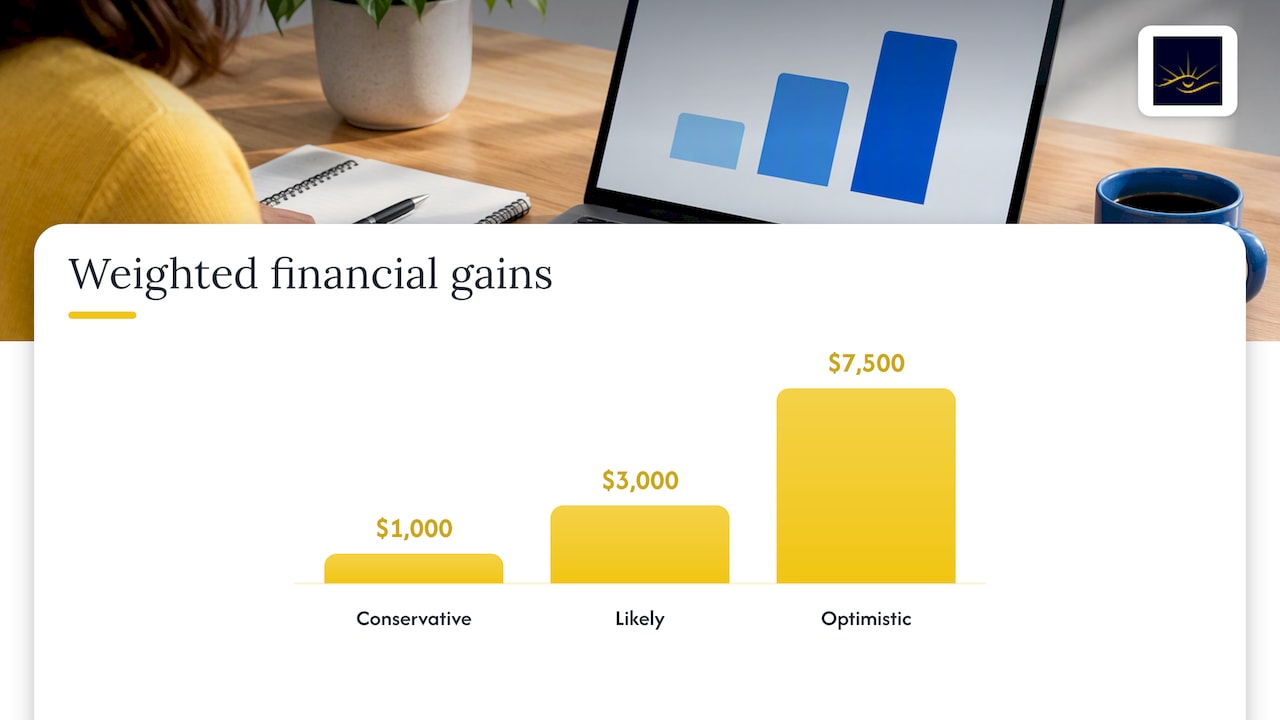
Here is a worked example using illustrative numbers, not market averages: say your coaching package costs $6,000 over six months, and you value your session time at $2,000, for a total cost of $8,000.
| Scenario | Promotion probability | Value if promoted | Weighted financial gain | Net ROI |
|---|---|---|---|---|
| Conservative | 10% | $10,000 raise | $1,000 | negative $7,000 |
| Likely | 30% | $10,000 raise | $3,000 | negative $5,000 |
| Optimistic | 50% | $15,000 raise | $7,500 | negative $500 |
Even the optimistic scenario shows a negative pure financial return in year one, which is normal: frameworks for measuring return on investment, as described in a practical guide to measuring ROI, stress that early-stage investments often show a lag before financial gains catch up. Add the burnout-reduction proxy and a client in a high-stress role can turn that negative into a positive within the same year.
Pro Tip: Run the calculation twice, once counting only financial gains and once adding your non-financial proxies. If the second number turns positive and the first doesn’t, you’re valuing coaching correctly.
What does the research actually show, and where does it fall short?
The strongest evidence for personal coaching ROI comes from randomized and near-randomized studies, not testimonials.
- A near-randomized field trial in a large corporate setting found effect sizes up to d = 1.1 and identified the coach-client working alliance as the primary driver of outcomes, per a near-randomized controlled trial in a field setting.
- A systematic review found that while coaching affects leadership behavior and wellbeing, precise financial ROI is difficult to calculate because of attribution problems and inconsistent methods across studies, according to a systematic review of coaching as a developmental intervention.
- The same review flagged that some organizational ROI claims report figures as high as 600 to 700%, numbers the review’s authors describe as subjective and hard to trust.
- A randomized clinical trial found one-on-one coaching produced a meaningful absolute reduction in burnout, with small-group coaching producing an even larger reduction, and cited trial costs of $400 to $1,000 per participant depending on modality, per the same Springer Nature trial.
The honest limitation here: these studies measure averages across groups, not your specific outcome, and sample sizes in coaching research tend to be small. What shows up consistently across the literature is that the strength of the working relationship between coach and client predicts more of the outcome variance than the specific technique used. That is worth weighing more heavily than brand claims or session counts when you choose a coach.
How do you raise the odds that coaching pays off for you?
Coaching ROI is not passive. The client’s own behavior between sessions is one of the biggest levers on outcome quality.
Before you start:
- Set two or three measurable goals with explicit success criteria, not just “get better at leadership.”
- Agree on a timeline and how you will judge progress at the midpoint and end.
During the engagement:
- Commit to homework between sessions. Insight without practice rarely changes behavior.
- Use a structured assessment, such as the Energy Leadership™ Index (E.L.I.) Assessment, to baseline your current state and measure movement over time.
- Schedule milestone reviews at roughly the one-third and two-thirds marks of your package.
Accountability that works:
- Keep a short journal of decisions and behaviors you’re trying to change.
- Ask a manager, peer, or mentor for informal feedback at the midpoint.
- Tie at least one goal to a concrete, checkable outcome, like completing a specific project or having a specific difficult conversation.
If three or four sessions in you cannot describe what has changed, ask your coach directly for a progress review. A coach who cannot show you movement against your original goals is a signal to reassess the engagement, not push through it.
Does coaching pay off for organizations too, and how would you know?
Individual ROI and organizational ROI are related but not the same measurement, and conflating them is where a lot of confusion starts. An individual’s improved resilience or promotion is a personal win. Whether that translates into a company-wide return depends on separate metrics entirely.
Organizations that invest in coaching for their leaders typically look at team performance indicators such as engagement scores or project delivery timelines, retention of coached employees and their direct reports, and whether coached leaders move successfully into larger roles as part of a leadership pipeline. These are legitimate measures, but they are calculated differently than personal ROI, use different data sources like HR systems and 360 reviews, and answer a different question: did the company get value, not did the individual.
If you are coaching on your own dime rather than through an employer-sponsored program, these organizational metrics are not your concern and you should not try to force your personal experience into that framework. Your ROI is about your career, your compensation, and your wellbeing. If you happen to be in a role where your growth visibly improves your team’s output, that is a bonus outcome worth noting to your manager, but it should not be the basis of your own ROI calculation.
Why is executive coaching ROI so hard to pin down, and what should you do about it?
The biggest pitfall in calculating your own coaching ROI is attribution: how do you know the promotion came from coaching and not from a strong quarter, a departing colleague, or simple timing? You usually cannot isolate coaching as the sole cause, and pretending otherwise produces the kind of inflated, unreliable figures that show up in some organizational case studies.
A second pitfall is counting only the outcomes that are easy to measure. Compensation is easy to track and burnout reduction is not, so financial gains get overweighted in most informal ROI conversations even though wellbeing gains are often the more consistent result across the research.
A third pitfall is expecting a fixed timeline. Behavioral change can show up within weeks. Financial change often takes a year or more to materialize because it depends on external timing like hiring cycles and budget approvals.
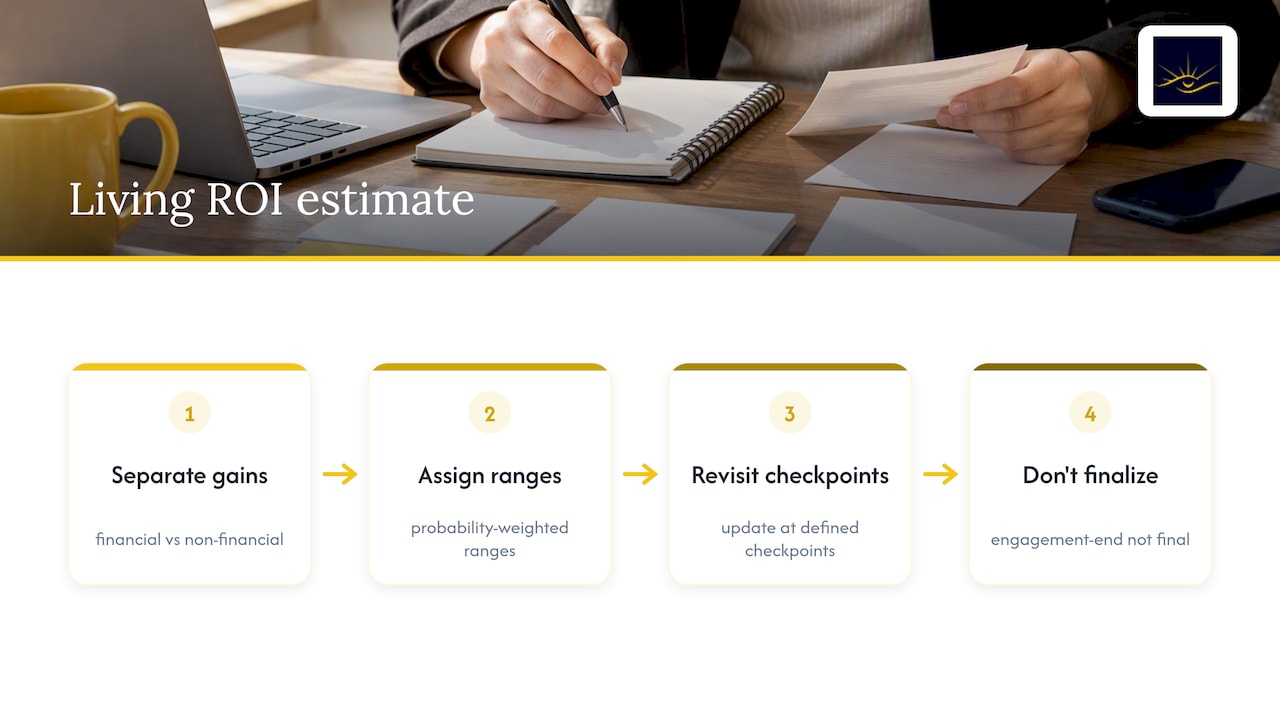
The fix for all three is the same: use probability-weighted ranges instead of single numbers, separate financial and non-financial gains rather than mashing them into one score, and revisit your estimate at defined checkpoints rather than trying to lock in a final ROI figure the day your engagement ends. Treat the calculation as a living estimate, not a one-time verdict.
How does coaching compare with other leadership development options?
Executive coaching sits alongside a handful of other common leadership development paths, and each trades off differently on cost, personalization, and evidence.
Leadership workshops and multi-day seminars are cheaper per person and can build shared vocabulary across a cohort, but they rarely include the sustained accountability that drives individual behavior change. Online leadership courses are the least expensive option and scale well, but completion rates are typically low and there is no working relationship to hold you to your goals. Formal mentorship programs are low-cost or free and offer real relational accountability, but mentors are usually not trained in structured behavior-change methods the way coaches are.
One-on-one coaching costs more than a course or workshop, but the evidence base is stronger for individual behavior change specifically because of the working alliance mechanism: a near-randomized field trial identified working alliance as a key driver of outcomes, per the AOM trial cited earlier. If your goal is a broad, low-cost introduction to leadership concepts, a workshop or course may be the more efficient choice. If your goal is a specific, personal behavior change tied to a career transition, burnout recovery, or identity shift, the sustained one-on-one relationship is what the research consistently points to as the stronger lever.
What do real ROI calculations look like in practice?
The clearest illustrations of ROI measurement come from controlled trials rather than anecdotes, because they isolate coaching’s effect from other variables.
In the physician burnout trial, participants who received one-on-one coaching over several months showed a meaningful absolute reduction in burnout symptoms, while those in small-group coaching showed an even larger reduction, with the trial’s own cost figures ranging from $400 to $1,000 per participant, per the Springer Nature trial. That is a clean example of how to frame ROI: a known cost, a measured outcome, and a defensible dollar proxy for the wellbeing gain.
In the corporate field trial, coached employees showed outcome improvements with effect sizes as large as 1.1 standard deviations compared to non-coached peers, and the researchers traced most of that gain back to the strength of the coaching relationship rather than any specific technique, per the AOM near-randomized trial. That is a useful model for a personal calculation: measure a specific behavior before and after, and credit the relationship, not the brand of coaching, for the change.
Both examples share a structure worth copying: a defined cost, a specific measured outcome, and an honest acknowledgment of what could not be isolated. That is a more useful template than any single ROI percentage you’ll find quoted elsewhere.
What patterns show up across hundreds of coaching engagements?
Across more than 600 client transformations at MMDC Alchemy, the clearest pattern is not the dollar figure. It is how often clients arrive burned out and leave with a rebuilt sense of what they actually want from their careers. Identity shifts and the dismantling of limiting beliefs show up as often as promotions do, sometimes more so. The financial upside tends to follow once someone stops operating from exhaustion and starts operating from clarity. If you want a concrete first step, the Energy Leadership™ Index assessment gives you a real baseline before you spend a dollar on coaching.
— Junna Liao
How MMDC Alchemy helps you track and grow your return
Most ROI conversations stop at theory. This coaching practice builds the measurement into the engagement itself: personalized, high-touch coaching where progress against your specific goals gets checked, not assumed.
- 1:1 Career Coaching with Junna: career coaching built around your specific transition, whether that’s a promotion push, a burnout recovery, or a full career pivot.
- Life Coaching with Junna: for readers whose goals extend past the job title into how work fits the rest of their life.
- The Energy Leadership™ Index Assessment: a structured way to baseline where you stand now and measure movement later.
Engagements typically run as personalized packages of three to twelve months, with substantial work happening between sessions, not just during them. If you want your own starting number before you commit to anything, book a session through the career coaching page or take the E.L.I. assessment first.
Sources
- A systematic meta-analysis reporting coaching effectiveness across outcome types (Frontiers, 2023)
- Coaching as a Developmental Intervention in Organisations: A Systematic Review (PLOS ONE, 2016)
- Professional Coaching to Reduce Physician Burnout: A Randomized Clinical Trial (Springer Nature, 2025)
- Executive Coaching Outcome Research in a Field Setting: A Near-Randomized Controlled Trial (AOMLE, 2018)
FAQ
Is executive coaching worth the money for individuals?
For many individuals, yes: coaching shows moderate positive effects on behavior and wellbeing, and can lead to career or financial gains, though results vary by person and role. Run your own probability-weighted calculation using your specific costs and goals rather than relying on a general answer.
How long does it take to see a return from coaching?
Behavioral changes often show up within a few months of consistent work, while financial outcomes like promotions or raises typically take six months to over a year. Timelines depend heavily on external factors like hiring and budget cycles, not just your own effort.
What is the Energy Leadership™ Index used for?
The Energy Leadership™ Index is an assessment used to baseline a client’s current mindset and energy patterns before coaching begins, then measure change over time. MMDC Alchemy uses it as a concrete way to track progress against a client’s stated goals.
Can I calculate coaching ROI without a big financial outcome?
Yes: convert non-financial gains like reduced burnout into conservative annualized dollar proxies, such as the $6,000 to $8,000 per person year figure drawn from burnout-reduction research, and add that to any financial estimate. Many clients find their strongest ROI comes from wellbeing and role fit rather than a single raise or promotion.
Why do some coaching ROI claims seem inflated?
Some organizational studies report ROI figures as high as 600 to 700% 700%, but a systematic review found these calculations often rely on subjective attribution methods rather than controlled measurement. Individual buyers get a more honest number by using probability-weighted scenarios and conservative assumptions instead of citing a single flashy percentage.
Recommended
- Executive Coaching for High Performers: Mastering the Alchemy of Leadership
- The Alchemy of Mastery: Choosing the Right Individual Leadership Growth Program
- Coaching Programs
This blog is for educational and inspirational purposes only. It is not medical, legal, financial, or mental health advice. Your journey is unique; please seek qualified professional support for decisions that affect your health, finances, or wellbeing.