
Career identity coaching works at the level of who you are: your patterns, beliefs, and professional self, rather than just your resume or job search tactics. It helps you surface the assumptions driving repeated career frustrations and test a more authentic professional identity through real action. We see this approach serve professionals, leaders, and high-achievers who feel stuck in the same patterns across different jobs or titles.
TL;DR:
- Identity coaching is most effective for mid-to-senior professionals experiencing repeated patterns, stalled promotions, or roles that feel misaligned with their self-concept.
- The MAP model guides staged work: clarifying current identity, exposing patterns, exploring future selves, and testing through real-world experiments.
- Coaches should incorporate small, actionable experiments within sessions to ensure identity shifts occur through actual social feedback, not just reflection.
- Professionals in mental health crises or trauma need to first seek therapy, as identity coaching is not designed to address clinical conditions or highly sensitive issues.
- Choosing a coach involves verifying their process, credentials, and their ability to provide staged, experiment-based identity work, with clear confidentiality and scope boundaries.
Table of Contents
- What Makes Identity Coaching Different From Other Support
- Why Identity Coaching Matters Now
- How Identity Coaching Works in Practice
- Who Benefits and Who Should Pause
- How to Choose an Identity-Focused Coach
- Risks, Ethics, and Boundaries in Deep Identity Work
- Junna Liao and MMDC Alchemy’s Approach to Identity Work
- Ready to Work Through Your Own Career Identity Shift
- FAQ
- Sources
What Makes Identity Coaching Different From Other Support
Identity coaching addresses the self making career decisions, not just the decisions themselves. A tactical career coach helps you rewrite a resume or rehearse interview answers. A therapist works with clinical patterns and mental health. A mentor or consultant hands you advice based on their own path. Identity coaching sits apart from all three: it asks what beliefs and roles you have inherited, which ones still fit, and what evidence would prove a new professional identity is real.
The scope lines matter because clients often arrive expecting one thing and need another:
- Tactical career coaching fixes the external presentation: resumes, LinkedIn profiles, interview prep.
- Therapy diagnoses and treats mental health conditions using clinical frameworks.
- Mentoring or consulting offers advice from someone else’s experience, not a process for examining your own patterns.
- Identity coaching examines the beliefs and self-concept behind your career choices, then tests new ones through action.
Consider a senior manager who has been passed over for three promotions despite strong performance reviews. A resume rewrite will not touch the pattern. The deeper issue might be a self-concept built around being the reliable second-in-command rather than the decision-maker, a pattern identity coaching is built to surface and test.
Why Identity Coaching Matters Now
Workplace roles are shifting faster than most career frameworks can keep up with, and professionals increasingly show up to coaching with a mismatch between their formal title and what they actually do day to day. That mismatch, combined with pressure from automation and skill shifts, pushes more people to question whether their current path still fits who they are becoming.
A 2024 peer-reviewed coaching framework found that identity work, structured around clarifying a current self-concept, surfacing patterns, exploring future selves, and testing decisions through action, supports more successful voluntary career transitions than advice-only approaches. That evidence matters because it points to a specific mechanism: change sticks better when it is tested in the real world, not just discussed, highlighting why why spending habits must shift for career success is crucial in professional transitions.
The clients who show up for this work tend to describe the same handful of triggers: a pattern that keeps repeating across jobs, a stalled promotion despite strong results, a sense of energy depletion that rest does not fix, or a role that technically succeeds but feels like someone else’s life.
How Identity Coaching Works in Practice
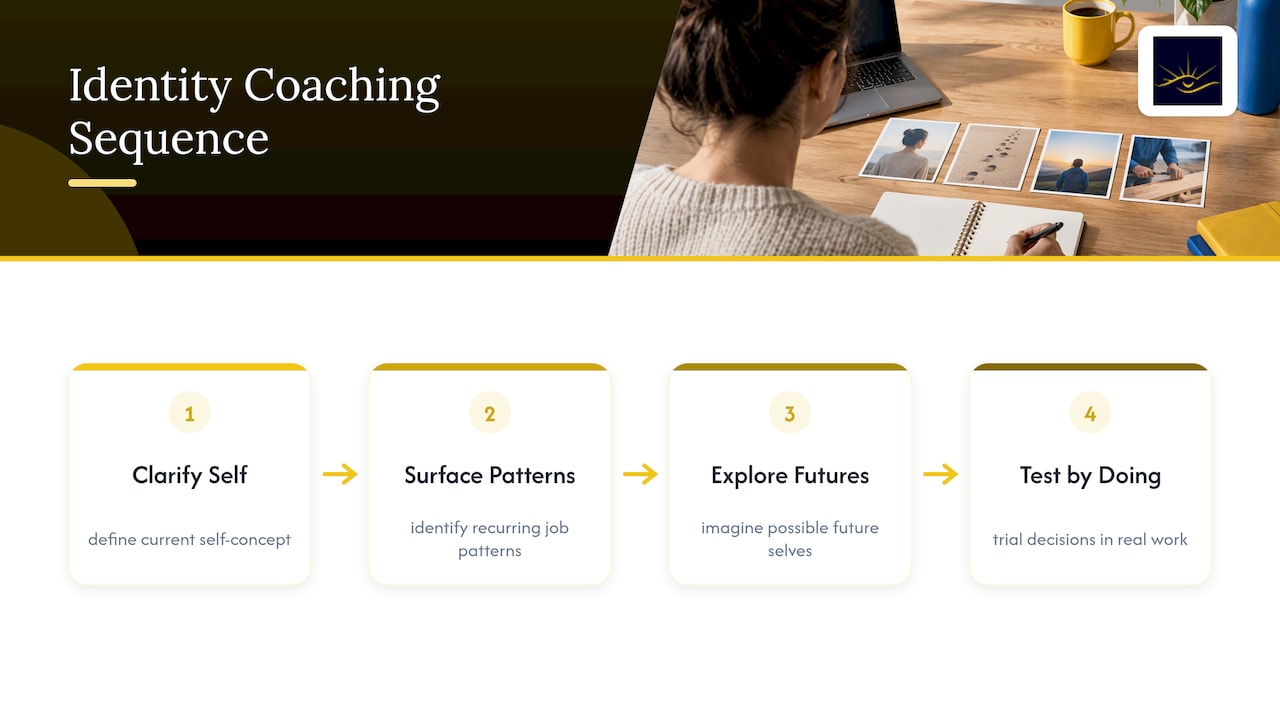
Most structured identity coaching follows a staged process rather than open-ended conversation. The MAP model, developed for coaching identity work in career transitions, outlines four stages that map well onto what a well-run engagement actually does:
- Clarify your current identity. Name the beliefs, roles, and self-concept you are operating from right now, often surfaced through targeted questions rather than direct advice.
- Surface recurring patterns. Identify the assumptions and behaviors that show up across different jobs, teams, or relationships, especially the ones that keep producing the same frustrating result.
- Explore possible future selves. Generate a small set of plausible identities you could grow into, grounded in your actual history and strengths rather than wishful thinking.
- Test through real-world experiments. Try a future self on through a specific action, a pitch, a project, a conversation, and gather feedback before committing further.
That last stage separates identity coaching from journaling or self-reflection alone. The MAP framework stresses that identity change should be checked against real feedback, not just private introspection, which is why good coaching treats experiments and social testing as core to the method rather than optional homework.
Programs built on this structure typically run weekly or biweekly sessions over a period of months, with homework between sessions built around a specific micro-experiment: a conversation to initiate, a role to volunteer for, a boundary to test. Some coaches also use structured assessments, such as an energy and leadership assessment, to give clients a concrete baseline to work from rather than relying on impression alone.
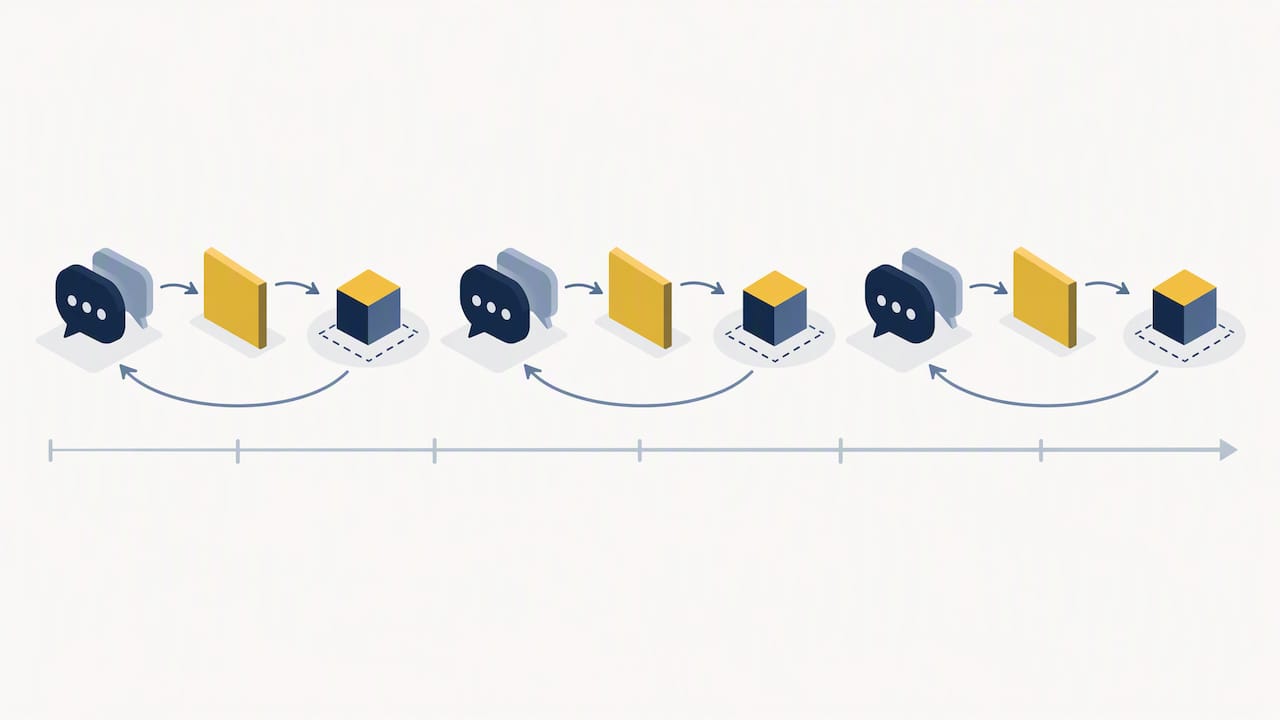
Pro Tip: Ask your coach for one small, real-world experiment by the end of your first session. If they only offer reflection questions with no action step, the engagement may stay theoretical.
Who Benefits and Who Should Pause
Identity coaching tends to serve mid-to-senior professionals, leaders, and entrepreneurs who have already proven competence but feel a gap between their title and their sense of self. It also fits generalists who want clarity on which direction to grow into next, rather than another lateral move.
- Good fit: professionals facing a repeated pattern, a stalled promotion, or a role that no longer matches who they have become.
- Pause and seek other support first: anyone in an acute mental health crisis, dealing with trauma symptoms, or needing clinical diagnosis, since identity coaching research flags boundary risks that make referral to therapy the responsible next step.
- Pause if confidentiality is unclear: a coach unwilling to specify how session content is handled is not ready for deep identity work.
Realistic outcomes look like a clearer sense of which roles fit your actual strengths, a specific pattern named and interrupted, and one or two tested experiments that changed how you show up at work.
How to Choose an Identity-Focused Coach
A discovery call is where you test fit before paying for anything. Come with specific questions rather than a general sense of the coach’s reputation.
- Ask the coach to describe their model for identity work in concrete terms, since research on coaching practice found the field lacks a consistent shared definition of identity coaching.
- Ask whether they carry ICF credentialing or follow ICF core competencies for scope, confidentiality, and referral.
- Ask for an example of a past client’s identity shift, described generically enough to protect confidentiality.
- Ask about session frequency, typical program length, and what happens if the engagement is not working.
- Ask whether they receive supervision for deep identity work, a signal of professional structure rather than solo practice.
Pricing for identity coaching varies by coach and is rarely published outright; expect most engagements to run three to twelve months, with the first few sessions focused on clarifying your current identity before any pattern work begins. After the discovery call, a simple decision flow works:
- Confirm the coach answered your scope and confidentiality questions directly.
- Check whether their described process matches a staged, experiment-based model rather than open-ended advice.
- If both check out and the cost fits your budget, move forward with a written agreement before the first paid session.
Risks, Ethics, and Boundaries in Deep Identity Work
Identity work touches personal territory, which is why professional boundaries matter more here than in tactical career coaching. The ICF Code of Ethics requires coaches to maintain confidentiality, clarify the line between coaching and therapy, and refer clients out when issues exceed coaching scope.
Executive coaching identity research notes that identity work can have unintended effects on a client’s personal life, which is why supervision and clear referral pathways matter as professional safeguards. A written coaching agreement is the practical check on all of this. Expect it to cover:
- Stated goals and how progress will be reviewed.
- Session frequency, total duration, and cancellation terms.
- Confidentiality terms and the coach’s referral policy if issues exceed coaching scope.
Junna Liao and MMDC Alchemy’s Approach to Identity Work
We built our practice at MMDC Alchemy around the idea that career identity shifts require more than insight. Our approach works with executives and high achievers navigating burnout, career transitions, and identity shifts, combining deep coaching with practical life strategy rather than advice alone. We lean on tools like the Energy Leadership Index assessment to give clients a concrete starting point, and we have guided over 600 client transformations through this holistic, action-oriented model.
— Junna Liao
Ready to Work Through Your Own Career Identity Shift
If the patterns in this article sound familiar, we offer a direct path forward rather than another round of generic advice. Our 1:1 career coaching pairs deep identity work with real accountability between sessions, including substantial support outside scheduled calls. We also offer life coaching for clients whose identity shift extends beyond their job title, and The Energy Leadership Index assessment as a starting point for clients who want a concrete baseline before committing to a full engagement.

A typical first step looks like:
- A discovery call to talk through your current pattern and what you want to shift.
- An optional assessment to establish a baseline before coaching begins.
- A written agreement outlining goals, cadence, and duration before your first paid session.
Book a discovery call through our career coaching page to see whether this approach fits where you are right now.
FAQ
How much should I pay for a career coach?
Career coaching fees vary widely by coach, credentials, and program length, and most identity-focused coaches do not publish flat rates since pricing depends on the scope of the engagement. Our own program pricing for 1:1 career coaching is available on request after a discovery call.
What is the 70/30 rule in coaching?
Definitions of this rule vary across coaching schools and are not tied to a single peer-reviewed standard, so treat any specific ratio as a general guideline rather than a fixed rule, consistent with the question-led approach described in identity coaching research.
Do I need a certification to be a career coach?
Coaching is not a licensed profession in most places, so no government-mandated certification is required to call yourself a career coach. Credentialing through a body like the International Coaching Federation signals adherence to defined competencies and an ethics code, which is a useful screening criterion for clients evaluating a coach.
Can you use ChatGPT as a career coach?
A controlled trial comparing human and simulated AI coaching found clients formed a moderately similar working alliance with both in a single session, suggesting AI tools can support some coaching tasks. The same research cautions that human coaches remain important for deep identity work, ethical boundaries, and referral decisions that AI is not equipped to handle.
Sources
- The MAP (Me‑As‑a‑Process) coaching model: a framework for coaching women’s identity work in voluntary career transitions
- 2025 ICF core competencies
Recommended
This blog is for educational and inspirational purposes only. It is not medical, legal, financial, or mental health advice. Your journey is unique; please seek qualified professional support for decisions that affect your health, finances, or wellbeing.