
A career clarity coach helps you convert scattered options and self-doubt into a testable direction and the confidence to move on it. This kind of support tends to matter most for mid-career professionals stuck at a plateau, executives running on empty, and anyone eyeing a meaningful change but unsure where to start. Before booking, request a written package outline and run through the screening questions covered later in this guide.
TL;DR:
- Effective coaching requires clear, measurable actions tested over time, with progress reviewed every four to eight weeks to ensure sustained results.
- Most clients see modest but lasting improvements in decision confidence and career clarity, especially when coaching incorporates structured experiments and accountability.
- Pricing varies widely based on experience and scope, so always ask for a written fee schedule and scope before committing to a coach.
- Coaches with credentialing from organizations like NCDA and a focus on behavioral change are more likely to provide reliable, ethical support aligned with research findings.
- Coaching benefits most mid-career professionals and those experiencing burnout, major identity shifts, or sudden transitions, with a typical engagement lasting at least several months for meaningful change.
Table of Contents
- What a career clarity coach does differently from counselors or resume services
- Who benefits most from clarity coaching, by situation
- What a typical engagement looks like: sessions, timeline, and price
- What the evidence says about coaching outcomes
- How MMDC Alchemy approaches career clarity
- Typical qualifications and training pathways for coaches
- Examples of coaching impact worth understanding
- Rules that separate real change from insight alone
- How to start working with MMDC Alchemy
- Sources
- FAQ
What a career clarity coach does differently from counselors or resume services
A career clarity coach works on the question underneath the question: not “which job posting should I apply to” but “what actually makes work feel worth doing, and how do I know.” The engagement typically moves through a few connected stages, each building on the last.
- Self-concept clarification: naming your values, strengths, and non-negotiables so decisions have a stable reference point.
- Decision-criteria development: turning vague preferences into a short list of filters you can apply to any opportunity.
- Option testing: trying ideas in low-stakes ways, through informational interviews, side projects, or short trials, before committing.
- Action planning: sequencing next steps with target dates instead of leaving clarity as an abstract insight.
This is different work from what a licensed therapist, a resume writer, or a recruiter does. A therapist treats clinical concerns like anxiety or depression under a legal scope that clarity coaching does not carry, and a coach who suspects a clinical issue should refer out rather than continue. A resume writer or recruiter executes a job search once direction exists. A career clarity coach fills the gap before that: helping you decide what to search for in the first place.
The realistic deliverable is a written framework and short-term action plan, not a guaranteed offer letter. If a coach promises a specific job outcome or salary jump, that is outside what this kind of work can honestly claim.
Who benefits most from clarity coaching, by situation
Fit matters more than motivation. The following profiles cover most people who seek out this kind of coaching, along with a realistic sense of what to expect.
- Mid-career plateau: professionals five to fifteen years in who feel competent but unfulfilled usually need three to six months to rebuild a decision framework and start testing new directions.
- Layoff or forced transition: people navigating sudden job loss often benefit from clarity work paired with practical job-search support, since urgency and identity questions arrive at the same time.
- Returning from extended leave: parents, caregivers, or people recovering from illness often need help translating a changed identity into a renewed professional direction.
- Executive burnout: senior leaders who have hit a wall typically need slower pacing and more attention to energy and boundaries before any career decision gets made.
- Identity shift: people questioning a long-held career path, sometimes after a personal milestone, tend to need the deepest self-concept work and the longest engagement.
Someone dealing with a diagnosable mental health condition is better served by a licensed therapist first. Someone who already knows their direction and needs credential-matching or degree planning may be better served by a career counselor with an advanced degree. Someone who has clarity but lacks interview traction needs a job-search specialist, not a clarity coach. Reading about layoffs and how to lead yourself through that kind of uncertainty can help you figure out which category you’re in before you book anything.
What a typical engagement looks like: sessions, timeline, and price
Career clarity coaching is usually sold in one of three shapes: a single strategy session for a narrow question, a short package of four to six sessions for a defined decision, or a multi-month package for a full transition or identity shift. Sessions generally run 45 to 90 minutes, spaced one to three weeks apart to leave room for the work that happens between meetings.
- Single session: best for a narrow, well-defined question, like choosing between two offers.
- Short package: four to six sessions over six to ten weeks, suited to a defined decision such as changing functions within the same industry.
- Multi-month package: three to twelve months, suited to burnout recovery, identity shifts, or a full career pivot.
Between-session work carries more weight than the sessions themselves. A coach worth paying will assign small experiments: an informational interview, a short freelance trial, a values exercise, or a single hard conversation you’ve been avoiding. Insight without action rarely moves anyone forward, so a coach who never assigns anything outside the call is a warning sign.
Pro Tip: Ask any prospective coach for a written fee schedule, cancellation policy, and a plain description of what’s included before you pay for anything.
Pricing for this kind of coaching varies widely by coach experience, session length, and package scope, and reputable practitioners will give you exact numbers only after a scope conversation, not a flat rate off a website. Treat a coach who refuses to put fees in writing as a reason to keep looking.
What the evidence says about coaching outcomes
Career coaching has a modest but real evidence base, and reading it correctly means paying attention to effect size and follow-through, not just the headline result.
A 2025 randomized waitlist-controlled trial tested five individual coaching sessions over eight months with medical master’s students and found a small-to-moderate reduction in career-decision stress, alongside increased career decision self-efficacy, with the effect partly explained by that rise in self-efficacy.
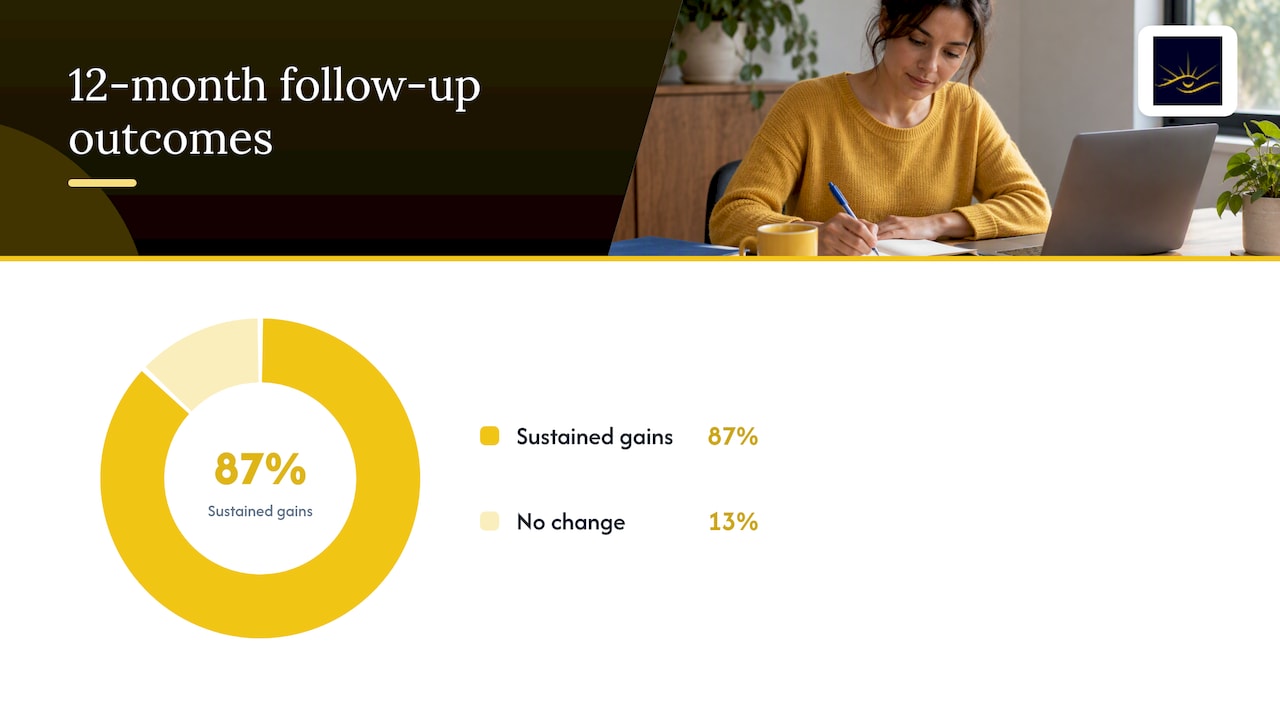
A 12-month follow-up study of a manualized career counseling intervention found sustainable positive outcomes for 87% of clients a year later. The same study found that the 13% of clients who showed no measurable change during counseling itself tended to have worse outcomes at follow-up than clients who improved even modestly during sessions. That detail matters more than the headline number: progress during the engagement, not just the plan on paper, predicted whether gains held up over time.
- Coaching’s benefit appears to run partly through decision self-efficacy, the confidence to make and act on a choice, not through insight alone.
- Process adherence (a coach sticking to a structured method) was linked to better long-term client trajectories in the follow-up study.
- No measurable movement during the engagement is a signal to reassess fit rather than assume the benefit will show up later.
The practical takeaway: ask a prospective coach how they measure progress session to session, and what behavior changes their clients typically make, rather than relying on testimonials alone.
How MMDC Alchemy approaches career clarity
MMDC Alchemy, founded by executive coach Junna Liao, works with leaders and high achievers navigating burnout, career transitions, and identity shifts through one-on-one career coaching and life coaching. The practice also uses The Energy Leadership™ Index (E.L.I.) Assessment, a tool that gives clients language for the energy patterns and limiting beliefs driving their current stuck points before any decision work begins.
The sequence maps to what the research above points toward: clarify self-concept first, build decision confidence through small tested actions, then act on a plan rather than stopping at insight. The practice describes its track record as many client transformations, and frames its method as more high-touch than conventional career coaching, with substantial expected work between sessions rather than passive reflection.
Before starting any engagement, bring these questions to a discovery call:
- How will progress be measured session to session, and how often will we check in?
- What is the expected timeframe for this specific goal?
- What exactly is included in the written scope, and what falls outside it?
- What is the referral policy if a clinical or legal issue comes up during our work?
Typical qualifications and training pathways for coaches
There is no single license required to call yourself a career coach, which makes credential checks part of the buyer’s job rather than an assumption. Many practitioners come through coach-specific training programs, graduate work in counseling or organizational psychology, or years of experience in HR, recruiting, or leadership roles before transitioning into coaching.
The National Career Development Association offers competency-based credentialing that requires ongoing continuing education, 30 contact hours every three years, which gives consumers a concrete way to check a provider’s standing rather than relying on a job title alone. The NCDA’s code of ethics also sets expectations around informed consent, confidentiality, and staying within scope, including a clear expectation that coaches refer out when a client’s needs are clinical rather than developmental.
The closely related occupation of school and career counselors, tracked by the Bureau of Labor Statistics, had 376,300 jobs in 2024 with median pay of $65,140 and projected growth of 4% from 2024 to 2034, though that figure covers a broader, often credentialed occupation rather than independent coaching specifically. When you evaluate a coach, ask directly about their training pathway and any credentials held, and treat vague answers as a reason to ask more questions.
Examples of coaching impact worth understanding
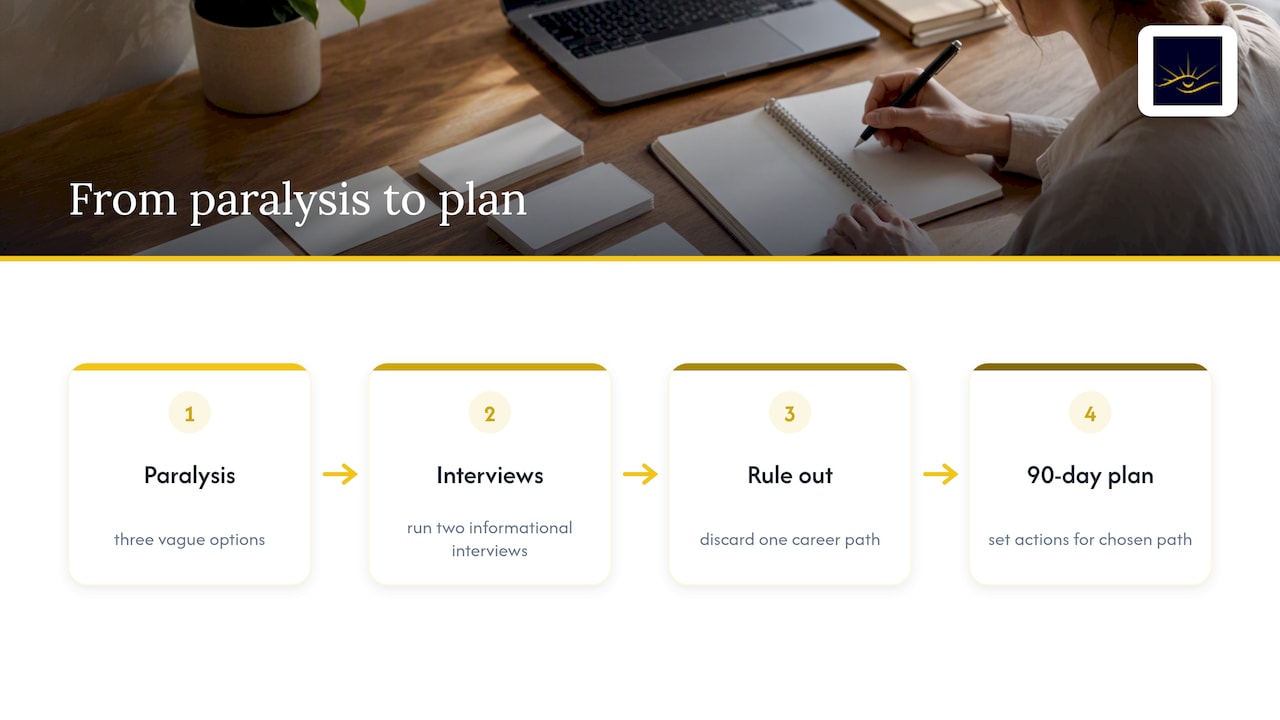
Coaching outcomes are best understood through the mechanism, not anecdote. The 2025 randomized trial found that coaching reduced career-decision stress and raised decision self-efficacy for participants, and that the improvement in confidence was the pathway through which stress reduction happened. In practice, that looks like a client moving from paralysis over three vague options to running two informational interviews, ruling one path out, and setting a 90-day plan for the other.
That pattern, visible change during the work predicting durable change afterward, is a more honest measure of impact than a single testimonial, because it tracks a group over time rather than describing one favorable case.
The practice frames its results as involving revitalized careers and a break from limiting beliefs, a claim from the practice itself rather than an independently verified figure. Readers evaluating any coach, MMDC Alchemy included, should ask for specifics on what changed for past clients and over what timeframe, rather than accepting a round number at face value.
Rules that separate real change from insight alone
Clarity coaching fails most often not because the ideas are wrong, but because nothing measurable follows them. A few rules keep the work honest.
Agree on a small, testable experiment starting in session one, something with a deadline, not just a reflection exercise. Put the scope in writing and schedule a progress review every four to eight weeks rather than assuming things are on track. If a review shows no measurable movement, whether that’s a decision made, a conversation had, or an option ruled out, treat that as a signal to change the approach or the coach, not a reason to keep waiting.
Pro Tip: Write down one thing that would count as proof of progress before your first session, then check it at every review.
— Junna Liao
How to start working with MMDC Alchemy
If the research above tells you anything, it’s that structure and follow-through matter more than the number of sessions on a package. MMDC Alchemy’s 1:1 career coaching is built around that same sequence: clarify what actually matters to you, build the confidence to test a direction, then act on it with accountability between sessions rather than left to your own momentum.
For clients whose stuck point is less about the next job and more about identity or energy, life coaching and The Energy Leadership™ Index (E.L.I.) Assessment are often used alongside career work to get at what’s driving the plateau in the first place. A discovery call is the place to ask for a written scope, a fee schedule, and a plain answer on how progress will be tracked. Confidentiality and referral boundaries are part of any serious coaching relationship, and a coach who suspects your situation calls for clinical or legal support should say so rather than continue past their scope.
Ready to see if the fit is right? Book a discovery call and bring the questions from this guide with you.
Sources
- Career coaching to support medical student career decision-making: a randomized controlled trial | Advances in Health Sciences Education
- Predicting Outcomes of a Manualized Individual Career Counseling Intervention Over a One-Year Follow-Up From Trajectories of Change in Career Decision Difficulties – PMC
- School and career counselors and advisors : Occupational Outlook Handbook : U.S. Bureau of Labor Statistics
- NCDA Credentialing
FAQ
How much should I pay for a career coach?
Pricing depends heavily on the coach’s experience, session length, and package scope, so there is no single standard rate across the field. Ask any prospective coach for a written fee schedule and cancellation policy before paying, since reputable practitioners will quote exact numbers only after understanding your goals.
Are career coaches actually worth it?
A 2025 randomized trial found that structured coaching reduced career-decision stress and increased decision self-efficacy, though the effect was small to moderate rather than dramatic. A separate 12-month follow-up found that 87% of clients sustained their gains a year later, with the best predictor of long-term success being measurable progress during the engagement itself.
What is the 70/30 rule in coaching?
There is no established or widely documented “70/30 rule” specific to career coaching, and no source reviewed here defines one. Definitions of this kind vary by individual coach or program, so ask any practitioner using the term to explain exactly what it means in their methodology.
Can you use ChatGPT as a career coach?
An AI chatbot can help you brainstorm options or draft materials, but it cannot replicate the structured, accountable relationship that research on coaching outcomes actually studied, including between-session check-ins and progress tracking over months. For a real transition, a trained coach who can adjust to your specific situation and hold you to measurable milestones is a different kind of support than a general-purpose chat tool.
Recommended
This blog is for educational and inspirational purposes only. It is not medical, legal, financial, or mental health advice. Your journey is unique; please seek qualified professional support for decisions that affect your health, finances, or wellbeing.