
A career transition coach is worth hiring if you need clarity, structure, and outside accountability to move from “stuck” to a working plan, and the evidence backs that up: coaching interventions have raised job-finding rates by about 9 percentage points in controlled studies. Some coaching firms and coaches, credentialed through bodies like the International Coaching Federation, pair that structure with accountability. If you already have a clear plan and just need execution help, a mentor or a free government resource may be enough.
TL;DR:
- Coaching is most effective if you have done basic self-assessment and have some financial plan, especially if burnout or career plateau is causing your transition.
- A typical coaching engagement lasts three to twelve months, focusing on clarity, materials, and job search activities, with measurable improvements in job-finding and earnings.
- Credentials and experience matter; look for coaches with specific transition experience, International Coaching Federation certification, and clear methodology during an intro call.
- The core value of coaching is accountability, structured work, and ongoing contact, which can increase job-finding success by about 9 percentage points and long-term earnings by up to 20%.
- For best results, prioritize coaches who focus on practical action steps, financial timelines, and concrete outcomes rather than promotional promises or vague guarantees.
Table of Contents
- What a career transition coach actually does
- Who benefits and when to hire a career transition coach
- How coaching works: process, timeline, and outcomes
- How to choose the right career transition coach
- MMDC Alchemy and Junna Liao: a practitioner view
- What outcomes and results actually look like
- What the research actually supports about coaching
- Next steps: working with MMDC Alchemy
- Sources
- FAQ
What a career transition coach actually does
A career transition coach helps you turn a vague sense that “something needs to change” into a concrete plan, then holds you accountable to it. The work is structured, not just supportive conversation, and it usually mixes self-assessment tools with practical job-search mechanics.
Most engagements include a combination of the following:
- Values and strengths mapping to identify what you actually want from your next role, not just what you’re qualified for
- Assessments such as the Energy Leadership™ Index to surface how your energy and mindset shape decisions under stress
- Career design sessions that translate insight into two or three viable directions instead of an open-ended search
- Resume, LinkedIn, and interview preparation once a direction is chosen
- Homework between sessions (informational interviews, market research, drafts) with accountability check-ins
Coaching is distinct from therapy, mentoring, and training, even though people sometimes lump them together. Therapy addresses mental health and past experience; a coach works from where you are now toward a defined future goal. A mentor shares their own path and contacts, usually informally and without a structured process. Training builds a specific skill or credential. A career transition coach’s job is to combine self-assessment with practical, self-directed research into occupations, training paths, and finances, then keep you moving.
Who benefits and when to hire a career transition coach
Coaching tends to help most at three points in a mid-career professional’s arc: when burnout has made the current role unsustainable, when a promotion track has stalled for reasons that aren’t fully clear, and when someone has decided on a pivot but doesn’t know how to sequence the move. In each case, the value isn’t motivation. It’s a structured way to separate emotion from strategy.
Signals you’re ready to hire a coach now include having some financial runway or a plan to create it before you leap:
- You’ve named the problem (burnout, plateau, misalignment) but not the next step
- You have some financial runway or a plan to create it before you leap
- You’re willing to do homework between sessions, not just talk through feelings
Signals you might wait or look elsewhere first:
- You haven’t yet done basic self-assessment of values, skills, and finances, which government career guidance treats as the necessary first stage of any change
- Your employer offers free outplacement or career counseling you haven’t used yet
- You need a specific technical credential more than strategic clarity, in which case training comes first
Employer-sponsored career services and free tools like O*NET and CareerOneStop are reasonable starting points before a paid engagement, especially if your timeline isn’t urgent.
How coaching works: process, timeline, and outcomes
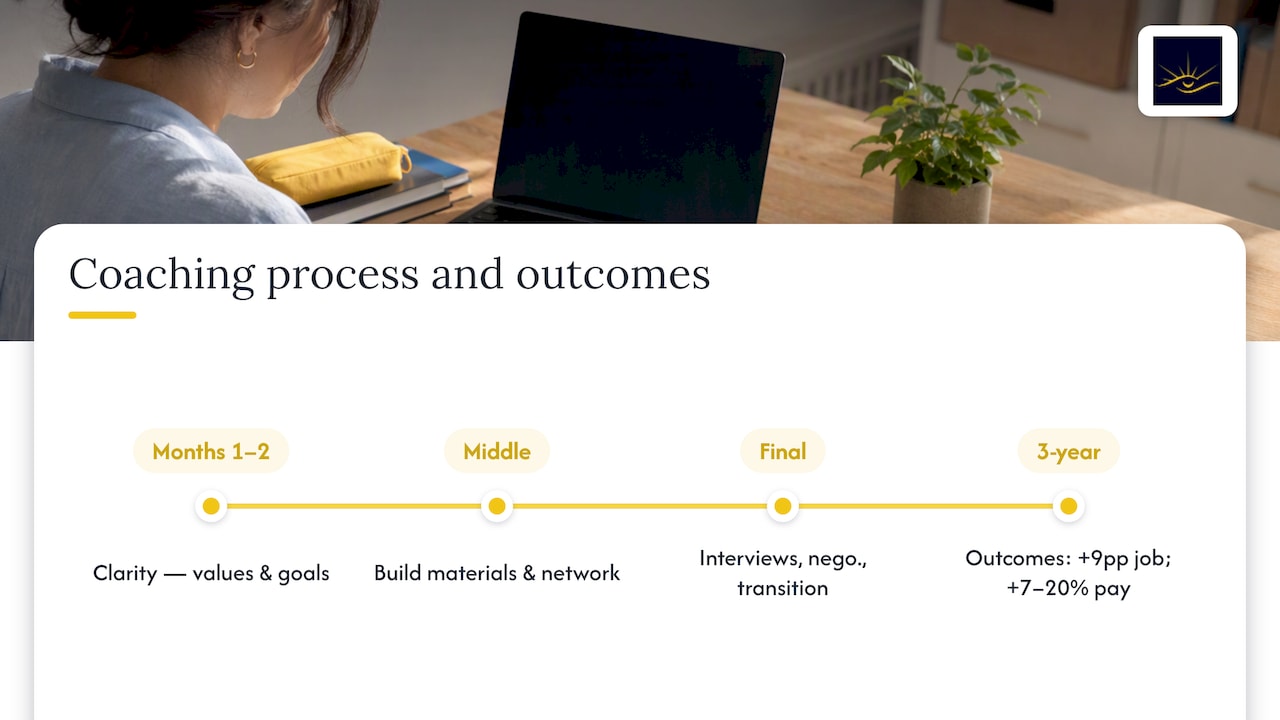
A typical career transition coaching engagement runs three to twelve months, structured around a few milestones rather than an open-ended number of sessions. The first month or two usually focuses on clarity: values, strengths, and a short list of viable directions. The middle stretch builds the materials and network needed to act, resume, outreach, informational interviews, applications. The final phase covers interviews, negotiation, and the actual transition.
One coaching intervention for job seekers raised the job-finding rate from 63% to about 72%, a roughly 9 percentage point improvement attributed to better search efficiency and more realistic wage expectations. For a mid-career professional, that translates into fewer months spent applying broadly and more time spent pursuing roles that actually fit.
Longer-term research on intensive employment counseling found that access to one-on-one services, including coaching and career strategy, increased participants’ earnings by 7% to 20% over a three-year follow-up, with benefits that exceeded program costs. That range matters because it shows the payoff isn’t immediate. It compounds over the years after the transition, not just in the first new paycheck.
How to choose the right career transition coach
Fit matters more than credentials alone, but credentials and process still narrow the field fast. Use an intro call to test both.
- Ask what percentage of their clients have a background similar to yours (industry, seniority, or transition type)
- Ask how many years they’ve worked specifically in career transition, not coaching broadly
- Ask whether they hold an International Coaching Federation credential or equivalent accreditation, and at what level
- Ask them to describe their methodology in plain terms, not buzzwords
- Ask for two or three client references you can actually contact
- Ask what a typical engagement includes session by session
- Ask how they measure progress between sessions
- Ask what happens if the plan changes mid-engagement
- Ask about their fee structure: per session, package, or retainer
- Ask what’s expected of you outside sessions
- Ask what a stalled or unsuccessful engagement has looked like for a past client, and why
- Ask directly what results their recent clients have seen and in what timeframe
Red flags include vague answers about methodology, no willingness to offer a reference, and promises that sound guaranteed rather than probable. ICF’s global research shows experienced coaches and those specializing in a specific type of transition, executive, industry pivot, or burnout recovery, tend to command higher fees and deliver more consistent value, so specialization is a fair screening filter.
Pro Tip: Ask a prospective coach to walk you through one real (anonymized) client’s timeline from first session to outcome. Vague answers here usually mean vague results.
MMDC Alchemy and Junna Liao: a practitioner view
Some coaching firms focus on helping leaders and high achievers move through burnout, career transitions, and identity shifts rather than offering generic career advice. Some firms report many client transformations, combining deep coaching with practical life and career strategy rather than motivation alone.
Some coaching firms offer services such as 1:1 career coaching for professionals building a concrete transition plan, life coaching for transitions involving broader identity or life-direction questions, and assessments used early in an engagement to surface mindset patterns that shape decision-making under stress.
A discovery call typically covers where you are now, what’s driving the transition, and whether the methodology fits how you want to work.
What outcomes and results actually look like
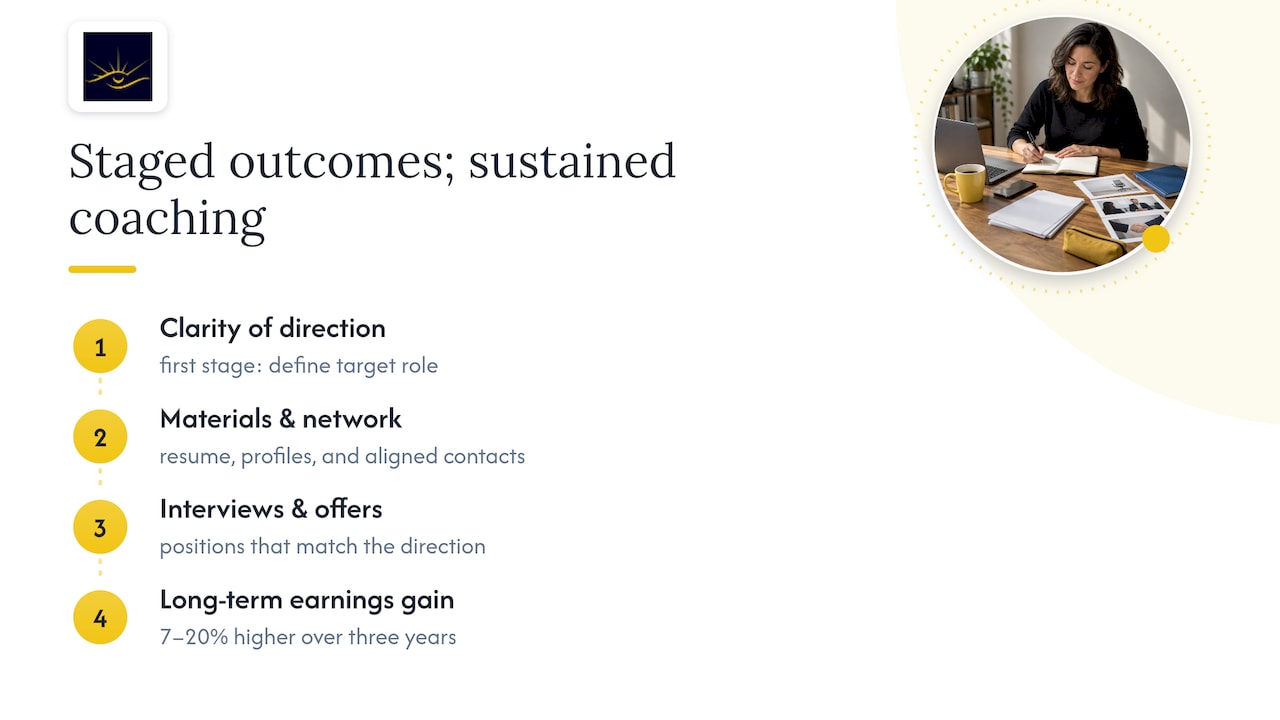
Coaching outcomes are rarely a single moment. They build in stages: first clarity about direction, then materials and a network that reflect that direction, then interviews and offers that match it. Research on intensive employment counseling found earnings gains of 7% to 20% over three years, which is a useful reminder that the financial upside of a well-run transition often shows up well after the new job starts, not in the first month.
Program evaluations that combine structured coaching with sustained follow-up, rather than a single session, tend to show the strongest and longest-lasting employment gains. That pattern holds across different populations and coaching formats: the common thread is contact that continues past the first burst of enthusiasm.
For a mid-career professional, the practical takeaway is to judge a coaching engagement by whether it produces a plan you actually execute, not by how motivated you feel after one call. Some coaching providers frame client outcomes around revitalized careers and breaking free of limiting beliefs, which is a claim worth testing against your own goals in a discovery conversation rather than taking at face value.
What the research actually supports about coaching
The honest reading of the evidence is that coaching works best as a structured accountability system, not as a source of inspiration. The studies that show real earnings and job-finding gains describe programs built on repeated contact, homework, and course correction, not a single pep talk. That’s the opposite of how coaching is often marketed.
Conventional advice tends to oversell the emotional breakthrough and undersell the boring middle: the months of informational interviews, application drafts, and financial planning that actually move a transition forward. A coach’s real value is keeping you doing that unglamorous work consistently, informed by honest self-assessment rather than wishful thinking.
If you take one thing from this, prioritize a coach who asks about your finances and timeline before your feelings. Clarity about what you want matters, but clarity about what you can actually afford to do about it matters just as much, and government career guidance treats both as prerequisites, not afterthoughts.
— Junna Liao
Next steps: working with MMDC Alchemy
If you’ve read this far and recognize your own stalled promotion, burnout, or half-formed pivot in it, MMDC Alchemy’s 1:1 career coaching is built for exactly that stage: turning a vague need for change into a plan with accountability attached. For readers whose transition is tangled up with a bigger identity or life question, life coaching with Junna addresses that directly rather than treating it as noise around a resume update.
A discovery call is the fastest way to see if the fit is right. Before booking, bring three things:
- A one-paragraph description of what’s not working in your current role
- Your realistic financial runway in months, not just a number you hope holds
- One or two directions you’re curious about, even if they feel unfinished
| What you bring to the call | What it helps clarify |
|---|---|
| Description of the current problem | Whether the issue is role, company, or industry |
| Financial runway | How aggressive the transition timeline can be |
| Candidate directions | Where the Energy Leadership™ Index assessment should focus first |
Book an introductory call to talk through whether coaching, and specifically this approach, fits where you are.
Sources
The claims above draw on government career guidance and peer-reviewed labor research, not marketing copy.
- The Effects of Employment Counseling on Labor Market Outcomes for Adults and Dislocated Workers: Evidence from a Nationally Representative Experiment
- Field experiment on coaching interventions for older job seekers
- ICF Global Coaching Study (Executive summary)
- Career planning the second time around (BLS Occupational Outlook Quarterly)
FAQ
What does a career transition coach actually do?
A career transition coach helps you clarify what you want from your next role, then builds a concrete plan and holds you accountable to it through structured sessions, assessments, and homework. This differs from therapy or mentoring because the focus stays on a defined future goal and measurable action, not just conversation or shared experience.
How much does career transition coaching cost?
Pricing varies by coach, package length, and location, and most coaches, including MMDC Alchemy, quote fees during a discovery call rather than publishing a flat rate. Ask directly about package structure, session count, and what’s included before comparing coaches on price alone.
How long does a career transition coaching engagement take?
Most engagements run three to twelve months, moving through clarity, plan-building, and execution phases rather than a fixed number of sessions. Timelines depend on how defined your goal already is and how much groundwork, like financial planning, still needs attention.
Is a career transition coach different from a career counselor or mentor?
Yes: a career counselor often focuses on assessment and information, a mentor shares their own path informally, and a coach builds a structured plan with ongoing accountability toward a specific goal. Coaching credentials from a body like the International Coaching Federation can help distinguish trained coaches from informal advisors.
Does career transition coaching actually improve job outcomes?
Peer-reviewed research on intensive employment counseling found earnings increases of 7% to 20% over three years, and a separate field experiment found coaching raised job-finding rates by about 9 percentage points. Results depend on sustained engagement and follow-through, not a single session.
Recommended
This blog is for educational and inspirational purposes only. It is not medical, legal, financial, or mental health advice. Your journey is unique; please seek qualified professional support for decisions that affect your health, finances, or wellbeing.