
Executive coaching works for Silicon Valley leaders who need measurable change in how they delegate, communicate, or handle burnout, and one-on-one transformational coaching is built for exactly that job. The clearest path to results is targeting observable behaviors, such as delegation, feedback routines, and decision cadence, rather than vague growth goals. If you are ready to act, use the vetting checklist below or book a confidential discovery call.
TL;DR:
- Executive coaching in Silicon Valley emphasizes observable behaviors like delegation and feedback routines to ensure measurable leadership improvements.
- Most engagements last six months with regular sessions, and success relies on clear, behavior-focused goals and predefined measurement plans.
- Confidentiality, reporting boundaries, and measurable success criteria must be negotiated upfront, especially in company-sponsored coaching.
- Effectiveness is supported by research showing moderate to large positive effects on workplace behaviors, with virtual coaching being as impactful as in-person.
- Coaches should demonstrate relevant industry experience, clear methodologies, and alignment on measurable outcomes during the initial discovery call.
Table of Contents
- What executive coaching in Silicon Valley actually addresses
- Who benefits most, and when to start
- How to choose an executive coach: questions for the first call
- What a typical engagement looks like, and what it costs
- What the research says about coaching effectiveness
- Protecting confidentiality: what belongs in your coaching agreement
- About MMDC Alchemy’s approach to executive coaching
- How to prepare for your first coaching session
- When to stop, change, or expand your coaching engagement
- Ready for a confidential conversation about your next step
- Sources
- FAQ
What executive coaching in Silicon Valley actually addresses
Most engagements in this market center on a handful of recurring problems: leadership transitions into a new C-suite role, scaling a management style as headcount doubles, navigating board and investor relationships, recovering from burnout, and founders facing identity shifts when their company outgrows their original role.
The common modalities look similar across providers:
- One-on-one sessions, typically held weekly or biweekly.
- Diagnostic assessments such as the Energy Leadership™ Index (E.L.I.), which maps how a leader’s energy and reactions shape their decisions.
- Structured stakeholder interviews to surface blind spots a leader cannot see alone.
- Occasional team sessions when the coaching extends to a direct report group.
Silicon Valley’s pace changes what coaching needs to prioritize. Fast-growing, engineering-heavy organizations compress the time a new leader has to build credibility, and investor relationships add a layer of scrutiny that leaders in slower-moving industries rarely face. Coaching here tends to focus on speed to competence: a leader cannot spend a year finding their footing when the org chart reshuffles every two quarters.
Who benefits most, and when to start
Coaching tends to pay off fastest for a specific set of leaders, not everyone who feels stretched thin.
- Senior leaders or newly promoted C-suite executives navigating a first 90 to 180 days in a bigger seat.
- Founders at an inflection point, such as a Series B raise, a leadership team expansion, or a pivot that changes what the job actually requires.
- Anyone showing early signs of burnout or stagnation, where effort keeps rising but results flatten.
Who pays for the engagement matters too. Private pay gives a leader full control over what gets shared and with whom. Company-sponsored coaching usually involves some reporting back to HR or a manager, so confidentiality terms need to be set before the first session, not after.
Three signals suggest it is time to hire a coach: repeated feedback about the same blind spot, a new role that exceeds your current playbook, or a sense that you are managing symptoms (exhaustion, friction with peers) instead of causes.
How to choose an executive coach: questions for the first call
Fit decides more than credentials do. HBR’s guidance on coach mismatch treats fit as the single most important variable in whether coaching delivers, and the first consultation is where you test it.
Evaluate coaches on five things:
- Relevant experience with leaders at your level or in your industry.
- A methodology they can explain in plain language, not jargon.
- Clear confidentiality boundaries, especially if your company is paying.
- Willingness to agree on measurable success criteria up front.
- Chemistry: do you feel comfortable being direct with this person.
Bring these questions to the discovery call: What does your process look like in the first 90 days? Can you describe an outcome you helped a client achieve, without naming them? How will we measure change, and how often will we check progress? What happens to notes or assessment results, and who else sees them? What is your cancellation and rescheduling policy? How do you handle a sponsor who wants updates? What happens if we are not a fit after a session or two? Can you share a reference from a past client in a similar role?
Pro Tip: Ask for a short sample plan tied to one specific behavior change in the first 90 days, and ask how they will show you evidence that it happened.
Red flags include vagueness about how progress gets measured, no clear boundary around confidentiality, and an inability to describe even an anonymized client outcome.
What a typical engagement looks like, and what it costs
Most executive coaching engagements start as six-month commitments, often with weekly or biweekly sessions, a midpoint check-in to assess progress, and the option to renew toward 12 months or longer if new goals emerge. The ICF’s 2023 global coaching study notes that fees and structures vary by client seniority and coach specialty, which is why pricing is rarely one-size-fits-all.
Pricing generally takes one of two shapes: a package retainer covering a defined period, or per-session fees for more flexible arrangements. What drives the price is seniority of the client, the coach’s specialization, and whether the company or the individual is footing the bill.
What matters more than the shape of the pricing is what you are actually buying. Prioritize:
- A defined objective tied to an observable behavior, not a vague theme like “better leadership.”
- A measurement plan agreed on before the engagement starts.
- Built-in accountability checkpoints, not just a running tally of sessions.
A coach who sells you a number of sessions without a measurement plan is selling you time, not a result — to understand how to achieve real outcomes, see this evidence-based training approach.
What the research says about coaching effectiveness
A 2023 randomized-trial meta-analysis on executive coaching found a moderate to large positive effect on behavioral outcomes, with moderate effects on leadership behaviors specifically. A related Frontiers meta-analysis reports consistent positive effects on workplace behaviors and finds that virtual coaching can be as effective as in-person delivery, with no clear advantage tied to a higher number of sessions.
Behavior change is the outcome coaching reliably moves, and that same research shows positive effects extending to self-efficacy and resilience as well.
The practical implication: set goals you can observe, such as delegating a specific category of decisions, running a consistent feedback routine, or shortening the time it takes you to make a call under pressure. Coaching will not rewrite your personality in six months. It works when you show up, practice the behavior between sessions, and track whether it actually changed.
Protecting confidentiality: what belongs in your coaching agreement
Before you sign anything, confirm these five items are addressed in writing.
- Confidentiality terms: what stays between you and the coach, and what, if anything, gets shared.
- Who receives updates, and in what form, if your company is sponsoring the engagement.
- How assessment results (like E.L.I. data) are stored and who can access them.
- The cancellation and rescheduling policy for missed sessions.
- Exit and renewal criteria, so either side can end the engagement cleanly.
When a company sponsors your coaching, negotiate a narrow reporting agreement, such as confirmation of attendance and high-level progress categories, while keeping session content private. Two phrases worth using on a discovery call: “I’d like session content to stay between us, with only progress summaries shared,” and “Can we agree on what gets reported before we start?”
About MMDC Alchemy’s approach to executive coaching
MMDC Alchemy was founded by Junna Liao, who leads its executive coaching practice. The practice reports having facilitated over 600 transformations through 1:1 career coaching, life coaching, and the Energy Leadership™ Index assessment. Its approach pairs deep coaching with practical life and career strategy, treating burnout, career transitions, and identity shifts as connected problems rather than separate issues to solve one at a time.
How to prepare for your first coaching session
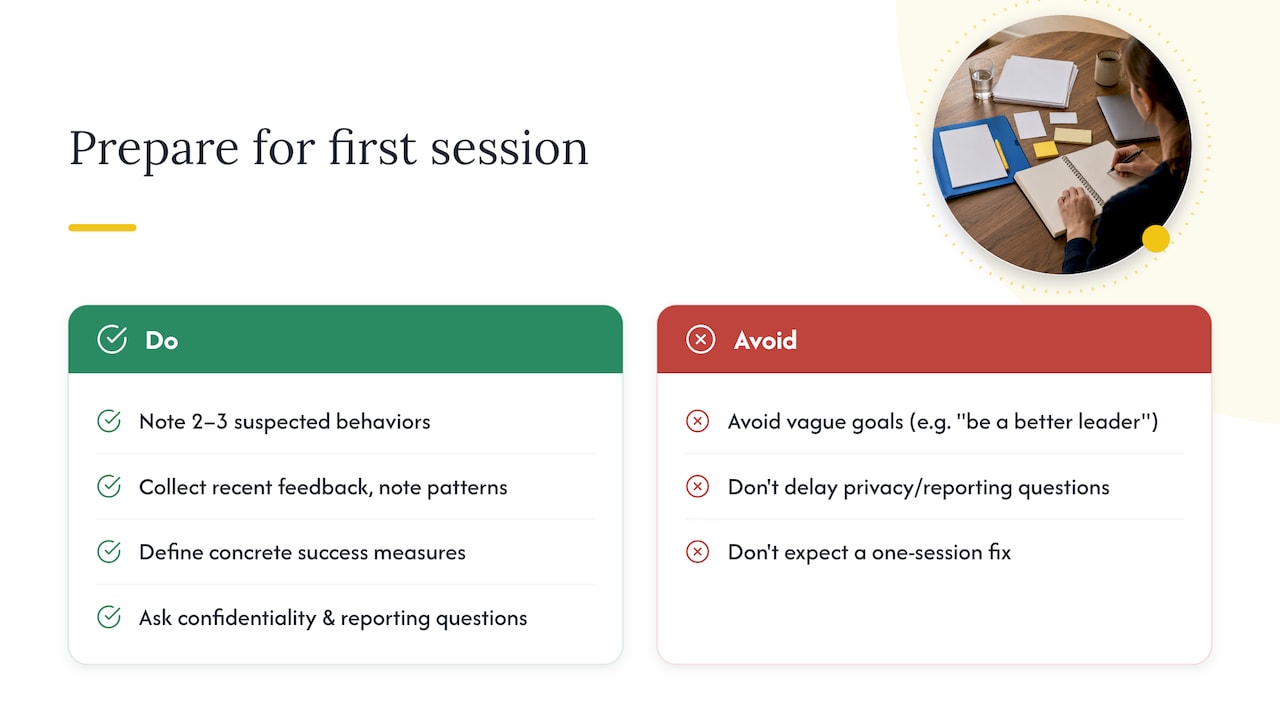
Walk into the first session with more than openness. Write down the two or three behaviors you suspect are holding you back, even if you are not sure which one matters most. A coach can help you prioritize, but you need to bring raw material.
Gather any recent feedback you have received, from a performance review, a peer, or a board member, especially anything repeated more than once. Patterns matter more than a single comment.
Think through what success would look like in concrete terms: fewer escalations landing on your desk, a direct report taking on more ownership, or simply feeling less reactive in meetings. Vague goals like “be a better leader” give a coach very little to work with.
Expect the first session to include a conversation about confidentiality boundaries, especially if your company is paying. Ask your questions about reporting and privacy here, not three sessions in. Finally, come with realistic expectations: the ICF-LA pricing survey notes that most engagements include a starter phase, a midpoint check, and a completion phase, so treat the first session as the start of a structured process, not a one-time fix.
When to stop, change, or expand your coaching engagement
Watch for signs the engagement has stalled: sessions that feel like venting instead of progress, or goals that have not moved in two check-ins. A new role, a merger, or a major setback often signals it is time to bring in a different specialist or renegotiate scope with your sponsor.
— Junna Liao
Ready for a confidential conversation about your next step
If what you have read sounds like your situation, 1:1 career coaching with Junna and life coaching both address the kind of transitions and burnout covered above, and the Energy Leadership™ Index assessment gives you a concrete starting point if you are not sure where to begin.
A discovery call is where fit gets tested directly: you will talk through what you are facing, how confidentiality works for your situation, and whether the approach matches what you need. There is no pressure to commit on the spot. Book a discovery call when you are ready to find out.
Sources
- The effects of executive coaching on behaviors, attitudes, and personal characteristics: a meta-analysis of randomized control trial studies
- The effects of executive coaching on behaviors, attitudes, and personal characteristics: a meta-analysis
- 2023 ICF Global Coaching Study — Executive summary
- You and Your Executive Coach Are a Bad Match. Now What? — HBR
FAQ
What is the average cost of an executive coach?
Published pricing varies by seniority, specialty, and sponsorship structure, with no single standard rate across the industry. The ICF’s global coaching study notes fees shift based on these factors rather than following a fixed formula, so ask any coach you are considering for their specific rate structure directly.
What is the 70/30 rule in coaching?
This is not a standard, research-backed term in the executive coaching field, and definitions vary depending on who is using it. Rather than relying on an informal rule, focus on agreeing with your coach on specific, observable goals and how progress will be measured.
Where can I find an executive coach in the Bay Area?
Look for a coach whose experience matches your industry and seniority level, and use a discovery call to test fit before committing. MMDC Alchemy, founded by Junna Liao, offers 1:1 career coaching built around this kind of transformational work.
How much do executive coaches charge per session?
Per-session fees and package retainers both exist in the market, and the rate depends on the coach’s experience and the client’s seniority. There is no single published per-session figure that applies across the industry, so confirm pricing directly with any coach you are evaluating.
Recommended
This blog is for educational and inspirational purposes only. It is not medical, legal, financial, or mental health advice. Your journey is unique; please seek qualified professional support for decisions that affect your health, finances, or wellbeing.