
Yes, specialized coaching for high achievers can create clarity fast, ease burnout symptoms, and produce measurable progress within three to six months when paired with real accountability. A client might shift from reactive overwhelm to a clear decision framework in a few weeks, then build a concrete career plan with regular check-ins over the following months. What follows covers what this coaching actually delivers, who tends to benefit, what the evidence shows, and how to choose a coach with confidence.
TL;DR:
- Coaching for high achievers produces measurable progress within three to six months, especially when combined with regular accountability and targeted actions.
- Most clients report increased self-awareness, behavior changes like saying no or restructuring calendars, along with clearer direction after six to twelve weeks.
- Effectiveness relies heavily on a strong coach-client relationship, with trust and collaboration being the best predictors of successful outcomes.
- Coaches should have specific experience working with high achievers, clearly defined methods, and transparent success measures to ensure a good match.
- Post-coaching habits such as quarterly self-checks and keeping a record of proven strategies help sustain long-term growth and prevent regression into old patterns.
Table of Contents
- What coaching for high achievers actually offers
- Who benefits most from this kind of coaching
- How coaching works and the evidence behind it
- How to choose the right coach
- MMDC Alchemy’s approach to high-achiever coaching
- Integrating goal-setting with performance strategy
- Sustaining growth after coaching ends
- Why coaching is a strategic investment, not a quick fix
- Start your coaching engagement with MMDC Alchemy
- FAQ
- Sources
What coaching for high achievers actually offers
Coaching for high achievers tends to center on a handful of recurring problems: burnout recovery, boundary setting, decision clarity, identity and energy work, and career transitions. A session rarely looks like generic advice. It looks like a structured conversation that surfaces a pattern the client cannot see alone, followed by a specific action to test before the next meeting.
Engagements come in different shapes depending on the need:
- A single intensive session for a specific decision, such as whether to accept a promotion or leave a role.
- A three to six month package built around a defined goal, usually with weekly or biweekly sessions.
- An assessment-integrated program that opens with a tool like the Energy Leadership™ Index to map current thinking patterns before setting a plan.
Progress at six to twelve weeks usually looks like sharper self-awareness and a few concrete behavior changes, saying no to a project, restructuring a calendar, naming a long-avoided conversation. By three to six months, clients typically report a clearer sense of direction and visible shifts in how they handle pressure, supported by consistent accountability outside scheduled sessions.
Coaching is not therapy. A coach works on goals, performance, and forward movement; a therapist treats diagnosable mental health conditions and past trauma. When a client shows signs of clinical depression, anxiety disorders, or unresolved trauma, a well-trained coach refers out rather than continuing the coaching relationship, since that distinction keeps the engagement safe and effective for both parties.
Pro Tip: Ask a prospective coach how they screen for issues outside their scope, and listen for a clear referral process rather than a vague reassurance.
Who benefits most from this kind of coaching
High achievers show up in coaching with a recognizable set of patterns, even when their titles differ widely.
- Senior leaders and executives carrying decision fatigue from constant high-stakes calls.
- High-performing individual contributors who have outgrown their current role but cannot articulate what comes next.
- Entrepreneurs managing identity fusion with their business, where a setback at work feels like a personal failure.
- High-achieving women navigating perfectionism, often compounded by pressure to prove competence repeatedly.
The readable symptoms tend to overlap: chronic exhaustion that does not lift with a vacation, decision paralysis on choices that used to feel easy, a sense of identity drift after years of defining themselves through output, friction at home from the same intensity that fuels success at work, and a nagging gap between external achievement and internal meaning. These patterns respond well to coaching because the format combines reflective conversation, small experiments between sessions, and someone checking in on follow-through, a combination that plain willpower rarely sustains on its own.
How coaching works and the evidence behind it
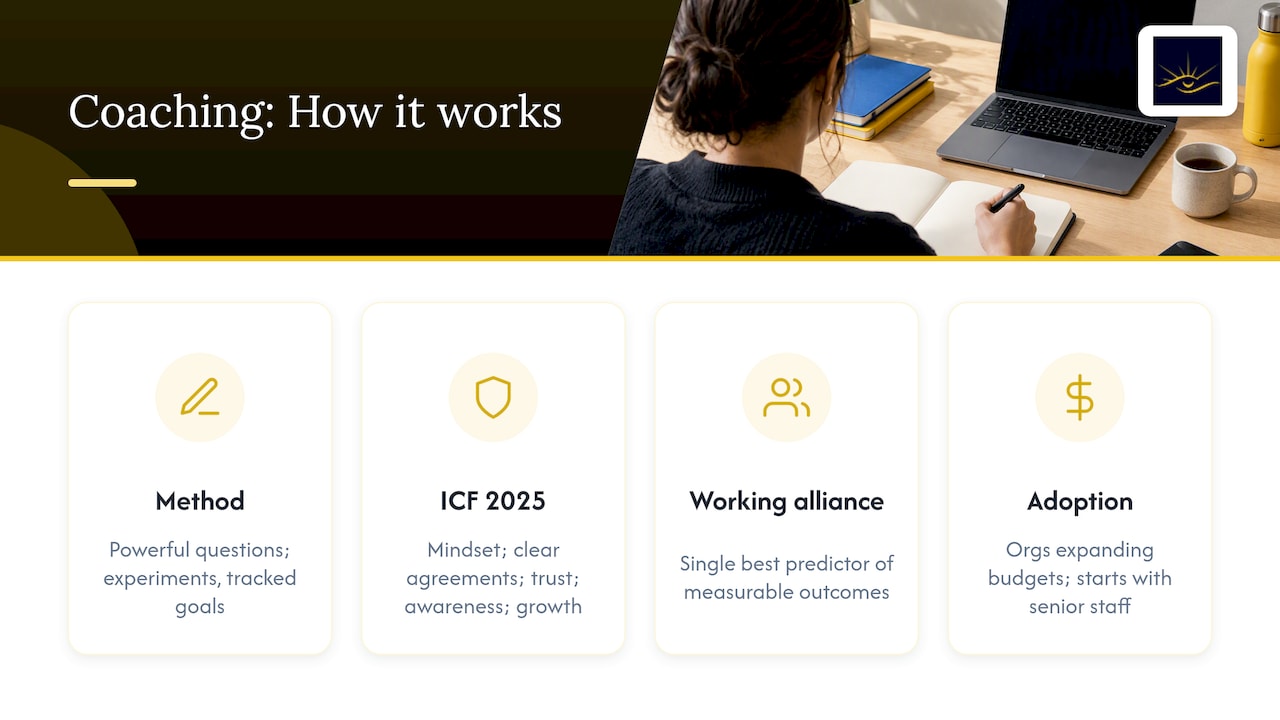
A coaching session typically runs on powerful questions rather than advice. The coach asks what the client has not asked themselves, then assigns a specific experiment, a conversation to have, a boundary to test, a decision to make by a set date. Progress gets tracked against goals the client defines early, not against the coach’s opinion of success.
The 2025 ICF Core Competencies updated the profession’s standards around a coaching mindset, clear agreements, trust and safety, evoking awareness, and facilitating client growth. That framework also stresses that effectiveness improves when coach and client define measures of success up front and revisit the coaching plan periodically rather than letting it drift.
The strength of the working alliance, the quality of trust and collaboration between coach and client, is the single best predictor of measurable coaching outcomes.
A near-randomized field study in a global healthcare corporation found that this working alliance drove the bulk of the measurable effect on well-being and self-efficacy, more than any specific technique the coach used.
Organizations are expanding coaching budgets as a direct response to post-pandemic burnout, with ICF and HCI research showing that coaching access often starts with senior staff before spreading further. That pattern matters for a high achiever deciding whether coaching is worth the investment: it is increasingly treated as a retention and resilience tool, not a remedial afterthought.
When a coach cites research, ask what kind: a randomized trial, a field study, or a practitioner survey each carry different weight, and a credible coach will tell you which one backs a specific claim.
How to choose the right coach
The selection process matters as much as the coaching itself. A mismatched coach wastes months.
Look for these markers before committing:
- Direct experience coaching high achievers through burnout or transition, not just general life coaching.
- A described method, not just a personality, so you know what a session actually involves.
- Willingness to discuss how they define and measure progress.
- Clear confidentiality terms and a sense of personal compatibility in the first conversation.
On a discovery call, ask these questions in order:
- What does a typical three-month engagement look like with a client in my situation?
- How do you define success, and how often do we check progress against it?
- What happens between sessions, and how do you handle accountability?
- How do you recognize when something is outside coaching’s scope?
- What is included in your pricing, and what is billed separately?
Pricing varies widely by coach experience and engagement depth: lighter packages may cover biweekly check-ins, while higher-fee engagements often include weekly sessions, an initial assessment, and more direct access between meetings. Set a review point at six weeks to confirm fit, and a milestone check at three months to evaluate real progress against the goals you named at the start.
Pro Tip: Write down your three biggest goals before the first call so you can tell quickly whether a coach’s approach actually fits what you need.
MMDC Alchemy’s approach to high-achiever coaching
MMDC Alchemy, founded by executive coach Junna Liao, builds its coaching around identity shifts and burnout recovery rather than generic goal-setting. The practice combines deep coaching conversations with practical life and career strategy, and has guided over 600 client transformations involving career reinvention and breaking free from limiting beliefs. Some clients work with an Energy Leadership™ Index early in an engagement to surface thinking patterns driving exhaustion or stagnation, then build a plan from there with substantial work and accountability between sessions.
Integrating goal-setting with performance strategy
Coaching works best when goal-setting and performance improvement happen together rather than as separate exercises. A goal without a performance strategy stays an intention; a performance tactic without a goal becomes busywork that does not move anyone forward.
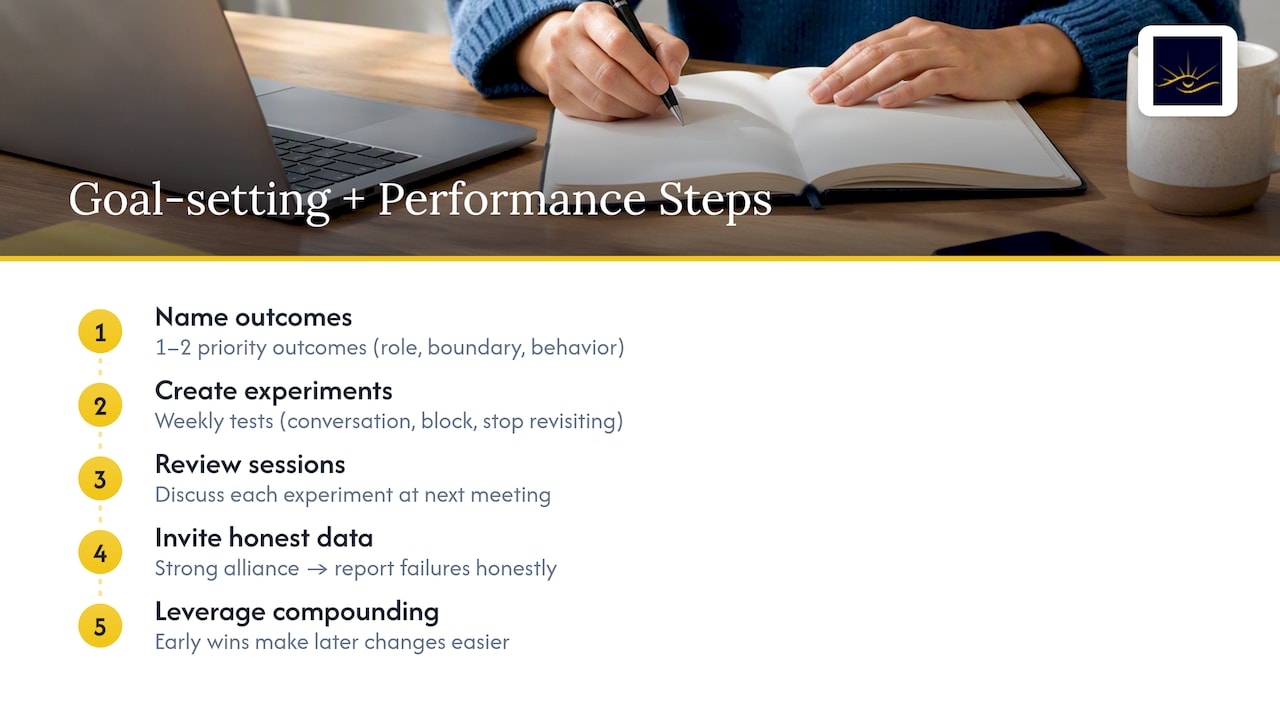
A typical approach starts with naming one or two outcomes that matter most over the engagement, a role change, a healthier boundary with work hours, a specific leadership behavior. From there, the coach and client break that outcome into weekly experiments: a difficult conversation to have, a calendar block to protect, a decision to stop revisiting. Each experiment gets reviewed at the next session, which keeps the goal connected to real behavior instead of staying abstract.
This is also where the working alliance research applies directly. A strong coach-client relationship makes a client more willing to report failed experiments honestly, which is often where the most useful adjustments come from. A client who only reports successes to their coach is usually hiding the exact pattern coaching is meant to interrupt.
Performance gains tend to compound rather than arrive all at once. A boundary set in week three makes a difficult conversation in week six easier, which makes a bigger career decision in month four feel less daunting. The goal-setting structure gives that compounding effect something to attach to, rather than letting progress stay a vague feeling of improvement.
Sustaining growth after coaching ends
The period after a coaching engagement ends is where many high achievers lose ground they worked hard to gain. Without the regular check-in, old patterns, overcommitting, avoiding hard conversations, measuring worth through output, tend to creep back in under pressure.
A few practices help sustain the work. Scheduling a quarterly self-check against the goals named during coaching keeps the plan visible instead of letting it fade into memory. Some clients return for a single session every few months rather than a full new engagement, using it as a tune-up when a specific decision or setback arises. Keeping a short written record of the experiments that worked during coaching, the boundary scripts, the decision frameworks, the energy patterns to watch for, turns insight into something reusable rather than something that lived only in the room with the coach.
The identity shift coaching often produces, moving from defining worth through achievement to defining it through alignment, needs ongoing reinforcement, since old professional environments often reward the exact behaviors a client just worked to change. Naming that tension in advance makes it far easier to resist sliding back into it when the first hard quarter hits.
Why coaching is a strategic investment, not a quick fix
I think the biggest mistake high achievers make is treating coaching as an emergency fix for burnout instead of a standing part of how they manage a demanding career. The clients who sustain change treat it as ongoing maintenance for judgment and energy, not a one-time repair. If you are weighing this, a short discovery call tells you more than another week of deliberating.
— Junna Liao
Start your coaching engagement with MMDC Alchemy
If what you have read sounds like your situation, the next step is a direct conversation, not another article. MMDC Alchemy offers 1:1 career coaching for leaders navigating transitions and life coaching for those working through identity shifts and burnout, often starting with the Energy Leadership™ Index assessment to map where you are now.
A discovery call typically covers:
- Your current situation and what prompted you to look into coaching now.
- Which program fits best given your goals and timeline.
- What a first few months of work together would involve.
Book a discovery call through MMDC Alchemy’s coaching programs page to see if this is the right next step.
FAQ
What is the average cost for a life coach?
Pricing varies widely by coach experience, session format, and engagement length, with lighter packages covering biweekly check-ins and higher-fee engagements including weekly sessions plus an initial assessment. A pricing framework analysis notes that higher-ticket coaching offers typically bundle more direct access and structured accountability into the fee. MMDC Alchemy’s coaching prices are available on request through a discovery call.
What is the 70/30 rule in coaching?
There is no single, widely recognized “70/30 rule” established by a major coaching body like the ICF. Definitions vary by practitioner, and some use it informally to describe a rough split between structured session time and self-directed work between meetings, but no standard source confirms this as an industry framework.
Who is the most successful life coach?
There is no verified, universally recognized ranking of the most successful life coach, since success depends on the client’s goals, fit, and measurable outcomes rather than a single title. The stronger question to ask a prospective coach is what specific outcomes their past clients have achieved and how those outcomes were tracked.
What type of life coach is most in demand?
Coaches specializing in burnout recovery, leadership transitions, and executive performance are seeing rising demand, with organizations increasing their coaching investments as a direct response to post-pandemic burnout. Demand often starts at the senior leadership level before expanding to other roles within an organization.
Recommended
- Mindful Leadership Coaching: Mastering the Alchemy of Presence and Energy
- Executive Coaching for High Performers: Mastering the Alchemy of Leadership
This blog is for educational and inspirational purposes only. It is not medical, legal, financial, or mental health advice. Your journey is unique; please seek qualified professional support for decisions that affect your health, finances, or wellbeing.