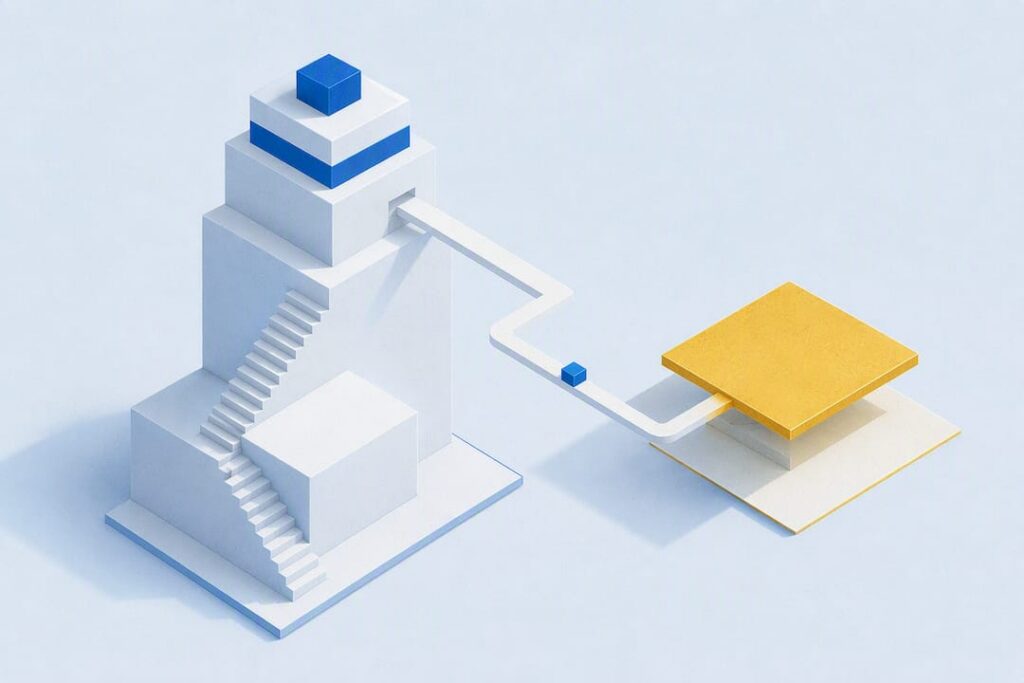
Attention residue is the part of your mind that stays on a task after you have moved to another one. You close the budget file and open the strategy deck, but some of your thinking is still in the spreadsheet. The result is a weaker performance on the work in front of you, and the cost shows up most when the task you left was unfinished or when you expect to return to it under pressure. The good news is that a short, specific habit, a written plan for returning to the interrupted task, reduces it.
This guide explains what the research says, why senior people are hit hardest, and how to redesign your day around it.
TL;DR
- Attention residue is the persistence of thoughts about Task A after you have started Task B. The term comes from Sophie Leroy’s research.
- It is worst when work is unfinished and when you expect to resume it under time pressure.
- A brief “ready-to-resume” plan, written before you switch, reduced residue in four studies.
- Executives pay the most, because their days are built from back-to-back meetings, messages and decisions.
- If you keep carrying residue despite good habits, the cause is often overcommitment or chronic stress, not technique.
Table of Contents
- What attention residue actually is
- Why it costs you more than the minutes you lose
- What the studies show
- The fix that has evidence behind it: a ready-to-resume plan
- Design your day for lower residue
- A quick self-check
- Perspective: when residue is a symptom, not the problem
- When it points to something bigger
- Residue and interviews
- Work on it with a coach
- FAQ
- Sources
What attention residue actually is
In her 2009 paper, Sophie Leroy defined attention residue as the persistence of cognitive activity about a Task A even though you have stopped working on it and are now performing a Task B. The paper asked why work is so hard to do when it is organized as a string of short, interrupted pieces, and it focused on the challenge of switching attention from one task to the next.
The key finding is intuitive once you hear it. Unfinished work is hard to let go of. In Leroy’s experiments, people who left a task incomplete found it difficult to move their attention away, and their performance on the following task suffered.
Two details matter for how you read this:
- Residue is not distraction. A notification pulling you away is an outside force. Residue is internal: your own mind keeps working on something you have already left.
- Residue is not laziness or poor discipline. It is a normal feature of how attention works. It simply collides with a work culture that expects instant switching.
Why it costs you more than the minutes you lose
The obvious cost of switching is time. The American Psychological Association summarizes the experimental work this way: people lose time when changing tasks, and the loss grows when the tasks are more complex or less familiar. That is the switching cost you can measure with a stopwatch.
Residue adds a second, quieter cost: quality. Part of your cognitive capacity is still occupied by the old task, so less is available for the new one. In a 2020 interview with BBC Worklife, Leroy described how residue takes up some of your cognitive resources and can reduce efficiency, listening quality, decision-making and information processing, while raising the odds of errors and a feeling of overwhelm.
That list should sound familiar if you lead people. Listening quality and decision-making are not side effects for an executive. They are the job.
A worked example
Imagine a vice president who finishes a tense budget review at 10:00 and walks straight into a one-on-one with a direct report who is struggling. The review ended without a decision. For the first ten minutes of the one-on-one, her mind keeps replaying what the finance lead said. She hears the words but misses the hesitation in her colleague’s voice. She agrees to a plan she would normally have questioned.
Nothing dramatic happened. No one interrupted her. But the one-on-one was worse than it needed to be, and neither person knows why. That is residue.
What the studies show
You do not need to read every paper, but the main results are worth knowing, because they point to what works.
Unfinished work lingers. Leroy’s 2009 experiments found that leaving a task incomplete makes it difficult to transition attention away from it, and performance on the next task falls. The same paper reported something less obvious: simply finishing the earlier task was not enough for a good transition. Time pressure while finishing it helped people disengage and perform better on the next task.
Expecting to return under pressure makes it worse. Leroy and Glomb’s 2018 paper in Organization Science found that anticipating time pressure when you resume interrupted work increases attention residue and lowers performance on the interrupting task. If you know the report will be due in two hours and you are pulled into a call, the report keeps nagging.
Even engaging work can leave residue. A 2019 study by Newton and colleagues examined 477 task transitions made by 20 crew members in a NASA analog research environment, along with a laboratory study of 346 participants. It found that engagement in a task can create residue that impedes engagement and performance on the next task, even while positive feeling from the engagement carries forward. The researchers also identified task completeness as something that reduces the negative effect. In plain terms, enjoying your work does not protect you from residue.
A plan helps you let go. A University of Washington report describes a field study of 202 working professionals in Midwestern organizations, plus laboratory studies of interruptions between work tasks. Participants without a return plan kept thinking about the abandoned task and did worse on the interrupting one. Those who made a ready-to-resume plan made better decisions and recalled more information from the professional résumés used as the interrupting task.
The fix that has evidence behind it: a ready-to-resume plan
The 2018 Organization Science paper reported evidence from four studies that a brief ready-to-resume intervention, reflecting on and planning your return to the interrupted work, reduces residue and prevents the interrupting task’s performance from suffering.
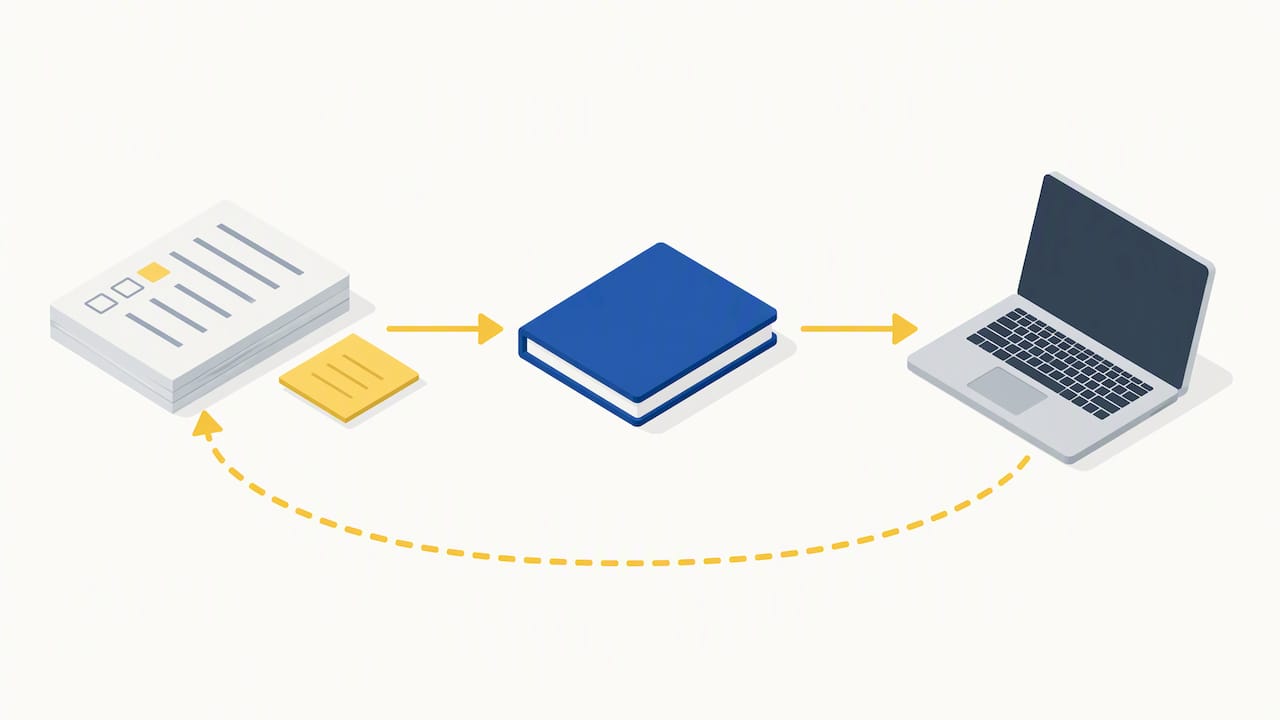
The University of Washington summary describes the practical version: write down what you need to resume and how or when you will resume it, then turn your attention to the new task.
Here is how to do that in under two minutes.
- Name the stopping point. One line: “Finished the revenue section; the cost section is not started.”
- Write the next action. One concrete step, not a topic. “Pull Q3 vendor costs from the shared sheet,” not “work on costs.”
- Set the return time. Put it on your calendar or a list you trust: “Back at 2:30 after the board prep call.”
- Capture the open worry. If a concern is pulling at you, write it in a sentence. Getting it out of your head and onto paper is the point.
- Switch deliberately. Take a breath and begin the new task with its own first line: what is the outcome I need from this meeting?
The plan works because it tells your mind the task is held somewhere safe. You are not abandoning it, you are scheduling it.
If you also keep a running record of why you made certain calls, a simple decision log with a few clear practices gives the same relief at the scale of whole projects, since you do not have to keep reconstructing context in your head.
Design your day for lower residue
A return plan handles switches you cannot avoid. Structure handles the rest. BBC Worklife’s 2020 guide recommends working on one task at a time until it is complete where possible, and using a ready-to-resume list or plan when switching is unavoidable. Here is what that looks like for a leader.
Finish small things fully, stop big things deliberately
Residue grows around open loops. For tasks under twenty minutes, finish them before you move on. For large tasks, stop at a natural boundary, such as the end of a section, and write the return plan. Stopping mid-sentence with no note is the most expensive way to leave work.
Build buffers between meetings
Back-to-back meetings give you no time to write a plan, so every meeting starts with the last one still running in your head. Even five minutes between calls is enough for a three-line note. If your calendar tool defaults to full-hour meetings, shorten them to 50 minutes and protect the gap.
Batch the shallow work
Email, chat and approvals generate constant tiny switches. Check them at set times instead of continuously. Each check is a transition, and each transition can leave residue behind. Our article on protecting 60 to 90 minutes to reduce cognitive load walks through how to carve out an uninterrupted block, and the piece on context switching fatigue covers why a day of small switches exhausts you.
Close the day on purpose
Before you log off, spend five minutes listing where each open task stands and what tomorrow’s first action is. You are writing a return plan for the biggest interruption of all: the night. People who skip this often replay unfinished work in the evening, which feeds the exhaustion that makes the next day harder.
Use short resets between very different tasks
When you move from a hard conflict to creative strategy work, a brief physical or breathing reset helps you arrive. We collected 60-second resets for executives that fit between calls without turning into another task.
A quick self-check
Ask yourself these questions after a typical week:
- Do you often reread a paragraph or message because your mind was elsewhere?
- Do you realize mid-meeting that you are still thinking about the one before?
- Do you end days with a long list of half-finished work and a sense that you were busy but did not move anything?
- Do you sit down to work at night because the day was too fragmented to do it earlier?
Three or four yeses suggest that residue is shaping your days. Start with the return plan and the buffers above before you change anything bigger.
Perspective: when residue is a symptom, not the problem
We coach executives and senior professionals through burnout, career transitions and identity shifts, and attention residue comes up in nearly every first conversation, even when the client does not use the term. They tell us they cannot switch off, cannot focus in meetings, cannot be present at home.
Our view is that technique helps, and you should use it. A written return plan is cheap and has research behind it. But when a capable leader has tried the plans, the buffers and the batching and still feels pulled in ten directions, the issue is rarely a missing productivity hack. More often it is a calendar that reflects too many commitments, or a role that no longer fits who the person has become. Residue is what that overload feels like from the inside.
That is why our coaching combines practical planning with deeper work on what matters to you. We use the Energy Leadership™ framework to look at how you respond under pressure, and we ask what you are saying yes to and why. The work includes substantial effort and accountability between sessions, because a new habit that lives only in a coaching conversation does not survive a Tuesday full of meetings.
If you recognize this pattern, read our guide to overcommitment at work before you add another tool to your stack. Often the best way to reduce residue is to have fewer things competing for your attention in the first place.
— Junna Liao
When it points to something bigger
Residue that never lifts, even on quiet days, can be one sign of sustained strain. Persistent trouble concentrating, irritability, poor sleep or dread on Sunday evenings deserve attention. If these are affecting your health, speak with a physician or licensed mental health professional. They can assess what you are experiencing, which a productivity article cannot.
For leaders whose load is high but who are functioning, there are structured ways to lighten it. Our five-step CLEAR plan for executive mental load and our guide to spotting chronic stress at work are good places to start. If you are recovering from a leave, returning to work after burnout without relapsing requires a plan for how your attention is protected from the first week.
Residue and interviews
Switching well is also a skill hiring managers probe for. If you are preparing for a job change, you may meet questions about how you handle competing priorities, and a strong answer draws on the same ideas covered here: finishing what you can, writing a return plan and protecting focus. This overview of interview questions about multitasking shows how such questions are usually framed. Be honest in your answer. Claiming that you multitask effortlessly is a weaker story than describing how you manage transitions.
Work on it with a coach
If you want a structured partner for this, our 1:1 career coaching with Junna is built for executives and senior professionals who are overextended or at a turning point. Engagements are individual and typically run three to twelve months. We look at your calendar, your commitments and your sense of purpose together, and we hold you accountable between sessions. We do not publish a price, so reach out to learn how an engagement would work for you.
If you want a clearer read on how you respond under pressure first, the Energy Leadership™ Index assessment is a good starting point. For a broader look at the approach, see what transformational coaching is.
FAQ
What does attention residue mean?
It means thoughts about a previous task keep occupying your mind after you have moved to a new one. Sophie Leroy introduced the concept in her 2009 paper, where it describes cognitive activity about Task A that persists while you perform Task B. The more unfinished the first task, the stronger the pull.
How do you reset your focus at work after an interruption?
Before you switch, write down where you stopped, what the next step is and when you will return. Research summarized by the University of Washington found that people who made such a plan performed better on the interrupting task. Then start the new task with a clear first line about what you need from it.
Can finishing a task first prevent attention residue?
Only partly. Leroy’s 2009 study found that merely finishing the earlier task was not enough for a smooth transition, though time pressure while finishing helped people disengage. Finishing small tasks fully is still wise, and for larger work a return plan is the reliable tool.
Does attention residue affect decision-making?
Yes, according to the research. In the University of Washington work, people who lacked a return plan did worse on the interrupting task, while those with a plan made better decisions on résumé-review tasks. Leroy has also said residue can reduce decision-making quality and listening.
Is attention residue the same as multitasking?
They are related but different. Multitasking describes trying to do things at once or in rapid alternation, and the APA notes that switching between tasks carries time costs. Residue is the mental carryover that results when you leave one task for another, whether you switch by choice or because you were interrupted.
Sources
- Why is it so hard to do my work? The challenge of attention residue when switching between work tasks (Leroy, 2009)
- Tasks Interrupted: How Anticipating Time Pressure on Resumption of an Interrupted Task Causes Attention Residue (Leroy and Glomb, 2018)
- Task interrupted: A plan for returning helps you move on (University of Washington, 2018)
- Taking Engagement to Task: The Nature and Functioning of Task Engagement Across Transitions (Newton and colleagues, 2019)
- Multitasking: Switching costs (American Psychological Association)
- How to reduce ‘attention residue’ in your life (BBC Worklife, 2020)
Recommended
- Protect 60–90 Minutes to Reduce Cognitive Load at Work for Leaders
- Cut Executive Mental Load in 90 Days with a Five Step CLEAR Plan
- Mindfulness for Executives: Research Backed 60 Second Resets
- Professionals: Stop Losing 23 Minutes to Context Switching Fatigue
This blog is for educational and inspirational purposes only. It is not medical, legal, financial, or mental health advice. Your journey is unique; please seek qualified professional support for decisions that affect your health, finances, or wellbeing.