
A people-pleasing leader manages other people’s reactions instead of the work. They say yes to protect approval, soften decisions until they stop meaning anything, and quietly absorb what their team should carry. It looks like kindness from the outside. From the inside it is tiring, and over time it costs the leader’s judgment, their boundaries and their energy.
This guide separates people-pleasing from real empathy, shows what the pattern looks like in a leader’s week, explains the link to burnout, and lays out what to change first.
TL;DR
- People-pleasing leadership is driven by the need to be liked. Empathy is driven by understanding what people need so you can lead them well. The two feel similar and produce opposite results.
- The usual signs: yes by default, decisions checked with too many people, agreement you do not hold, and tasks you take back because it is easier than a hard conversation.
- The pattern is expensive. It slows decisions, weakens challenge on your team, and drives the kind of exhaustion that ends in burnout.
- The fix is not becoming harsh. It is trading likability for trust: pause before you commit, say no to small things first, and explain the reasoning behind decisions.
- Patterns this old rarely yield to willpower alone. Working with a coach on the belief underneath tends to make the change last.
Table of Contents
- What people-pleasing looks like in a leader
- People-pleasing versus empathy
- Why leaders do it
- What it costs your team and your decisions
- How people-pleasing leads to burnout
- How to stop without becoming harsh
- A worked example
- Why the belief underneath matters
- Working on it with a coach
- What to expect when you change
- FAQ
- Sources
What people-pleasing looks like in a leader
People-pleasing is not a personality flaw. It is a strategy, usually learned early, that works well until you are responsible for other people’s performance. Writer Kelly L. Campbell traces the pattern to early assumptions that you must put others’ needs first to earn belonging, which leads to an unconscious effort to be liked by as many people as possible.
In a leadership role, that effort shows up in ordinary moments:
- You say yes before you have thought. A request arrives in a hallway or a message and you accept it while your calendar is already full.
- You take work back. A report comes in below standard, and rewriting it yourself feels easier than a feedback conversation.
- You agree in the room and disagree afterward. The meeting ends with nods. The real opinion surfaces in a private chat or not at all.
- You over-check decisions. You circulate a choice to everyone who might object, not to improve it, but to make sure nobody is unhappy.
- You soften feedback until it disappears. Your team leaves a review not knowing what to change.
- You explain too much. Every no arrives with a paragraph of apology.
The IMD leadership faculty describe much the same cluster: taking on tasks others could do, checking decisions unnecessarily and agreeing despite disagreement are signs of the pattern, and they note that new leaders are especially exposed.
That last point matters. Many people-pleasing leaders were promoted because they were helpful, responsive and easy to work with. The traits that earned the promotion become the trap once the job is to decide, prioritize and hold people to standards.
People-pleasing versus empathy
This is the question that stops most good leaders from changing. If you care about your people, is that not a strength? It is. The problem is not caring. It is what the caring is for.
Empathy is understanding what someone is experiencing and responding in a way that helps them. Research on leader empathy, including a theory-and-test study of empathetic leadership, found that leader empathy raises follower performance by increasing job satisfaction and fostering innovation. Empathy done well makes the team better at the work.
People-pleasing aims at a different outcome: your comfort, specifically the relief of not being disliked. The test is simple.
| Situation | Empathetic response | People-pleasing response |
|---|---|---|
| A team member misses a deadline | Asks what happened, names the impact, agrees on a fix | Says it is fine and does the work yourself |
| You must decline a request | Says no clearly, explains the priority behind it | Says maybe, then resents the commitment |
| Your team disagrees with your plan | Hears the objection, decides, explains why | Changes the plan to end the tension |
| Someone is struggling | Adjusts support and keeps expectations clear | Lowers the bar without telling them |
| You disagree in a meeting | States your view with respect | Nods, then vents later |
A useful question to ask in the moment: Am I doing this because it helps this person and the team, or because I cannot stand the thought of their reaction? Empathy survives an honest answer. People-pleasing does not.
The second distinction is cost. An empathetic leader can sustain the behavior, because it is aligned with their role. A people-pleasing leader pays a hidden toll each time, because they are acting against what they actually think or want.
Why leaders do it
The origin is usually understandable. Early in life, many of us learn that safety and belonging depend on being agreeable, helpful or low-maintenance. Those lessons are not deliberate. They harden into assumptions: If I disappoint someone, I will lose them. If I say what I think, there will be conflict. If I am not useful, I am not valued.
At work, a few things reinforce them:
- Promotion rewards the pattern at first. Responsive, accommodating people get noticed.
- Leadership raises the stakes. Now more people can be disappointed by every decision.
- Culture can reward overextension. A 2025 paper on people-pleasing in the workplace suggests organizations can reduce unhealthy overcommitment by rewarding time management and prioritization rather than just excessive dedication. If your company celebrates the person who never says no, it is feeding the pattern.
- Conflict feels more dangerous than it is. Avoidance feels safe in the short run and creates larger problems later.
Understanding the origin is not an excuse. It is a way to see that the habit has a logic, which is also why it can be changed. You are not fighting a character defect. You are updating an old rule that no longer fits the role.
What it costs your team and your decisions
Conflict goes underground
Avoiding conflict does not remove it. A UW-Green Bay Small Business Development Center article reports that employees spend over two hours a week involved in conflict, and that ineffective conflict management costs roughly a full day of productivity each month. When the leader will not address friction directly, it moves into side conversations, passive resistance and slow decisions.
Dissent disappears
Teams read their leader quickly. If you visibly need agreement, people stop offering the objections you most need to hear. Research summarized by Knowledge at Wharton found that powerful, popular leaders who discourage dissent can cause teams to converge too quickly on solutions, leaving assumptions untested and questionable choices unchallenged. A leader who is liked and cannot be disagreed with is a risk to the organization.

Standards blur
When you absorb the gap between what was promised and what was delivered, your strong performers see the difference in treatment. Expectations become negotiable, and the people who meet them start to wonder why they bother.
Your own work suffers
The hours you spend rewriting, over-communicating and saying yes are hours not spent on strategy. Many people-pleasing leaders are working very hard on the wrong things.
Our guide to leadership boundaries covers how to set limits that actually hold, which is often where the first practical change begins.
How people-pleasing leads to burnout
People-pleasing is a form of constant emotional management. You monitor reactions, adjust your tone, suppress disagreement and absorb tension. IMD’s guidance notes plainly that the pattern is exhausting and can quickly lead to burnout.
The wider research on emotional labor points the same way. A 2019 literature review found that emotional labor contributes to health problems ranging from burnout and fatigue to sleep disruption. A study of 1,517 public-sector employees reported that the effort and control needed to express organizationally desired emotions contributes to stress and burnout. These studies are about service and care settings rather than executives, so treat them as evidence of the mechanism: acting out feelings you do not have is draining, and a pleasing leader does it daily.
A related finding comes from a Dutch study of employees: a gap between how people think they are perceived and how colleagues actually see them was linked to higher burnout. Leaders who spend energy managing an image they imagine others hold are carrying a load that may not even be real.
Signs the pattern has become burnout
- You are exhausted after a day of conversations, not after a day of hard thinking.
- You feel resentment toward people you like.
- You dread messages that ask for “a quick favor.”
- Recovery on weekends no longer works.
- You feel detached from work that used to matter.
If this sounds familiar, our four questions to separate burnout from emotional exhaustion can help you name what you are dealing with, and the chronic stress signs page covers the early warnings. If you are experiencing persistent low mood, hopelessness or trouble functioning, talk to a physician or licensed mental health professional. Coaching is not a substitute for clinical care.
How to stop without becoming harsh
Most people-pleasing leaders fear that stopping will turn them into someone cold. It will not. You are not removing warmth. You are removing the fear that has been steering it.
The IMD guidance offers a clean reframe: being trusted is a requirement for a leader, while being liked is a bonus. Trust is built through clarity and consistency, which is exactly what people-pleasing erodes. Here is how to start.
1. Pause before you accept
Adopt one sentence: “Let me check my priorities and get back to you.” It costs nothing and breaks the automatic yes. Then decide against your actual commitments, not the discomfort of the moment.
2. Practice no on small things
Do not start with the board. Start with a low-stakes request, decline cleanly, and notice that the relationship survives. Each small repetition updates the old rule that disappointing someone is dangerous.
3. Explain the why, not the apology
“I am not taking this on because we agreed to focus on the Q3 launch” is clear, kind and tied to shared goals. Long apologies invite negotiation.
4. Say what you actually think
Use your voice in meetings before you read the room. Offer your perspective first, then invite disagreement. That also gives your team permission to push back, which protects the quality of your decisions.
5. Give the feedback
Name the gap, the impact and the next step. Resist the urge to cushion it into nothing. Teams generally prefer a leader who is clear over one who is pleasant and vague.
6. Return work to its owner
When someone hands you a task that belongs to them, coach instead of rescuing. This is also where the boundary between supporting and carrying becomes visible. The same discipline matters in client-facing teams, where coaching without burning out managers depends on building skill in people rather than absorbing their work.
7. Protect recovery
A 2024 article on emotionally intelligent leadership emphasizes that regulating your own emotions, managing the work-life interface and prioritizing recovery activities are part of setting boundaries. Treat recovery as a leadership responsibility, not a reward.
If conversations are where it breaks down, clear communication coaching for leaders focuses on exactly these moments, and our piece on emotional triggers at work explains why certain requests make you say yes before you think.
A worked example
Consider a composite scenario, not a real client. A newly promoted director, Maya, answers messages within minutes, rewrites her team’s presentations on Sunday nights, and agrees to every stakeholder request. Her team likes her. Her projects slip, two strong people quietly leave for roles with clearer expectations, and she is exhausted.
The first changes are small. She introduces a 24-hour rule for new commitments. She gives one team member direct feedback on a weak presentation and lets them redo it. She starts stating her view first in staff meetings. Within weeks the Sunday rewrites stop. The uncomfortable part is the first conversation, not the tenth.
What matters here is sequence: behavior first in low-risk moments, then the belief underneath, which loosens as the feared consequences fail to arrive.
Why the belief underneath matters
Our perspective
We see this pattern constantly in the executives and senior professionals we work with. The most common mistake is treating people-pleasing as a communication-skills problem. Scripts help, but they do not hold when the old belief is still running: if they are disappointed in me, I am not safe, not valued, not enough. Under pressure, the belief wins.
That is why our work combines deep coaching with practical strategy. We look at the identity the leader built around being helpful and agreeable, what it protected, and what it is costing. Then we build real changes in how the week is run: what you say yes to, what you hand back, how you hold a boundary, how you recover. The work outside the sessions is substantial, and the accountability is part of why it sticks.
One tool we use is the Energy Leadership™ Index assessment, which shows how you respond to pressure and where your energy goes. For many leaders, seeing a pattern on paper makes it easier to stop defending it.
The goal is never to make you less caring. It is to make your care sustainable and your leadership trusted.
— Junna Liao
Working on it with a coach
If you recognize yourself here, you do not need to be fixed. You need a thinking partner who will tell you the truth and hold you to the changes you decide to make. We offer one-on-one career coaching with Junna for leaders working through burnout, role changes and identity shifts, and life coaching for the wider patterns that follow you in and out of work. You can also start with the Energy Leadership Index assessment to see your current baseline.
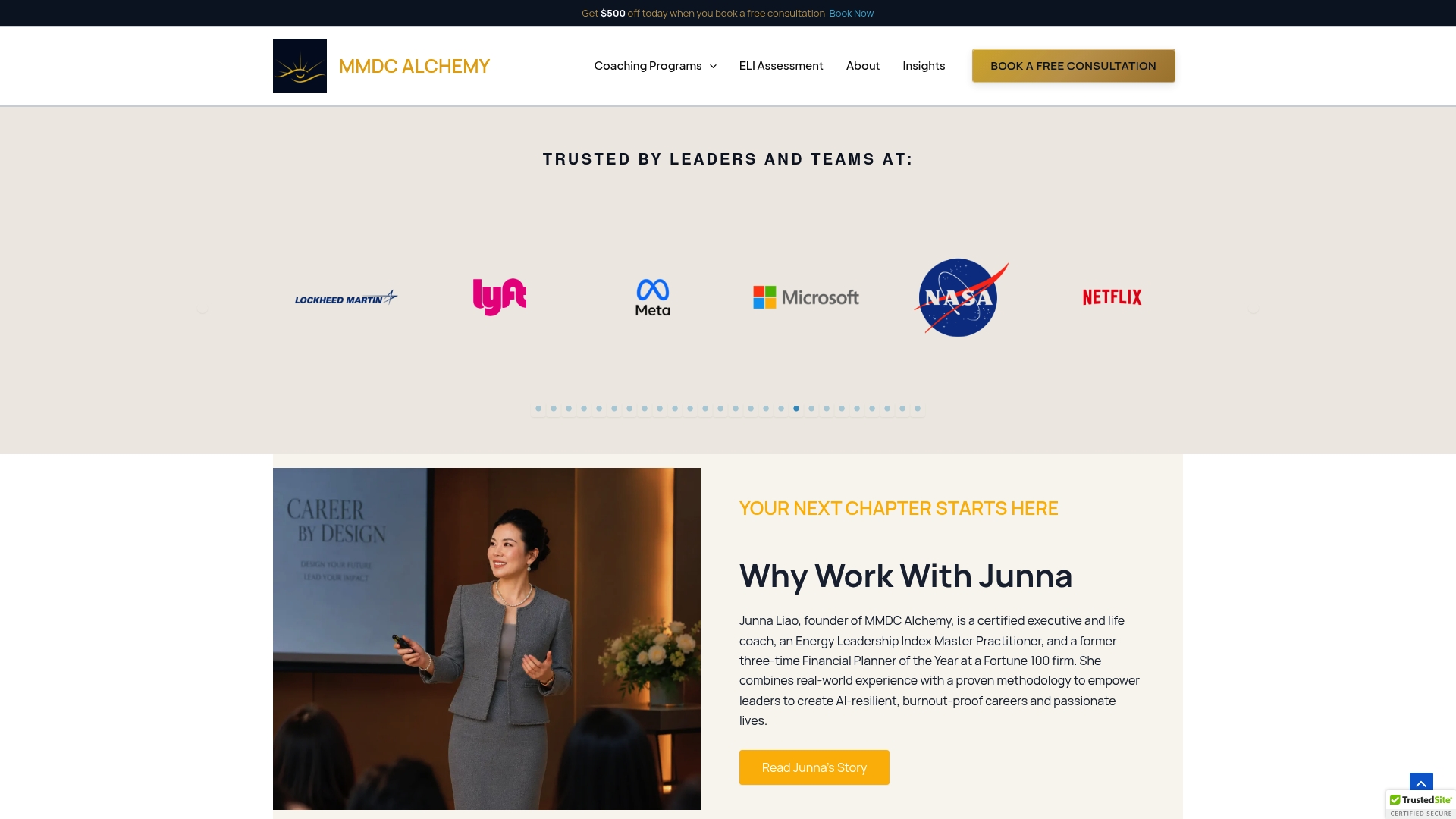
Engagements are private and personalized, and typically run three to twelve months. Pricing is shared in conversation, not published on the site.
What to expect when you change
Some discomfort is normal and a sign it is working. Expect:
- Pushback. People who benefited from your yes may protest. Hold the boundary, kindly.
- Guilt. It usually fades faster than you expect.
- Better challenge. Once you stop needing agreement, your team starts telling you what they really think.
- Sharper priorities. With fewer commitments, the important ones get done well.
If the exhaustion is already deep, build recovery alongside behavior change. Our page on rebuilding capacity after burnout describes how that can be structured, and the mental load guide addresses the constant background carrying that often comes with it.
FAQ
Is people-pleasing the same as being a nice leader?
No. A nice leader is warm and still makes hard calls, gives honest feedback and holds standards. A people-pleasing leader avoids those things to avoid disapproval. The difference lies in what drives the behavior: care for the team, or fear of their reaction.
Can people-pleasing cause burnout?
Yes, it is a common path. Suppressing disagreement, over-committing and managing others’ emotions is constant effort, and research on emotional labor links that kind of effort to fatigue and burnout. If symptoms are severe or persistent, see a physician or licensed mental health professional.
How do I know if my boss is a people pleaser?
Look for decisions that change after pushback, vague feedback, avoidance of conflict and a pattern of saying yes then reversing. Be specific and calm when you raise issues, and ask for clear priorities in writing so the gaps are visible without blaming.
Can a people pleaser become a strong leader?
Yes. Many do, once they learn to separate being trusted from being liked. The skills are learnable: pausing before committing, saying no, giving direct feedback and stating your view. Lasting change usually involves the belief underneath as well as the behavior.
What is a good first step?
Choose one small request this week and decline it clearly, or use a 24-hour pause before accepting anything new. Notice what happens. Small, repeated evidence that disapproval is survivable does more than any insight on its own.
Sources
- Don’t Become a People Pleaser, IMD
- Are You a People-Pleasing Leader?, Built In
- Empathetic Leadership: How Leader Emotional Support and Understanding Influences Follower Performance
- The Workplace Dynamic of People-Pleasing, MDPI
- Avoiding Conflict Can Often Cause Conflict, UW-Green Bay SBDC
- Strong Leaders Encourage Dissent, and Gain Commitment, Knowledge at Wharton
- The impact of emotional labor on health, PMC
- Job Demands-Resources and service workers, PMC
- Self-, other-, and meta-perceptions of personality, PMC
- Understanding Emotional, CDC Stacks
- Coaching at Scale: How to Coach Every Rep Without Burning Out Managers
Recommended
- Coaching for Limiting Beliefs in Leadership
- Self-Awareness for Leaders: How to Build It and Use It
- Leadership Boundaries: How to Set Them and Make Them Hold
- Leadership Purpose: One Sentence to Guide Decisions Under Pressure
This blog is for educational and inspirational purposes only. It is not medical, legal, financial, or mental health advice. Your journey is unique; please seek qualified professional support for decisions that affect your health, finances, or wellbeing.