For leaders, mental load at work is the cognitive and emotional burden of sustained decision-making and constant vigilance. The fastest way to cut its damage is to build verified coverage for your responsibilities—an AI triage system or a trusted delegate, plus a short VIP escalation list—and block a daily decision-triage window before your inbox opens. What follows is the research behind why this works and how to build it properly.
TL;DR:
- Leaders should limit the volume of low-impact decisions processed daily by batching them into fixed time blocks to reduce cognitive overload.
- Establishing pre-commit rules and a concise VIP escalation list helps prevent unnecessary interruptions, preserving mental capacity.
- Using AI triage tools can effectively filter demands and decrease after-hours message checks when combined with clear delegation and escalation protocols.
- Structural fixes must be complemented with internal work, such as identity and somatic coaching, to prevent vigilance from migrating and ensure sustainable recovery.
- Tracking key metrics like after-hours message checks and decision-making time over 30 days reveals whether the mental load reduction system is effective or needs reinforcement.
Table of Contents
- What Mental Load at Work Actually Looks Like in Leaders
- Root Causes: Why Leadership Roles Manufacture Mental Load
- A Framework for Reducing Mental Load: Categorize, Limit, Establish, Audit, Recover
- Where Coaching Fits: Rebuilding Capacity, Not Just Managing Symptoms
- Verified Coverage Alone Doesn’t Fix You
- How to Start Rebuilding Your Capacity With MMDC Alchemy
- Sources
- FAQ
What Mental Load at Work Actually Looks Like in Leaders
Mental load rarely announces itself as a crisis. It shows up as a slow leak, and most executives misdiagnose it as a time management problem when it’s actually a processing-capacity problem.
Cognitive overload happens when the volume of mental demands on you exceeds what your brain can actually process at once, and the effect is measurable: slower reaction times, weaker working memory, and impaired executive functioning. You don’t feel “busy.” You feel foggy, irritable, and strangely unable to make small decisions you’d normally breeze through.
Watch for these patterns in yourself or your leadership team:
- Decision fatigue by early afternoon, even on light meeting days
- Brain fog during routine reviews you’ve done a hundred times
- Compulsively rechecking Slack or email between meetings, even with nothing urgent pending
- Reactive, short-fuse responses to minor problems that wouldn’t normally register
- Defaulting to the easiest available option instead of the best one, just to make the decision stop
Signs to watch: if you notice three or more of these most days, you’re not just tired. You’re operating with impaired executive functioning, and the Muse’s practitioner research ties this exact cluster, reduced focus, frequent mistakes, and a persistent sense of being overwhelmed, directly to cognitive overload rather than simple fatigue.
Root Causes: Why Leadership Roles Manufacture Mental Load
The volume of decisions is the obvious culprit, but it’s rarely the whole story. Senior roles concentrate several distinct sources of cognitive strain that stack on top of each other rather than replacing one another.
Ambient vigilance is the quiet one. It’s not the meeting itself that drains you. It’s the part of your brain that never fully stands down between meetings, scanning for the fire that might be starting somewhere in the organization. Organizational researchers increasingly treat this baseline hypervigilance, not raw workload, as the leading indicator of executive burnout, and it costs energy even when nothing is actually wrong.
The other drivers tend to cluster into four buckets:
- Decision volume: dozens to hundreds of choices daily, most low stakes but still consuming attention
- Context switching: jumping between a board deck, a Slack thread, a direct report’s crisis, and a client call within the same hour
- Identity fusion: senior leaders often can’t separate “I made a bad call” from “I am failing,” which turns ordinary mistakes into emotional labor
- Organizational noise: unclear escalation rules, weak delegation habits, and reporting systems that surface everything with equal urgency
That last point deserves attention because it’s the most fixable. When nobody has explicitly defined what counts as urgent, everything defaults to urgent, and your brain treats a scheduling conflict the same way it treats a client walking away. Coaching work on clear communication and delegation exists specifically to fix this gap, because most leaders were never taught how to build escalation rules that actually hold.
A Framework for Reducing Mental Load: Categorize, Limit, Establish, Audit, Recover
Diagnosing the problem is the easy part. Building a system that actually reduces the load requires structure, which is where a framework earns its keep. Think of CLEAR as five sequential moves you can start today and refine with a coach over the following weeks.
- Categorize decisions by impact. Sort what crosses your desk into three tiers: irreversible and high-stakes, moderate and correctable, and trivial. Most executives discover that a majority of their daily decisions belong in the bottom tier, yet they’re spending premium cognitive energy on all three equally.
- Limit decision windows and batch low-impact items. Pick two fixed blocks a day, say 20 minutes each, to clear every tier-three decision at once instead of reacting to them as they land. Time-blocking works precisely because it removes the “should I deal with this now” micro-decision that precedes every actual decision.
- Establish pre-commit rules and delegation guardrails. Write down, in advance, how categories of recurring decisions get handled: budget requests under a set threshold, scheduling conflicts, standard client escalations. A pre-commit rule turns a decision into a lookup, which costs almost nothing cognitively.
- Audit your inputs and build a VIP escalation list. Most leaders have never actually mapped who and what genuinely needs to reach them versus what merely feels urgent to the sender. A short, named list of the five to eight people authorized to interrupt you directly does more to protect attention than any productivity app.
- Recover on a schedule, not by accident. Deliberate breaks aren’t a reward for finishing work. They’re what restores the processing capacity you spent, and skipping them is why the same problems resurface by Thursday.
AI-assisted triage tools now let executives build genuine verified coverage, someone or something screening incoming demands against your pre-commit rules and VIP list, and this measurably reduces after-hours checking and the ambient vigilance that comes with it, according to reporting on AI-enabled executive boundaries. Pair that with operational frameworks like the ones outlined in Keystone Consulting’s guidance on prioritization and time management, and you have a system, not just a habit.
Pro Tip: Track three numbers for 30 days: after-hours message checks, average time from decision prompt to decision made, and whether your recurring meetings ended with a clear owner assigned. If none of the three improve, the framework isn’t broken, your enforcement of it is.
Run a 90-day version of the same tracking and you’ll usually see a second-order effect: fewer decisions reversed, because the ones you made were made with actual bandwidth rather than fumes.
Where Coaching Fits: Rebuilding Capacity, Not Just Managing Symptoms
Structural fixes like decision architecture and verified coverage solve the mechanics of mental load. They don’t touch the part of burnout that’s psychological, the identity fusion and chronic vigilance that keep rebuilding the load even after you fix the calendar. Executive burnout recovery typically requires both tracks running together, structural change and deeper internal work, according to analysis of executive burnout patterns.
This is where a coaching relationship does work a framework alone can’t:
- A confidential assessment, such as MMDC Alchemy’s Energy Leadership Index Assessment, surfaces the unconscious energy patterns driving your reactivity before you’re consciously aware of them
- Somatic and presence-based practice, the kind taught in mindful leadership coaching, regulates the nervous system response that keeps you scanning for threats even in safe moments
- Accountability structures turn a pre-commit rule from a good intention into an actual habit, because most people abandon new systems within two weeks without outside reinforcement
- Identity work separates “I made a mistake” from “I am the mistake,” which is often the real reason leaders can’t delegate
The timeline tends to follow a pattern: reduced reactivity within the first few weeks, sharper decision quality by month two or three, and a genuinely different leadership presence, the kind that doesn’t collapse the next time the organization gets loud, by month six. Many coaching clients have progressed through some version of this arc, often senior leaders who arrived thinking they needed better time management and left having rebuilt something closer to their actual capacity.
Verified Coverage Alone Doesn’t Fix You
Here’s what I keep coming back to: the executives who recover fastest never treat the tactical fixes and the internal work as separate projects. Build verified coverage without doing the somatic and identity work underneath it, and the vigilance just migrates. You’ll stop checking Slack at 11 p.m. and start lying awake instead, because the nervous system that learned to scan for threats doesn’t get a memo about your new escalation list.
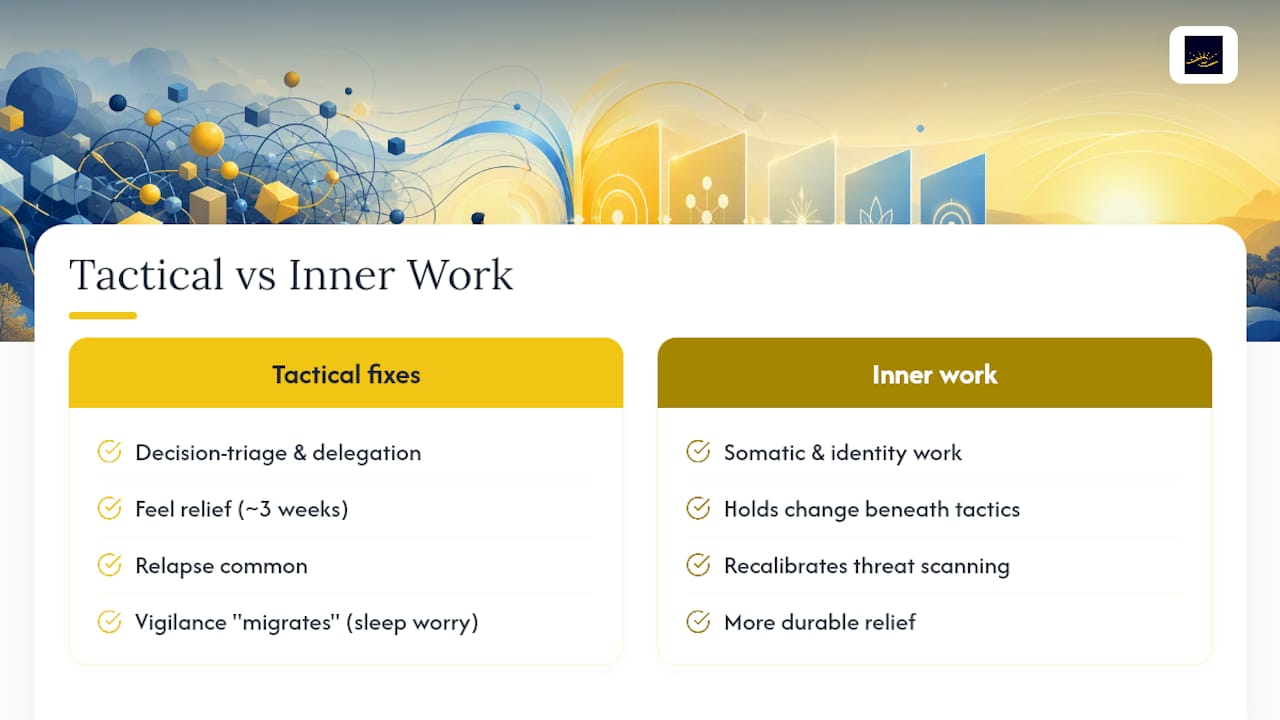
One client pattern I’ve seen repeatedly: a leader installs a decision-triage block and a delegation system, feels the relief for about three weeks, then quietly reverts, because nobody addressed why letting go felt like losing control in the first place. The tactical layer needs the inner layer to hold.
If you want a fast, honest read on where you actually stand, try this for 48 hours: route every nonessential decision through a real triage system, human or AI, and protect a strict 20-minute daily block for the decisions that survive it. Notice what your body does when something urgent doesn’t reach you immediately. That reaction is the real work.
— Junna Liao
How to Start Rebuilding Your Capacity With MMDC Alchemy
Certain coaching services are designed specifically for leaders who’ve already tried productivity fixes and know that their challenges run deeper than calendar management. Many coaching engagements start with a confidential discovery call to map what’s driving a leader’s mental load before designing a tailored program.

A discovery call typically covers where your decision fatigue is coming from, whether an Energy Leadership Index Assessment makes sense as a starting baseline, and what a coaching arc could look like given your specific role and pressures. MMDC Alchemy has worked with more than 600 clients navigating this exact pattern, burnout, identity strain, and the exhaustion of leadership decision volume, and the Career Coaching track is designed for exactly the recovery arc described above: structural clarity paired with the internal work that makes it stick. If you’re ready to stop managing the symptoms and actually rebuild the capacity underneath them, book a discovery call and start from an honest read on where you stand.
Sources
- Frontiers in Organizational Psychology — cognitive overload study
- The Muse — cognitive overload at work: symptoms and management
- Consul — Executive work-life balance in 2026: How AI creates boundaries
- People Development Magazine — executive burnout
FAQ
What is mental load at work for executives?
It’s the cognitive and emotional burden created by sustained decision-making, constant vigilance, and fragmented attention, distinct from simple task volume or long hours.
What are the first signs of cognitive overload in leaders?
Decision fatigue by midday, brain fog during routine tasks, compulsive message checking, and reactive responses to minor issues are the earliest reliable indicators.
Can AI tools actually reduce mental load at work?
AI-assisted triage systems can screen incoming demands against pre-set rules, which reduces after-hours checking and ambient vigilance when paired with a clear escalation list.
How is the CLEAR framework different from basic time management?
CLEAR targets the decision itself, not just the schedule, by categorizing decisions by impact, batching low-stakes ones, and pre-committing rules so fewer choices ever reach conscious attention.
Does coaching help with mental load, or only structural fixes?
Structural changes like delegation and verified coverage solve the mechanics, but sustainable recovery generally requires the identity and somatic work coaching addresses, which structural fixes alone don’t reach.
Recommended
- Coaching Programs
- Clear Communication Coaching for Leaders
- Mindful Leadership Coaching: Mastering the Alchemy of Presence and Energy
- Executive Coaching for High Performers: Mastering the Alchemy of Leadership
This blog is for educational and inspirational purposes only. It is not medical, legal, financial, or mental health advice. Your journey is unique; please seek qualified professional support for decisions that affect your health, finances, or wellbeing.