
Self-leadership coaching teaches professionals to run their own decisions, energy, and habits with the same rigor they’d apply to managing a team. It works best for mid-to-senior leaders who already have the skills but lack consistent self-trust, clear priorities, or the discipline to act on what they know. The outcome isn’t motivation. It’s a repeatable system for managing yourself under pressure, which is exactly what transformative coaching programs aim to deliver.
TL;DR:
- Self-leadership coaching is most effective for mid-to-senior leaders already skilled but lacking self-trust, discipline, or clear priorities.
- It employs practical practices like journaling, mindfulness, micro-goal setting, and boundary routines to build automatic discipline over time.
- Coaching programs typically last 90 days with staged phases focused on assessing, building habits, and embedding changes under pressure.
- Trustworthy coaches should have transparent credentials, clear outcomes, proper fit, and a defined approach, especially for leaders facing burnout or career transitions.
- This work complements executive coaching and therapy by developing internal stability that ensures strategic decisions and frameworks are consistently applied under stress.
Table of Contents
- What Self-Leadership Coaching Actually Covers
- Practical self-leadership strategies coaches often use
- What a Coaching Engagement Looks Like Week to Week
- How to Choose a Self-Leadership Coach You Can Actually Trust
- How MMDC Alchemy Approaches Self-Leadership Work
- Where Self-Leadership Coaching Fits Alongside Other Development Work
- Why Most Advice on This Topic Skips the Hard Part
- Getting Started With MMDC Alchemy
- Sources
- FAQ
What Self-Leadership Coaching Actually Covers
Self-leadership coaching is the practice of intentionally directing your own decisions, development, and daily actions rather than reacting to whatever the day throws at you. LeadershipIQ frames it as a discipline built on self-awareness, values clarity, and consistent follow-through, not a personality trait some leaders happen to have.
It’s not therapy, and it’s not generic leadership training either. Therapy tends to look backward, processing what happened. Coaching looks forward, applying inner work to specific decisions you’re facing this quarter. The core components show up again and again across serious programs:
- Self-awareness: knowing your triggers, defaults, and blind spots before they cost you a decision
- Values clarity: naming what actually matters so your calendar reflects your priorities, not everyone else’s
- Emotional regulation: staying steady when a deal collapses or a reorg lands on your desk
- Habit design: building the small daily behaviors that make discipline automatic instead of exhausting
The distinction matters for anyone comparing options: skills training teaches you what to do, self-leadership coaching teaches you how to keep doing it when nobody’s watching.
Practical self-leadership strategies coaches often use
If you’ve ever wondered what happens inside a coaching engagement beyond the conversation, it’s this: a specific set of practices you rehearse until they become automatic. IMD’s research on self-leadership identifies eight strategies that show up in nearly every serious program, and coaches typically sequence them rather than throwing all eight at you at once.
- Self-awareness tools. Journaling prompts and 360 feedback surface patterns you can’t see from inside your own head.
- Mindfulness and emotional intelligence exercises. Brief daily practices that build the pause between trigger and reaction.
- SMART goals broken into micro-goals. A quarterly objective gets sliced into weekly actions small enough that skipping them feels obviously wrong.
- Adaptability and growth-mindset practice. Treating a setback as data instead of verdict, rehearsed deliberately rather than hoped for.
- Time management and discipline techniques. Calendar audits and boundary rules that protect the hours that actually move your goals.
- Continuous learning habits. Deliberate skill-building tied to where your role or industry is heading, not random courses. Forbes points out that leaders who build future skills intentionally outperform those waiting for a training calendar to tell them what’s next.
- Self-care and boundary routines. Sleep, recovery, and the hard “no” that keeps burnout from undoing everything else on this list.
- Progress measurement. Trackers and structured feedback loops so growth isn’t a feeling, it’s a record.
Pro Tip: Stack one five-minute reflection with one measurable behavior each day rather than trying to overhaul your routine at once. That small combination, reviewed weekly, tends to build momentum faster than a sweeping resolution that fizzles by week two.
What a Coaching Engagement Looks Like Week to Week
Most one-on-one engagements run weekly or biweekly for several months, long enough for new behaviors to survive contact with a bad week. Shorter arrangements tend to produce insight without durable change; longer ones let a coach watch how you handle an actual crisis, not just a hypothetical one.
A structured 90-day phased plan tends to outperform loosely scheduled check-ins, moving through three stages:
- Days 1 to 30, Assess: baseline assessments, values work, and naming the specific pattern that’s costing you the most.
- Days 31 to 60, Build: new habits, boundary experiments, and the first real test under pressure.
- Days 61 to 90, Integrate: the habits stop needing conscious effort and start showing up in how colleagues describe you.
A typical session moves through discovery (what happened since last time), practice (rehearsing a specific skill), a tracker review, and a short list of action steps for the week ahead. Metrics worth tracking include decision speed, self-reported stress under specific triggers, and how consistently you’re keeping the boundaries you set. Pricing shapes vary by scope and coach seniority: a narrowly scoped 90-day sprint costs less than an open-ended engagement with a senior executive coach, and program length is usually the biggest lever on total investment.
How to Choose a Self-Leadership Coach You Can Actually Trust
Credentials matter, but they’re not the whole picture. Coach-client fit predicts engagement outcomes almost as strongly as credentials do, which is why a trial conversation matters more than a résumé alone.
Run through these before signing anything:
- Credentials and training. Ask what certification body they trained with and how long they’ve practiced.
- Evidence of outcomes. Ask for a specific example of a client who arrived stuck and left with a measurable change.
- Approach. Some coaches lean heavily tactical, others lean into inner work first. Know which you’re getting.
- Fit. Book one paid or trial session before committing to months. Chemistry is not optional.
- Logistics. Session length, cadence, and what happens between sessions if you hit a wall.
- Price transparency. A coach who won’t lay out program length and cost clearly upfront is a red flag on its own.
- What happens after the engagement ends. Ask directly. A coach with no answer hasn’t thought past the invoice.
Watch for coaches who promise transformation without a plan, who skip assessment entirely, or who can’t describe what a typical week of work looks like. If you’re early in your career and mostly need frameworks, self-directed learning might get you most of the way. If you’re managing a team through a transition, recovering from burnout, or stuck despite doing “all the right things,” a coach earns its cost.
How MMDC Alchemy Approaches Self-Leadership Work
MMDC Alchemy combines deep transformational coaching with actionable life and career strategy rather than treating self-leadership as a checklist of productivity hacks.
This approach has guided many client transformations, often involving leaders who look accomplished on paper but feel disconnected from their own decisions.
A client arrives mid-career, technically excellent, quietly burned out, and unsure whether the next move should be a promotion or an exit. The work isn’t adding more ambition. It’s rebuilding the self-trust that got buried under years of performing for other people’s expectations.
A typical pathway starts with naming what’s actually driving the burnout, moves through rebuilding a values-based decision filter, and ends with a concrete next step: a role change, a boundary reset, or a full career pivot, chosen deliberately instead of defaulted into.
Where Self-Leadership Coaching Fits Alongside Other Development Work
Self-leadership coaching rarely operates alone, and it shouldn’t. It’s the connective layer underneath executive coaching, therapy, and formal leadership training, the part that determines whether any of those other investments actually stick.
Executive coaching tends to focus on strategic decisions and stakeholder management. Self-leadership work underneath it builds the internal stability that keeps those strategic calls from being driven by anxiety or ego. Someone in executive coaching without the self-leadership layer often executes brilliant strategy while quietly running on fumes. Structured leadership development plans with concrete behavioral indicators compound faster than either discipline pursued alone, because the plan gives the inner work somewhere concrete to land.
Therapy and self-leadership coaching complement rather than compete. Therapy often processes root causes, especially trauma or long-standing patterns, while coaching applies present-tense structure to daily decisions. Many leaders run both simultaneously without conflict; the disciplines answer different questions.
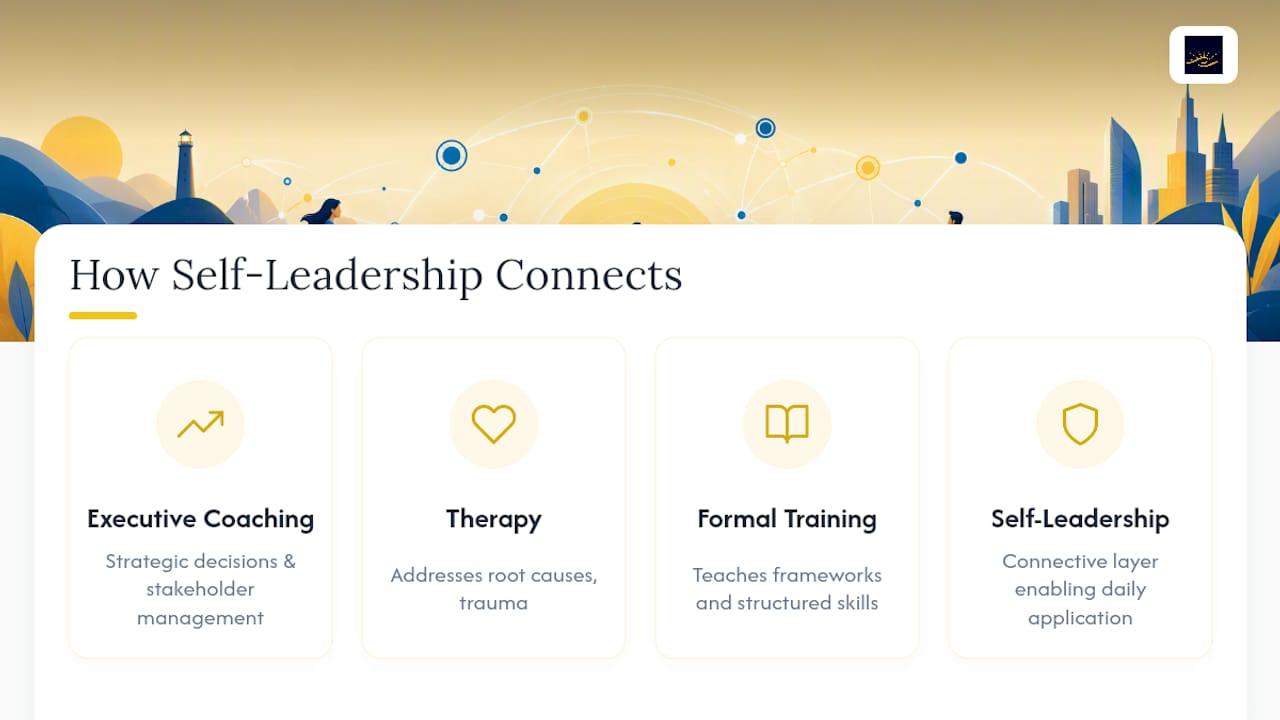
Formal leadership training, meanwhile, teaches frameworks: how to run a difficult conversation, how to structure a team offsite. Self-leadership coaching is what determines whether you actually use the framework when you’re tired, frustrated, or under deadline pressure. A team management resource like Altiam’s guide to scalable team leadership works best paired with the inner discipline that keeps a leader consistent when the team is watching how they handle stress, not just what they say in the all-hands meeting.
Why Most Advice on This Topic Skips the Hard Part
Most content on self-leadership jumps straight to tactics: goal-setting frameworks, morning routines, productivity trackers. That’s not wrong, it’s just incomplete, and it’s usually why the advice doesn’t stick past week three.
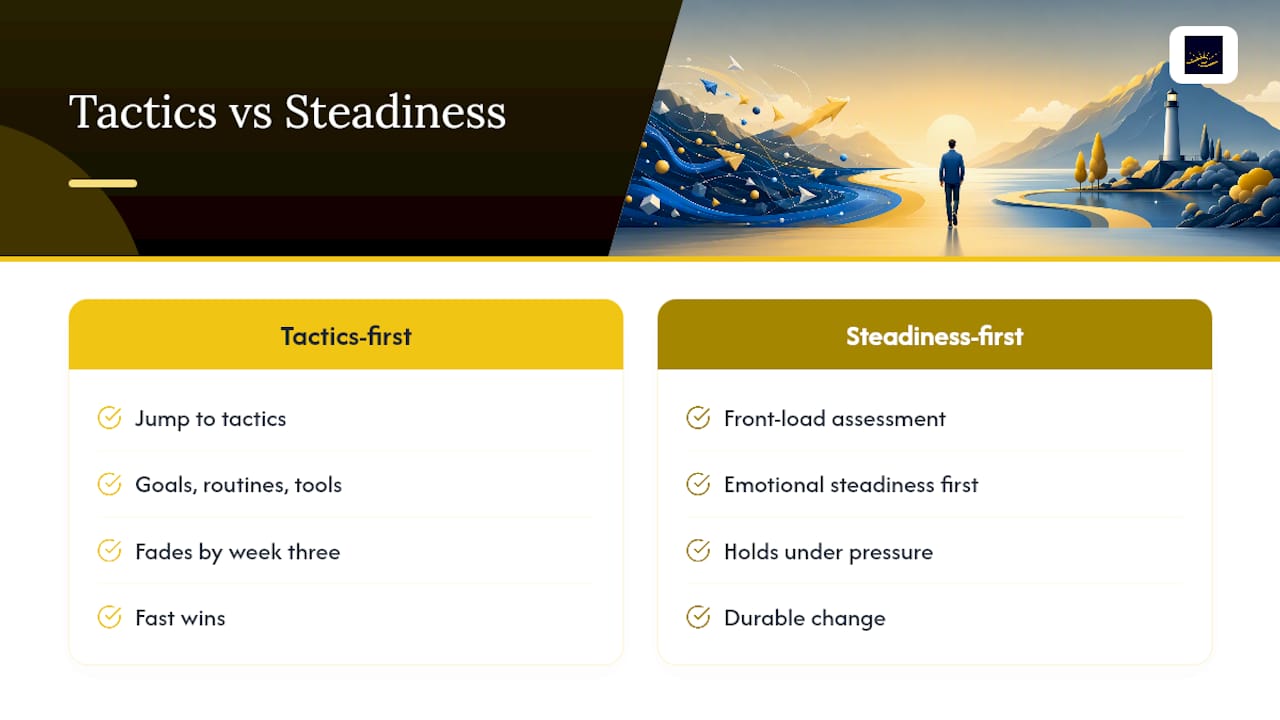
The research on behavioral change is fairly consistent on this point: meaningful growth is non-linear, and it tends to require building emotional steadiness before new habits hold under pressure. Skip that step and you get a leader who can recite their values but reverts to old patterns the moment a crisis hits. That’s the gap conventional advice keeps missing: tactics without nervous-system steadiness are a house built on sand.
Here’s what I’d prioritize if I were advising a client today: don’t start with the productivity system. Start with naming what’s actually driving the exhaustion or the stuck feeling, because a goal-setting framework applied to the wrong problem just makes you more efficient at running in the wrong direction. The 30/60/90 structure works precisely because it front-loads assessment before it asks for behavior change. Programs that skip straight to tactics are optimizing for a fast win instead of a durable one. If a coaching approach can’t tell you what changes for you emotionally in the first month, not just what tasks you’ll complete, that’s worth questioning before you sign a six-month contract.
— Junna Liao
Getting Started With MMDC Alchemy
This coaching approach is suited for leaders who have outgrown generic productivity advice and need support that treats burnout, identity shifts, and career transitions as connected challenges. The approach pairs deep inner work with concrete career strategy, so sessions produce both clarity and a next move you can actually execute.
This fits professionals navigating a stalled career, a layoff, or the quiet exhaustion of performing well while feeling disconnected from the work. Before an intro call, come with a rough sense of what’s not working: a role that no longer fits, a pattern of burnout, or ambition that’s gone quiet. From there, career coaching is the primary starting point for most engagements, and the coaching programs overview lays out how scope and format adjust to different situations, including a dedicated track for leading yourself through a layoff. Book an intro call to talk through what’s actually going on before committing to a program length.
Sources
- 8 Self-Leadership Strategies For Personal Growth — IMD
- Cultivating Personal Leadership for Success — LeadershipIQ
- Personal Leadership Development Planning and Leading High Performing Teams — Coursera
- 4 ways to build future skills in your team — Forbes
FAQ
What Are the 8 C’s of Self-Leadership?
There’s no single agreed-upon “8 C’s” framework in the research behind this article; definitions vary by source. What’s consistently supported is IMD’s eight self-leadership strategies, covering self-awareness, mindfulness, goal-setting, adaptability, discipline, continuous learning, self-care, and progress measurement.
What Is the 70/30 Rule in Coaching?
This isn’t a standardized framework in the sources behind this article, so treat any specific ratio you see elsewhere with caution. The consistent principle across coaching research is that structured practice and regular tracking, not occasional big conversations, drive most of the measurable change.
What Are the 7 C’s of Leadership?
Like the 8 C’s, this specific framework isn’t backed by the research used here, and versions vary widely across sources. The components this article can confirm matter most are self-awareness, values clarity, emotional regulation, and consistent habit-building.
How Much Do Leadership Coaches Cost?
Pricing depends heavily on program length, coach seniority, and scope, with shorter, narrowly defined engagements costing less than open-ended work with a senior executive coach. Ask any coach for clear, upfront pricing tied to a specific program length before you commit.
Is Self-Leadership Coaching Different From Self-Coaching?
Self-coaching is what you do on your own, using books, frameworks, or trackers without outside guidance. Self-leadership coaching adds an outside professional who spots blind spots you can’t see yourself and holds you accountable to a structured plan, which is why coach-client fit matters so much to outcomes.
Recommended
- Executive Coaching for High Performers: Mastering the Alchemy of Leadership
- Mindful Leadership Coaching: Mastering the Alchemy of Presence and Energy
This blog is for educational and inspirational purposes only. It is not medical, legal, financial, or mental health advice. Your journey is unique; please seek qualified professional support for decisions that affect your health, finances, or wellbeing.