
Executive coaching typically runs $300 to $1,000 or more per session, with a standard six-month engagement landing between $7,500 and $30,000 according to market data from Stratos Coaching. Corporate-funded engagements often price significantly higher than individually-paid ones, and rates climb further with an ICF Master Certified Coach or a former C-suite executive at the helm. Check the breakdown below before you sign anything.
TL;DR:
- Corporate-funded coaching can cost up to double or triple individual rates, especially for senior executives or niche industry expertise.
- Engagement costs vary from a few thousand dollars for short sprints to over $75,000 for year-long retainers, depending on scope and deliverables.
- Credentials like ICF tiers influence rates, but experience, seniority, and scope often weigh more heavily on price than certification alone.
- Additional costs such as assessments, travel, and stakeholder interviews can add roughly 20% to the base fee, so budgeting for extras is essential.
- Short pilot programs with clear, specific outcomes often provide the best value for assessing fit before longer-term commitments.
Table of Contents
- Executive Coaching Pricing Ranges by Buyer Type
- Why Executive Coaching Prices Vary So Much
- Hourly, Package, or Retainer: Which Pricing Model Fits?
- What ICF Credential Levels Mean for Coaching Rates
- Add-Ons, Hidden Costs, and What ROI Actually Looks Like
- How to Build a Business Case and Set the Budget
- How to Choose an Executive Coach
- Who’s Behind This Guide
- Do Coaching Rates Vary by Region?
- What Happens If You Need to Cancel or Pause Coaching?
- When Coaching Delivers the Most Value
- Ready to Talk Coaching Investment?
- Sources
- FAQ
Executive Coaching Pricing Ranges by Buyer Type
The fastest way to sanity-check a quote is to know where it should fall. Rates split along two lines: who’s paying and who’s coaching.
Individual professionals paying out of pocket usually see lower per-session numbers because they’re not funding the reporting infrastructure a company demands. Corporations, by contrast, are typically buying stakeholder interviews, progress reporting to HR, and measurement frameworks tied to performance reviews, which is why market analysis from CoachStack Hub puts corporate-funded rates 40 to 100 percent above what an individual pays for a comparable coach.
Here’s how the ranges typically shake out:
- Entry-level coaches (newer credential, limited executive-specific track record): lower hundreds of dollars per session
- Established coaches (5+ years, ACC or PCC credential): mid-range hundreds of dollars per session
- Senior coaches (PCC/MCC, deep executive résumé): higher hundreds of dollars per session
- Elite C-suite specialists (former Fortune 500 executives, niche industry expertise): high-end hundreds to over a thousand dollars per session
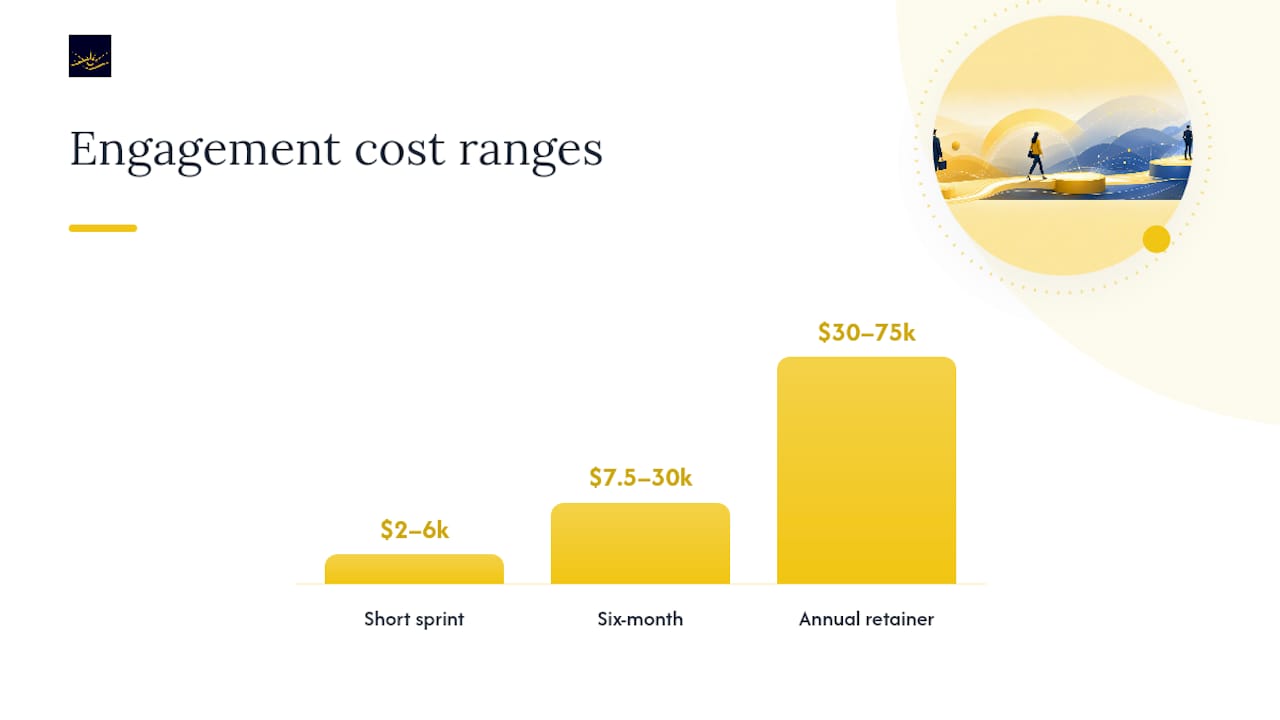
On the engagement side, a short sprint (4 to 6 sessions) commonly totals $2,000 to $6,000. A standard six-month engagement runs $7,500 to $30,000, matching the range Stratos Coaching documents across the market. Annual advisory retainers for senior leaders often land between $30,000 and $75,000, particularly when the coach is embedded in quarterly leadership reviews.
For context on where coaching sits relative to the broader coaching market: the ICF Global Coaching Study puts the North America median session rate for coaching generally near $297. Executive coaching sits well above that median because it bundles seniority, confidentiality, and business outcomes that general life or wellness coaching doesn’t carry.
Corporate budgets per leader typically fall within a wide range depending on company size and number of leaders in the program. Single VIP engagements for top executives can exceed typical program budgets.
Why Executive Coaching Prices Vary So Much
A $300 session and a $1,200 session can look identical on a calendar invite. What separates them is scope, credential, and what happens between the sessions, not just the hour itself.
Five factors drive the spread:
- Coach credential and background. An ICF-credentialed coach at the ACC level charges differently than an MCC, but credential alone doesn’t tell the whole story. A former Fortune 500 CFO with no formal ICF credential can command premium rates purely on operating experience and track record, a nuance ICF’s own coaching blueprint points out directly.
- Leader seniority and mandate complexity. Coaching a director costs less than coaching a C-suite executive navigating a board-level succession decision. The complexity of stakeholders involved drives price as much as title does.
- What’s bundled into the fee. A packaged engagement usually includes assessments, stakeholder interviews, a written development plan, and preparation time between sessions, not just the conversation itself.
- Delivery mode. Virtual coaching is now the default and prices accordingly. In-person work, especially with travel, adds a premium that can run several hundred dollars per engagement day.
- Payer reporting expectations. When a company is footing the bill, it usually wants measurement: 360 feedback comparisons, manager check-ins, sometimes a formal ROI report. Building that infrastructure adds cost that an individually-paid engagement skips entirely.
Pro Tip: Ask any coach candidate directly what’s included in the between-session work. That’s often where the real value lives, and it’s the line item most buyers forget to ask about before signing.
Market forecasts from JRG Partners project average hourly rates for quality executive-level coaching in a range from several hundred dollars, with modest upward pressure as demand for senior coaches outpaces supply in some markets.
Hourly, Package, or Retainer: Which Pricing Model Fits?
Coaches structure fees three main ways, and each suits a different kind of buyer.
Hourly or per-session billing works best for leaders who want flexibility and aren’t sure how long they’ll need support. You pay for what you use, but costs are harder to forecast, which makes hourly billing a tougher sell to a finance department that wants a fixed number for budget approval.
Package pricing bundles a fixed number of sessions plus deliverables into one price. This is the most common structure for defined outcomes, a leadership transition, a specific skill gap, a 90-day onboarding plan, and it’s easier to defend in a budget request because the total is known upfront.
Retainer pricing covers an ongoing relationship, often monthly, for leaders who want continuous access rather than a defined endpoint. Retainers suit board advisors and CEOs who need a sounding board available on short notice, not just scheduled sessions.
Here’s how the math typically plays out:
- 4 to 6 session sprint: Typical packages include multiple sessions plus an intake assessment, totaling a few thousand dollars
- Standard 6-month engagement: Regular biweekly sessions plus additional deliverables often total mid to higher five-figure amounts
- 12-month advisory retainer: Monthly retainer fees typically represent a substantial annual budget commitment
- VIP intensive (C-suite, condensed timeline): Higher-frequency sessions over three months often represent a premium, front-loaded investment
A useful industry insight: coaching pricing is increasingly framed around packaged outcomes rather than hourly labor, because buyers get the most value from the preparation and stakeholder synthesis happening between sessions, not the session time itself.
Favor a package for defined, time-bound goals. Favor a retainer when the relationship needs to outlast any single project. Save hourly billing for situations where scope genuinely can’t be predicted, like an unexpected crisis requiring occasional guidance.
What ICF Credential Levels Mean for Coaching Rates
Credential tiers give buyers a shorthand for experience, though they’re not the only signal worth checking. The ICF’s credentialing framework sets three main levels, each tied to minimum training and logged coaching hours.
- ACC (Associate Certified Coach): Requires 100 logged coaching hours and 60 hours of training. Rates commonly fall between $150 and $350 per session, and engagements at this level often skip deep 360 assessments in favor of a lighter intake process.
- PCC (Professional Certified Coach): Requires 500 logged hours. This is the most common credential among practicing executive coaches, with rates typically $300 to $600 per session and engagements that usually include a structured assessment and a written development plan.
- MCC (Master Certified Coach): Requires 2,500 logged hours, the top ICF tier. Rates run $500 to $1,000+ per session, often bundled with deeper stakeholder interview processes and ongoing measurement check-ins.
- Senior former-executive coaches: Sometimes without a formal ICF credential but with direct C-suite operating history. Rates can match or exceed MCC pricing, sometimes reaching $1,200 to $1,500 per session for niche industry expertise (say, a former biotech CEO coaching biotech founders).
Scarcity pushes prices up faster than credential alone. A coach who specializes in a narrow situation, post-acquisition leadership integration, first-time CEO transitions, industries facing regulatory upheaval, can charge above the general market simply because there aren’t many alternatives for that specific need.
Add-Ons, Hidden Costs, and What ROI Actually Looks Like
The headline coaching fee rarely covers everything a comprehensive engagement needs. Budgeting a contingency equal to roughly 20% of the base fee for add-ons is a reasonable rule of thumb, based on projections from JRG Partners, and it keeps a mid-engagement surprise from blowing up an approved budget.
| Add-on | Typical cost range | When it’s usually needed |
|---|---|---|
| 360-degree feedback assessment | $2,000 to $6,000 | Leadership transitions, promotion readiness |
| Standalone behavioral assessment (DISC, Hogan) | $300 to $500 | Onboarding, team dynamics work |
| Travel and in-person session premiums | $300 to $600 per day | Executive retreats, board-level intensives |
| Workshop or team facilitation add-on | $1,500 to $3,000 | When coaching extends to a leader’s direct team |
On the return side, SHRM’s coverage of coaching ROI documents measurable performance gains tied to well-structured coaching engagements, and offers guidance to HR and finance teams on what to track before approving spend. The measures worth watching are retention of the coached leader (a real cost avoidance if coaching prevents an executive departure), documented performance shifts tied to specific KPIs the leader owns, and stakeholder feedback collected before and after the engagement, not just a satisfaction score from the leader themselves. A parallel case for measuring soft-skill development spend shows up in team-building ROI research, where the strongest business cases pair a dollar figure with a specific behavior change, not a vague sense of improvement.
How to Build a Business Case and Set the Budget
Most coaching budgets come from one of three buckets: a dedicated leadership development line, a broader L&D budget, or a performance improvement fund tied to a specific business problem. Knowing which bucket you’re pulling from changes what your approval request needs to emphasize.
- Define the outcome first, then price it. A vague request for “leadership development” gets scrutinized. A request tied to a specific transition, succession readiness, a failing team dynamic, gets approved faster.
- Build the approval checklist. Cover four things: total cost with add-ons included, the specific outcomes expected, the timeline (sprint vs. six-month vs. annual), and how you’ll measure whether it worked.
- Negotiate structure, not just price. Ask about a pilot program (one leader, one sprint) before committing to a cohort-wide rollout. Ask about phased scope, starting with core sessions and adding assessments only if needed. Volume pricing is realistic if you’re coaching more than two or three leaders simultaneously.
- Tie milestones to payment where possible. Some coaches will structure fees around checkpoints rather than a single upfront invoice, which makes the budget easier to defend internally.
Pro Tip: If your organization has never funded coaching before, propose a single pilot engagement with one leader and a 90-day outcome. A successful pilot is the easiest way to unlock a bigger budget next cycle.
How to Choose an Executive Coach
Price tells you almost nothing about fit. The coaches worth their fee share a few traits regardless of what they charge.
- Relevant track record over generic credentials. Ask for examples of leaders at a similar level or industry the coach has worked with, not just a client list.
- Clarity on deliverables before you sign. A reputable coach can tell you exactly what’s included, session count, assessment type, whether a written plan is part of the package, before you pay a deposit.
- Confidentiality terms in writing. Especially for corporate-funded engagements, get explicit language on what gets reported to HR or a manager versus what stays private between coach and leader.
- A defined statement of work. The contract should specify session cadence, total engagement length, cancellation terms, and how progress gets measured or reported.
Interview questions worth asking directly: “What does a typical week between our sessions look like for you?” and “Can you describe an engagement that didn’t go well and what you’d do differently?” A coach who deflects the second question is a red flag. One who answers with specifics, including what they changed afterward, is showing you real self-awareness.
On cancellation clauses specifically: look for a policy that allows rescheduling with reasonable notice (24 to 48 hours is standard) without penalty, but confirms no-show sessions still bill. A contract silent on this detail is a contract you’ll regret three months in.
Who’s Behind This Guide
This guide is written from the perspective of Junna Liao, founder of MMDC Alchemy and an executive coach who works with leaders navigating burnout, career transitions, and identity shifts at the executive level. Read more on the author’s background and coaching philosophy.
MMDC Alchemy combines practical budgeting and engagement structures with a deeper focus on what leaders want out of their careers, not just performance metrics. The engagement models described earlier in this guide, sprints, six-month programs, and longer advisory relationships, map closely to how MMDC Alchemy structures its own coaching programs, built around the specific transition a leader is facing rather than a one-size template.
Do Coaching Rates Vary by Region?
Yes, though less dramatically than most buyers expect once you control for coach seniority.
Virtual delivery has flattened a lot of this variation. A senior coach based in a lower cost-of-living city can charge metro rates because their client base is national, not local. The gap that remains has less to do with geography and more to do with industry concentration: coaches specializing in tech leadership tend to cluster around innovation hubs and price accordingly, while coaches specializing in healthcare or manufacturing leadership are more evenly distributed and price closer to the national median.
International engagements add another layer. A US-based executive relocating for a global assignment may need a coach familiar with cross-cultural leadership dynamics, and that specialization commands a premium regardless of which country the sessions happen in. If your organization operates across borders, budget for that specialization rather than assuming a generalist coach transfers seamlessly.
The practical takeaway: use the national ranges in this guide as your baseline, then adjust upward modestly for major metro markets or highly specialized niches, and don’t assume a rural or remote location automatically means a discount, since most coaching now happens over video regardless of address.
What Happens If You Need to Cancel or Pause Coaching?
Cancellation and refund terms vary by coach, but a few patterns hold across most professional engagements. Package pricing, where you’ve prepaid for a set number of sessions, typically comes with a refund policy for unused sessions, though many coaches prorate rather than issue a full refund once the engagement has started.
Retainer arrangements are usually the most flexible to exit, often requiring 30 days’ notice rather than a penalty fee, since you’re not locked into a prepaid session count. Rescheduling individual sessions is standard practice; most coaches allow it with 24 to 48 hours’ notice without any charge, but a no-show or late cancellation typically still bills at full rate.
Corporate-funded engagements sometimes carry different terms than individually-paid ones, since the company, not the leader, may be the contracting party. Read the statement of work carefully here: some corporate contracts specify that unused sessions are forfeited if the leader changes roles or leaves the organization mid-engagement.
Before signing anything, ask directly what happens if the engagement isn’t working after two or three sessions. A coach confident in their process should welcome an early check-in conversation rather than treating cancellation as an adversarial event. Vague or evasive answers on this point are worth treating as a warning sign, regardless of how strong the credentials look on paper.
When Coaching Delivers the Most Value
The highest returns show up in three situations: a leader stepping into a new role with real ambiguity about what success looks like, someone burning out under a workload they can no longer sustain, and succession moments where a company is betting on one person’s readiness.
If you’re deciding between a short pilot and a long-term retainer, start smaller than you think you need. A four to six session sprint with one clearly defined outcome tells you more about fit and impact than a year-long commitment signed on faith. You’ll know within the first month whether the coach understands your actual situation or is running a generic playbook.
If any of this sounds like where your organization or your own career sits right now, a diagnostic conversation costs nothing and clarifies a lot.
— Junna Liao
Ready to Talk Coaching Investment?
Many executive coaching quotes do not always clarify whether you’re paying for genuine expertise or just an hourly rate. Some coaching engagements are priced around a defined transformation, burnout recovery, a leadership transition, or an identity shift tied to career reinvention, rather than a generic hourly meter, so clients can understand what the engagement covers before committing budget.
If you’re navigating a layoff, a promotion that doesn’t feel right, or the sense that your career has stopped fitting who you’ve become, MMDC Alchemy’s career coaching is built around exactly that kind of transition. The coaching programs page walks through typical engagement shapes so you can compare structure against the ranges covered in this guide before you talk to anyone. If a layoff or restructuring is what brought you here, the guide on leading yourself through uncertainty is worth reading first. When you’re ready, book a discovery call and bring your budget questions. That conversation, not a generic quote, is where you’ll find out if the fit is real.
Sources
- The ROI of executive coaching — SHRM
- Executive Coaching Cost: 2026 Rates, Fees & ROI Guide | Stratos Coaching
- Executive Coaching Costs 2026: Rates, Formats, and ROI Data – JRG Partners LLC
FAQ
Is Executive Coaching Worth the Cost?
For leaders facing a real transition, burnout, promotion readiness, or succession, the ROI evidence SHRM summarizes supports measurable performance and retention gains, making the investment worthwhile when the engagement is scoped to a specific outcome rather than treated as a generic perk.
What Is the 70/30 Rule in Coaching?
Definitions of this ratio vary by practitioner.
What Is the 80/20 Rule in Coaching?
This is a general coaching heuristic rather than a fixed industry standard.
How Does Employer-Paid Coaching Differ From Self-Funded Coaching?
Employer-paid engagements typically cost more per session and include added scope like stakeholder interviews and progress reporting, while self-funded coaching tends to be more flexible on structure but carries fewer built-in measurement tools.
Recommended
This blog is for educational and inspirational purposes only. It is not medical, legal, financial, or mental health advice. Your journey is unique; please seek qualified professional support for decisions that affect your health, finances, or wellbeing.