The fastest reliable path out of executive burnout is a multi-component program that stabilizes your physiology, treats the underlying psychological patterns, and redesigns how work actually loads onto your calendar. Skipping protected sleep and a real clinical or coaching relationship means you’re managing symptoms, not recovering. Expect the process to run weeks to months, not days. And most executives can do it without stepping away from the role entirely.
TL;DR:
- Recovery requires a multi-platform approach focused on physiological stabilization, psychological repair, and workload redesign, which takes weeks to months to complete.
- Combining organizational strategies with clinical therapy, such as Acceptance and Commitment Therapy, enhances long-term burnout reduction compared to self-help alone.
- Immediate medical attention is necessary if symptoms include severe sleep loss, suicidal thoughts, or physical issues like chest pain, rather than relying solely on coaching or therapy.
- Effective recovery involves early wins like better sleep, reduced crashes, and delegation conversations, supported by metrics tracking and confidential professional support.
- Long-term prevention hinges on structural changes, accountability, and ongoing maintenance, as relapse often occurs from unchanged workload patterns and unresolved identity issues.
Table of Contents
- What Does Executive Burnout Recovery Actually Involve?
- How Long Does Burnout Recovery Actually Take?
- Coaching, Therapy, or Both: What the Evidence Actually Supports
- Recovering While You Keep Running the Company
- Your First Four Weeks: A Practical Recovery Checklist
- How Do You Prevent Relapsing Into the Old Baseline?
- Why Leaders Burn Out Differently Than Everyone Else
- When Is It Time for Medical Leave, Not Just Coaching?
- Choosing Between Coaching, Therapy, or a Combined Program
- What Does Executive Burnout Recovery Cost?
- How to Vet a Burnout Recovery Coach or Therapist
- Author Perspective: Where Coaching Ends and Clinical Care Begins
- How MMDC Alchemy Supports a Confidential Recovery
- Sources
- FAQ
What Does Executive Burnout Recovery Actually Involve?
Burnout in leadership rarely announces itself as a single crisis. It shows up as emotional exhaustion that doesn’t lift after a weekend, a creeping cynicism toward people and projects you used to care about, and a drop in the sharp decision-making that got you into the corner office in the first place. Mayo Clinic lists these alongside physical markers: disrupted sleep, frequent headaches or stomach issues, and a weakened immune response that turns into a string of minor illnesses.
The leadership-specific version has its own tells. Decision fatigue by 2 p.m. Snapping at direct reports you’d normally handle with patience. Avoiding one-on-ones because you don’t have the bandwidth to absorb someone else’s problem. Delegation that used to feel like trust now feels like losing control, so you take everything back and burn out faster.
Burnout differs from clinical depression in an important way: the World Health Organization classifies it as an occupational phenomenon tied to chronic workplace stress, not a standalone medical diagnosis. That distinction matters for treatment, but it doesn’t matter at all if you’re in crisis. Certain symptoms require immediate clinical attention regardless of the burnout label:
- Suicidal thoughts or a sense that life isn’t worth continuing
- Inability to function in basic daily tasks, not just work tasks
- Sleep loss severe enough to cause hallucination-like confusion or memory gaps
- Panic attacks that are increasing in frequency or intensity
Ask yourself three questions honestly: Have you stopped caring about outcomes you used to fight for? Are you making decisions slower or worse than six months ago? Has anyone close to you mentioned a change in your mood or behavior? Two “yes” answers warrant a conversation with a clinician this week, not next quarter.
How Long Does Burnout Recovery Actually Take?
Recovery moves in three phases, and the biggest mistake executives make is trying to skip straight to phase three.
- Stabilization (roughly 2 to 6 weeks). The goal here is nervous system regulation, not productivity. Sleep becomes non-negotiable. You’re looking for objective markers like falling asleep in under 30 minutes, fewer 3 a.m. wake-ups, and a noticeable drop in midday crashes.
- Repair (several weeks following stabilization). This is where clinical work or structured coaching addresses the patterns that got you here: chronic overcommitment, identity fused with output, unprocessed conflict avoidance. Progress markers include shorter recovery time after a stressful meeting and the ability to sit with an unresolved problem without spiraling.
- Redesign (the ongoing phase starting a few months in). You rebuild your role’s actual architecture. Delegation gets restructured. Meeting load gets renegotiated. This phase never fully ends, because a sustainable baseline needs periodic maintenance the same way physical fitness does.
The target isn’t returning to your pre-burnout performance level. That level was often the problem. Clinical research on stress physiology shows chronic cortisol elevation changes how your body handles stress over time, which is why a long weekend rarely resolves what took eighteen months to build. The real target is a new baseline that doesn’t require burning yourself down to hit quarterly numbers.
Coaching, Therapy, or Both: What the Evidence Actually Supports
A systematic review published in the International Journal of Environmental Research and Public Health compared organizational-level interventions against individual-only self-help approaches for workplace burnout. The finding was clear: combining organizational strategies (coaching, training, structural change) with third-generation therapies like Acceptance and Commitment Therapy produced larger reductions in burnout than self-help alone. Short-term effects were consistently strong; long-term effects depended heavily on whether the organizational piece stuck around.
That single finding should reshape how you think about your own recovery. Individual willpower alone against a system that keeps generating the same load is a losing bet.
Clinical therapies each target a different failure point:
- Cognitive Behavioral Therapy (CBT) addresses distorted thought patterns, like the belief that delegating equals weakness. Clinical evidence links CBT-based interventions to measurable improvements in function and return-to-work outcomes.
- Acceptance and Commitment Therapy (ACT) helps leaders reconnect with values that got buried under KPI pressure.
- Dialectical Behavior Therapy (DBT) builds emotion regulation skills for executives who’ve been running on reactivity for years.
- Internal Family Systems (IFS) work addresses identity fragmentation, common when someone has spent a decade as “the person who never says no.”
The evidence in one line: Organizational and third-generation therapy combinations outperform individual self-help approaches for burnout reduction, according to the MDPI systematic review, though long-term durability depends on whether structural changes are maintained.
Coaching plays a different, complementary role. A good executive coach doesn’t treat trauma or diagnose depression. Instead, coaching rebuilds delegation architecture, tightens decision hygiene, and redesigns behavior patterns in real time, inside your actual job. The two approaches work best together when the underlying pattern is psychological (unresolved identity or emotional regulation issues call for clinical therapy) and the surface pattern is structural (an unsustainable calendar calls for coaching).
Recovering While You Keep Running the Company
An approach built around a simple observation: most senior leaders will not take extended medical leave, no matter how depleted they are. The program runs three tracks in parallel rather than sequentially.
- Physiological stabilization: sleep protocols, nervous system regulation practices, and removing the stimulants and habits that mask fatigue instead of resolving it.
- Targeted clinical or coaching work: addressing the specific pattern driving the burnout, whether that’s achievement-based identity, conflict avoidance, or chronic overcommitment.
- Load architecture redesign: restructuring what actually lands on your calendar, who owns what, and where your energy leaks out unnoticed.
Sessions typically run weekly or biweekly, scheduled after hours or in protected blocks that don’t show up on a shared calendar. Early wins tend to show up in weeks, not months: better sleep quality, fewer 2 p.m. crashes, and faster decision turnaround on things that used to sit in your inbox for days. MMDC Alchemy has guided more than 600 client transformations using this integrated model, drawing on Energy Leadership principles to help leaders re-anchor their baseline rather than chase a return to an unsustainable prior state.
Pro Tip: If you need to tell your board or COO you’re addressing burnout, frame it in operational terms rather than clinical ones. “I’m restructuring my calendar and delegation model to improve decision quality” is honest, protects your privacy, and gets buy-in faster than a vague admission of struggling.
Your First Four Weeks: A Practical Recovery Checklist
Start this week, not after the next board meeting.
- Days 1 to 3: Triage. Protect seven hours of sleep opportunity tonight. Cancel or delegate one recurring meeting that drains you disproportionately. Call a therapist or coach who specializes in executive burnout and get on the calendar, even if the first available slot is two weeks out.
- Week 1: Establish one protected block. Ninety minutes, daily, with no calls, no email, no exceptions. Use it for whatever restores you, whether that’s a walk, deep work, or nothing at all.
- Week 2: Add a micro-recovery ritual. A five-minute breathing practice between meetings, or a hard stop on screens sixty minutes before bed. The American Psychological Association points to consistent sleep and movement as reliable levers for nervous system regulation.
- Weeks 3 and 4: Begin structural conversations. Identify one task or relationship you’re overfunctioning in and start the delegation conversation, even if it’s uncomfortable.
Track four simple metrics weekly: sleep hours and quality on a 1 to 10 scale, a decision clarity rating (how fast and confident you felt making calls that week), a mood rating, and whether you actually detached during your protected block or checked email anyway.
When contacting a therapist or coach, ask directly about their experience with executive clients specifically, how they handle confidentiality relative to your company, and what pacing they recommend given your symptom severity. A rushed answer to the confidentiality question is a red flag.
Pro Tip: Log your four metrics in a notes app, not a spreadsheet you’ll abandon. The goal is thirty seconds a day, not a new project.
How Do You Prevent Relapsing Into the Old Baseline?
Most executives who recover from burnout relapse within a year, and it’s almost never because the recovery work failed. It’s because nobody redesigned the structure that caused it in the first place. The same calendar, the same delegation habits, and the same conflict avoidance patterns are still sitting there waiting to reload.
Common relapse triggers include a new high-stakes project landing without a corresponding reduction elsewhere, a direct report leaving and their work quietly redistributing onto your desk, or a board deadline that erases your protected recovery blocks for “just this one quarter.”
A durable relapse-prevention plan names these triggers explicitly and pairs each one with a structural fix:
- Enforced boundaries around calendar blocks, ideally with an assistant or chief of staff empowered to protect them
- A delegation hygiene check every quarter: who’s doing what, and is it still the right allocation
- A maintenance cadence with your coach or therapist, even monthly, rather than stopping cold once symptoms ease
- One accountability partner, inside or outside the company, who has permission to flag when your behavior starts drifting
If symptoms reappear, don’t wait for a full relapse to escalate. Return to your coach or clinician at the first sign, whether that’s two bad nights of sleep in a row or snapping at someone over something small.
Why Leaders Burn Out Differently Than Everyone Else
Executives don’t get burnout the same way an overworked employee does, and treating it identically misses what actually drives the collapse.
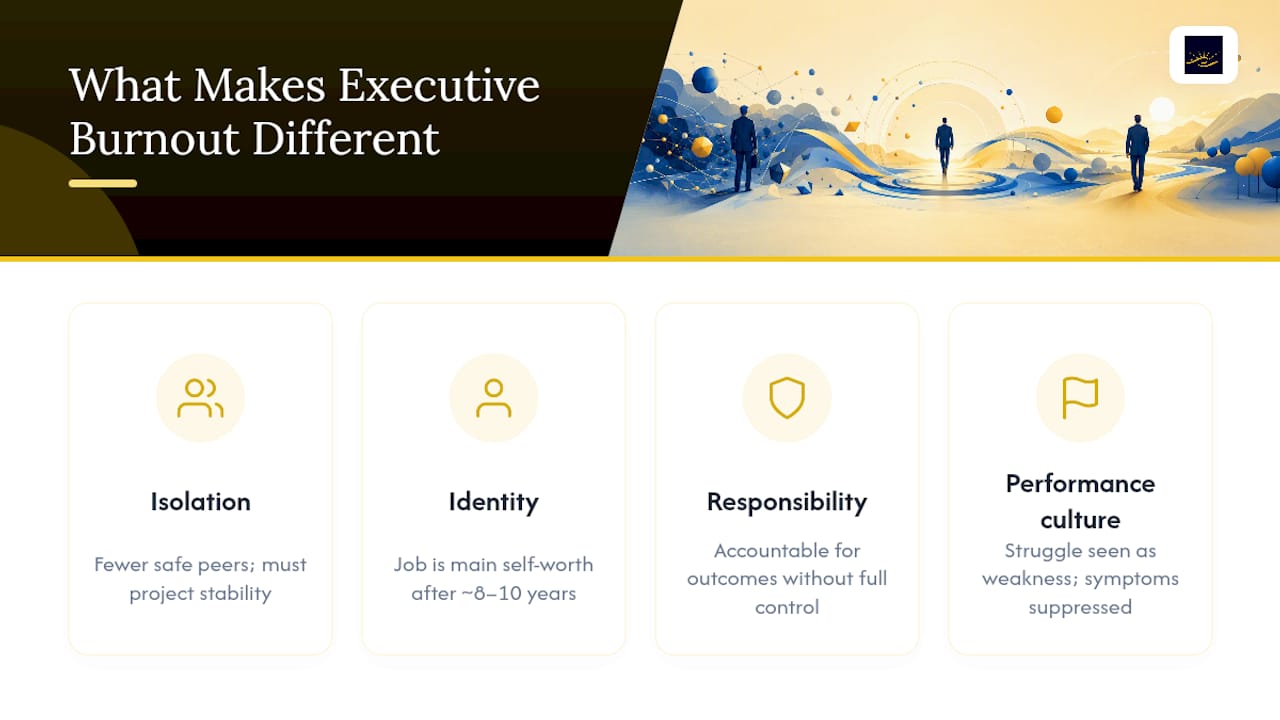
Isolation is structural, not incidental. The higher you climb, the fewer people you can be honest with. Peers are also competitors or board members. Direct reports need you to project stability. Even a spouse can only absorb so much of the specific weight you’re carrying, especially when confidentiality rules prevent you from explaining the actual problem.
Identity enmeshment compounds it. For most senior leaders, the job stopped being a job somewhere around year eight or ten. It became the primary source of self-worth, and burnout starts to feel less like exhaustion and more like an existential threat, because slowing down feels like admitting the identity was built on sand.
High responsibility with limited real control creates a chronic stress loop most staff-level employees never experience. You’re accountable for outcomes you can influence but not fully determine, market conditions, board decisions, macroeconomic shifts, and that gap between accountability and control is a well-documented driver of chronic stress.
Performance culture finishes the job. Admitting struggle at the top often reads as weakness rather than honesty, so executives suppress symptoms far longer than a junior employee would, until the collapse is harder to hide and harder to reverse. Organizational patterns like poorly managed overtime and scheduling often sit underneath this culture, quietly normalizing the overload that performance culture then punishes people for admitting to.
When Is It Time for Medical Leave, Not Just Coaching?
Coaching and structural redesign solve a lot, but they are not a substitute for medical evaluation when specific red flags appear.
Seek immediate medical or psychiatric evaluation if you experience suicidal thoughts, a sense of hopelessness that doesn’t lift, or an inability to perform basic daily functions like eating regularly or maintaining hygiene. These are not burnout symptoms to coach through. They require a clinician, and possibly emergency care, before anything else.
Sleep loss deserves its own threshold. Occasional bad nights are normal during high stress. Chronic sleep loss that produces memory gaps, hallucination-like confusion, or an inability to fall asleep despite exhaustion signals a physiological crisis that needs medical attention, not just better sleep hygiene.
Physical symptoms matter too. Chest pain, unexplained weight loss or gain, or a marked increase in illness frequency all warrant a full medical workup, since chronic stress can mask or mimic other conditions. Mayo Clinic’s guidance is explicit that burnout symptoms interfering with daily functioning call for professional help rather than self-management.
Many executive health programs, including those at institutions like Mayo Clinic, combine full medical assessment with behavioral and coaching support specifically because leaders often need both a clean bill of health and a structural intervention. If you’re unsure whether you need medical leave, that uncertainty itself is a reason to get evaluated rather than guess.
Choosing Between Coaching, Therapy, or a Combined Program
The decision usually comes down to what’s actually broken: your patterns, your structure, or both.
Choose therapy first if your symptoms include persistent low mood, anxiety that extends beyond work triggers, trauma responses, or identity fragmentation that feels bigger than “I have too much on my plate.” These are clinical territory, and a licensed therapist trained in CBT, ACT, or IFS is the right starting point.
Choose coaching first if your core problem is structural: you know intellectually that you’re overcommitted, but you haven’t been able to translate that awareness into different behavior. Coaching excels at closing the gap between insight and action, particularly around delegation, boundary-setting, and decision hygiene.
Choose a combined program when both are true, which describes most senior leaders further along in a burnout cycle. The MDPI systematic review found combined organizational and clinical approaches consistently outperformed either alone.
Ask any prospective coach or therapist these questions before committing: What’s your specific experience with executive-level clients? How do you handle scheduling around unpredictable demands? What does progress look like in the first month, realistically? A vague or defensive answer to any of these is worth noting.
What Does Executive Burnout Recovery Cost?
Investment varies widely depending on the path. Individual therapy sessions with a licensed clinician typically run as standalone hourly fees, often covered partially by insurance depending on your plan and provider network. Executive coaching engagements are usually structured differently, as multi-month packages rather than per-session billing, reflecting the sustained work required to rebuild delegation habits and decision patterns over time.
Combined programs that integrate coaching with clinical referral tend to require a larger time and financial commitment upfront, but they also tend to produce more durable results, according to the organizational-intervention evidence comparing multi-component approaches to single-method fixes.
The more useful framing isn’t “what’s the cheapest option” but “what’s the cost of not addressing this.” A senior leader operating at reduced decision quality for another year, making worse calls, alienating direct reports, and risking a harder collapse later, carries a cost that dwarfs almost any coaching or therapy fee. Most executives who delay recovery aren’t saving money. They’re deferring a larger bill.
Ask any provider directly about package structure, session frequency, and what happens if your schedule requires flexibility during a demanding quarter. A provider who can’t answer that clearly isn’t set up for executive-level engagements.
How to Vet a Burnout Recovery Coach or Therapist
Credentials matter, but they’re only the starting point. For therapists, confirm licensure (LCSW, LMFT, PsyD, or similar) and ask specifically about training in evidence-supported modalities like CBT, ACT, DBT, or IFS, since general talk therapy without a structured framework tends to move slower for burnout specifically.
For coaches, formal certification exists (ICF accreditation is the most recognized standard), but certification alone doesn’t guarantee executive-specific experience. Ask how many senior leaders they’ve worked with, what industries, and request a description of a recent engagement’s arc, not outcomes tied to identifiable clients, but the general shape of the work.
Effectiveness is harder to measure than credentials, but a few signals help. A coach or therapist who can articulate a phased approach, something resembling stabilization, repair, and redesign, understands burnout as a process rather than a single fix. One who promises fast, dramatic transformation in a handful of sessions is overselling what the physiology actually allows.
Ask about their approach to confidentiality relative to your organization, especially if you’re not planning to disclose the engagement broadly. And trust your own read after an initial conversation: did they ask specific questions about your situation, or did they deliver a generic pitch? The former is a much better sign than a polished sales script.
Author Perspective: Where Coaching Ends and Clinical Care Begins
The line between coaching and therapy gets blurred constantly in this space, and that’s a disservice to leaders who need clarity, not marketing language. Coaching changes behavior and structure. Therapy treats the underlying psychological pattern when one exists. A leader with unresolved trauma or clinical anxiety needs a licensed clinician first, full stop, and no amount of calendar redesign fixes that.
What I find most executives underestimate is how much of their burnout is identity work in disguise. The calendar problem is real, but it’s rarely the root cause. Recovery that lasts requires redefining what success actually means to you, not just proving you can still hit the old numbers.
— Junna Liao
How MMDC Alchemy Supports a Confidential Recovery
MMDC Alchemy is built for leaders who need to recover without stepping back from the role, which is the reality for most senior executives regardless of how depleted they’ve become. The engagements are private, one-on-one, and scheduled around your actual calendar, including after-hours and protected blocks that don’t require explaining anything to your team.

A first engagement usually starts with an honest conversation about where the load is actually coming from, followed by a structured plan across stabilization, repair, and redesign, drawing on Energy Leadership principles to establish a baseline you can actually sustain. If your situation involves organizational upheaval alongside burnout, resources on leading through uncertainty address that combined pressure directly. With over 600 client transformations behind the coaching programs, the process is built around leaders who don’t have the option of disappearing for three months. If you’re ready to start, the life coaching page is the direct next step to schedule a confidential first conversation.
Sources
Key references to include the MDPI systematic review on organizational interventions, Mayo Clinic’s burnout guidance, WHO’s occupational phenomenon classification, and peer-reviewed clinical evidence on CBT outcomes. For practical next steps, visit MMDC Alchemy’s coaching programs or insights pages.
- Effectiveness of Organizational Interventions to Reduce Burnout in the Workplace: A Systematic Review
- Burnout: How to recognize and deal with job burnout — Mayo Clinic
- Burn-out an occupational phenomenon — WHO
- PubMed article related to burnout interventions (selected clinical evidence)
FAQ
How Do You Fix Executive Burnout?
The most effective approach combines physiological stabilization (sleep, nervous system regulation), targeted clinical or coaching work on underlying patterns, and a redesign of your actual workload and delegation structure, since organizational and individual approaches together outperform self-help alone.
How Long Does It Take to Fully Recover From Burnout?
Most leaders move through stabilization, then repair work over a number of weeks, followed by ongoing redesign that continues for months afterward, meaning full recovery typically spans several months rather than days or weeks.
What Are Some Tips for Returning to Work After Burnout?
Return with a relapse-prevention plan already in place, including enforced calendar boundaries, a delegation hygiene check, and a maintenance cadence with your coach or therapist, rather than sliding back into the exact schedule that caused the burnout.
Should I Choose a Coach or a Therapist for Burnout Recovery?
Choose therapy if symptoms include persistent low mood, anxiety beyond work triggers, or identity fragmentation; choose coaching if the core issue is structural, like overcommitment and poor delegation; choose both if, like most senior leaders, you have elements of each.
Recommended
- Layoffs: Leading Yourself Through Uncertainty
- Executive Coaching for High Performers: Mastering the Alchemy of Leadership
This blog is for educational and inspirational purposes only. It is not medical, legal, financial, or mental health advice. Your journey is unique; please seek qualified professional support for decisions that affect your health, finances, or wellbeing.