If your exhaustion is tied to your role, your hours, or a specific dysfunction at work, you are likely facing burnout, and coaching can move you forward now. If your low mood follows you everywhere, including weekends, family time, and things you used to enjoy, that pattern points toward clinical depression and calls for a professional evaluation first. A specialized coaching practice works with leaders in the first category every day.
TL;DR:
- Coaching is most effective for occupational burnout when leaders still have emotional range outside of work and no serious clinical symptoms are present.
- Addressing burnout through coaching focuses on role redesign, boundary setting, and energy management, not on diagnosing or treating depression.
- Clinical evaluation is essential if leaders experience persistent low mood, suicidal thoughts, sleep disruption, or loss of interest in all life areas for two weeks or more.
- Initial steps for burnout recovery include quick structural changes, boundary setting, and defining measurable progress markers before engaging in coaching.
- True change involves shifting role clarity and identity, not just scheduling adjustments, since burnout often stems from misaligned responsibilities or leadership roles.
Table of Contents
- Burnout vs Depression: The Core Differences From a Leader’s Chair
- When to Choose Coaching, When to Get Clinical Care, and When to Do Both
- How Executive Coaching Treats Workplace Burnout
- A 6-Step Recovery Roadmap You Can Start This Week
- Where Leaders Get Stuck, and What Real Change Looks Like
- Ready to Talk to Someone Who Gets It?
- Sources
- FAQ
Burnout vs Depression: The Core Differences From a Leader’s Chair
The clearest marker is where the flatness lives. Burnout tends to stay parked at your job. You dread Monday’s calendar, feel numb through a leadership meeting, and still laugh at dinner or get genuinely excited about a weekend trip. That’s work-specific anhedonia. Depression doesn’t respect those boundaries. It shows up as a global flatness that follows you into the things that used to matter, the hobby you dropped, the relationships you stopped investing in, the mornings that feel heavy no matter what’s on the calendar.
Functionally, the split shows up fast. A burned-out VP can often still execute a well-defined task, close a deal, run a board deck, even while feeling depleted and cynical about the process. Someone in a depressive episode frequently struggles with basic functioning across contexts: getting out of bed, managing groceries, holding a conversation with a partner.
Consider two leaders. One is numb through every Tuesday standup, has stopped caring about quarterly targets, but comes alive coaching his daughter’s soccer team on Saturday. Another cannot summon interest in that same soccer game, or in food, or in a phone call from an old friend. Same job title. Different condition entirely.
The overlap is real, and it’s what makes self-diagnosis risky. Chronic, unaddressed burnout raises the risk of developing a depressive episode over time. A 2013 controlled trial found that a 10-session executive coaching program measurably reduced emotional exhaustion and cynicism in leaders. That’s a meaningful data point, but it applies to occupational burnout, not to clinical depression.
Quick contrast, not exhaustive:
- Burnout: irritable at work, restored by a real weekend off, motivation returns when the workload or role changes.
- Depression: low mood most days for weeks, motivation stays flat even during time off, pleasure is hard to access anywhere.
- Both: sleep disruption, fatigue, difficulty concentrating, a sense of falling behind.
When to Choose Coaching, When to Get Clinical Care, and When to Do Both
Some signals mean you need clinical support before anything else. Treat these as non-negotiable:
- Any suicidal thoughts, passive or active, at any intensity.
- Sleep disruption that has gone on for weeks, not days: barely sleeping, or sleeping far more than usual and still exhausted.
- Mood that stays low across every part of life, not just at your desk, for two weeks or longer.
- A loss of interest in nearly everything, including people and activities you’ve cared about for years.
If none of those apply, and your struggle is largely occupational, is tied to a specific role, boss, or workload, and you still have emotional range outside of work, coaching is a reasonable and often faster path. The Forbes Coaches Council draws this line clearly: coaching is forward-looking and performance-focused, while therapy addresses clinical, often past-rooted, conditions.
You don’t have to pick only one. Many leaders also consider lifestyle support resources like those offered at the Vitaluxe Drip Lounge as helpful adjuncts alongside coaching. Plenty of leaders benefit from a coordinated approach, working with a therapist on the clinical picture while a coach handles role redesign and career direction. Coordinated care reduces the fragmentation that comes from two providers working from different playbooks.
Pro Tip: If you’re not sure which category you fall into, book a clinical screening first. A short intake conversation costs you little and rules out the scenario where coaching alone would leave something serious unaddressed.
How Executive Coaching Treats Workplace Burnout
Coaching does not treat burnout the way a therapist treats depression. There’s no diagnosis, no medication, no clinical protocol. What coaching does well is structural: it looks at the gap between what your role demands and what you actually have capacity for, then works to close that gap through action, not insight alone.

The starting question is rarely “how do I manage my time better.” It’s closer to workload against capacity: what’s actually being asked of you, versus what you have the energy and clarity to sustain. A practitioner-level observation echoed across coaching literature is that fixing a to-do list rarely produces lasting change when the real problem is a misaligned role or an identity mismatch that no amount of scheduling can fix.
Concrete tools a coaching engagement typically works through:
- Energy mapping, tracking where your energy actually goes across a week, not where you assume it goes.
- Role redesign templates, used to renegotiate scope, delegate specific recurring tasks, and clarify decision rights.
- Boundary-setting frameworks, applied to meetings, after-hours availability, and email response norms.
- Accountability structures between sessions, so change happens in the calendar, not just in conversation.
Executive coaching aimed at burnout prevention typically works by building stress-management skills and structural fixes rather than offering symptom relief alone.
Sustainable recovery rarely comes from a lighter to-do list. It comes from clarifying what actually matters to you and redesigning a role that fits your capacity, not the other way around.
Timelines vary, but a typical coaching engagement follows a multi-month arc where initial weeks focus on structural relief, followed by development of identity and values clarity, leading eventually to role redesign or transition. Coaching does not diagnose or prescribe. If clinical material surfaces mid-engagement, an ethical coach refers out.
A 6-Step Recovery Roadmap You Can Start This Week
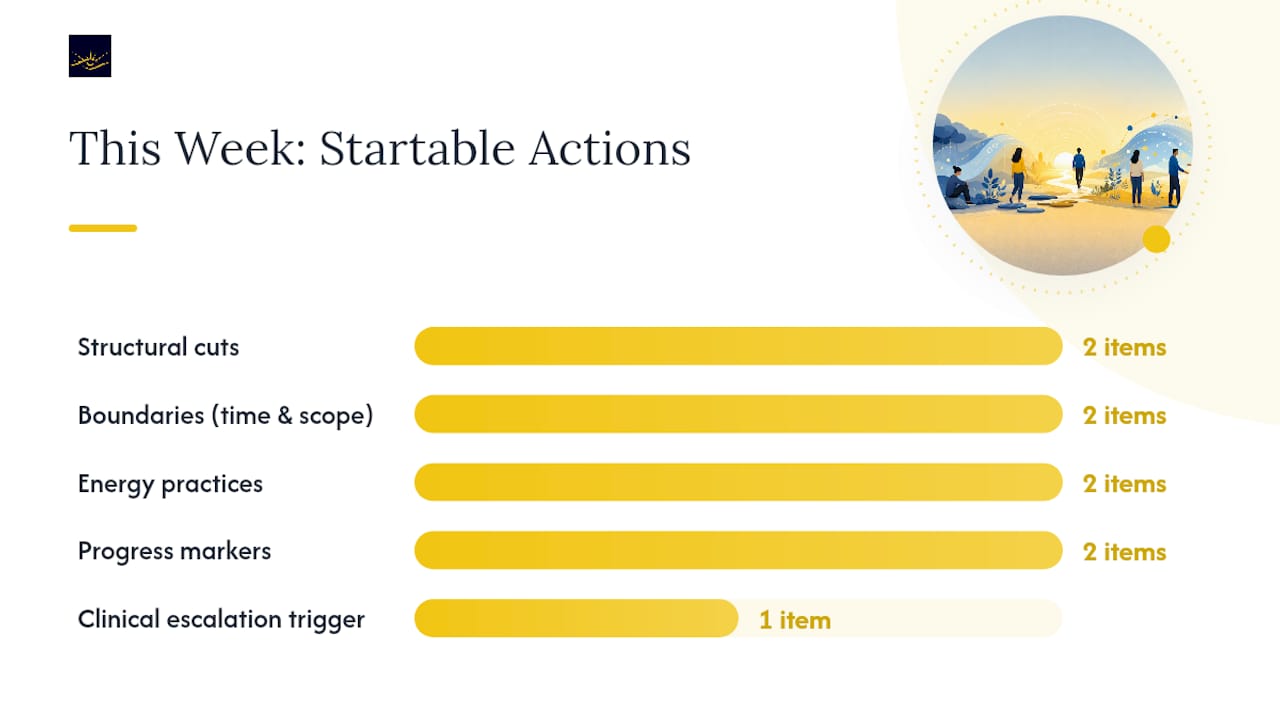
- Run the safety check first. Rule out the clinical red flags above before doing anything else. If any apply, book a clinical evaluation this week, not “eventually.”
- Make two structural cuts immediately. Rewrite one recurring meeting to be shorter or optional, and delegate one task you’ve been quietly holding onto out of habit.
- Set two boundaries and name an accountability partner. One boundary around time (no email after 7 PM), one around scope (say no to one new commitment this month), and someone who checks in on both.
- Add two short energy practices between now and your next review. A 10 minute walk before your first meeting and a real lunch break, no laptop, count.
- Book a coaching discovery call. Use it to map role redesign and identity work rather than just venting about workload, which a structured recovery framework treats as the actual leverage point.
- Define what progress looks like and what would change your plan. Pick two measurable markers (energy on a 1 to 10 scale, number of dreaded meetings per week) and one clinical escalation trigger.
Pro Tip: Write your two progress markers down before your first coaching session. Vague goals like “feel better” are nearly impossible to track; a number on a scale isn’t.
An Energy Leadership Index assessment can give you a baseline for step 6 before you even start coaching, so you’re measuring change against something concrete.
Where Leaders Get Stuck, and What Real Change Looks Like
Most leaders try to fix burnout by rearranging their calendar. Fewer meetings, a later start time, a weekend unplugged. Those changes help for a week or two, then the same exhaustion creeps back, because the real problem was never the schedule. It was a role or identity that no longer fit who they’d become. Real change starts when a leader stops asking “how do I do less” and starts asking “what am I actually building toward.” When clinical symptoms surface in that process, referring out isn’t a failure of coaching. It’s the responsible move.
— Junna Liao
Ready to Talk to Someone Who Gets It?
If your exhaustion is occupational, tied to a role, a workload, or a leadership identity that no longer fits, specialized coaching can provide high-touch, one-on-one support for professionals seeking to regain their energy and direction without long waits.

An initial engagement typically starts with an E.L.I. Assessment to map your current energy profile, followed by individualized 1:1 career coaching built around your actual role and capacity, not a generic template. Sessions may include accountability between meetings, supporting progress toward role redesign. Leaders navigating an identity shift alongside the burnout, a career pivot, a promotion that doesn’t fit, a return from a layoff, often pair this with life coaching work. If you’re ready to find out whether coaching is the right next step for you, book an exploratory call and start with a conversation, not a commitment.
Sources
- Psychotherapy and executive coaching: differences between the two and why it matters
- Therapy or Executive Coaching for Leadership Burnout?
FAQ
Is Burnout the Same as Depression?
No. Burnout is typically tied to work and improves when the role, workload, or environment changes, while depression is a clinical condition that touches every part of life regardless of context. They can overlap, and prolonged burnout raises the risk of developing depression over time.
Can Coaching Help With Burnout or Do I Need Therapy?
Coaching is often the right fit when your exhaustion is occupational and you’re emotionally stable enough to act on structural changes to your role. If symptoms are pervasive, severe, or involve safety concerns, clinical care comes first, sometimes alongside coaching rather than instead of it.
What Are the Clearest Signs I’m Dealing With Burnout, Not Depression?
You still feel pleasure and connection outside of work, your dread is specific to your job or role, and your functioning holds up in other areas of life. If none of that flatness lifts even away from work, that points toward something clinical rather than occupational.
How Long Does Coaching-Led Burnout Recovery Usually Take?
Most engagements run three to six months, with structural relief showing up in the first month and identity and role clarity developing over the following months. Progress depends on how much structural change, delegation, boundaries, role redesign, actually gets implemented, not just discussed.
Recommended
- Mindful Leadership Coaching: Mastering the Alchemy of Presence and Energy
- Executive Coaching for High Performers: Mastering the Alchemy of Leadership
This blog is for educational and inspirational purposes only. It is not medical, legal, financial, or mental health advice. Your journey is unique; please seek qualified professional support for decisions that affect your health, finances, or wellbeing.