
You cannot make your inner critic disappear, and trying to often makes it louder. What works instead is creating distance from the voice, meeting its message with curiosity rather than combat, and pairing quick grounding tactics with longer-term frameworks like mindfulness, cognitive behavioral therapy (CBT), and Internal Family Systems (IFS). This is the approach MMDC Alchemy uses with executive clients: befriend the critic, don’t fight it.
TL;DR:
- Externalizing the inner critic by naming it can create psychological space, making it easier to respond rather than react to harsh self-talk.
- Quick techniques such as asking “is this helpful?” and grounding exercises can reduce the critic’s immediate impact in under five minutes.
- Long-term management relies on evidence-based practices like cognitive behavioral therapy, self-compassion, mindfulness, and internal family systems, each suited to different situations.
- Suppressing the critic often backfires by increasing its activity, as the critic perceives silence as a threat and escalates its defense.
- Persistent, overwhelming criticism linked to trauma or depression requires professional therapy, not just self-guided routines or coaching.
Table of Contents
- How Do You Quiet Your Inner Critic Right Now?
- What Are the Best Evidence-Based Ways to Manage a Harsh Inner Voice?
- Why Trying to Silence the Critic Usually Backfires
- A 4-Week Routine for Changing Your Relationship With the Critic
- What a Coaching Lens Adds to This Work
- Working With the Inner Critic: My Take
- Sources
- FAQ
How Do You Quiet Your Inner Critic Right Now?
You need something you can do in under five minutes, standing in a bathroom stall before a board presentation or sitting at your desk after a brutal email lands. The goal isn’t to erase the voice. It’s to turn its volume down enough that you can think clearly again.
Start by giving the voice a name. This sounds almost silly until you try it. Therapists who work with self-critical clients often recommend externalizing the critic, calling it “the Judge,” “Gremlin,” or even a name that makes you smirk a little. Naming does something specific: it moves the critical thought from “I am a failure” to “The Judge is saying I’m a failure again.” That shift creates just enough psychological space to respond instead of react. Practitioners describe this technique as combining naming with somatic grounding to help cognitive reframing actually stick.
Here’s a short script you can say, out loud or silently, the next time the voice pipes up:
- Name it. “There’s the Judge again.”
- Ask if it’s helpful. “Is this comment helping me right now, or just making me feel small?”
- Ask “compared to what?” If the critic says “you’re behind,” ask behind whom, on what timeline, measured against what standard. Most critical statements collapse once you demand a comparison point.
- Ground your body. Place one hand on your chest, breathe in for four counts, hold for four, exhale for six. The extended exhale activates your parasympathetic nervous system, the part of your body responsible for calming you down after a stress spike.
- Do a sensory check. Name five things you see, four you hear, three you can touch, two you can smell, one you can taste. This pulls your attention out of the mental loop and back into the room.
The “is this helpful?” question deserves its own spotlight because it does something most advice doesn’t: it skips the argument entirely. You don’t need to prove the critic wrong. Clinical guidance from UNC Health specifically recommends asking whether the critic’s message is helpful rather than debating whether it’s true, because arguing with the voice on its own terms just keeps you locked in its logic. “Is this helpful?” sidesteps the trap. Most of the time, the honest answer is no, and that alone loosens its grip.
Use these micro-practices in the moments that matter most: right before you send a high-stakes email, in the sixty seconds before a client call, mid-sentence during a meeting when you feel your throat tighten, or when you’re staring at a blank page and the voice says you have nothing worth writing. These aren’t meant to replace deeper work. They’re triage.
Pro Tip: Keep your grounding sequence to under 90 seconds and rehearse it when you’re calm, not just when you’re spiraling. A script you’ve practiced in low-stakes moments is far more available to you during high-stakes ones.
What Are the Best Evidence-Based Ways to Manage a Harsh Inner Voice?
Quick tactics buy you breathing room. Lasting change comes from four approaches that show up again and again in clinical practice: CBT, self-compassion, mindfulness, and IFS. Each one treats the inner critic differently, and knowing which tool fits which moment makes all the difference.
CBT: catch, check, rewrite
CBT treats critical thoughts as claims that can be tested, not truths to be absorbed. The process has three steps. First, catch the automatic thought the instant it appears, word for word if you can. Second, list evidence for it and evidence against it, on paper, not just in your head. Third, rewrite the thought as a more balanced statement based on what the evidence actually shows.
Clinicians who use this method routinely have clients keep a written evidence-for/evidence-against worksheet, because writing it down forces a level of scrutiny that mental rebuttal never achieves. Say the thought is “I completely botched that presentation.” Evidence for: you stumbled over two slides. Evidence against: three colleagues followed up with specific questions about your recommendations, the client extended the meeting by ten minutes to keep discussing it, and your manager asked you to present the same material to the leadership team next week. The rewritten thought: “I made a couple of small mistakes, but the substance landed well enough that people want more.”
Building your own version of this worksheet takes about ten minutes and works best as a recurring habit rather than a one-time fix. Readers working through recurring perfectionism patterns often find it useful alongside broader work on limiting beliefs.
Self-compassion: notice, connect, comfort
Kristin Neff’s self-compassion framework breaks into three moves you can practice in any order, though most people find this sequence intuitive:
- Notice the pain without minimizing or exaggerating it. “This is a hard moment. I’m struggling right now.”
- Recognize common humanity. “Other people feel this exact way after a mistake. I’m not uniquely broken.”
- Offer yourself kindness the way you’d offer a friend. “What do I need to hear right now that would actually help?”
Self-compassion isn’t the same as self-esteem, and it isn’t permission to lower your standards. It’s a stance that lets you look at a mistake honestly without the shame spiral that usually follows. Research on occupational stress finds that self-compassion practices reduce negative emotional reactivity and build resilience in high-pressure work environments, which matters if your inner critic tends to show up hardest during deadlines and performance reviews.
Mindfulness: watch the noise instead of becoming it
Mindfulness treats the critic as mental weather, something passing through rather than something you are. Two short practices work well here. The first: sit for three minutes and simply label each critical thought as it arises, “there’s a judgment,” “there’s a comparison,” without engaging its content. The second: imagine the critical voice as a radio playing in another room. You can hear it, but you’re not obligated to walk in and turn the volume up by arguing with it.
The distance this creates is the whole point. You’re not suppressing the thought. You’re changing your relationship to it, which is a different move entirely and one that tends to hold up better over time.
IFS: befriend the protector, don’t fight it
Internal Family Systems takes the most counterintuitive stance of the four: it treats the inner critic not as an enemy but as a protector part trying, badly, to keep you safe. IFS practitioners use a process sometimes shortened to the “6 Fs”: find the part, focus on it, flesh out how it shows up, feel toward it with curiosity, befriend it, and ask what it fears would happen if it stopped criticizing you.

That last question is the hinge. Ask your critic directly: “What are you afraid would happen if you stopped pushing me?” Often the answer underneath is something like “you’d get lazy” or “people would reject you” or “you’d fail publicly.” The critic isn’t cruel for its own sake. It’s terrified, and criticism is the only strategy it knows. IFS practice frames this shift as the gateway to actual change, because once you understand the fear driving the voice, you can address the fear directly instead of fighting its symptom.
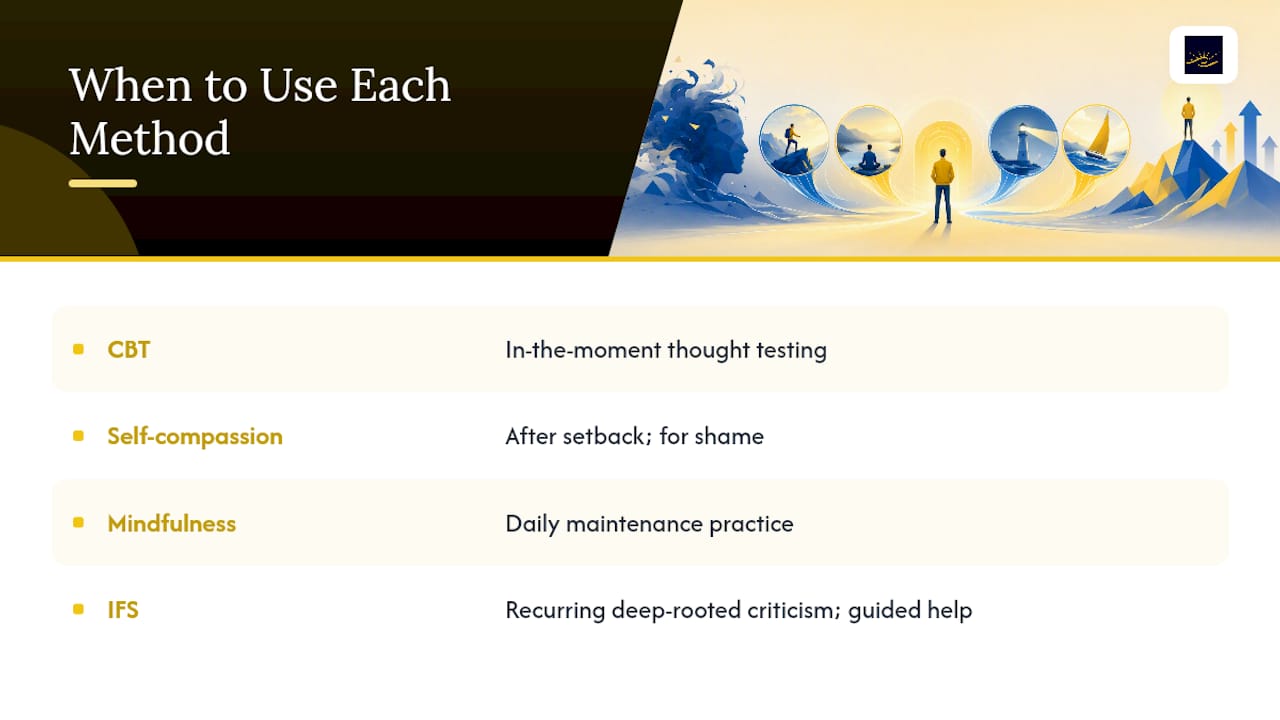
When to use which method
CBT works best in the moment, when you have a specific thought you can pin down and test against evidence. Self-compassion works best after a setback, when shame is the dominant feeling rather than distorted logic. Mindfulness works best as a daily maintenance practice that keeps the critic from building momentum in the first place. IFS works best for recurring, deep-rooted criticism that traces back to old fears, and it’s often the method that benefits most from guided practice with a therapist or coach rather than solo journaling.
Why Trying to Silence the Critic Usually Backfires
Suppression doesn’t work, and there’s a name for why: the rebound effect. When you actively try to push a thought out of your mind, meta-analytic research on thought suppression shows the thought tends to return at a higher frequency afterward, not a lower one. Telling yourself “stop thinking that” is functionally the same as telling yourself to think about it more, just on a delay.
IFS explains why this happens at a structural level. If the critic is a protector part whose entire job is keeping you safe from perceived threats, silencing it doesn’t calm the threat detection system. It escalates it. A protector that senses it’s being ignored or shut down doesn’t retire quietly; it gets louder, because from its perspective, the danger it’s guarding against just got worse. Suppressing a protector part increases its activity precisely because its role is safety, and the corrective move isn’t force. It’s building enough trust between you and the part that it can finally relax.
This is also why generic affirmations often fail. Saying “I am confident and capable” ten times in a mirror doesn’t work when a louder, older part of you doesn’t believe it. That’s a mismatch between your rational brain, which can generate the affirmation, and your emotional brain, which is the part actually running the critic’s script. You can’t out-argue an emotional threat response with a logical statement. You have to address the emotional layer directly.
The correct clinical move with a protector part isn’t to banish it. It’s to build a trusting relationship with it so it feels safe enough to stand down on its own.
The practical implication: instead of trying to overpower the voice, ask it questions. Soothe the fear underneath it. Experiment with small, low-stakes actions that give the protector evidence you can handle things without its constant intervention. That’s slower than a mantra, but it’s also the version that actually holds.
A 4-Week Routine for Changing Your Relationship With the Critic
Real change here isn’t a single breakthrough. It’s a sequence, built week by week, that moves from noticing the voice to actually renegotiating its role.
- Week 1: Build awareness. Track every time the critic speaks up, just a quick note in your phone: time, trigger, what it said. Pick one or two micro-practices from your quick-response list, most people start with naming plus the “is this helpful?” question, and use them daily.
- Week 2: Add cognitive tools. Introduce the CBT evidence worksheet for your most recurring critical thought. Pair it with a short self-compassion check-in each evening: notice the day’s hardest moment, name the common humanity in it, offer yourself one kind sentence.
- Week 3: Go deeper with IFS. Set aside fifteen minutes once this week for a guided journaling session where you ask the critic directly what it fears. Write its answer without editing. Most people are surprised by what surfaces.
- Week 4: Consolidate and plan ahead. Build a go-to sequence, name, ground, ask “is this helpful,” check evidence, that you can run in under two minutes. Decide which practices you’ll keep doing weekly versus daily, and identify your personal early-warning signs that the critic is escalating rather than softening.
Progress here isn’t about the voice going silent. It’s about three measurable shifts: how often the critical thought shows up, how strong the emotional reaction is when it does, and whether you still complete the task despite the noise.
| Week | Focus | Daily/weekly action | What to track |
|---|---|---|---|
| Week 1 | Awareness | Name the critic; ask “is this helpful?” | Frequency of critical thoughts |
| Week 2 | Cognitive tools | CBT evidence worksheet; nightly self-compassion check-in | Emotional intensity |
| Week 3 | IFS depth work | One guided journaling session asking the critic’s fear | Insight gained; shift in tone of the voice |
| Week 4 | Consolidation | Build a two-minute go-to sequence | Task follow-through despite critical thoughts |
If, by week four, the critical voice is still consistently overwhelming, shows up alongside persistent low mood, or is tied to patterns that feel too heavy to unpack alone with journaling, that’s a signal worth taking seriously. A therapist trained in CBT or IFS can work with material that surfaces in ways a self-guided routine simply isn’t built to hold. Coaching can extend this work further for career-specific patterns, but it isn’t a substitute for clinical care when the criticism is rooted in trauma or clinical depression.
What a Coaching Lens Adds to This Work
Junna Liao founded MMDC Alchemy after watching a pattern repeat across high-achieving clients: the inner critic doesn’t quiet down when you hit the next milestone. It just finds a new target. This tracks with what’s known as arrival fallacy, the well-documented tendency for people to feel only brief satisfaction after reaching a goal before the mind resets and starts measuring the next gap. Psychologists tie this to hedonic adaptation, where new successes normalize quickly and the critic simply raises the bar again. For leaders, this isn’t a personality flaw. It’s a predictable pattern, and one that responds to intervention.
MMDC Alchemy has guided numerous client transformations, and the throughline across most of them is the same one Harvard Business Review points to for leaders: the goal isn’t to silence the critical voice but to talk to it, because trying to suppress it under pressure tends to trigger exactly the shame spirals that undermine performance.
Coaching engagements at MMDC Alchemy typically start with an intake conversation mapping where the critic shows up most, in decision-making, delegation, public speaking, or performance reviews. From there, the work often includes behavioral experiments (testing a small action the critic insists will fail, then reviewing what actually happened), structured evidence review similar to CBT but applied to career-specific beliefs, and accountability check-ins that track whether the client’s relationship to the voice is shifting over time. This differs from generic self-help in one key way: it’s built around your specific patterns and history, not a universal script, and it’s paced to your actual career transitions rather than a fixed workbook. Anyone navigating a leadership identity shift or persistent imposter-style self-doubt tends to get the most out of this kind of structured, personalized work.
Coaching complements clinical therapy well when the critic’s roots are more situational, tied to a role transition, a burnout period, or a specific leadership challenge. When the criticism connects to trauma, clinical depression, or anxiety that interferes with daily functioning, clinical care should come first, with coaching as a later addition rather than a replacement.
Working With the Inner Critic: My Take
Most advice on this topic treats the inner critic like a bug to patch. Find the right affirmation, install it, move on. That framing fails almost everyone I’ve watched try it, and the research on thought suppression explains why: you cannot patch over a fear-based system with a nicer sentence. The critic isn’t a software error. It’s a part of you that learned, at some point, that vigilance and harsh self-talk were the price of staying safe or staying successful.
What surprises people most in coaching work isn’t the tactics, it’s how often clients discover the critic actually softens once they stop treating it as an enemy. The moment a client asks their own inner critic what it’s actually afraid of, and gets a real answer, something shifts that no affirmation ever touched. That’s not a coincidence. It’s what happens when you finally negotiate with the part of you that’s been shouting because it thought shouting was the only way you’d listen.
The other pattern I’d push back on: the idea that hitting the next big goal will finally quiet things down. It won’t, not permanently. Arrival fallacy is real for a reason, and I’ve watched it play out in leader after leader who assumed the next promotion, the next launch, the next milestone would be the one that finally earned them peace. It never is, because the critic isn’t actually tracking your achievements. It’s tracking your safety. That’s a different problem, and it needs a different solution than another win.
If there’s one thing I’d want every high achiever to sit with, it’s this: the critic got loud because something in your history made loud feel necessary. Respect that history instead of fighting it, and the volume tends to drop on its own.
— Junna Liao
Sources
- Ifs
- Stop Bullying Yourself: How to quiet your inner critic | UNC Health Talk
- How to challenge your inner critic—and win | Psychology Today
- Don’t silence your inner critic. Talk to it. | HBR
Ready to work through recurring self-criticism with structured support? MMDC Alchemy’s career coaching programs pair behavioral experiments with identity work built for leaders navigating burnout, transition, or persistent self-doubt.
This article is general information, not a substitute for advice from a qualified doctor. Consult a qualified healthcare professional about your own circumstances before acting on anything here.
FAQ
What does “silence your inner critic” mean?
It’s often used to mean making the self-critical voice disappear entirely, but the more accurate goal is reducing its power and changing your relationship to it, not achieving total silence.
What are the 7 types of inner critics?
Definitions vary across practitioners and no single clinical framework is universally agreed upon; some coaches and authors describe recurring patterns like the perfectionist, the taskmaster, and the guilt-tripper, but treat any specific numbered list as one author’s model rather than an established standard.
What triggers your inner critic?
Common triggers include perceived failure, comparison to others, high-stakes performance moments, and reaching a goal without the expected sense of relief, a pattern tied to arrival fallacy.
Why is my inner critic so harsh?
From an IFS perspective, harshness usually reflects fear rather than cruelty; the critic often escalates because it believes intensity is the only way to keep you safe from failure or rejection, and it tends to get louder when ignored or suppressed.
When should I get professional help for my inner critic?
If the voice stays overwhelming after weeks of consistent practice, connects to trauma or clinical depression, or interferes with daily functioning, a therapist trained in CBT or IFS is the right next step rather than continued self-guided work.
Recommended
- Clear Communication Coaching for Leaders
- Coaching for Limiting Beliefs in Leadership
- Leadership Blind Spot Assessment for Clearer Growth
This blog is for educational and inspirational purposes only. It is not medical, legal, financial, or mental health advice. Your journey is unique; please seek qualified professional support for decisions that affect your health, finances, or wellbeing.