
Vertical development in leadership is the growth of how you think, not just what you know. It is the progressive expansion of a leader’s capacity to make meaning of complex situations, take in more perspectives and act with more self-awareness when things are uncertain. Skills can be added in a weekend workshop. This kind of growth usually takes longer, and it tends to come from reflection, discomfort and honest feedback.
Below, we explain the idea, the stages researchers describe, how it differs from horizontal development, what practices help and how to notice progress. We also say plainly what the research cannot yet prove.
TL;DR
- Horizontal development adds skills and knowledge. Vertical development upgrades the mindset you use to apply them.
- Models such as Kegan’s orders of consciousness and Torbert’s action logics describe predictable stages of adult mindset growth.
- Self-reflection, seeking out uncomfortable situations and asking better questions are the best-supported practices.
- Progress shows up as a greater ability to question assumptions, hold paradox and adapt. Measurement is still imperfect.
- Leaders rarely do this well alone. A coach who challenges your blind spots can speed it up.
Table of Contents
- What vertical development means in leadership
- Vertical vs. horizontal development
- Leader development vs. leadership development
- The stages: Kegan, Torbert and what they describe
- Why it matters when the work gets complex
- How leaders develop vertically
- How to recognize progress
- Our perspective: growth that holds up under pressure
- Working with a coach on your own vertical growth
- FAQ
- Sources
What vertical development means in leadership
Academic work on the topic describes vertical leadership development as the growth of a leader’s cognitive and socio-emotional meaning-making capacity. As that capacity grows, a leader can read a situation through more complex and inclusive perspectives and respond to change with more self-awareness.
Kevin Coopersmith frames it in practical terms: it improves a person’s capacity to think and make decisions, communicate, interpret the world and navigate uncertainty and change. He also notes that the process is often lifelong.
The word “vertical” is a metaphor for altitude. Think of the view from a hillside compared with the view from a ridge. The terrain is the same, but you see more of it, you see how the parts connect, and you stop mistaking your valley for the whole map.
A useful test is this: when a leader keeps hitting the same wall despite excellent skills, the problem is often not a missing skill. It is a way of seeing the problem that no longer fits it.
Vertical vs. horizontal development
This is the question people ask most, and the distinction is simple. According to the same academic review, horizontal development focuses on technical skills and abilities, while vertical development focuses on how leaders make sense of the knowledge they acquire and build more complex, inclusive perspectives.
| Horizontal development | Vertical development | |
|---|---|---|
| What grows | Skills, knowledge, competencies | Meaning-making, perspective, self-awareness |
| Typical format | Training, courses, certifications | Reflection, stretch experiences, coaching, feedback |
| Question it answers | What can I do? | How do I see, and who am I when I lead? |
| Pace | Fast, measurable | Slower, harder to measure |
| Example | Learning financial modeling | Noticing why you override your team under pressure |
They are not rivals. One practitioner view describes them as interdependent polarities, with vertical growth as an outcome of healthy horizontal development. A leader with new perspective and no skills cannot execute. A leader with many skills and a narrow mindset will use them in the same limited way, only faster.
The researchers behind the academic review make a pointed observation: investment in leadership education often focuses too much on the skills people possess and too little on developing the people themselves. That imbalance explains why so many expensive programs change a leader’s toolkit and leave their leadership untouched.
Leader development vs. leadership development
People often ask whether these two terms mean the same thing. They overlap, but they are not identical. In the literature, leader development is the expansion of an individual’s capacity to be effective in leadership roles and processes, which builds what researchers call human capital. Leadership development is the broader expansion of a group’s capacity to set direction, create alignment and sustain commitment. Leader development is one part of it.
Vertical development sits in both. It changes the individual’s meaning-making, and when several leaders in a team grow this way, the team’s shared capacity to handle disagreement and complexity grows too.
The stages: Kegan, Torbert and what they describe
Vertical models share one idea: adults keep developing in recognizable stages, and each stage includes and transcends the last. Two frameworks come up most often.
Kegan’s orders of consciousness include the Socialized Mind, the Self-Authoring Mind and the Self-Transforming Mind. Torbert’s action logics include the Opportunist, the Achiever, the Strategist and the Alchemist. Both appear in the academic review of vertical leadership development.
Here is what the middle stages look like in a working leader:
- Socialized mind. You take your cues from your organization, your boss and your profession. Approval and belonging steer your decisions. Conflict feels dangerous because disagreement threatens the relationship.
- Self-authoring mind. You have your own values, standards and direction. Research summarized by the London School of Economics describes these leaders as able to take an independent stance and craft their own leadership mindsets rather than relying only on norms or others’ expectations. The risk is rigidity: your framework starts to feel like the truth.
- Self-transforming mind. You see that your viewpoint is shaped by experience, so you seek out others’ perspectives and grow more comfortable with opposing views. Contradiction becomes information instead of threat.
A sobering figure from Kegan’s research: fewer than 34 percent of adults reach the Fourth Order, and none in his research fully attained the Fifth. The takeaway is not that the later stages are out of reach. It is that nobody gets there by accident, and most leaders are working at an earlier stage than they assume.
Stages are not a ranking of human worth. A later stage is not a better person. It is a larger capacity for complexity, and not every role demands the most complex capacity at every moment.
Why it matters when the work gets complex
Most leaders hit a ceiling at some point that more effort does not break. The problems get less technical and more adaptive: competing stakeholders, no clear right answer, and a changing context. Vertical development speaks to exactly this.
The LSE research notes that it can give leaders greater perspective and self-awareness, which increases their flexibility and choice in managing complexity and opposing viewpoints. Coopersmith argues it helps leaders become better collaborators, problem-solvers and change agents because they understand themselves, other perspectives and complex challenges better.
That last point matters in any big organizational shift. When a technology wave arrives, for example, the hard part is rarely the tool. It is helping people through the change while holding several viewpoints at once, which is why people-first AI change management is as much a leadership question as a technical one.
We see the personal version of this often. A senior leader burns out not because the workload outgrew their skills, but because the identity that drove their success, always the strongest, always the one with the answers, can no longer carry the weight.
How leaders develop vertically
The practices below are the ones with the clearest support. Research summarized in the LSE piece points to self-reflection, seeking out uncomfortable situations and consciously asking inquiry-based questions that encourage higher-stage thinking.
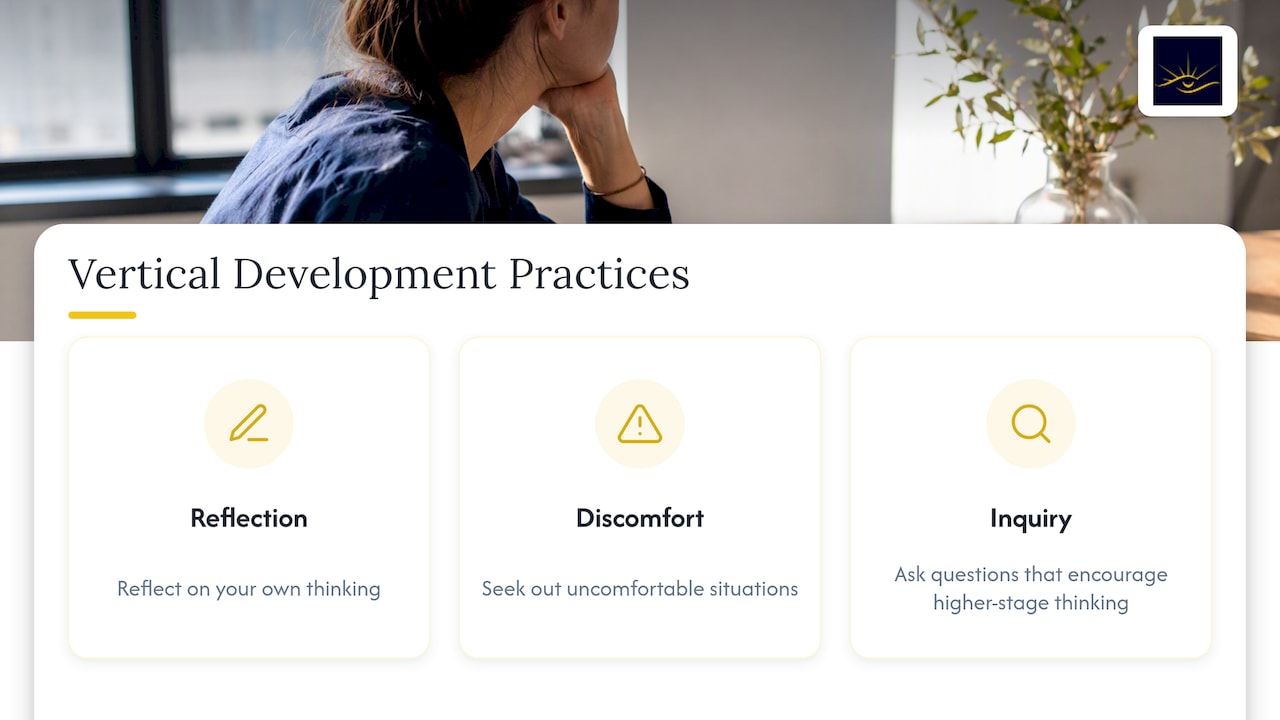
Reflect on how you interpret events, not only what happened
After a hard meeting, ask what story you told yourself in the moment and what else could be true. A short written log, kept for a few weeks, shows patterns quickly: the same trigger, the same assumption, the same reaction.
Seek discomfort on purpose
Growth tends to come when your current way of seeing stops working. One practitioner view holds that reality itself often acts as a catalyst, pushing leaders to reinterpret experience when old mental models no longer fit. You do not have to wait for a crisis. Take the assignment where you are not the expert. Work closely with someone who sees the world differently. Spend time in a function or culture that is unfamiliar.
Ask better questions
Swap “Who is wrong here?” for “What would have to be true for both of these views to be reasonable?” Swap “How do I fix this?” for “What is this situation asking of me?” Questions like these invite a more complex frame.
Get an outside view of your blind spots
Others can see the assumptions you cannot. Structured feedback helps, and so does a thinking partner who will not simply agree with you. Our Leadership Blind Spot Assessment is one way to start surfacing what you are not seeing, and building self-awareness as a leader is the foundation under all the rest.
Give it time and repetition
A single insight is not a stage shift. New ways of seeing need to be practiced under real pressure before they hold. This is why we work with clients over months rather than sessions, with real work between conversations.
How to recognize progress
The signs are behavioral and often subtle. The academic review suggests progress may show as a greater capacity to question assumptions, accept paradox, solve complex problems and adapt to changing demands.
In practice, you may notice that:
- You catch your reactions sooner and recover faster.
- You can argue another person’s position well enough that they agree you got it right.
- You hold a decision loosely enough to change it when new facts arrive.
- Feedback that once felt like an attack now feels like data.
- You stop needing to be the smartest person in the room.
The same review is candid that measurement remains difficult and that organizational impact can be hard to separate from correlation. Be skeptical of any provider that promises a guaranteed jump in stage. Treat the stages as a map, not a scorecard.
Our perspective: growth that holds up under pressure
We work with executives and high achievers at the point where skills are no longer the issue. They are good at their jobs. They are tired, or stuck, or facing a change in who they are, and what got them here has stopped working.
We do not treat vertical development as a vocabulary lesson. Knowing the names of the stages changes nothing on its own. What shifts a leader is seeing their own pattern, in their own situation, and then testing a different response in real life. That is why our coaching combines deep, reflective work with practical strategy and accountability outside the sessions.
We also use Energy Leadership principles. They give leaders a concrete way to see how their internal state shapes decisions, relationships and results. Many of our clients find that this makes abstract developmental ideas easier to apply on a Tuesday afternoon.
Over 600 transformations have taught us one thing about this work: the leaders who grow most are not the ones with the best intentions. They are the ones willing to be honestly seen, and to stay in discomfort long enough to learn from it.
— Junna Liao
Working with a coach on your own vertical growth
If you recognize yourself here, particularly if you are facing burnout, a career change or a shift in identity, one-on-one work is the most direct path. Our 1:1 career coaching is built around the person, not a curriculum. Engagements typically run three to twelve months. If you want a baseline first, the Energy Leadership Index assessment shows how you tend to operate under stress. You can also read how transformational coaching for leaders is studied, or book a call to talk through where you are.
FAQ
What is the difference between vertical and horizontal development?
Horizontal development adds skills, knowledge and competencies. Vertical development grows the way you make sense of that knowledge, so you can handle more complexity and more perspectives. Strong leaders need both, because skills without perspective get used in the same narrow way.
What is the difference between leader development and leadership development?
Leader development builds an individual’s capacity to be effective in leadership roles. Leadership development is broader and builds a group’s capacity to set direction, align and stay committed. Individual growth feeds the collective one.
How long does vertical development take?
There is no fixed timeline. Coopersmith describes the process as often lifelong. Meaningful shifts generally need sustained reflection, real challenges and feedback over months, not a one-off workshop.
Can you measure vertical development?
Partly. Assessments and structured interviews exist, and you can watch for behavioral signs such as questioning assumptions and holding paradox. The research notes that measurement is still difficult, so treat any score as one input.
Sources
- Helping Leaders Grow Up: Vertical Leadership Development, Journal of Values-Based Leadership
- Three Conditions for Vertical Leadership Development, Journal of Values-Based Leadership
- Vertical development: cultivating mindsets, emotions and habits to lead effectively, LSE Business Review
- LSE Business Review, Vertical development (full text PDF)
- What are Horizontal & Vertical Development?, Sloww
- Leader development, Wikipedia
Recommended
- Overcoming Leadership Plateaus: An Alchemical Guide to Sustainable Mastery
- The Alchemy of Mastery: Choosing the Right Individual Leadership Growth Program
This blog is for educational and inspirational purposes only. It is not medical, legal, financial, or mental health advice. Your journey is unique; please seek qualified professional support for decisions that affect your health, finances, or wellbeing.