
Choose a coach whose experience maps to your measurable outcome, whose methodology tracks behavioral change, and with whom you have clear chemistry. Weigh credentials from a body like the International Coaching Federation as a floor, not a finish line, and treat a provider as an example of a coach that pairs deep transformation work with actual measurement. The rest comes down to running a tight discovery process before you sign anything.
TL;DR:
- Choose a coach with proven experience in your specific role, industry, or challenge, and ensure they have a clear measurement plan for progress.
- Clarify precise behavioral goals, assess your available time, and determine short-term outcomes like promotions or retention before engaging.
- Verify a coach’s credentials, experience, and methodology, and prioritize chemistry and trust, asking for references and outcome examples.
- Conduct a structured discovery call with targeted questions, focusing on their process, evidence of success, and scenario handling skills.
- Opt for shorter pilot programs to evaluate compatibility, and establish measurable success criteria from the start to track real behavior change.
Table of Contents
- Clarify Your Goals Before Choosing an Executive Coach
- What to Look for in an Executive Coach: Credentials, Experience, and Fit
- Where to Find a Qualified Executive Coach
- What to Ask an Executive Coach on a Discovery Call
- Executive Coaching Cost and Commitment Models
- How to Measure Success in an Executive Coaching Engagement
- How MMDC Alchemy Thinks About Selecting and Measuring a Coach
- Ready to Work With a Coach Who Tracks Real Change?
- Sources
Clarify Your Goals Before Choosing an Executive Coach
Choosing an executive coach starts with a target, not a search. “Get better at leadership” is not a goal a coach can work with. “Cut my decision time on escalations from three days to same day” or “reduce attrition on my team by a third within two quarters” gives both of you something to measure.
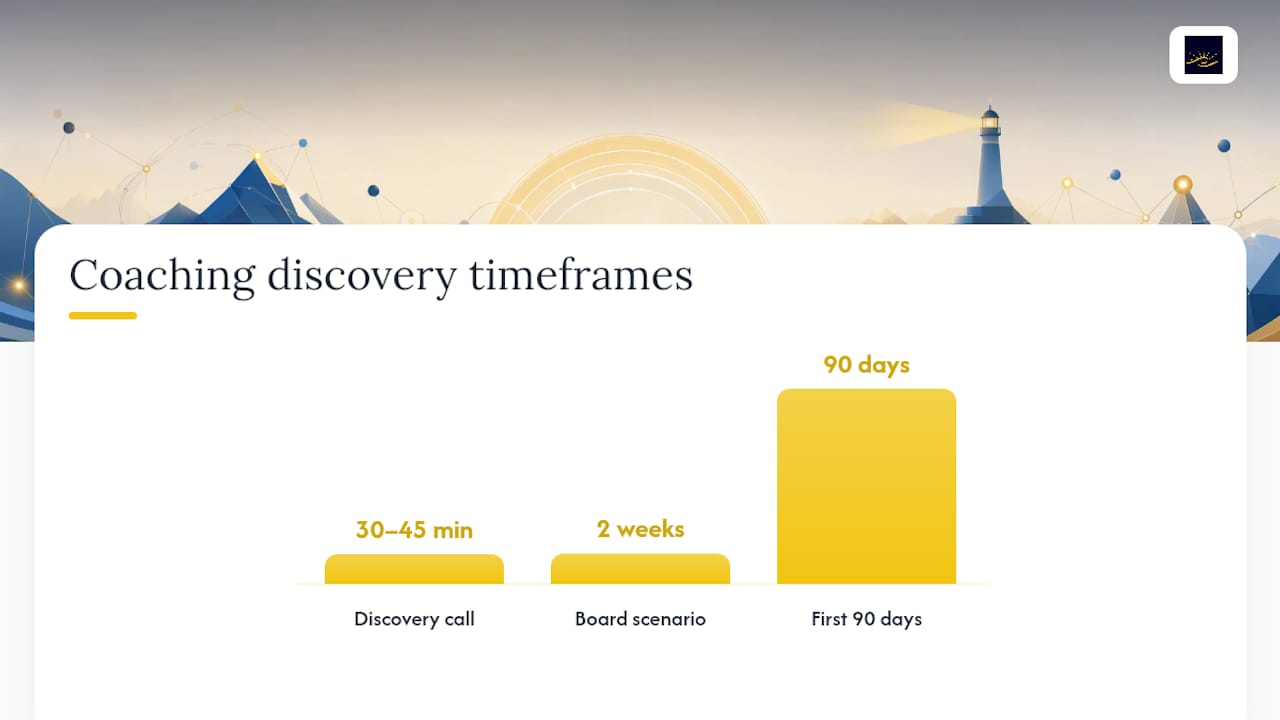
Most engagements run 3 to 12 months, and that window exists for a reason: real behavior change under pressure takes repeated reps, not a few pep talks. A coach who proposes six sessions total for a promotion-readiness goal is underselling the timeline.
Before you contact anyone, work through:
- What specific behavior needs to change, and who notices when it does?
- How many hours a month can you realistically protect for sessions and practice?
- What would a good return look like: a promotion, a retention number, a calmer nervous system in board meetings?
- Is this self-funded or sponsored by your organization, and does that sponsor need to see progress reports?
Budget conversations get easier once the goal is specific. Medium-length engagements aimed at a defined promotion timeline differ financially from open-ended “help me figure out what’s next” engagements, and you should price them differently in your own head before you ever ask a coach for a rate.
What to Look for in an Executive Coach: Credentials, Experience, and Fit
An ICF credential (ACC, PCC, or MCC) tells you a coach has logged supervised hours and agreed to a professional code of ethics. It does not tell you whether they have ever coached someone through a hostile board, a first-time COO transition, or a burnout spiral. Credentials and experience answer different questions, and you need both answered.
Run every candidate through these checks:
- Credential level: ICF certification confirms training and ethical accountability, including recourse if a coach violates standards.
- Comparable experience: Have they coached someone at your level, in your industry, facing a similar transition?
- Methodology: Do they describe a session structure, or just “we’ll see where the conversation goes”?
- Measurement plan: Will they use 360-degree feedback or KPI tracking, or is progress just a feeling by month six?
- Chemistry: Do they listen past the first answer, and can they challenge you without triggering defensiveness?
Coaching effectiveness leans heavily on relationship quality. Even a coach with a wall of certificates fails if the sessions feel unsafe or performative, so chemistry isn’t a soft add-on to the checklist. It’s often the deciding factor once the credentials check out.
Ask every finalist for two or three references from clients with a comparable role or challenge, plus a sample engagement plan showing what a typical month looks like. A coach who can’t produce either is asking you to buy blind. Structured evaluation frameworks like the 5 E’s approach exist precisely because chemistry alone leaves too much to chance.
Pro Tip: Ask for an anonymized before/after summary from a past client, not just a testimonial quote. A coach who tracks outcomes will have this ready; one who doesn’t measure anything usually won’t.
Where to Find a Qualified Executive Coach
Sourcing candidates well saves you from screening a dozen mismatches later. Work through these channels in order:
- Start with the ICF directory. Coach Finder lets you filter by credential level, specialty, and location, and every listed coach has agreed to the ICF’s ethical code.
- Ask your network directly. Peers, HR business partners, and executive sponsors often know coaches who delivered real results, not just pleasant conversations. Vet referrals fast by asking what specific change the coach helped produce.
- Search LinkedIn with precision. Filter for “Executive Coach” plus your industry and target credential level (PCC coaches who’ve worked with your sector show up reliably with the right search terms).
- Decide generalist versus specialist. A coach who’s worked exclusively in healthcare leadership brings context a generalist won’t, though a strong generalist methodology can still transfer well across industries.
If you’re leading in a clinical or healthtech environment, sector fluency matters more than usual. This piece on clinical advisory scope for founders is worth a read if you’re weighing how much industry-specific experience your coach actually needs.
What to Ask an Executive Coach on a Discovery Call
A discovery call should run 30 to 45 minutes and end with you knowing exactly how this person works, not just whether you liked them. Structure it in three parts: their process, their evidence, and a scenario test.
Questions worth asking directly:
- “Walk me through your first 90 days with a new client. What actually happens?”
- “How do you measure whether coaching is working, beyond how I feel about it?”
- “Have you worked with someone in a role like mine? What was the outcome?”
- “Can I speak to a past client with a similar goal?”
- “How do you handle confidentiality if my sponsor asks for updates?”
Then push a scenario at them: “I have a direct report underperforming and a board presentation in two weeks. How would you coach me through that?” A grounded answer describes a process. A vague one describes a philosophy.
Watch for red flags in the 5 C’s framework: promises of guaranteed outcomes, refusal to discuss measurement, or fuzziness about confidentiality boundaries between you and a corporate sponsor. Any coach guaranteeing a promotion or a specific title change is overselling something coaching can’t control.
Pro Tip: If a coach can’t name a single measurement method unprompted, that’s your answer. Methodology should come up before you ask about price.
Executive Coaching Cost and Commitment Models
Session rates for executive coaching vary widely by seniority and market, generally running higher for C-suite work than for first-time manager coaching. A six-month engagement with weekly or biweekly sessions costs meaningfully less in total than a 12-month program, but the longer format usually produces more durable behavior change simply because there’s more time to practice under real pressure.
- Ask about a shorter trial or pilot arrangement before committing to a full contract. This is the cheapest way to test chemistry and process fit.
- Negotiate on scope and deliverables (session count, measurement checkpoints, sponsor reporting) rather than just haggling on the hourly number.
- Confirm what happens if the engagement isn’t working by month two. A good coach has an answer already.
How to Measure Success in an Executive Coaching Engagement
Coaching accountability depends on picking metrics before you start, not after six months of good conversations. Baseline assessment first, then check in monthly or quarterly against it.
- Behavioral metrics: decision speed under pressure, recovery time after a setback, stakeholder feedback trends.
- Multi-source data: a 360-degree review at the start and again near the midpoint shows whether perception is actually shifting, not just self-report.
- Goal-specific sets: promotion readiness might track visibility and sponsor feedback; team retention tracks attrition numbers directly; resilience tracks recovery time after high-stakes weeks.
Coaching tied to specific, business-aligned outcomes and measured against behavior under pressure consistently outperforms coaching measured only by satisfaction scores, according to Exec Learn’s best-practice guidance. Set your exit criteria at the start too: if the agreed metrics haven’t moved by the midpoint of a 3 to 12 month engagement, that’s your signal to renegotiate scope or walk away, not to just keep going and hope.
How MMDC Alchemy Thinks About Selecting and Measuring a Coach
Founded by Junna Liao, MMDC Alchemy built its approach around a simple premise: coaching should move something measurable, not just feel good in the moment. One client came in mid-burnout with no language for what was actually wrong, just exhaustion and a vague sense of misalignment. Six months of structured work later, the shift showed up in concrete decisions: a role change, clearer boundaries, and stakeholder feedback that reflected it. That kind of outcome fits readers weighing a pilot engagement before committing to a full program.
— Junna Liao
Ready to Work With a Coach Who Tracks Real Change?
If burnout, a career transition, or an identity shift is the actual problem underneath your goal, generic leadership coaching won’t touch it. This coaching specializes in that deeper layer: many client transformations built on baseline assessment, ongoing check-ins, and a methodology designed to surface what’s actually driving the stuck feeling, not just polish the symptoms on top of it.
You don’t have to commit to a year up front. A pilot conversation is the fastest way to test chemistry and see whether the approach matches what you actually need right now. Start with a look at career coaching options, or review the full range of programs if you’re comparing engagement lengths. If you’re navigating a layoff or forced transition specifically, there’s a dedicated resource on leading yourself through that uncertainty worth reading first. Book a discovery call and bring your actual goal, not a vague one, so the first conversation can be useful instead of exploratory.
Sources
For deeper research, the ICF’s coach directory and ethics standards explain how credentialing and recourse work. American University’s practice notes on coaching ROI cover engagement length and measurement in more depth. For MMDC Alchemy’s own methodology and program details, see the coaching programs page and assessment tools overview.
- Executive coaching ROI and practice notes (American University)
- Find a coach | International Coaching Federation (ICF)
- Executive coaching best practices — Exec Learn
- Beyond chemistry: The 5 E’s of evaluating an executive coach — Forbes Councils
Recommended
This blog is for educational and inspirational purposes only. It is not medical, legal, financial, or mental health advice. Your journey is unique; please seek qualified professional support for decisions that affect your health, finances, or wellbeing.