
Trauma-informed leadership means running teams so that people’s nervous systems, not just their job descriptions, are accounted for in how you communicate, decide, and respond to mistakes. The immediate payoff is practical: leaders who prioritize safety, transparency, and their own regulation see fewer defensive blowups, clearer thinking under pressure, and teams that recover faster from setbacks. The steps to get there are concrete, not therapeutic, and they start below.
TL;DR:
- Trauma-informed leadership requires consistent, day-to-day adjustments in communication and policies that reduce threat signals and support nervous system regulation.
- Leaders must prioritize their own self-regulation practices, such as grounding and pausing, to prevent activation that undermines team safety and trust.
- Successful implementation depends on strong leadership buy-in, cross-functional teams, structural changes, and ongoing monitoring of psychological safety and turnover metrics.
- Recognizing and responding to nervous-system responses like fight, flight, freeze, or dissociation helps address the root causes of stress and conflict at work.
- Organizational culture change benefits from peer support, clear routines, cultural responsiveness, and avoiding performative or superficial trauma-informed symbols.
Table of Contents
- What Does Trauma-Informed Leadership Mean in Practice?
- Core Frameworks Every Leader Should Know
- How Does Trauma Show Up at Work?
- Relational Practices That Build Trauma-Aware Management
- How to Roll Out Trauma-Informed Practices Organization-Wide
- How Do You Know If It’s Working (or Just Performative)?
- Posttraumatic Growth: Building Resilient Teams That Come Back Stronger
- A Coach’s Toolkit: Practical Exercises for Regulation and Feedback
- Why Leader Regulation Has to Come First
- Getting Buy-In From the Whole Organization, Not Just Leaders
- Culturally Responsive Practices for Diverse Teams
- Legal and Ethical Guardrails to Keep in Mind
- What Trauma-Informed Leadership Looks Like in Different Settings
- A Leader’s Turnaround: What Actually Changed
- How Coaching Helps You Actually Lead This Way
- Where to Learn More
- Sources
What Does Trauma-Informed Leadership Mean in Practice?
Trauma-informed leadership is a management discipline, not a mental health service. It means designing how you communicate, delegate, and give feedback so you don’t accidentally trigger the fight, flight, freeze, or shutdown responses that derail focus and trust. You’re not diagnosing anyone. You’re removing unnecessary threat signals from the way work gets done.
SAMHSA’s foundational framework lays out four assumptions every trauma-informed organization operates from: realize that trauma’s impact is widespread rather than rare, recognize the signs and symptoms of it in behavior, respond by building trauma knowledge into policies and procedures, and actively resist practices that retraumatize people. Translated into daily leadership, that means assuming some portion of your team is carrying stress you can’t see, reading withdrawal or irritability as possible signals rather than character flaws, and checking your own policies for hidden landmines like public call-outs or surprise reorganizations.
A few things trauma-informed leadership is not:
- It is not therapy, and leaders should never attempt to diagnose or treat an employee’s trauma history.
- It is not a synonym for lowering performance standards. Clear expectations and accountability stay intact.
- It is not a one-time training module. It’s an operating pattern that shows up in meetings, feedback, and scheduling every week.
- It is not exclusively for crisis moments. The daily grind of vague deadlines and inconsistent feedback creates its own low-grade activation.
The distinction matters because leaders often confuse “trauma-informed” with “soft.” In practice, the leaders who do this well tend to run tighter, more predictable operations, precisely because predictability is the thing that calms an activated nervous system. Vague, chaotic environments trigger the same stress responses trauma does, even for people with no clinical history at all.
Core Frameworks Every Leader Should Know
You don’t need a psychology degree to apply the major frameworks. You need to know what they say and what to do about it this week.
SAMHSA’s six principles, paired with a leader action for each:
- Safety — audit one recurring meeting for anything that feels punitive or unpredictable, and fix it.
- Trustworthiness and transparency — explain the “why” behind decisions before people have to ask.
- Peer support — create or protect existing informal support channels instead of routing everything through you.
- Collaboration and mutuality — ask for input on a process change before announcing it as final.
- Empowerment, voice, and choice — give people at least one real decision point in how they do their work.
- Cultural, historical, and gender responsiveness — check whether your policies assume one background or communication style is the default.
The National Council’s TIRO Framework (trauma-informed, resilience-oriented) adds a leadership layer on top of SAMHSA’s principles, framing adaptive skills like protecting all voices in a discussion, maintaining focused attention during a crisis, and “giving the work back” to the team rather than rescuing them as core leadership competencies. It treats leadership itself as the intervention point, not a separate policy layer bolted onto HR.
CTIPP’s toolkit takes a more granular, day-to-day view. It emphasizes that implementation is an ongoing journey, and that small, consistent leader behaviors, protecting autonomy, communicating clearly, keeping routines predictable, compound into real cultural change faster than any single policy overhaul.
The common thread across all three frameworks: leaders don’t need a new title or budget line to start. They need to change how they run the meetings, feedback conversations, and decisions they’re already responsible for.
How Does Trauma Show Up at Work?
Activation rarely looks like what people expect. It shows up as a direct report who goes silent in meetings and agrees to everything, then misses every deadline. It shows up as the manager who over-explains a routine decision three times because ambiguity feels dangerous. It shows up as someone who gets defensive at a minor piece of feedback, not because they disagree, but because their body has already registered the conversation as a threat.
These are nervous-system responses, and they map to four familiar patterns:
- Fight — sharp pushback, defensiveness, or visible irritation over small requests.
- Flight — sudden disengagement, excessive multitasking, or leaving meetings early.
- Freeze — going blank under pressure, missing obvious next steps, or long delays before responding to feedback.
- Dissociate — flat affect, checked-out body language, or an inability to recall instructions given minutes earlier.
At the organizational level, these individual responses aggregate into signals leaders can actually track: rising voluntary turnover in a specific team, a spike in interpersonal conflicts routed to HR, or a manager who suddenly starts micromanaging a team that used to run itself. Micromanagement, in particular, is often a leader’s own activation response to feeling out of control, not a genuine judgment that the team needs closer supervision.
Vicarious trauma deserves its own mention. Managers who absorb their team’s stress stories, layoffs, client crises, repeated bad news, can develop the same symptoms as direct trauma exposure without ever experiencing the event themselves. The Office for Victims of Crime identifies peer supervision and access to an Employee Assistance Program as two of the most effective supports for this, and leaders should build both into their own routines, not just offer them downstream.
Relational Practices That Build Trauma-Aware Management
Researchers studying trauma-informed leadership and posttraumatic growth point to four relational skills that separate leaders who genuinely support their teams from leaders who just talk about it: attuning, wondering, following, and holding.
- Attuning means noticing a shift in someone’s tone or energy and naming it gently: “You seem a bit off today, is now a good time?” You’re not diagnosing. You’re signaling that you saw them.
- Wondering replaces assumption with curiosity. Instead of “Why didn’t you finish this?” try “What got in the way?” The second version invites information instead of triggering defense.
- Following means letting the person set the pace of a hard conversation rather than pushing your agenda. If they need five minutes before answering, give them five minutes.
- Holding is staying steady and present without trying to fix everything on the spot. Sometimes the job is simply not flinching.
Leaders can’t extend any of this if they’re activated themselves. A few regulation micro-practices worth building into your own routine:
- The conscious pause — before responding to bad news or a tense email, count to three before you speak or type.
- Box breathing — four seconds in, four seconds hold, four seconds out, four seconds hold, done twice before a difficult meeting.
- Brief grounding — naming three things you can physically see or feel resets an overactivated stress response faster than most people expect.
Pro Tip: Practice the conscious pause on low-stakes moments first, a slightly annoying email, a minor scheduling conflict, so it’s automatic by the time a real crisis hits.
Boundaries matter here. Leaders create what researchers call a “holding environment,” not a therapeutic one, and that distinction has real limits. If someone discloses something beyond the scope of a work conversation, the right move is a warm referral to an EAP or a qualified professional, not an attempt to counsel them yourself. Confidentiality matters too: what’s shared in a one-on-one stays there unless there’s a genuine safety concern.

How to Roll Out Trauma-Informed Practices Organization-Wide
Individual behavior change only goes so far without systems behind it. SAMHSA’s Practical Guide lays out ten implementation domains, and the order you tackle them matters almost as much as the content.
Start with leadership buy-in and a Core Implementation Team. Nothing sticks if senior leaders treat this as an HR initiative rather than a leadership practice. Assemble a small cross-functional Core Implementation Team, ideally including someone from operations, HR, and frontline management, to own the rollout rather than leaving it to one department.
From there, work through the domains with concrete first moves for each:
- Governance and leadership — name trauma-informed practice as a stated leadership expectation, not a side project.
- Training and workforce development — build a short, mandatory training on recognizing activation patterns, not a generic wellness seminar.
- Financing — allocate even a modest budget line for EAP access or peer supervision time before scaling anything else.
- Physical environment — review whether spaces (open floor plans, harsh lighting, lack of private rooms for hard conversations) add unnecessary stress.
- Engagement and voice — build a real feedback channel where employees can flag process problems without retaliation risk.
- Screening and assessment — use tools like a psychological safety survey to establish a baseline before changing anything.
- Progress monitoring — set a quarterly check on the metrics that matter (see the next section) rather than a one-time audit.
- Policy review — audit disciplinary, scheduling, and performance-review policies for punitive language or unpredictable procedures.
- Evaluation — treat the whole rollout as a pilot you’ll revise, not a finished product.
- Cross-sector collaboration — coordinate with benefits providers, EAPs, or external partners rather than trying to build every support internally.
The National Council’s TIRO Framework recommends pairing this domain work with genuine change-management skill: giving ownership of solutions back to the team instead of leaders solving everything themselves, and protecting quieter voices during the redesign process so the loudest people in the room don’t define the new normal by default.
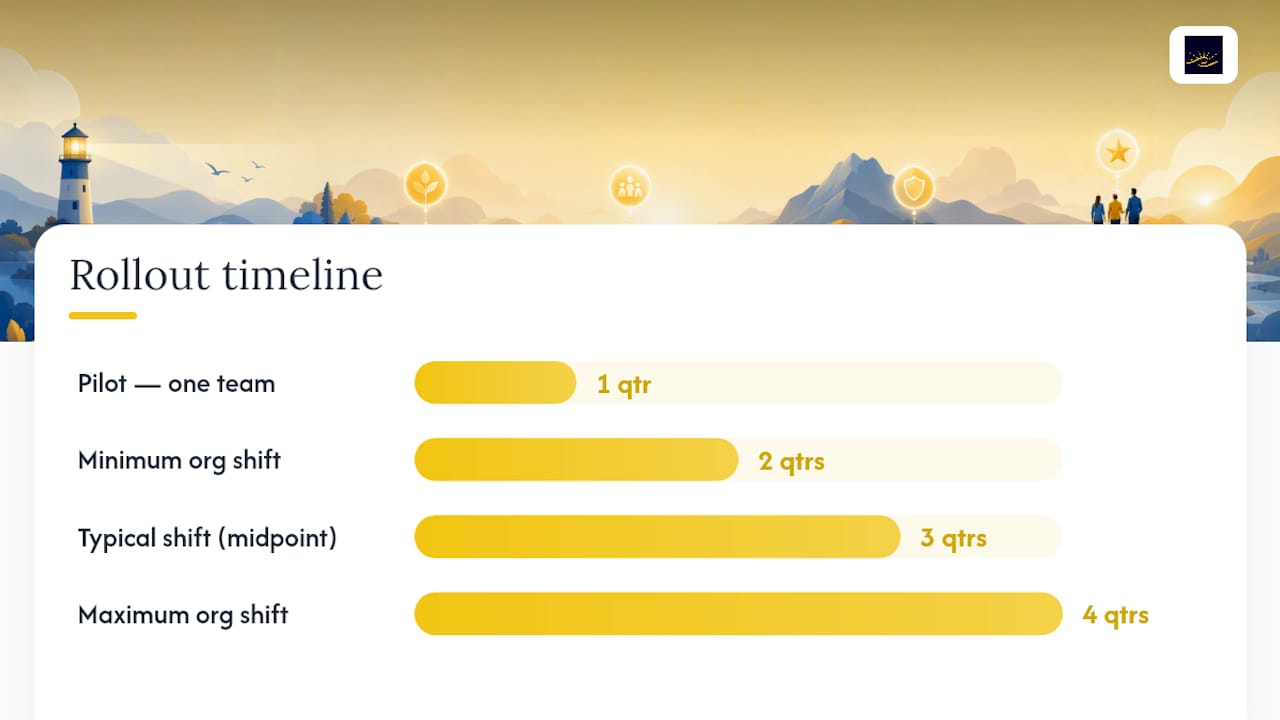
On pacing: pilot with one team or department for a full quarter before rolling out company-wide. Predictable cadence changes, a consistent weekly update rhythm, a known schedule for decisions, tend to produce outsized gains in perceived safety relative to how small they sound on paper, according to CTIPP’s implementation research. Expect real cultural shift to take two to four quarters, not weeks. Leaders who promise fast results usually end up disappointing their teams and quietly abandoning the effort.
Tools like MMDC Alchemy’s leadership blind spot assessment can help a Core Implementation Team identify where a leader’s own habits are undermining the rollout before it scales further.
How Do You Know If It’s Working (or Just Performative)?
Progress shows up in numbers you’re probably already collecting, if you know where to look. Track voluntary turnover by team, the volume and tone of incident reports, EAP utilization trends (a rise can actually be a good sign, meaning people trust the resource enough to use it), and results from a short psychological safety survey run on a regular cadence.
Team-level psychological safety and adaptive performance correlate closely with how leaders regulate themselves and build relational trust, according to Harvard Business School’s research on team performance. Watch for qualitative signals too: are people raising problems before they become crises, or only after? Do employees escalate concerns to you directly, or does everything filter through anonymous channels because direct escalation feels risky?
The real danger is what the Center for Conscious Leadership calls “trauma-informed theater”: posters about wellness, a one-time training, a mindfulness app subscription, none of which touch the actual workload, staffing levels, or decision-making patterns causing the stress in the first place. That’s not trauma-informed leadership. It’s decoration.
Guardrails against this:
- Never mandate personal disclosure in group settings, even in the name of “psychological safety.”
- Don’t publicize individual struggles as team-building content.
- Pair every training with at least one structural change (staffing, policy, scheduling) in the same quarter.
- If a leader champions the language but never adjusts their own behavior, the program will fail regardless of how good the training was.
Posttraumatic Growth: Building Resilient Teams That Come Back Stronger
Resilience gets a team back to baseline. Posttraumatic growth takes them past it, into new capability, deeper trust, or a clearer sense of purpose that wasn’t there before the disruption. The distinction matters because most leadership advice stops at “help people cope.” The research on trauma-informed leadership and posttraumatic growth points further: it identifies strengthening leaders’ capacity to support teams, prioritizing leader self-care, cultivating peer support, and helping people leverage their strengths as the conditions that actually produce growth, not just recovery.
Leaders enable this by creating space for meaning-making after a hard period, a debrief that asks “what did we learn” rather than rushing straight back to output. Teams that navigated a layoff or major restructuring, for instance, often need explicit space to process before they can genuinely re-engage; MMDC Alchemy’s guide on leading through uncertainty during layoffs covers how to hold that space without letting it stall momentum indefinitely.
Team practices that embed growth rather than just relief:
- Structured post-mortems focused on strengths discovered under pressure, not just what went wrong.
- Rotating stretch assignments that let people rebuild confidence deliberately.
- Regular peer recognition rituals that reinforce what the team learned about itself.
A Coach’s Toolkit: Practical Exercises for Regulation and Feedback
Leadership development coaching tends to work on the layer systems can’t touch directly: how a specific leader regulates under pressure and delivers hard feedback without triggering defensiveness. A founder with extensive experience has guided many client transformations built on Energy Leadership principles, which map how a leader’s internal state shapes team outcomes long before any policy takes effect.
Two exercises worth practicing on your own before your next tense conversation:
The pre-conversation reset. Before delivering difficult feedback, take sixty seconds to name your own emotional state honestly. Frustrated? Anxious? Rushed? Naming it reduces the odds it leaks into your tone.

The curiosity rewrite. Take a criticism you’re about to deliver and rewrite it as a question. “You missed the deadline again” becomes “What’s been getting in the way of the deadline lately?” Same concern, different nervous system response on the receiving end.
Coaching engagements built around a tool like the Energy Leadership Index assessment work alongside organizational rollout, not instead of it. Systems change the environment; coaching changes how the individual leader shows up inside it, and both tend to move faster together than either does alone.
Why Leader Regulation Has to Come First
You cannot extend calm you don’t have. The Center for Conscious Leadership frames this as a “regulation ripple effect”: a leader’s nervous-system state spreads through a team faster than any policy memo, for better or worse. A leader running on chronic stress, skipped breaks, and constant reactivity will undercut even a well-designed trauma-informed rollout, because people respond to tone and body language long before they process the words.
This isn’t a call for leaders to become perfectly calm robots. It’s a call to build the same regulation practices into your own week that you’re asking your team to trust. That means protecting actual recovery time, not just scheduled vacation that gets interrupted by messages. It means having your own outlet, whether that’s a peer group of other leaders, a coach, or a trusted mentor, for processing the stress you absorb from your team before it becomes your default operating state.
Leaders who skip this step tend to burn out quietly and then either disengage or over-control, both of which erode the very safety they’re trying to build. Self-care here isn’t a spa day. It’s sleep, boundaries around after-hours availability, and a real support system outside the people who report to you. If you’re carrying your team’s stress with nowhere to put it down, that’s the first thing to fix, before the next training module or policy rewrite.
Getting Buy-In From the Whole Organization, Not Just Leaders
Trauma-informed practices fail when they stay locked inside the leadership tier. Frontline employees need to understand the “why” behind new routines, or they’ll read predictable check-ins and clearer communication as micromanagement in disguise.
Start with plain-language framing rather than clinical vocabulary. Most employees don’t need to hear the word “trauma-informed” at all; they need to understand that meetings will follow a clearer structure, feedback will come with context, and raising a concern won’t get punished. Explain changes in terms of what’s different day to day, not the theory behind them.
Peer champions matter more than top-down mandates. Identifying a few respected employees at different levels, not just managers, to model new behaviors and answer questions informally tends to spread adoption faster than a formal announcement ever does.
Make the training two-way. A session where employees can push back on a proposed policy change, or flag where a “safety” measure actually feels invasive, builds more trust than a one-way lecture. That kind of engagement is itself SAMHSA’s empowerment principle in action, not a separate initiative bolted onto training.
Reinforce it in unglamorous places: onboarding materials, performance review templates, and manager check-in agendas. Culture change sticks in the boring paperwork long before it sticks in the mission statement.
Culturally Responsive Practices for Diverse Teams
A single trauma-informed template applied uniformly across a diverse team will miss the mark for a meaningful share of employees. SAMHSA’s own principles name cultural, historical, and gender responsiveness explicitly, because trauma exposure, communication norms, and comfort with disclosure vary significantly across backgrounds.
Practically, this means auditing your default communication style for hidden assumptions. Direct, confrontational feedback styles that read as “efficient” to some leaders can register as deeply threatening to employees from cultures or backgrounds where hierarchy and indirect communication are the norm. Flexibility in how feedback is delivered, not lowering the standard of feedback, respects that difference.
Historical context matters too. Employees from communities with documented histories of institutional harm, whether related to policing, immigration enforcement, or workplace discrimination, may respond to authority and surveillance-adjacent practices (monitoring software, strict badge tracking) with heightened caution that has nothing to do with their performance.
Leaders should also watch for one-size-fits-all “safety” language that assumes a shared baseline experience. A wellness room stocked with generic self-care items, a mandatory group share circle, or a holiday schedule built around one cultural calendar can all unintentionally signal that some identities are the default and others are accommodations. Building in genuine input channels, ideally from employees across different backgrounds, before finalizing new policies catches most of these blind spots before they become complaints.
Legal and Ethical Guardrails to Keep in Mind
Trauma-informed leadership sits close to several legal boundaries leaders need to respect. Confidentiality is the biggest one: information an employee shares in a vulnerable moment, whether about a health condition, a personal crisis, or a disability accommodation need, carries real legal protection in most jurisdictions, and leaders should never repeat it beyond who genuinely needs to know.
Accommodation requests tied to mental health or trauma histories may trigger formal disability accommodation obligations depending on your jurisdiction. Leaders aren’t expected to be legal experts, but they should know when to loop in HR or legal counsel rather than handling a disclosure informally.
The ethical line leaders cross most often is scope creep: attempting informal counseling instead of referring someone to a qualified professional. Providing a “holding environment” through relational presence is well within a leader’s role. Diagnosing, treating, or pressuring someone to disclose a trauma history is not, and can create real liability alongside the ethical harm.
Documentation matters too. If a performance issue may be linked to a disclosed condition, inconsistent or undocumented handling of that situation compared to similar cases elsewhere on the team is where good intentions turn into discrimination claims. When in doubt, involve HR early rather than improvising.
What Trauma-Informed Leadership Looks Like in Different Settings
Healthcare systems have led much of the published research here, largely because burnout and vicarious trauma are baked into the job. Programs studied in the posttraumatic growth research found that structured peer support and explicit leader self-care initiatives, not just individual resilience training, produced measurable shifts in how staff described their capacity to recover from hard shifts and difficult patient outcomes.
Outside healthcare, the pattern holds up differently but consistently. A manufacturing floor supervisor who replaced surprise schedule changes with a two-week posted rota saw fewer conflict escalations within a single quarter, not because the work got easier, but because the unpredictability that was activating people disappeared. A nonprofit executive director who built a standing peer-support hour for case workers handling difficult client situations found that turnover in that role dropped noticeably once staff had a legitimate outlet built into their actual schedule instead of an informal, ad hoc one.
Startups facing layoffs or rapid restructuring show a different failure pattern: leaders often try to project total confidence to avoid alarming the remaining team, which frequently backfires because employees can sense the mismatch between the messaging and the visible stress. Teams that instead got honest, regular updates, even without full information, reported higher trust through the transition than teams given falsely reassuring silence.
A Leader’s Turnaround: What Actually Changed
A mid-level manager I worked with inherited a team that had been through two rounds of layoffs in eighteen months. Meetings had gone quiet. People agreed to everything and delivered late. Her first instinct was more oversight: daily check-ins, tighter deadlines, closer review of every deliverable.
It made things worse. Turnover ticked up. So she tried something smaller: she stopped surprising the team with agenda changes, started explaining the reasoning behind decisions before announcing them, and replaced her Friday status-update demand with an open ten-minute check-in where anyone could raise a concern first.
Within two quarters, voluntary attrition on her team dropped to zero, and two people who had gone silent in meetings started raising process problems unprompted, the clearest sign the freeze response had lifted.
Three takeaways worth copying: predictability calms activation faster than reassurance does, explaining the “why” costs you almost nothing and buys enormous trust, and oversight is rarely the right response to a team that’s gone quiet.
— Junna Liao
How Coaching Helps You Actually Lead This Way
Reading about trauma-informed leadership and living it under real pressure are two different skills, and most leaders stall somewhere in between: they know the principles but freeze the moment a feedback conversation turns tense or a restructuring forces a hard call under time pressure. That gap, between knowing and doing, is exactly where a coaching engagement earns its cost.

Some coaching services work with executives and leaders one-on-one on the specific muscles trauma-informed leadership demands: staying regulated in a heated conversation, delivering feedback that lands without triggering defensiveness, and holding steady while implementing organizational change like the roadmap covered above. This isn’t a replacement for the governance and policy work your organization needs. It’s the individual layer that makes leaders capable of carrying that work through without burning out in the process, drawing on Energy Leadership principles and extensive client experience.
If you’re leading a team through change and recognize your own activation patterns in what you just read, a career coaching engagement is the direct next step. For leaders who want a more structured, multi-session path, MMDC Alchemy’s coaching programs build the regulation and feedback skills in this article into a sustained development plan rather than a one-time fix.
Where to Learn More
For deeper reading beyond this guide, start with SAMHSA’s Practical Guide for the full ten-domain implementation model, the PMC synthesis on posttraumatic growth for the research behind relational leadership, CTIPP’s toolkit for workplace-specific rollout guidance, and the National Council’s TIRO Framework for adaptive leadership skill-building. For team-level psychological safety practices that pair well with this work, Gatherilla’s guide is worth a look.
Sources
- Leading Organizations From Burnout to Trauma-Informed Resilience: A Vital Paradigm Shift – PMC
- CTIPP toolkit: Trauma-informed workplaces – CTIPP
Recommended
This blog is for educational and inspirational purposes only. It is not medical, legal, financial, or mental health advice. Your journey is unique; please seek qualified professional support for decisions that affect your health, finances, or wellbeing.