If your tiredness eases after a weekend off and traces back to one specific stressor, that’s emotional exhaustion. If it persists alongside cynicism, detachment, and a drop in how well you function at work even after rest, that points to burnout. The next move differs too: exhaustion usually responds to rest and a firm boundary; burnout often needs professional support or an actual change to your workload or role. The sections below walk through the self-checks and recovery steps for each.
TL;DR:
- Emotional exhaustion typically improves within days of rest and boundary-setting, while burnout requires structural role changes and longer recovery efforts.
- Persistent cynicism, reduced work performance, and feeling disconnected from your job indicate burnout and may not resolve with mere time off.
- Symptoms like headaches, muscle tension, and fatigue are common to both, but cynicism and cognitive decline are core to burnout.
- Addressing burnout often involves conversations with managers, workload redesign, therapy, and mindfulness practices, not just rest.
- Seek professional help immediately if you experience hopelessness, suicidal thoughts, or symptoms that do not improve despite genuine rest and role adjustments.
Table of Contents
- Emotional Exhaustion vs. Burnout: What Each One Actually Means
- Burnout Symptoms Comparison: Side by Side, Plus the Overlap
- What Causes Emotional Exhaustion vs. Burnout
- How to Tell If You Have Emotional Exhaustion or Burnout
- Emotional Exhaustion Recovery Tips and Burnout Recovery Steps
- When to Seek Professional Help for Burnout or Exhaustion
- How Coaching Fits Into Burnout Recovery
- What Realistic Recovery Actually Looks Like
- Ready to Redesign Your Role, Not Just Rest From It
- Sources
- FAQ
Emotional Exhaustion vs. Burnout: What Each One Actually Means
Emotional exhaustion is a state of depletion. It’s what happens when demands on your emotional reserves outpace your recovery time, and it’s often tied to a specific situation, a hard project, a sick parent, a rough few months. Rest and distance from the trigger tend to bring real relief.
Burnout is bigger. The World Health Organization classifies it as an occupational phenomenon, not a medical diagnosis, defined by three things: exhaustion, growing cynicism or mental distance from your job, and a decline in how effective you feel doing it. Emotional exhaustion is one ingredient in burnout, not a synonym for it.
Both can look like depression from the outside, and that overlap matters. Psychology Today notes that burnout is context-specific, tied to work or caregiving, while depression follows you everywhere, into relationships, hobbies, and rest. Confusing the two delays getting the right kind of help.
Burnout Symptoms Comparison: Side by Side, Plus the Overlap
Emotional exhaustion tends to show up as:
- Fatigue that doesn’t fully lift even after a full night’s sleep
- Irritability that feels disproportionate to the trigger
- Brain fog and slower decision-making
- A flat, numb feeling rather than sadness
Burnout carries all of that plus two things exhaustion alone doesn’t: a growing cynicism toward your job, coworkers, or clients, and a real decline in professional efficacy, missed deadlines, sloppier work, a sense you’re just going through the motions.
The physical overlap is where these two conditions get genuinely hard to separate. Headaches, gastrointestinal distress, muscle tension, and heart palpitations show up in both, and peer-reviewed research on burnout differentiation points to exhaustion, depersonalization, and cognitive dysfunction as the three features that cluster together most reliably in burnout specifically. If you’re only tracking how tired you feel, you’re missing two-thirds of the picture.
| Symptom | Emotional exhaustion | Burnout |
|---|---|---|
| Fatigue after sleep | Yes | Yes |
| Irritability | Yes | Yes |
| Cynicism/detachment | Rare | Core feature |
| Drop in job performance | Occasional | Core feature |
| Headaches, GI issues, muscle tension | Common | Common |
What Causes Emotional Exhaustion vs. Burnout
Burnout has an address, and it’s almost always work. Chronic overload, low control over your schedule or decisions, unclear expectations from a manager, and weak support systems are the four horsemen here.
Emotional exhaustion casts a wider net. It shows up after acute life events, a divorce, a move, a health scare, and it’s extremely common in caregivers managing a parent’s decline or a child’s medical needs without relief.
A few traits make either one more likely:
- Perfectionism, because it makes rest feel like falling behind
- High personal responsibility, especially in roles where you can’t easily delegate
- Chronically limited recovery time, whether from a second job, caregiving, or a culture that treats time off as suspicious
How to Tell If You Have Emotional Exhaustion or Burnout
Run through four questions honestly:
- Is it tied to one specific context, like a job, a caregiving role, or a season of life, or does it follow you everywhere?
- Does a few days away actually help, or do you come back feeling the same?
- Have you started feeling cynical or checked out about the thing itself, not just tired from doing it?
- Can you still function on daily tasks, or has your output genuinely dropped?
From there, follow a simple sequence: first, take real rest and set one concrete boundary, no email after 7 PM, one weekend fully off. Second, reassess after two weeks. Third, if things haven’t shifted, or you’re sliding backward, get a professional assessment rather than trying another round of the same fix.
Pro Tip: Keep a one-line daily log for two weeks: energy level, one-word mood, and what you were doing right before it dipped. Patterns tied to specific contexts (Monday meetings, a particular client, caregiving hours) point toward exhaustion; patterns that show up everywhere point toward something deeper.
Emotional Exhaustion Recovery Tips and Burnout Recovery Steps
Emotional exhaustion responds well to short-term moves: protect your sleep window like it’s a meeting you can’t cancel, build in micro-rests during the day rather than waiting for the weekend, and set the boundary that’s actually causing the drain, whether that’s an overloaded calendar or a family member who calls at 11 PM.
Burnout needs deeper intervention. That means:
- A real conversation with your manager about workload and role clarity, not just “I’m tired”
- Redesigning which tasks are yours versus delegated or dropped
- Structured therapy, particularly cognitive behavioral therapy, for the cynicism and cognitive fog
- Mindfulness practice, which has decent evidence for reducing the physiological stress response
Cleveland Clinic’s guidance on recovering from burnout emphasizes that enforced rest and boundary-setting only work long term when paired with workload or role changes. Rest without structural change tends to produce temporary relief followed by relapse. Restorative movement practices also have a place here. A 12-week restorative yoga plan built for burnout recovery can support the nervous system piece while you work on the structural piece.
Pro Tip: If your company has an EAP or HR wellness line, use it before you assume nothing is available. Most people never call.
When to Seek Professional Help for Burnout or Exhaustion
Certain signs mean skip the self-check entirely: suicidal thoughts, a hopelessness that feels total rather than tied to your job, or symptoms that don’t budge after genuine rest and real changes to your situation.
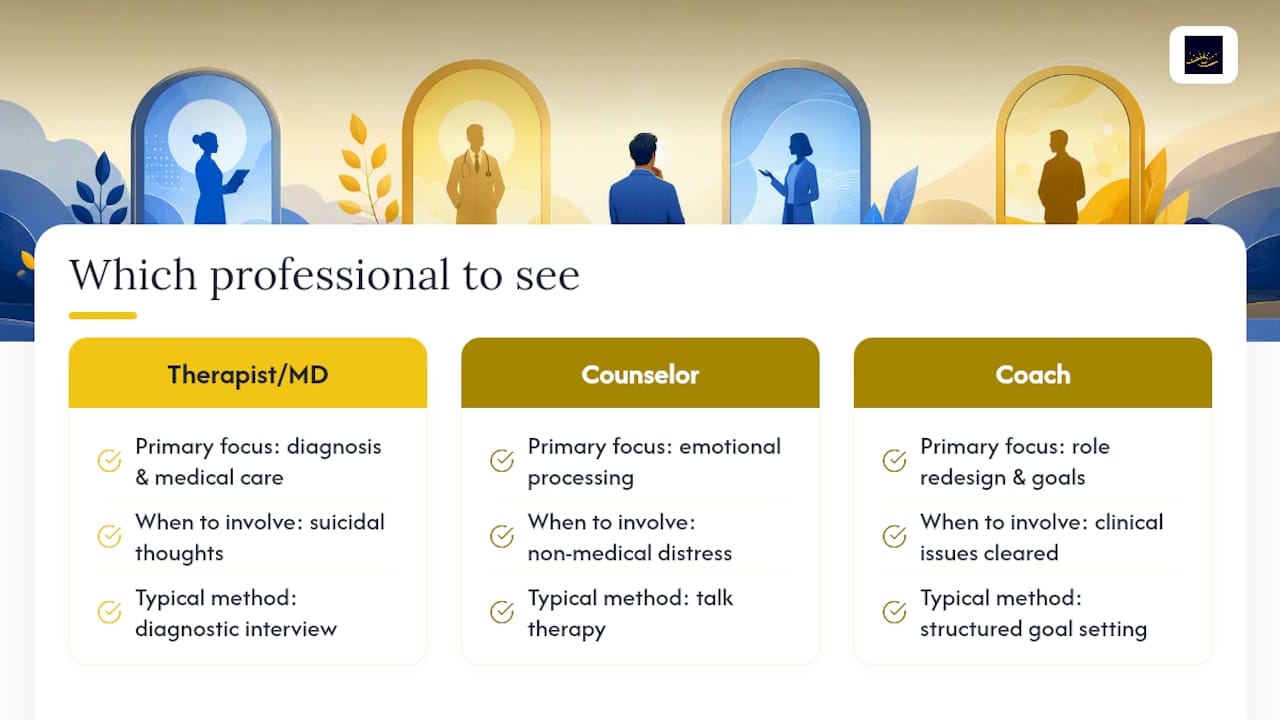
Different professionals solve different problems. A therapist or psychiatrist handles diagnosis and treatment when depression or anxiety is in the mix, since those conditions require medical evaluation rather than a vacation. Licensed counselors work through the emotional processing. Coaches step in for the role redesign, identity, and behavior-change work once the clinical picture is clear or ruled out. A clinical assessment looks like a diagnostic interview; a coaching engagement looks like structured goal setting around your career and life design.
How Coaching Fits Into Burnout Recovery
The coaching practice was built around a pattern seen repeatedly: high achievers mistake protective emotional numbing for a permanent loss of passion, when it’s often a signal their role or identity no longer fits who they’ve become. Numerous coaching engagements have centered on exactly that gap.
Coaching complements therapy rather than replacing it. Where therapy addresses the clinical symptoms, coaching addresses values alignment, role redesign, and the identity work that keeps burnout from recurring once you’re back on your feet. A useful starting point is the Energy Leadership Index Assessment, which maps how your current thinking and energy patterns are shaping your decisions at work.
What Realistic Recovery Actually Looks Like
Recovery from emotional exhaustion can move fast, sometimes a week of real rest changes everything. Burnout rarely does. It usually needs structural change layered under the self-care, and it moves in fits and starts, not a straight line. Combine rest, professional support, and an honest conversation about your role, and expect to adjust course more than once. Needing help isn’t a setback in that process. It’s the process.
— Junna Liao
Ready to Redesign Your Role, Not Just Rest From It
The coaching service works with leaders and high achievers who’ve done the rest, taken the vacation, and still come back feeling like the job itself doesn’t fit anymore. That’s the gap self-care can’t close on its own, and it’s the specific problem this coaching model was built to solve: identity, role, and career redesign, not just stress management.

If the self-checks above pointed you toward burnout rather than simple exhaustion, the next step isn’t another weekend off. It’s a structured look at what’s actually driving the disconnect, guided by someone trained to spot the patterns you can’t see from inside them. Start with the Career Coaching page to see how the engagement works, or take the Energy Leadership Index Assessment first if you want a diagnostic starting point before booking a conversation.
This article is general information, not a substitute for advice from a qualified doctor. Consult a qualified healthcare professional about your own circumstances before acting on anything here.
Sources
- Psychology Today — Burnout
- Cleveland Clinic — Signs of burnout and steps to recover
- NCBI PMC — Research on burnout symptoms and differentiation
FAQ
Is there a cure for emotional exhaustion?
There’s no single cure, but emotional exhaustion typically improves significantly with rest, boundary-setting, and removing or reducing the specific stressor causing it, since it’s a depletion state rather than a fixed condition.
What are the symptoms of emotional exhaustion caused by stress?
Common signs include fatigue that doesn’t lift with sleep, irritability, brain fog, emotional numbness, and physical symptoms like headaches, muscle tension, and gastrointestinal distress.
Can burnout be emotional?
Yes. Emotional exhaustion is one of the three core features of burnout alongside cynicism and reduced professional efficacy, according to the WHO’s occupational framing.
What is the difference between burnout and exhaustion?
Exhaustion is depletion that often improves with rest and time away from the trigger; burnout includes exhaustion plus persistent cynicism and a real drop in performance that doesn’t resolve without addressing the underlying role or workload.
How do I know if I need therapy or coaching for burnout?
Seek therapy or a medical evaluation if you have symptoms of depression, anxiety, or thoughts of self-harm; consider coaching, such as MMDC Alchemy’s approach, once any clinical concerns are addressed and you’re ready to redesign your role, habits, or career direction.
Recommended
- What an Energy Leadership Index Assessment Reveals
- Leadership Blind Spot Assessment for Clearer Growth
- Overcoming Leadership Plateaus: An Alchemical Guide to Sustainable Mastery
- Mindful Leadership Coaching: Mastering the Alchemy of Presence and Energy
This blog is for educational and inspirational purposes only. It is not medical, legal, financial, or mental health advice. Your journey is unique; please seek qualified professional support for decisions that affect your health, finances, or wellbeing.