
Whole person leadership means developing your inner life, your relationships, and the systems around you at the same time, so your team performs with more resilience, clarity, and engagement. It replaces the old model of leading by title and technical skill alone. Leaders who invest in this approach tend to make sharper decisions under pressure and hold onto talent longer. The rest of this guide breaks down what to build, how to build it, and how to embed it in your organization.
TL;DR:
- Developing self-awareness, emotional regulation, and physical recovery skills is essential for sustainable leadership and should be practiced daily through small, integrated routines.
- Organizational success with whole person leadership relies on embedding development into existing systems, like performance reviews and promotion criteria, for lasting behavioral change.
- Effective programs combine coaching, feedback, and workplace experiments, with measurable outcomes such as improved decision quality and team engagement within 30 to 60 days.
- Inner work must precede behavior change, as leaders who neglect self-awareness or emotional regulation tend to revert to old patterns during crises, regardless of their technical expertise.
- Mentoring and coaching that address the whole person, including struggles outside work, produce more durable development and better performance outcomes.
Table of Contents
- What Is Whole Person Leadership, Really?
- The Six Domains Every Leader Needs to Develop
- Does Whole Person Leadership Actually Improve Results?
- How Do You Build Whole-Person Capacity as a Leader?
- How Do You Embed This in Your Organization?
- MMDC Alchemy’s Approach to Whole-Person Coaching
- Where Whole Person Leadership Programs Go Wrong
- What Does Whole Person Leadership Look Like in Practice?
- Why Do Mindfulness and Emotional Intelligence Matter Here?
- How Does Whole Person Leadership Compare to Other Models?
- Do the Inner Work First
- Ready to Build Your Own Whole-Person Leadership Practice?
- Sources
- FAQ
What Is Whole Person Leadership, Really?
Command-and-control leadership assumes a leader’s job is to direct behavior. Competency-based leadership assumes the job is to master a checklist of skills like delegation and strategic planning. Whole person leadership assumes something different: that how you show up as a human being, tired or rested, reactive or grounded, drives the outcomes those other models chase, but rarely reach.
The framework treats leadership as multi-domain work. It spans the mind (how you think and decide), emotion (how you regulate and connect), the body (how you recover and sustain energy), purpose (what you’re actually working toward), and relationships (how you build trust across a team). This lines up with what IE Insights describes as the need to “wake up, grow up, clean up, and show up” before external behavior change sticks.
Traditional programs teach skills in isolation. Whole person programs treat those skills as downstream of internal alignment. In practice, that difference shows up as:
- Coaching that addresses identity and values, not just calendar management
- Feedback tools like 360-degree assessments that reveal blind spots peers see but leaders miss
- Development plans that pair reflection with measurable, on-the-job experiments
The Regent University integrative leadership definition frames this as an open system, one where formal training, coaching, and continuous feedback all feed each other rather than running as separate tracks.
The Six Domains Every Leader Needs to Develop
Whole person leadership breaks into six practical domains. Each one needs a specific capability and a repeatable practice, not just awareness.
- Self-awareness. Build the capability to name your triggers before they run you. Practice a two-minute daily check-in, naming your current mood and energy level before your first meeting.
- Emotional regulation. Build the capability to pause before reacting in tense conversations. Practice a controlled breathing count (four seconds in, six seconds out) before responding to difficult emails.
- Physical recovery. Build the capability to protect sleep and recovery windows as whole-person health frameworks recommend. Practice a fixed shutdown time for screens, even on demanding weeks.
- Purpose alignment. Build the capability to connect daily tasks to a stated personal mission. Practice a weekly ten-minute review of whether your calendar matched your stated priorities.
- Relational skill. Build the capability to listen for what’s unsaid in team conversations. Practice one unscheduled, agenda-free check-in with a direct report each week.
- Systems thinking. Build the capability to see how your decisions ripple through other teams. Practice mapping one decision’s downstream effects before finalizing it.
Pro Tip: Attach each new practice to something you already do daily, like coffee or your commute. Habits stick faster when they piggyback on an existing routine instead of competing for a fresh slot on your calendar.
Does Whole Person Leadership Actually Improve Results?
Organizations pour money into leadership training every year, yet a large share of that investment underperforms when programs skip evidence-informed design, according to the MDPI framework on maximizing leadership development ROI. The pattern holding programs back isn’t weak content. It’s weak transfer: no workplace experiments, no supervisor engagement, no way to measure whether anything changed.
Programs that blend coaching, cohort learning, and 360-degree feedback show stronger behavior transfer than one-off workshops, largely because they build in the accountability that episodic training skips.
Track these outcomes if you want proof your program is working, not just running:
- Application of new skills on the job within 30 to 60 days
- Retention rates among high-potential leaders enrolled in development
- Team engagement scores before and after coaching cycles
- Decision quality, measured through post-mortems on major calls
Episodic training without sustained follow-up remains the most common failure mode. A single workshop rarely survives contact with a busy quarter.
How Do You Build Whole-Person Capacity as a Leader?
Start with a diagnostic, not a plan. You can’t develop what you haven’t measured.
- Run a self-assessment paired with 360-degree feedback. Ask five to eight colleagues, peers, direct reports, and a manager, to rate your presence, communication, and decision-making. Then write a short “True North” statement: one paragraph on what you want your leadership to stand for in the next year.
- Build a blended development plan. Combine one-on-one coaching, a peer cohort for accountability, and small on-the-job experiments, like changing how you run one recurring meeting. The Regent University research points to continuous feedback loops and real-world experimentation as the mechanism that actually shifts behavior, not just awareness.
- Set weekly and quarterly checkpoints. Weekly, review one moment where you led well and one where you slipped. Quarterly, revisit your True North statement and adjust based on what your 360 feedback and coach are telling you.
- Anchor daily rituals to specific times. A two-minute morning check-in, a breathing pause before hard conversations, a fixed evening shutdown. Small, repeated, boring rituals outperform occasional big gestures.
Pro Tip: Track one leading indicator weekly (like “number of pause-before-react moments”) and one lagging indicator quarterly (like team engagement scores). Leading indicators tell you if you’re doing the work; lagging indicators tell you if the work matters.
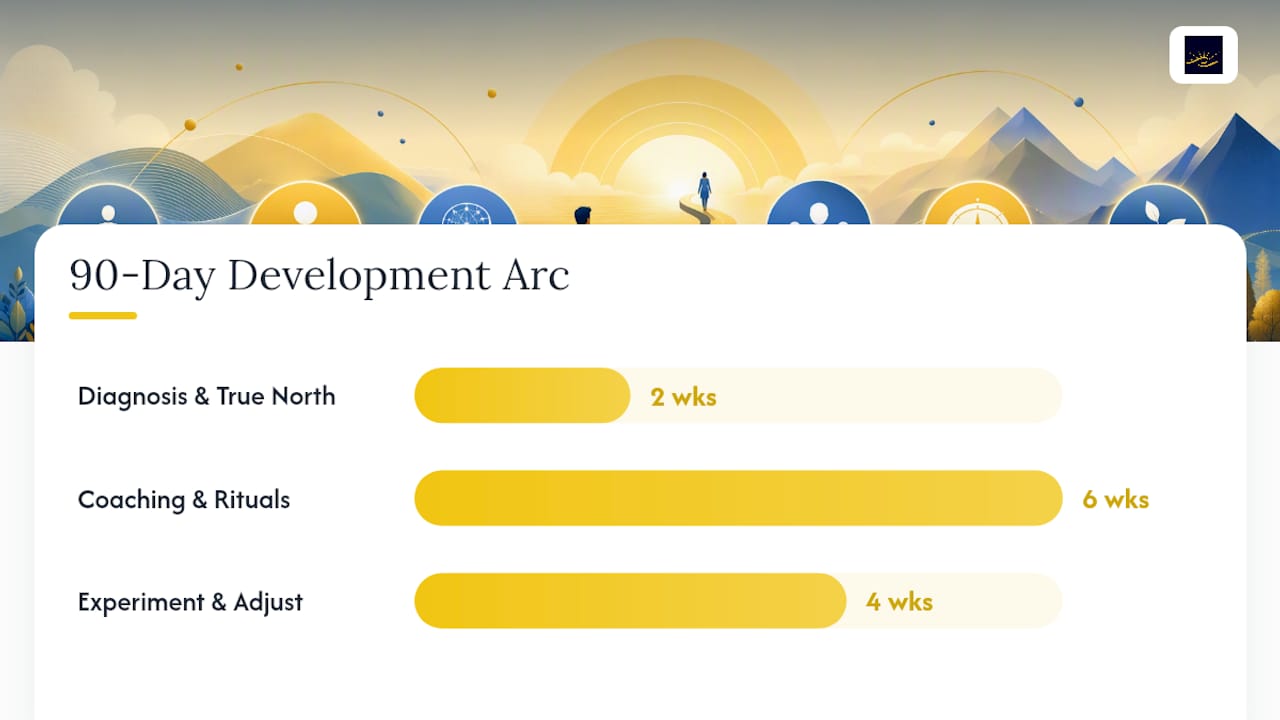
A simple 90-day arc: weeks 1 to 2, run the diagnostic and write your True North statement. Weeks 3 to 8, run weekly coaching sessions and daily rituals while tracking leading indicators. Weeks 9 to 12, run one on-the-job experiment publicly, ask for feedback, and adjust your plan for the next quarter.
How Do You Embed This in Your Organization?
Individual growth stalls without systems that reinforce it. Leadership development sticks when it’s built into how the organization already runs, not layered on top as an extra program.
Five design levers consistently separate strategies that work from ones that don’t, according to the Center for Creative Leadership: blended learning formats, broad organizational support, direct workplace linkage, interactive practice, and structured tools like assessments.
In practice, that means:
- Writing 360-degree feedback into your standard performance review cycle, not as a separate annual event
- Naming an executive sponsor who checks in on development goals, not just business metrics
- Updating job descriptions and promotion criteria to include relational and self-management skills alongside technical ones
- Pairing every coaching engagement with a peer cohort so accountability doesn’t depend on one relationship
The MDPI research is direct on this point: leadership development works best when it’s part of broader talent optimization, not isolated leader training that lives outside the systems people are actually managed by. A typical program shape runs coaching alongside a small cohort and one or two applied projects over a two to three quarter window, long enough for behavior to become habit. For more on how coaching and organizational practice reinforce each other, see MMDC Alchemy’s insights on integrated development.
MMDC Alchemy’s Approach to Whole-Person Coaching
MMDC Alchemy, founded by executive coach Junna Liao, pairs deep coaching with concrete life strategy rather than generic career advice. The method treats burnout, career transitions, and identity shifts as connected problems, not separate issues to patch one at a time. Clients work through what’s actually driving their stuck points, not just their resumes.
With numerous client transformations behind the approach, the coaching has helped leaders revitalize careers they had assumed were finished and break free of beliefs that were quietly running their decisions for years.
Where Whole Person Leadership Programs Go Wrong
The biggest pitfall isn’t lack of interest. It’s treating whole-person work as a one-time event instead of a sustained practice. A leader attends an offsite, feels inspired for two weeks, and then reverts once the calendar fills back up. Without structured follow-up, awareness fades faster than most leaders expect.
A second common mistake is skipping the assessment step. Leaders assume they know their blind spots, but self-perception and peer perception routinely diverge. Skipping 360-degree feedback means you’re guessing at what to fix.
A third pitfall is treating emotional and physical domains as “soft” extras rather than core leadership infrastructure. Leaders who deprioritize sleep, recovery, or honest self-reflection eventually hit a wall their calendar can’t fix. Whole-person frameworks that separate physical and mental well-being as legitimate leadership inputs, rather than personal side issues, get this right from the start, as NCCIH’s whole-person health guidance makes clear.
A fourth issue is organizational mismatch: an individual leader does the inner work, but the organization’s systems, performance reviews, promotion criteria, incentive structures, never change. The leader grows; the environment doesn’t reward it. That gap is where good coaching investments quietly die.
The fix for all four isn’t complicated, but it does require discipline: build in a follow-up cadence before you start, always pair development with an outside perspective through assessment, treat physical and emotional capacity as core work, and get organizational sponsorship before the first coaching session, not after the third one stalls.
What Does Whole Person Leadership Look Like in Practice?
Organizations that shift toward whole-person development tend to change three things at once: how they train leaders, how they measure success, and how they hold people accountable between sessions.
A common pattern shows up in mid-sized companies moving away from single-day leadership workshops toward multi-month coaching cohorts. Instead of a single trainer lecturing a room, small groups of leaders work through 360-degree feedback together, share progress on personal development goals, and run small workplace experiments, like changing how they run a weekly team meeting, then report back on what worked.
The shared thread across programs that produce results, per the design principles CCL identifies, is workplace linkage: development has to connect directly to a real project or team challenge, not a hypothetical case study. A leader working through a genuine team conflict during a coaching cycle retains the lesson longer than one practicing on a fictional scenario.
Mentoring relationships that treat the mentee as a whole person, not just a career project, show similar staying power. Research on effective mentoring, summarized by Harvard Business Review, found that mentors who address a mentee’s full identity, including struggles outside work, build development that transfers to performance more reliably than mentoring focused purely on tasks and titles.
The lesson from organizations getting this right isn’t a single tactic. It’s the pairing: sustained coaching relationships plus structured feedback plus real workplace stakes. Remove any one leg, and the whole structure gets shakier.
Why Do Mindfulness and Emotional Intelligence Matter Here?
Emotional intelligence isn’t a soft add-on to whole person leadership. It’s the operating layer underneath most of the other domains. A leader who can’t read their own emotional state in real time struggles to regulate it, and a leader who can’t regulate their own state struggles to read a room accurately.
Mindfulness functions as the practical training ground for that skill. A leader who practices even brief moments of present-focused attention, noticing physical tension, naming an emotion before reacting, builds the muscle that makes emotional regulation possible under real pressure, not just in calm moments.

This connects directly to the inner alignment work IE Insights describes as foundational: waking up, growing up, cleaning up, and showing up as the sequence that has to happen before outward behavior reliably changes. Skip the inner work, and behavioral coaching tends to produce surface-level compliance that reverts under stress. A leader can learn to say the right words in a difficult conversation, but without the underlying emotional regulation, the old reactive pattern resurfaces the moment stakes rise.
Practically, this shows up as leaders who pause before responding to a frustrating email, who notice defensiveness rising in a meeting and name it internally before it drives their next sentence, and who recognize their own fatigue as a signal to recalibrate rather than push through. None of that requires a meditation retreat. It requires consistent, small moments of attention repeated often enough to become reflexive.
How Does Whole Person Leadership Compare to Other Models?
Servant leadership focuses on putting team members’ needs first and building trust through service. It overlaps with whole person leadership on relational skill but says little about a leader’s own inner development, physical recovery, or purpose alignment. A servant leader can burn out just as easily as a command-and-control one if their own capacity isn’t part of the model.
Transformational leadership centers on inspiring vision and motivating change through charisma and clear communication. It’s powerful for driving big shifts, but it can run entirely on a leader’s external skill set without ever addressing whether that leader is operating from a grounded, regulated internal state. A transformational leader running on empty can inspire short bursts of change that don’t hold.
Whole person leadership doesn’t replace either model. It underwrites them. A leader can apply servant leadership’s focus on others or transformational leadership’s focus on vision, but both depend on the leader having the self-awareness, emotional regulation, and physical capacity to sustain that style under real pressure. The unique value of the whole-person frame is that it treats the leader’s own internal state as infrastructure, not an afterthought.
That distinction matters most under stress. Competency-based models tend to hold up fine in stable conditions and break down during crisis, layoffs, restructuring, sudden market shifts, precisely when a leader’s emotional regulation and decision quality matter most. Whole person leadership is built for exactly that moment, because it trains the underlying capacity rather than just the situational skill.
Do the Inner Work First
Most leaders try to change behavior before they’ve done the inner work that makes new behavior sustainable. That order gets it backward. A leader who hasn’t examined their own triggers will revert to old patterns the first time a real crisis hits, no matter how many workshops they’ve attended.
I’ve seen the pattern repeat: a leader takes on a bigger role, performance dips, and the instinct is to add more tactics, more frameworks, more hours. The actual fix is usually smaller and stranger, a leader finally naming the fear driving their overwork, or admitting the promotion they chased wasn’t actually aligned with what they wanted.
Pick one domain from this article, self-awareness, recovery, purpose, and commit to a single small practice this week. Don’t try all six at once.
— Junna Liao
Ready to Build Your Own Whole-Person Leadership Practice?
Reading about self-awareness and 360 feedback is one thing. Doing the actual inner work, with someone trained to spot what you can’t see in yourself, is another. MMDC Alchemy exists for leaders who’ve read the frameworks, tried the daily rituals, and still feel stuck between where they are and who they want to lead as.
This coaching pairs deep personal work with concrete career strategy, built specifically for leaders navigating burnout, transitions, or a role that no longer fits who they’ve become. If you’re facing a specific disruption, a layoff, a restructuring, a forced pause, the layoffs and uncertainty program addresses that directly. For leaders looking to invest in themselves at a foundational level, 1:1 career coaching is the starting point, and for those who want a structured, multi-month path, the coaching programs page lays out what that looks like. Career identity work also pairs well with strengths-based career approaches for leaders rethinking what “aligned work” actually means for them. Book a discovery call and find out what a whole-person plan looks like for your specific situation.
Sources
- Maximizing the Impact and ROI of Leadership Development — MDPI (2024)
- Holistic human development for modern leadership — IE Insights (2024)
- An integrative leadership definition — Regent University Journal
- 5 characteristics of a successful leadership development strategy — CCL
FAQ
What Are the Four Types of Leadership Styles?
Common frameworks group leadership into four broad styles: autocratic (directive control), democratic (shared decision-making), transformational (vision-driven inspiration), and laissez-faire (hands-off delegation). Whole person leadership doesn’t replace these styles; it strengthens the internal capacity a leader needs to apply any of them well under pressure.
What Is a Whole Person Approach in Leadership?
A whole person approach develops a leader’s mind, emotions, body, purpose, and relationships together, rather than focusing only on technical or managerial skills. MMDC Alchemy applies this by pairing deep coaching with practical life strategy so change holds up under real-world pressure.
What Are the Five Levels of Leadership?
Popular leadership models describe a progression from positional authority, through permission and relationship-building, to results-driven credibility, people development, and finally a legacy level where a leader’s impact outlasts their direct role. Whole person leadership supports movement through these levels by building the self-awareness and regulation that higher levels require.
What Are the Seven Types of Leadership?
Leadership literature commonly lists autocratic, democratic, laissez-faire, transformational, transactional, servant, and situational leadership as distinct styles. Whole person leadership functions differently: it’s not a style on this list but the underlying capacity, self-awareness, emotional regulation, purpose alignment, that determines how well a leader executes any of these styles under stress.
How Is Whole Person Leadership Different From Servant Leadership?
Servant leadership centers on prioritizing team needs, while whole person leadership centers on developing the leader’s own internal capacity across mind, emotion, body, and purpose. The two work together: a leader needs personal regulation and self-awareness to sustain a genuinely service-oriented style without burning out.
Recommended
- Junna Liao Featured by iPEC | The Human Beneath the High Achiever
- Book Call with Online Coach for Personal Growth
This blog is for educational and inspirational purposes only. It is not medical, legal, financial, or mental health advice. Your journey is unique; please seek qualified professional support for decisions that affect your health, finances, or wellbeing.