
Intuition in leadership is the rapid, subconscious recognition of patterns built from years of experience, and the leaders who use it well never treat it as a final answer. The right approach is a two-step move: let intuition flag what deserves attention first, then run a quick check before committing resources to anything high stakes. What follows covers the research behind that approach, when to lean on gut instinct, and how to actually train it.
TL;DR:
- Leaders rely on intuition in 85% of decisions, especially under ambiguity and time pressure, but must run quick validation checks to avoid guesswork.
- Intuition is a trained pattern recognition from past experience, not impulsiveness or emotion, and improves with practices like reflection, meditation, and exposure to varied scenarios.
- Combining intuition with analysis involves naming a gut signal, testing it with a fast disconfirming check, and setting clear guardrails before acting.
- Overconfidence and unvalidated intuition, particularly in people decisions, pose ethical risks that can reinforce bias unless paired with deliberate validation and outside perspectives.
- Deep coaching and structured reflection help leaders calibrate and track their intuitive judgment, making it a reliable, ongoing decision-making tool.
Table of Contents
- What Is Intuition in Leadership?
- Why Does Intuition Matter for Leaders?
- What Does the Research Say About Intuition in Leadership?
- When Should You Trust Your Gut Versus Run the Numbers?
- How Can You Develop and Access Intuition as a Leader?
- How Do You Combine Intuition With Analysis?
- How Do You Calibrate and Track Your Intuition Over Time?
- Does Intuition Look the Same Across Leadership Styles and Cultures?
- How Does Emotional Intelligence Strengthen Intuitive Leadership?
- What Training Builds Intuitive Decision-Making in Organizations?
- What Are the Ethical Risks of Leading by Intuition?
- Why Coaching Accelerates How Leaders Learn to Trust Their Gut
- Ready to Build Sharper Leadership Instincts?
- Where This Article’s Research Comes From
- Sources
- FAQ
What Is Intuition in Leadership?
Intuition in leadership is not a hunch pulled from thin air. It is your brain matching a current situation against thousands of stored patterns from past experience, context, and even physical sensation, then surfacing a conclusion before you consciously reason your way there. Executive education research from Northeastern’s D’Amore-McKim frames it exactly this way: rapid pattern recognition shaped by experience, values, and feedback loops, not random guessing.
That distinction matters because intuition gets confused with three other things constantly:
- Impulsiveness acts without any pattern check at all, usually to relieve discomfort.
- Raw emotion reacts to how something feels right now, without reference to prior outcomes.
- Wishful thinking ignores contrary evidence because the desired result feels good.
Real intuition, by contrast, is testable. That is the core of what MMDC Alchemy calls the detect, validate, act model: your gut flags a signal (detect), you run a fast, low-cost check against that signal (validate), and only then do you commit (act). Skip the middle step and you are not being intuitive. You are guessing with confidence.
Why Does Intuition Matter for Leaders?
The main advantage is speed under ambiguity. When information is incomplete and the clock is running, analysis alone stalls. Intuition fills that gap by surfacing the one or two variables that actually matter, faster than a spreadsheet ever could.
A few situations where this shows up constantly:
- Hiring and cultural fit. A candidate’s resume checks every box, but something in the interview does not sit right. That discomfort is often years of pattern recognition catching a mismatch a scorecard cannot capture.
- Mergers and acquisitions. Due diligence covers the numbers, but seasoned dealmakers frequently report a gut read on leadership chemistry or cultural friction before the financials reveal any problem.
- Strategic pivots. Market signals are noisy long before they are statistically clear. Leaders who sense the shift early get a head start on competitors still waiting for the data to catch up.
Paired with fast validation, intuition shortens the whole decision cycle. You are not skipping analysis. You are pointing it at the right question sooner.
What Does the Research Say About Intuition in Leadership?
The prevalence data is striking. Yale School of Management reports that 85% of CEOs use intuition as a core component of their decision-making process. That is not a fringe habit among visionary founders. It is standard practice at the top of most organizations, whether those leaders talk about it openly or not.
85% of CEOs report relying on gut instinct as a core part of how they make decisions — Yale School of Management.
The research also draws real boundaries around when intuition helps and when it misleads:
- It works best under ambiguity and time pressure, conditions where full analysis is impossible anyway.
- It is far more reliable when paired with deep domain experience, according to a meta-analytic synthesis in the Journal of Business Research, which found intuition’s effectiveness varies significantly and needs calibration to be trusted.
- On the physiological side, practices like meditation and time in nature increase the likelihood of alpha-wave brain states, which Yale’s research links to improved insight and intuitive access.
That last point matters most for anyone who assumes intuition is fixed at birth. The neuroscience suggests it behaves more like a trainable skill than a personality trait.
When Should You Trust Your Gut Versus Run the Numbers?
The decision rule is simpler than most leaders expect. Intuition earns more weight when a situation is ambiguous, time-limited, and inside your zone of real experience. Analysis should lead when the situation is data-rich, repeatable, or carries regulatory or irreversible consequences.
Lean toward intuition when:
- The clock is short and full data collection is not realistic.
- You have handled similar situations dozens of times before.
- The stakes justify a fast first move followed by monitoring.
Lean toward analysis when:
- Good data already exists and collecting more is cheap.
- The decision is repeatable, so past errors are correctable.
- A mistake would be irreversible, regulated, or extremely costly.
Watch for red flags that quietly undermine intuition’s reliability: strong emotion in the moment, a domain you have little real experience in, or group pressure nudging you toward consensus rather than an honest read of the situation. Forbes Coaches Council notes that the biggest risk isn’t bad instinct, it is suppressing your own signal under pressure and overcompensating with box-checking that looks rigorous but adds no real insight.
Pro Tip: If you notice you’re reaching for data to justify a decision you already emotionally made, stop. That is confirmation bias wearing analysis as a disguise.
How Can You Develop and Access Intuition as a Leader?
Intuition is not something you either have or lack. It is closer to a muscle that atrophies from constant screen time and sharpens with deliberate rest, reflection, and exposure to varied situations.
Short daily practices that build access:
- A five to ten minute morning meditation or breathing session. This is not about becoming a different person. It is about quieting the mental noise that drowns out subtler signals later in the day.
- Brief nature walks, ideally without a phone. HBR’s reporting on how CEOs hone their intuition points to unstructured time outdoors as one of the most consistent habits among leaders who describe strong intuitive instincts.
- Intentional device-free blocks, even 20 minutes, where your mind is allowed to wander instead of being fed constant input.
Deliberate-experience work that builds your pattern library:
- Journal your first impression of a new hire, deal, or strategic option before you look at any data. Come back to that entry after the outcome is known and see how close your first read actually was.
- Deliberately expose yourself to case studies outside your usual industry. Pattern recognition generalizes better when it is not confined to one narrow context.
- Build a habit of structured reflection after big decisions, not just the failures. Winning decisions teach just as much when you dissect why they worked.
Somatic checks worth building into your day:
Body signals often arrive before conscious thought does. Forbes Coaches Council highlights a specific technique: pause for 10 to 20 seconds before responding in a high-stakes conversation and scan for tension, energy shifts, or gut discomfort. That small pause measurably improves how accurately leaders catch the signal instead of talking over it.
Pro Tip: Try this in your next tense meeting: before you speak, take one slow breath and notice where you feel tightness in your body. That physical read is often faster and more accurate than your first verbal reaction.
Mindful leadership coaching built around presence and energy work gives these practices structure instead of leaving them as vague New Year’s resolutions.
How Do You Combine Intuition With Analysis?
The detect, validate, act model becomes genuinely useful once you turn it into a repeatable workflow instead of a one-time concept.
The sequence looks like this: notice the gut sense and name it specifically, articulate it as a testable hypothesis rather than a vague feeling, run one or two targeted checks that could prove it wrong, set a guardrail for how far you will go before reassessing, then act while monitoring for early disconfirming evidence.
Before any high-stakes call, run this six-item checklist:
- Do I have genuine domain experience here, or am I outside my expertise?
- What is one disconfirming test I could run in under a day?
- Does the speed of this decision actually match the stakes involved?
- What is my monitoring plan once I act?
- Have I checked this against a colleague with a different vantage point?
- Have I documented my reasoning somewhere I can revisit later?
| Step | What it looks like | Time cost |
|---|---|---|
| Detect | Name the gut signal specifically, not vaguely | Minutes |
| Validate | Run one cheap, fast disconfirming test | Hours to a day |
| Act | Commit with a guardrail and monitoring plan | Immediate, with review point |
Forbes’ framework on leadership intuition describes this hybrid approach directly: intuition detects the early signal, and analysis validates it before anything major gets executed. The validation step does not need to be expensive. A single reference call, a two-question survey, or one afternoon of digging is often enough to confirm or kill a hunch before it becomes a costly mistake.
How Do You Calibrate and Track Your Intuition Over Time?
Calibration is what separates leaders whose gut instinct genuinely sharpens over the years from those whose confidence outpaces their accuracy. The fix is a simple journaling habit, not a complicated system.
- Log four things every time you act on a hunch: the first impression, your rationale, what checks you ran, and the eventual outcome.
- Track a rough hit rate. HBR notes that even 20 entries in a lightweight template like this start producing genuinely useful calibration data.
- Watch decision latency alongside accuracy. A high hit rate paired with painfully slow decisions suggests you are over-validating and not trusting the signal enough.
- Run after-action reviews with your team, and make your own intuitive calls visible during them. That normalizes sharing gut impressions alongside data instead of hiding them behind purely rational-sounding justifications.
A leadership blind spot assessment can surface exactly where your calibration tends to break down, whether that is overconfidence in familiar domains or excessive hedging in unfamiliar ones.
Does Intuition Look the Same Across Leadership Styles and Cultures?
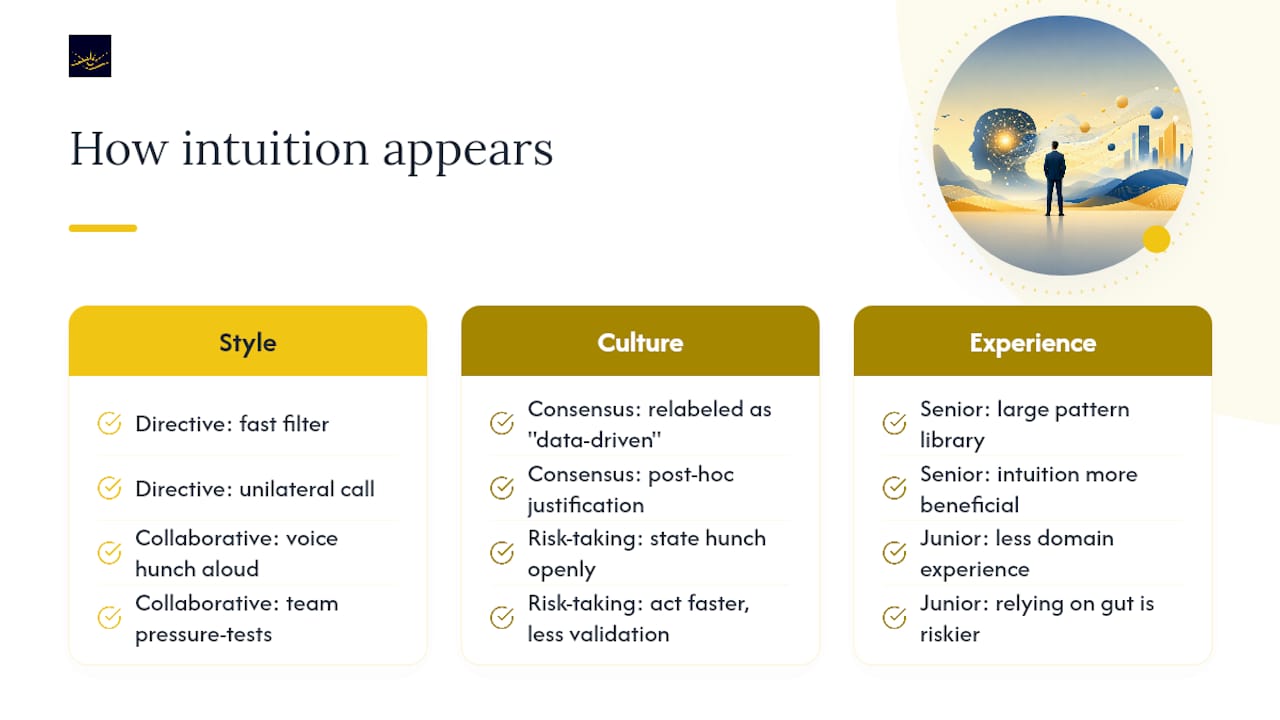
No, and treating it as universal is a common mistake. A directive leader tends to use intuition as a fast filter to narrow options before making a unilateral call. A collaborative leader is more likely to surface an intuitive read out loud and invite the team to pressure-test it before deciding together. Neither is wrong. They are just different ways of routing the same underlying signal through a decision process.
Cultural context shapes this even further. In leadership cultures that prize consensus and process documentation, intuitive calls often get relabeled after the fact as “data-driven” to fit organizational norms, even when the real decision started as a gut read. In cultures more comfortable with visible risk-taking, leaders will state a hunch openly and act on it faster, sometimes without the validation step that keeps intuition from tipping into recklessness.
Seniority and experience matter here too. Yale’s research points out that older, more experienced leaders benefit disproportionately from intuition, because a larger library of past situations gives their pattern recognition more raw material to draw from. A newer manager leaning hard on gut instinct in an unfamiliar function is playing a different, riskier game than a twenty-year veteran doing the same in their core domain.
The practical takeaway for any leader managing across styles or cultures: do not assume silence means an absence of intuition, and do not assume loud confidence means it is well calibrated. Ask directly how someone reached a conclusion before deciding how much weight to give it.
How Does Emotional Intelligence Strengthen Intuitive Leadership?
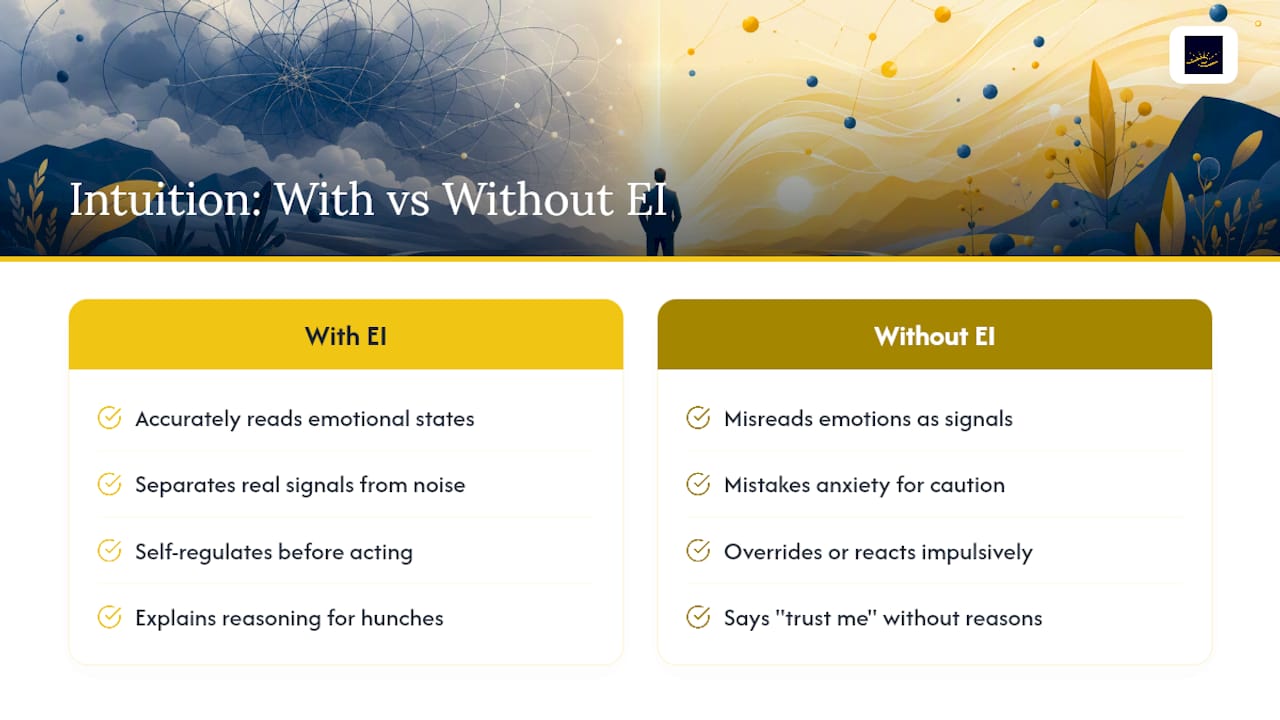
Emotional intelligence and intuition are not the same capability, but they run on overlapping wiring. Emotional intelligence is largely about accurately reading emotional states, your own and other people’s. Intuition draws on some of that same somatic and emotional data, alongside broader pattern recognition, to generate a fast read on a situation.
Leaders with weak emotional intelligence tend to either override their intuitive signals entirely or misread them as something else, mistaking anxiety for genuine caution, or personal irritation for a legitimate concern about a team member’s performance. That confusion is exactly why intuition gets a bad reputation in some organizations. It is not the intuition that failed. It is the inability to separate a real signal from unmanaged emotional noise.
Building emotional intelligence, particularly self-awareness and self-regulation, sharpens intuition’s usefulness because it improves your ability to distinguish a genuine early warning from a stress response. The somatic pause technique covered earlier works precisely because it forces a moment of emotional regulation before you act on whatever your body is telling you.
This is also where clear communication coaching earns its place in intuitive leadership development. A well-calibrated gut instinct is worth little if you cannot explain your reasoning to a team that expects justification. Leaders who can articulate why a hunch felt worth acting on, even in emotional or ambiguous terms, build far more trust than those who simply say “trust me”.
What Training Builds Intuitive Decision-Making in Organizations?
Most leadership development programs still train analysis almost exclusively and treat intuition as something leaders either have or do not. That is a gap, given how many senior leaders already rely on it daily.
Organizations serious about building this skill deliberately do a few specific things. They create case-based training that exposes leaders to varied, ambiguous scenarios rather than only clean, data-complete case studies, since pattern recognition needs variety to generalize well. They build in structured reflection time after major decisions, not just formal post-mortems after failures, so leaders can compare their initial gut read against the eventual outcome while the details are still fresh.
Some organizations go further and normalize sharing intuitive impressions in meetings before the data gets presented. D’Amore-McKim’s research on this recommends teams state a gut read out loud, then subject it to targeted tests, which respects tacit knowledge while still building accountability into the process. That single habit shift, saying “here’s my instinct, let’s check it” instead of hiding the instinct behind a data request, changes how teams make decisions under pressure.
Executive coaching programs also play a specific role here that generic training rarely covers: individualized accountability. A workshop can teach the detect, validate, act framework in an afternoon. Making it a habit under real pressure, with someone tracking whether you actually did the validation step or skipped it, is a different kind of work entirely.
What Are the Ethical Risks of Leading by Intuition?
Intuition carries real risk when it goes unchecked, and pretending otherwise does leaders a disservice. The most common failure mode is overconfidence: a leader with a strong track record starts treating every gut read as validated in advance, skipping the check step because past hunches worked out. That is precisely when a costly miss tends to happen.
Confirmation bias compounds the problem. Once a leader forms an intuitive conclusion, there is a natural pull toward interpreting new information as support rather than a genuine test. Groupthink adds another layer, particularly in cultures where challenging a senior leader’s stated instinct feels risky to a person’s standing on the team.
There is also a fairness dimension worth naming directly. Intuitive judgments about people, hiring calls, promotion decisions, performance reads, are exactly where unconscious bias hides most easily, dressed up as a “gut feeling” about fit or potential. A leader who trusts instinct on people decisions without any structured check is at real risk of reinforcing bias rather than exercising genuine pattern recognition.
The mitigation is not to abandon intuition. It is to hold it to the same validation standard every time, especially on decisions involving people, and to build in outside perspective deliberately rather than only when it is convenient.
Why Coaching Accelerates How Leaders Learn to Trust Their Gut
Most leaders already have functioning intuition. What they lack is a structured way to test it, track it, and stop overriding it out of self-doubt or overcorrecting from past mistakes. That gap is where deep coaching earns its value over generic advice.
Junna Liao founded MMDC Alchemy after seeing the same pattern repeat across hundreds of high-achieving clients: sharp instincts buried under years of second-guessing, burnout, or a career path chosen for someone else’s reasons. Across more than 600 client transformations, the consistent thread has been helping leaders reconnect with judgment they already had and never fully trusted.
Coaching makes the detect, validate, act model habitual in a way self-study rarely does, because accountability and curated reflection turn a concept into a practiced skill. A short reflective exercise or a baseline assessment is often the fastest way to see where your own intuitive instincts already run strong, and where they need real recalibration.
— Junna Liao
Ready to Build Sharper Leadership Instincts?
Reading about intuition and actually calibrating it are two different things, and most leaders get stuck trying to do the second one alone with no outside signal on where their blind spots are. A deep coaching approach paired with practical accountability can help make the detect, validate, act habit stick past the first tough week.
The starting point for most clients is 1:1 career coaching with Junna, which maps directly onto the work of sharpening judgment under real pressure rather than in a classroom exercise. For leaders who want a measurable baseline first, the Energy Leadership™ Index assessment reads your current energy patterns and decision tendencies before any coaching begins, so the practice plan that follows is built around where you actually are, not a generic template. An initial engagement may start with an assessment and move into a tailored practice plan focused on specific decisions and pressure points, supported by ongoing accountability to sustain habits beyond initial motivation. If burnout or a bigger identity shift is part of what’s dulling your instincts right now, life coaching with Junna addresses that layer directly. Book a conversation through MMDC Alchemy’s coaching programs to find the right starting point for where you are.
Where This Article’s Research Comes From
The findings, statistics, and frameworks referenced throughout draw on a small set of authoritative sources worth reading directly if you want to go deeper.
- Yale School of Management’s research on intuitive leadership supplies the 85% CEO statistic and the alpha-wave framing for how rest and reflection support insight.
- Northeastern’s D’Amore-McKim Executive Education piece grounds the operational definition of intuition and the team-level recommendation to state hunches out loud before testing them.
- HBR’s reporting on how CEOs hone and harness intuition covers the practical routines and journaling calibration approach used throughout this piece.
- Forbes Coaches Council’s piece on using intuition well supplies the somatic-marker technique and the risk of suppressing signals under pressure.
Sources
- The Best Leaders Use Intuition | Yale Insights
- Leading with Gut Feel: Why Intuition Belongs in Leadership Decisions | D’Amore-McKim Executive Education
- How CEOs Hone and Harness Their Intuition | HBR
- The Power Of Intuition In Leadership—And How To Use It Well | Forbes Coaches Council
FAQ
Does a Good Leader Rely on Intuition?
Yes, and the data backs this up directly: 85% of CEOs report using intuition as a core part of their decision-making. The distinction between a good leader and a reckless one is not whether they use intuition, it is whether they validate it before acting on high-stakes calls.
What Did Steve Jobs Say About Intuition?
Jobs was famous for describing intuition as more powerful than intellect in shaping his product decisions, favoring instinct over market research in several well-documented cases at Apple. His approach reflects a broader pattern among experienced founders: deep domain expertise plus a willingness to act on a strong internal signal, even when the data lags behind.
What Are the Signs That Someone Is Highly Intuitive?
Highly intuitive people tend to notice subtle inconsistencies before others do, form fast first impressions that hold up well over time, and report physical sensations, tension, ease, unease, tied to their judgments. In leadership contexts, this often shows up as sensing a cultural or strategic problem well before it appears in any report or metric.
What Careers Suit Intuitive People?
Intuitive strengths show up strongly in leadership, executive roles, negotiation, investing, hiring, and any field involving ambiguous, high-stakes human judgment. Coaching and consulting also draw heavily on this skill, since reading unstated dynamics quickly is central to the work, which is part of why structured coaching engagements are so effective at sharpening it further.
How Is Intuition Different From a Snap Judgment or Bias?
Intuition draws on a genuine pattern built from relevant experience, while a snap judgment or bias often reflects incomplete or irrelevant pattern-matching, especially around people. The practical fix is the same either way: run a quick validation check before treating either one as fact, particularly on decisions involving hiring, promotion, or performance.
Recommended
This blog is for educational and inspirational purposes only. It is not medical, legal, financial, or mental health advice. Your journey is unique; please seek qualified professional support for decisions that affect your health, finances, or wellbeing.