Chronic stress at work happens when job pressure stays switched on for weeks or months without real recovery, and it raises your risk for burnout, high blood pressure, and depression. If you’re feeling it now, start with belly breathing: inhale for four counts, hold for four, exhale for six, repeated five times. Then start a one-week log of your symptoms and triggers, and if things feel severe or unrelenting, talk to a doctor or counselor this week, not eventually.
TL;DR:
- Chronic workplace stress often results from constant high demands paired with low control, lacking adequate recovery periods and support.
- Signs include disrupted sleep, headaches, digestive issues, irritability, withdrawal, and increased substance use, which raise long-term health risks.
- Managing immediate stress requires quick techniques like belly breathing and mindfulness, while long-term resilience hinges on sleep, exercise, and cognitive flexibility.
- Organizational changes such as realistic workloads, flexible schedules, and mental health resources are crucial for reducing collective stress levels.
- Seeking professional help is essential when symptoms severely impair functioning or involve thoughts of self-harm, with various options including therapy, medication, and legal protections.
Table of Contents
- What Are the Warning Signs of Chronic Stress at Work?
- What Workplace Conditions Turn Stress Chronic?
- How Does Long-Term Stress Affect Your Health and Career?
- What Can You Do Today to Manage Work Stress?
- What Should Employers Do to Reduce Workplace Stress?
- When Should You Seek Professional Help for Work Stress?
- How Coaching Complements Clinical Care for Burnout Recovery
- How Does Chronic Stress Change Your Body and Brain?
- How Does Company Culture Shape Chronic Stress?
- How Do You Build Long-Term Resilience to Work Stress?
- Does Remote or Hybrid Work Increase Chronic Stress?
- What Legal Protections Exist for Workplace Stress?
- Seeking Help Is a Career Skill, Not a Weakness
- Ready to Build a Recovery Plan That Actually Sticks?
- Sources
- FAQ
What Are the Warning Signs of Chronic Stress at Work?
Occupational health researchers describe burnout as a three-part pattern: exhaustion, cynicism, and a sense of inefficacy, meaning you feel drained, detached from your work, and doubtful that anything you do matters. That’s different from a hard week. Acute stress spikes and fades. Chronic stress lingers, and your body starts showing it in specific, trackable ways.
Physical signs tend to show up first because your nervous system reacts before your mind catches up:
- Disrupted sleep, including trouble falling asleep or waking at 3 a.m. with your mind racing
- Frequent tension headaches or migraines
- Digestive issues like stomach pain, bloating, or irregular bowel habits
- Elevated blood pressure, sometimes only caught at a routine checkup
Emotional and behavioral signs include irritability with coworkers or family, pulling away from people you used to talk to, trouble concentrating on tasks that used to be routine, and reaching for alcohol or other substances more often than before.
Pro Tip: Spend five minutes each evening for one week writing down your stress level (1 to 10), what triggered it, and one physical symptom you noticed. Patterns emerge fast, usually within three or four days.
A peer-reviewed review of chronic stress and health outcomes links this triad to measurable increases in cardiovascular and mental health risk when it goes unaddressed.
What Workplace Conditions Turn Stress Chronic?
Stress becomes chronic when the same pressures repeat without a break long enough for your body to reset. A demanding sprint followed by two calm weeks is manageable. A demanding sprint followed by another demanding sprint, indefinitely, is not.
Occupational psychologists point to a specific combination that predicts chronic strain: high demands paired with low control over how the work gets done. Add any of these, and the risk climbs further:
- Workload that never tapers — no recovery period between deadlines or crises
- Role ambiguity — unclear priorities, shifting expectations, or conflicting instructions from different managers
- Low reward — effort and results that go unrecognized or underpaid relative to the work
- Lack of social support — no one to vent to, ask for help, or share the load with
- Perceived injustice — decisions that feel arbitrary, favoritism, or broken promises about promotion and pay
- Values mismatch — being asked to act in ways that conflict with your own ethics or sense of purpose
The American Psychological Association’s 2021 survey found that excessive workload, low autonomy, inadequate pay, and values mismatch were among the most commonly cited stressors by employees, with more than 85% saying specific employer action would improve their mental health.
How Does Long-Term Stress Affect Your Health and Career?
The physical toll of chronic stress at work is not speculative. A peer-reviewed clinical review links sustained occupational stress and burnout to elevated risk for hypertension, cardiovascular disease, and major depressive disorder. These aren’t rare outcomes reserved for extreme cases. They’re the predictable downstream effect of a stress response that never gets to power down.
The business costs run parallel to the health costs. OSHA’s workplace stress guidance documents that chronic stress drags down productivity and drives up absenteeism and turnover, expenses that compound quietly until leadership notices the pattern in retention numbers.
The ROI Case for Taking This Seriously
For every $1 U.S. employers spend on treating common mental health issues, they see roughly $4 back in improved health and productivity, according to research on employer mental health interventions. That return is one reason forward-looking employers now treat stress reduction as a budget line, not a soft perk.
Impacts worth flagging to leadership if you’re advocating for change:
- Higher absenteeism tied to stress-related illness
- Increased voluntary turnover among high performers
- Measurable dips in output quality and error rates under sustained pressure
What Can You Do Today to Manage Work Stress?
Coping with job stress works best as a two-track system: fast tools for the moment, and slower practices that change your baseline over weeks.
For right now, three techniques recommended by Harvard Health Publishing work within minutes:
- Belly breathing — inhale through the nose for four counts, hold for four, exhale for six, repeat five times. This slows your heart rate and signals your nervous system to stand down.
- Progressive muscle relaxation — tense each muscle group for five seconds, starting at your feet and working upward, then release and notice the contrast. Ten minutes, done.
- Three-minute mindfulness — sit still, name five things you can see, four you can hear, three you can feel, two you can smell, one you can taste. It interrupts spiraling thoughts fast.
For the long haul, sustained change comes from different habits:
- CBT reframing — when you catch a catastrophic thought (“I’m going to get fired over this”), write down the evidence for and against it. This is a core cognitive behavioral therapy technique, and it works without a therapist present once you’ve practiced it a few times.
- Sleep hygiene — a fixed wake time, no screens for 30 minutes before bed, and a cool, dark room. Sleep is where your body actually recovers from the day’s stress load.
- Regular exercise — even 20 minutes of brisk walking most days lowers baseline cortisol over time.
- Boundary scripts — a simple line like “I can take this on if we move X to next week” protects your workload without sounding defensive.
Relaxation techniques including deep breathing, progressive muscle relaxation, guided imagery, and mindfulness measurably reduce physiological stress markers, and none of them require special equipment or a subscription.
Pro Tip: Pick two techniques, not five. Schedule them like meetings for two to four weeks, then check your stress log to see which one actually moved the needle before adding anything new.
What Should Employers Do to Reduce Workplace Stress?
Individual coping only goes so far when the job itself is the problem. The World Health Organization recommends organizational interventions, not just personal coping skills, because changing working conditions reduces risk across an entire team rather than one person at a time.
Interventions worth requesting or expecting from leadership:
- Redesigned workloads with realistic deadlines and clear priority calls
- Flexible hours or hybrid schedules that fit real life
- Paid mental health leave, treated the same as physical sick leave
- Access to an Employee Assistance Program (EAP) and mental health benefits
- Regular one-on-one workload check-ins, not just annual performance reviews
Managers carry real weight here too. Building psychological safety, meaning a team where people can flag problems without fear of punishment, does more to lower chronic stress than any single wellness perk. Coaching that focuses on mindful leadership and presence often targets exactly this shift in how a manager shows up under pressure.
Pro Tip: When asking your manager for support, frame it as resource alignment, not a personal struggle. “I want to make sure priorities are clear so I can deliver on the highest-impact work” lands better than “I’m overwhelmed.”
When Should You Seek Professional Help for Work Stress?
Some signs mean it’s time to get help now, not after you try one more coping technique. Seek immediate care if you notice a significant decline in your ability to function at work or home, or if you have any thoughts of self-harm or suicide.
Options worth knowing about before you need them:
- EAP counseling — usually free, confidential, and available through your employer with no diagnosis required to start
- A licensed therapist — particularly one trained in CBT, for structured, skills-based work on thought patterns and coping
- A psychiatrist — for medication evaluation when symptoms are severe or persistent
- Your primary care doctor — a reasonable first stop if you’re unsure where to start, since they can rule out physical causes and refer you onward
Most EAP conversations stay confidential and separate from your personnel file, though it’s worth confirming your employer’s specific policy before you call.
How Coaching Complements Clinical Care for Burnout Recovery
A founder has guided numerous professional transformations through burnout, career transitions, and identity shifts. Coaching differs from therapy: it focuses less on diagnosing symptoms and more on rebuilding identity, career alignment, and daily behavior change, often using tools like the Energy Leadership Index assessment to map where your energy is going. A typical engagement includes an initial assessment, goal setting, regular one-on-one sessions, and homework between sessions. It works well alongside therapy or medical treatment, not instead of it.
How Does Chronic Stress Change Your Body and Brain?
Chronic stress works through a system called the HPA axis, short for hypothalamic-pituitary-adrenal axis, which controls your release of cortisol. Under acute stress, cortisol spikes, helps you respond to the threat, then drops back to baseline once the danger passes. Under chronic stress, that system never fully resets. Cortisol stays elevated or swings unpredictably, and your body starts treating a Monday inbox like an actual emergency.
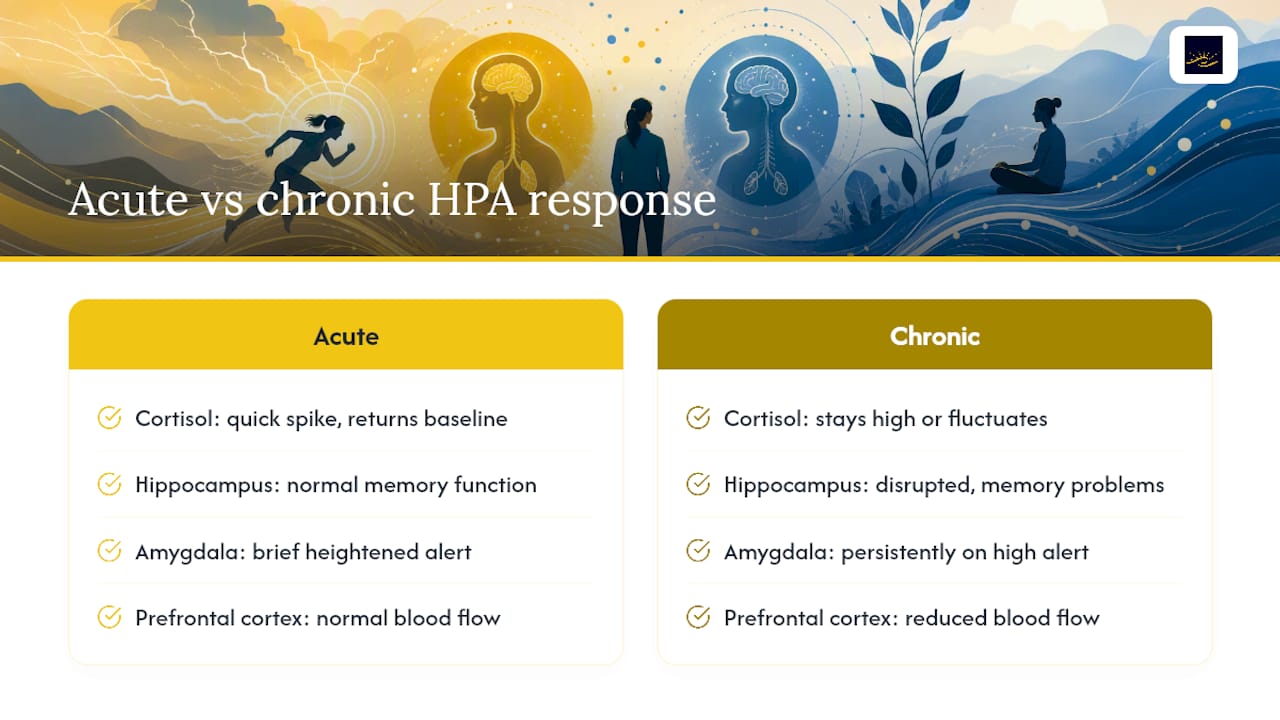
Sustained high cortisol has specific downstream effects. It disrupts the hippocampus, the brain region tied to memory formation, which is part of why chronic stress makes you forgetful or foggy. It also keeps your amygdala, the brain’s threat detector, on heightened alert, so small annoyances start triggering outsized reactions. Meanwhile, your prefrontal cortex, responsible for planning and impulse control, gets less blood flow under sustained stress, which explains why decision fatigue and impulsive choices climb during a bad stretch at work.
The physical body pays a parallel price. Chronically elevated cortisol raises blood pressure, disrupts blood sugar regulation, and suppresses immune function over time, one reason people under sustained work stress catch more colds and heal more slowly. None of this reverses instantly once the stressor lifts. Recovery of the HPA axis’s normal rhythm takes weeks of consistent lower stress exposure, which is exactly why brief vacations often don’t fix chronic workplace stress. The system needs sustained relief, not a single reset.
How Does Company Culture Shape Chronic Stress?
Culture sets the baseline stress level before any individual problem shows up. A team with clear priorities, consistent leadership, and psychological safety absorbs pressure differently than a team where priorities shift weekly and mistakes get punished publicly.
Leadership style matters more than most people assume. Managers who model transparency about workload and constraints, and who ask “what do you need to succeed here?” instead of “why isn’t this done yet?”, create teams that report chronic stress far less often. The inverse is also true: a leader who is chronically stressed themselves tends to transmit that state downward through terse communication, last-minute demands, and unpredictable mood.
Organizations that reward constant availability, where answering emails at 9 p.m. gets quietly praised, build chronic stress into the culture without ever naming it. Contrast that with a culture that protects focus time and treats a full inbox as a scheduling problem rather than a personal failing.
Coaching work with executives on leading through organizational uncertainty often surfaces this pattern directly: the leader’s own stress management, or lack of it, becomes the template their entire team unconsciously copies. Changing that template, not just adding a wellness webinar, is usually what actually shifts team-wide stress levels.
How Do You Build Long-Term Resilience to Work Stress?
Resilience isn’t a fixed trait some people have and others don’t. It’s a set of skills that strengthen with deliberate practice, similar to how a muscle adapts to repeated, moderate load.
The most reliable building block is what researchers call cognitive flexibility, the ability to view a setback from more than one angle instead of getting stuck in a single interpretation. You build this by practicing CBT-style reframing regularly, not just during a crisis, until it becomes a default reaction rather than an effort.
A second pillar is recovery habits that happen on a schedule, not just when you feel depleted. Athletes don’t wait until they’re injured to rest; they build recovery into training. The same logic applies to a demanding job: protected time off, a consistent sleep window, and short daily breaks work better than an occasional long vacation that has to undo months of accumulated strain.
Social connection is the third pillar, and it’s the one most people cut first when busy. Regular contact with a trusted colleague, mentor, or friend who understands your work context buffers stress in ways that solo coping techniques can’t match.
Finally, resilience grows through what’s sometimes called stress inoculation: deliberately taking on manageable challenges that stretch your capacity, then reflecting on what worked. Each successfully navigated difficulty raises your baseline tolerance for the next one. This is different from simply enduring stress passively, which tends to erode resilience rather than build it.
Does Remote or Hybrid Work Increase Chronic Stress?
Remote and hybrid arrangements changed the shape of workplace stress without necessarily reducing it. Some pressures eased: less commuting, more schedule flexibility, and often more control over your physical workspace. Other pressures got worse.
The biggest new stressor is blurred boundaries. When your kitchen table doubles as your desk, the workday has no clear edge, and many remote workers report checking email later into the evening than they ever did in an office. That erosion of downtime feeds directly into the chronic stress cycle: no recovery period means no reset.

Isolation is the second major factor. Casual hallway conversations that used to buffer stress and build support disappeared for many remote employees, and video calls don’t fully replace that informal connection. Hybrid workers sometimes face a different version of the same problem: pressure to be visibly “on” during office days while managing a completely different rhythm at home.
Managers also lose visual cues about who’s struggling. In person, a manager notices when someone looks exhausted or withdrawn. Over a video call, those signals are easy to miss, which means remote employees experiencing chronic stress may go unnoticed longer before anyone intervenes.
None of this means remote work causes more stress by default. It means the same core drivers, workload, autonomy, and support, need deliberate management in a remote setup rather than relying on office proximity to catch problems naturally.
What Legal Protections Exist for Workplace Stress?
Workplace stress itself isn’t automatically illegal, but the conditions causing it sometimes cross into legally protected territory. In the United States, the Americans with Disabilities Act (ADA) can apply if chronic stress has escalated into a diagnosed condition, such as major depressive disorder or an anxiety disorder, that substantially limits a major life activity. In that case, you may be entitled to reasonable accommodations, such as a modified schedule or additional breaks.
The Family and Medical Leave Act (FMLA) can provide unpaid, job-protected leave for a serious health condition, which some stress-related diagnoses qualify for with proper medical documentation. OSHA’s guidance also gives employers a duty-of-care framework, encouraging them to assess and mitigate psychosocial hazards the same way they’d address a physical safety risk, though enforcement here is less standardized than for physical injuries.
None of these protections require you to disclose a mental health condition to get support through most EAP programs, which typically operate independently of HR. If you believe you’re facing retaliation for requesting accommodations or leave, documenting dates, requests, and responses in writing gives you a record that matters if the situation escalates. A brief consult with an employment attorney or your state labor agency is worth it before assuming you have no options.
Seeking Help Is a Career Skill, Not a Weakness
What I’ve seen over years of coaching leaders through burnout is that the people who recover fastest are the ones who stop treating stress as a personal failure and start treating it as data. Your exhaustion is telling you something specific about a mismatch between your role and your actual capacity. Track it for a week, try two coping techniques with real consistency, and ask your manager for one concrete adjustment. That’s not weakness. That’s how capable people actually operate.
— Junna Liao
Ready to Build a Recovery Plan That Actually Sticks?
This service offers high-touch, one-on-one coaching built around specific career pressures, not a generic stress module. Where clinical care treats symptoms and self-help apps give you generic exercises, this work starts with the Energy Leadership™ Index (E.L.I.) Assessment to map exactly where your energy is leaking, then builds a personalized plan around it.
This approach works well alongside a therapist or physician, not as a replacement, and it’s built for professionals who want durable change in how they work, not just a temporary dip in stress levels. If chronic stress at work has you questioning your career path or leadership approach, 1:1 career coaching with Junna is the direct next step. Explore the coaching programs or start with the E.L.I. assessment to see exactly where to focus first.
This article is general information, not a substitute for advice from a qualified doctor. Consult a qualified healthcare professional about your own circumstances before acting on anything here.
Sources
- APA: Compounding Pressure: Work Well-Being (2021)
- World Health Organization: Mental health at work (WHO fact sheet)
- OSHA: Workplace stress
- Harvard Health Publishing: How to handle stress at work
FAQ
How Many Days Off Work Does Stress Cause?
Stress-related absences vary widely by industry and severity, and OSHA notes that chronic workplace stress reliably drives up absenteeism and turnover rather than a fixed universal number of days. The more useful marker is a pattern: repeated short absences or a single extended one tied to burnout symptoms signals it’s time to address the underlying workload, not just the missed days.
How Do You Deal With Emotional Stress at Work?
Start with an in-the-moment tool like belly breathing or a three-minute mindfulness check to calm your nervous system, then use CBT-style reframing to challenge catastrophic thoughts once you’re calmer. Longer term, Harvard Health Publishing recommends pairing these techniques with consistent sleep habits, exercise, and clear boundaries around work hours.
What Is the 42% Rule for Burnout?
There’s no widely recognized, evidence-based “42% rule” for burnout in occupational health research. Definitions of burnout risk vary by study and organization, so treat any specific percentage claim with caution and rely instead on the established burnout triad: exhaustion, cynicism, and reduced sense of effectiveness.
What Are the Symptoms of Long-Term Work Stress?
Common signs include disrupted sleep, frequent headaches, digestive issues, and elevated blood pressure, alongside irritability, withdrawal from coworkers, trouble concentrating, and increased substance use. A peer-reviewed review links this cluster to higher long-term risk for hypertension, cardiovascular disease, and depression.
Can Coaching Help With Chronic Work Stress?
Coaching, such as the 1:1 work MMDC Alchemy offers, complements clinical treatment by focusing on identity, career alignment, and sustained behavior change rather than diagnosing or treating symptoms directly. It typically starts with an assessment like the Energy Leadership Index and works well alongside therapy or medical care when symptoms are more severe.
Recommended
- Coaching for Difficult Workplace Conversations
- Executive Coaching for High Performers: Mastering the Alchemy of Leadership
- Coaching Programs
This blog is for educational and inspirational purposes only. It is not medical, legal, financial, or mental health advice. Your journey is unique; please seek qualified professional support for decisions that affect your health, finances, or wellbeing.