
Executive coaching reliably improves leadership behavior, and it does so with measurable evidence behind it. A 2023 meta-analysis found a moderate effect on individual performance, randomized trials link coaching to faster goal attainment and lower stress, and institutional research ties it to strong business returns. The payoff shows up at three levels: sharper individual judgment, stronger team performance, and organizational results that outlast any single engagement.
TL;DR:
- Executive coaching yields significant behavioral improvements, including faster goal achievement and enhanced decision-making under pressure.
- The most effective engagements target specific inflection points like promotions, restructurings, or plateauing high performers within three to six months.
- Structured processes with clear goals, regular tracking, and accountability are key to delivering measurable progress.
- Coaching benefits are strongest in behavioral outcomes, with evidence supporting ROI claims of up to 788 percent in productivity gains.
- Success depends more on the coach’s approach and measurement methods than on the coaching topic itself.
Table of Contents
- What Are the Benefits of Executive Coaching, and What Does a Coach Do?
- Benefits of Executive Coaching: Individual, Team, and Organizational Outcomes
- Why Executive Coaching Works: The Mechanisms Behind the Results
- Who Benefits Most From Hiring an Executive Coach
- Executive Coaching vs. Mentoring, Therapy, Training, and Consulting
- Types of Executive Coaching and How the Process Works
- What the Research Really Shows About Coaching ROI
- How MMDC Alchemy Applies These Benefits in Practice
- Why the Conventional Advice on Coaching Falls Short
- Ready to Work With MMDC Alchemy?
- Sources
- FAQ
What Are the Benefits of Executive Coaching, and What Does a Coach Do?
Executive coaching is a structured, one-on-one partnership between a trained coach and a leader, built around specific behavioral and career goals rather than general advice or motivation. It differs from leadership training programs in one key way: training teaches concepts to a group, while coaching applies those concepts to one person’s actual decisions, conflicts, and blind spots in real time.
A good coach isn’t a consultant handing down answers. The role centers on a few core functions:
- Discovery and assessment, often using tools like 360-degree feedback or psychometric instruments to surface patterns the leader can’t see alone
- Goal-setting, translating vague ambitions (“be a better leader”) into specific, trackable behaviors
- Action planning, designing between-session practices tied to real workplace situations
- Accountability, checking progress against goals and adjusting the plan when something isn’t working
Confidentiality is central to how coaching works, and it’s also more conditional than people assume. The International Coaching Federation sets ethical standards requiring coaches to protect client disclosures, but most engagements involve a sponsor (a manager, HR partner, or board member) who wants some visibility into progress. The ICF’s own guidance on confidentiality recommends coaches agree with both the client and the sponsor, upfront, about exactly what gets reported and what stays private. Skipping that conversation is one of the most common ways coaching engagements break down before they start.
Benefits of Executive Coaching: Individual, Team, and Organizational Outcomes
The benefits split into two categories that reinforce each other: what changes in the leader, and what changes around them.
On the individual side, five outcomes show up consistently across coaching research and practice:
- Faster goal attainment. A randomized controlled trial found that leaders who received short-term coaching alongside feedback and workshops reached their stated goals faster than control groups who did not receive coaching.
- Improved self-awareness. Structured feedback, particularly 360-degree reviews, closes the gap between how leaders see themselves and how their teams experience them, a gap that Harvard Business Review identifies as one of the biggest blockers to leadership growth.
- Better decision-making under pressure. Coaching builds the habit of pausing to check assumptions before reacting, which shows up most visibly during reorganizations or high-stakes negotiations.
- Greater resilience. The same randomized trial noted above found measurable resilience gains and reduced stress among coached participants compared to those who went without coaching.
- Renewed motivation. Leaders who felt stuck in a role often describe coaching as the thing that reconnected them to why the work matters in the first place.
On the team and organizational side, the benefits compound. A leader who communicates more clearly changes how an entire team operates, not just how one person performs. Common patterns include higher team performance scores, fewer escalations because feedback happens earlier and more directly, and better retention, since employees tend to stay longer under managers who show consistent self-awareness and follow-through.
The evidence at a glance: A 2023 meta-analysis found a moderate positive effect (g ≈ 0.59) of executive coaching on individual performance, with the strongest gains in behavioral outcomes like goal attainment. Separately, an American University ROI summary reports returns as high as 788%, alongside broader productivity and team-performance gains, though the underlying measurement methods vary by study.
A leader preparing for a promotion, for example, might use coaching to rehearse how to delegate work she previously did herself, a small behavioral shift that a meta-analysis would register as a performance gain, but that her team experiences as suddenly having room to grow.
Why Executive Coaching Works: The Mechanisms Behind the Results
Coaching doesn’t work through inspiration. It works through a repeatable structure that forces change instead of hoping for it.
- Goal-setting paired with accountability. A specific, dated goal reviewed every session creates pressure to act that a vague intention never does.
- Structured feedback, especially 360-degree reviews, gives leaders concrete evidence instead of a gut feeling about how they’re perceived.
- Behavioral practice between sessions. Leaders rehearse a specific conversation or decision before they face it live, then debrief what happened.
- Cognitive reframing. Coaches help leaders question the stories they tell themselves (“I have to control every detail”) that quietly drive bad habits.
Measurement ties it together. A coach who tracks the same three or four goals every session, rather than starting fresh each time, is the difference between coaching that drifts and coaching that compounds.
Pro Tip: Ask any prospective coach how they measure progress between sessions. If the answer is vague, the engagement probably will be too.
Who Benefits Most From Hiring an Executive Coach
Coaching tends to deliver the sharpest return for leaders facing a specific inflection point, not for leaders looking for general self-improvement.
- Newly promoted leaders adjusting to a bigger scope of responsibility, often within their first 90 days
- Founders and C-suite executives who lack a peer group inside their own company to give them honest feedback
- Leaders navigating a transformation, such as a merger, restructuring, or succession plan
- High performers who’ve hit a plateau, showing the same blind spot in review after review
If any of those describes your situation right now, that’s the signal to start, not to wait for a bigger crisis. Most engagements run three to six months before the first clear behavioral shift becomes visible, with organizational-level effects often taking longer to surface.
Executive Coaching vs. Mentoring, Therapy, Training, and Consulting
Coaching gets confused with four adjacent supports, and picking the wrong one wastes both time and money.
- Mentoring relies on a more senior person sharing their own path; coaching stays focused on the client’s goals, not the coach’s story.
- Therapy treats clinical mental health conditions; coaching assumes the client is functioning well and wants to perform better, not heal from a diagnosis.
- Training delivers the same content to a group; coaching adapts to one person’s specific situation.
- Consulting hands over an expert’s answer; coaching builds the client’s own capacity to find it.
They combine well, as shown in how consulting complements coaching with strategic visibility through consultant SEO services. A leader working through a major transition might pair coaching with difficult conversation support. One clear red flag: if the underlying issue is a clinical condition like depression or anxiety, refer to a licensed therapist first.
Types of Executive Coaching and How the Process Works
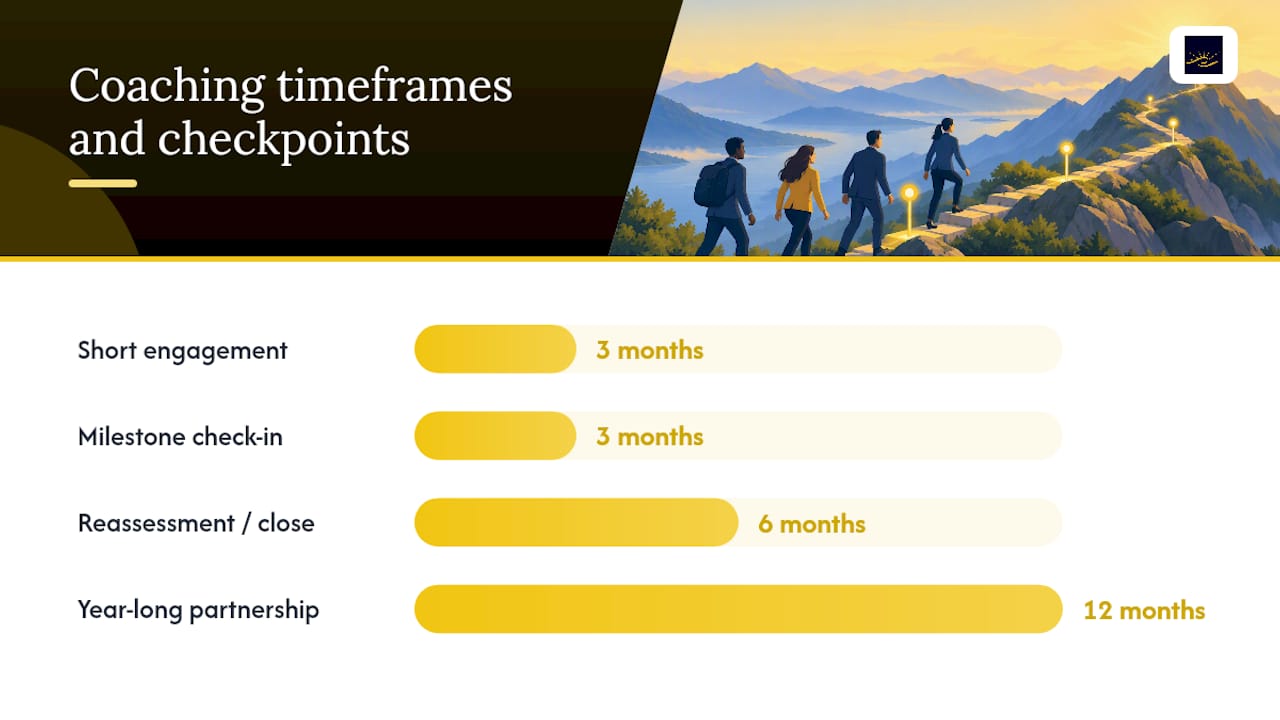
Most engagements fall into one of two formats: one-on-one coaching for an individual leader, or team coaching for an intact leadership group working through shared dynamics. Engagements also vary by length, from short three-month sprints tied to a specific transition, to year-long partnerships supporting a broader leadership arc.
A typical process looks like this:
- Discovery and assessment, often including a structured tool such as an energy or leadership-style index to establish a starting baseline.
- Goal-setting, usually in the first one to two sessions, defining what success looks like in concrete, observable terms.
- Regular sessions, typically biweekly, focused on real situations the leader is facing right now.
- Milestone check-ins, revisiting the original goals around the three-month mark to measure actual movement.
- Reassessment and close, deciding whether to extend, shift focus, or wrap the engagement around month six.
What the Research Really Shows About Coaching ROI
The strongest evidence for coaching comes from two different types of studies, and they tell a consistent story even though they measure different things.
The 2023 meta-analysis pooled results across many coaching studies and found a moderate effect size (g ≈ 0.59), with the biggest gains concentrated in behavioral performance like goal attainment rather than in softer measures like general well-being. A randomized controlled trial went further, isolating coaching from other variables and still finding real improvements in goal attainment, resilience, and workplace well-being compared with a control group.
- Meta-analytic evidence: moderate, consistent positive effect across many studies
- Experimental evidence: causal improvement in a controlled setting, not just correlation
- Institutional ROI claims: figures like the 788% return cited by American University are compelling, but they come from varied measurement methods across organizations, so they describe a pattern, not a guarantee
A broader review of workplace coaching research reaches the same conclusion from a different angle: the field needs more standardized methods, but the direction of the effect is consistently positive across the studies reviewed.
How MMDC Alchemy Applies These Benefits in Practice
MMDC Alchemy, founded by executive coach Junna Liao, builds engagements around the same principles the research points to: assessment-led discovery, concrete goals, and accountability that extends well beyond the scheduled session. The approach blends transformational coaching with practical life strategy, since career blind spots rarely exist in isolation from burnout, identity shifts, or major transitions happening at the same time.
The practice tracks progress through specific markers: clearer decision-making under pressure, measurable shifts in team feedback, and renewed direction after a career plateau or transition. The goal isn’t a motivational boost. It’s a documented change in how a leader operates.
Why the Conventional Advice on Coaching Falls Short
Most coverage of executive coaching treats it as a soft benefit, something nice to offer high performers as a reward. The research doesn’t support that framing. The effect sizes in the 2023 meta-analysis show up strongest in hard behavioral outcomes: goal attainment, decision quality, team performance. That’s not a wellness perk. That’s a performance lever.
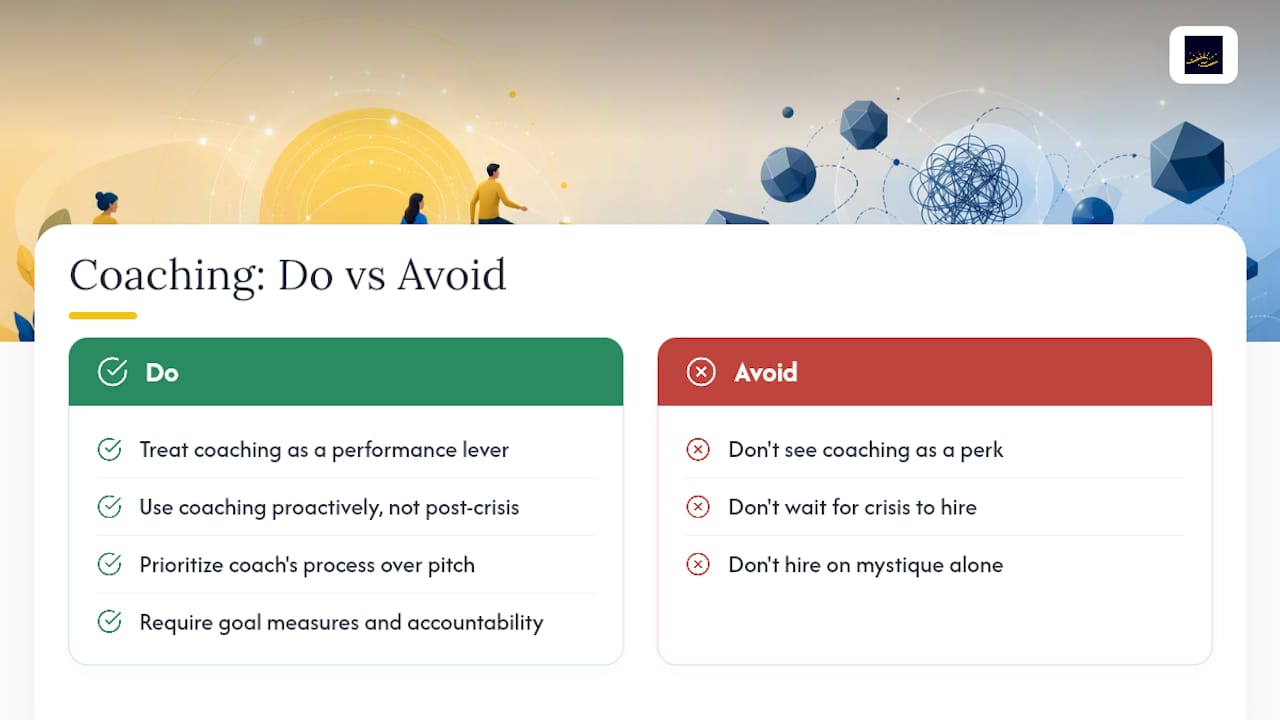
The bigger mistake I see leaders make is waiting for a crisis to justify the investment. Research on why leaders actually hire coaches shows the opposite pattern among high performers: they treat coaching as a strategic move, not damage control. That framing changes how engaged someone shows up to the work, and engagement is what determines whether coaching produces the effect sizes the studies describe or just a few pleasant conversations.
If you take one thing from the evidence, prioritize the coach’s process over their pitch. Ask how they measure goals, how they structure accountability between sessions, and how they define success at month three. The mechanism matters more than the mystique.
— Junna Liao
Ready to Work With MMDC Alchemy?
MMDC Alchemy is built for leaders who want the outcomes this research describes, not a generic pep talk. The approach starts with an assessment, like the Energy Leadership™ Index, to establish a clear baseline before setting any goals.
From there, a discovery conversation covers what’s actually driving your current plateau, transition, or burnout, and whether 1:1 career coaching or a broader life coaching engagement fits your situation better. If you’re navigating a promotion, a career pivot, or a leadership role that no longer feels sustainable, the next step is simple: book a discovery conversation and find out what a structured, accountability-driven engagement could look like for you.
Sources
- Meta-analysis: executive/workplace coaching outcomes (2023)
- Randomized controlled study on coaching outcomes (2009)
- The ROI of Executive Coaching | American University
- ICF Code of Ethics Rationale (2025)
FAQ
Who Benefits From Executive Coaching?
Newly promoted leaders, founders, C-suite executives, and high performers stuck at a plateau tend to see the biggest gains. The common thread is a specific inflection point, like a transition or a recurring blind spot, rather than a general desire for self-improvement.
What Is the Goal of Executive Coaching?
The goal is measurable behavioral change tied to specific leadership outcomes, such as better decision-making, clearer communication, or faster goal attainment, not general motivation or advice. Coaches work from a defined set of goals established during discovery and track progress against them throughout the engagement.
How Effective Is Executive Coaching?
A 2023 meta-analysis found a moderate positive effect (g ≈ 0.59) on individual performance, with the strongest impact on behavioral outcomes like goal attainment. A separate randomized controlled trial confirmed real improvements in goal attainment, resilience, and well-being compared with a control group.
What Is the Power of Executive Coaching?
Its power comes from combining structured feedback, specific goals, and accountability into one repeatable process, rather than relying on inspiration alone. That structure is what separates measurable outcomes from a series of well-meaning but forgettable conversations.
How Much Does Coaching With MMDC Alchemy Cost?
Pricing for career coaching and life coaching engagements is available directly through MMDC Alchemy after an initial discovery conversation. Current details are listed on the site rather than published as a flat rate, since engagements are individualized.
Recommended
- Executive Coaching for High Performers: Mastering the Alchemy of Leadership
- Clear Communication Coaching for Leaders
This blog is for educational and inspirational purposes only. It is not medical, legal, financial, or mental health advice. Your journey is unique; please seek qualified professional support for decisions that affect your health, finances, or wellbeing.