
An identity-based goal starts with the person you want to become, then works backward to the actions that person would take. “Get promoted” or “lose 20 pounds” names a result. “Become a leader who develops others” or “become someone who moves every day” names an identity, and the results follow from the behavior that identity produces. This guide shows how to write one, how it differs from outcome and process goals, and where it breaks down, with a focus on mid-career professionals and leaders facing a transition.
TL;DR
- Identity-based goals describe who you are becoming. Outcome goals describe what you want to get, and process goals describe what you do. The three work best stacked together.
- Research suggests identity can make effort feel less forced and help you recover from setbacks. It is not a guarantee, and it does not replace practice.
- A simple method: name the identity, list its skills and attributes, pair each with one small action, then say when and where you will do it.
- In one 15-week study, accepting behavioral challenges did not predict change. Completing them did. Follow-through is the mechanism.
- If burnout or a career shift has blurred who you are, clarify values first and test the new identity in small, real experiments.
Table of Contents
- What identity-based goals are
- How they differ from outcome goals, process goals and habits
- Why identity-linked goals can support lasting change
- Examples for career changers and leaders
- How to write an identity-based goal, step by step
- Our perspective
- When burnout makes the next step unclear
- Common mistakes and limits
- How coaching can help you apply this
- FAQ
- Sources
What identity-based goals are
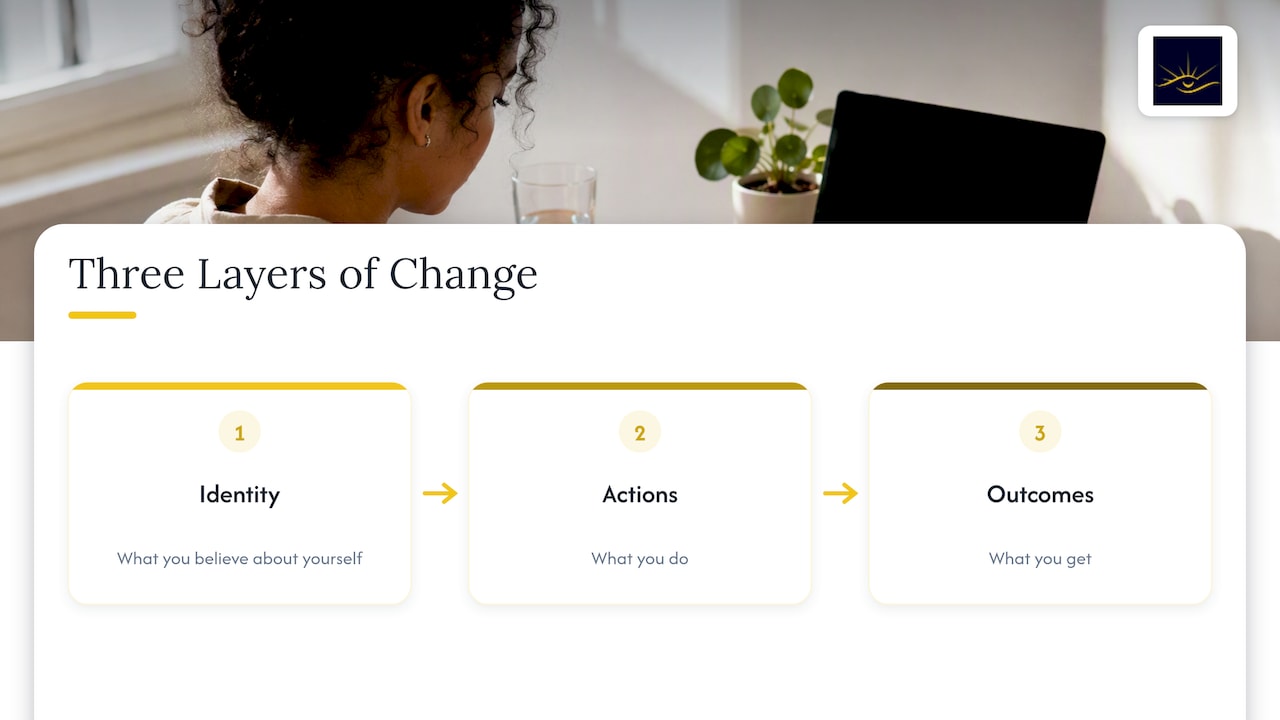
Most goals are about outcomes: a title, a salary, a race time, a number on a scale. An identity-based goal shifts the question from “what do I want?” to “who do I need to be?” James Clear, who popularized the idea in the habit-building world, separates three layers of change: outcomes are what you get, processes are what you do, and identity is what you believe about yourself. His argument is that lasting change starts with the identity layer instead of ending there.
His own example is simple. The goal is not to squat 300 pounds or lose 20 pounds. The goal is to become a person who moves every day, and the numbers become a by-product.
The idea is not only a self-help trope. Psychologists describe the same structure. A peer-reviewed paper on goal pursuit describes higher-order identity goals as goals that guide thoughts and actions over long periods, such as being a community leader, while lower-order goals supply the concrete actions that serve that identity. A longitudinal study of 3,095 German-speaking STEM professionals similarly found that identity can act as a higher-order goal shaping everyday, lower-level goals. That population is outside the U.S., so treat it as supporting evidence, not American data.
For professionals, this matters because the biggest goals are rarely about a task. “Lead the division” is not a to-do. It is a shift in how you see yourself, how you spend your attention, and how others see you.
How they differ from outcome goals, process goals and habits
These terms get mixed up. Here is how they fit together.
| Type | Answers the question | Example for a manager moving into senior leadership |
|---|---|---|
| Outcome goal | What do I want to get? | Become VP within two years |
| Process goal | What will I do, and how? | Hold a weekly strategy review with my team |
| Identity-based goal | Who am I becoming? | A leader who builds other leaders |
| Identity-based habit | What small repeated act proves it? | Every Friday, I delegate one decision I used to make myself |
Process goals have their own research base. Zimmerman and Kitsantas distinguished process goals, which specify strategic actions, from outcome goals, which specify the eventual result, and reported that process goals can be especially useful while people are still learning a skill.
The point is not to throw out outcomes. An identity with no direction can drift, and an outcome with no identity behind it can feel hollow once you reach it. Habits are the concrete repeated behaviors that provide evidence for the desired identity, so the layers work together rather than compete.
Why identity-linked goals can support lasting change
The case for identity is about maintenance. Starting something new takes motivation. Keeping it going for years takes something sturdier.
The Maintain IT model, published by Caldwell and colleagues, proposes that when a behavior is integrated with existing valued roles, groups and values, self-regulation may become less effortful and people may recover from lapses more easily. The same authors argue that lasting change is more likely when identity work complements, rather than replaces, deliberate action. Identity is a possible maintenance mechanism, not magic.
A related finding comes from self-concordance research. A 2024 study of Chinese university students reported that goals aligned with intrinsic interests and values were linked with autonomous motivation, satisfaction and goal achievement. The authors also note the relationship runs both ways: knowing who you are helps you pick goals, and pursuing goals helps define who you are. That is worth remembering if you are mid-transition and feel you must “figure yourself out” before acting.
Identity also seems to be context-sensitive. Daphna Oyserman’s identity-based motivation work describes identity as dynamically activated by context and linked to action readiness: when an identity feels relevant right now, people become ready to do what fits it. Her team’s School-to-Jobs intervention made students’ school-focused future identities more salient and tied them to strategies. Reported two-year effects included more homework, better grades, more initiative and fewer unexcused absences. Practically, this means the environment you build around a new identity (who you talk to, what you read, what is on your calendar) is part of the goal.
Examples for career changers and leaders
Good identity goals are specific enough to guide a Tuesday afternoon. Here are some patterns that fit mid-career and senior professionals.
- From expert to leader: “I am someone who makes my team better, not someone who does the best work on the team.” Actions: coach instead of fix, hand over visible projects, ask questions before offering answers.
- From executor to strategist: “I am someone who spends part of every week thinking, not only responding.” Actions: a protected weekly block, a standing question about what the business needs in 18 months.
- From corporate role to independent work: “I am a practitioner who solves a specific problem for a specific kind of client.” Actions: three conversations a month with people who have that problem.
- From burnout to sustainable high performance: “I am someone who treats energy as a leadership resource.” Actions: a hard stop time, a weekly review of what drained and what fed you.
- From role-defined to whole person: “I am a person first and a title second.” Actions: reclaim one commitment outside work that has nothing to do with performance.
Research on career change supports the experimental approach behind these. A qualitative study of 12 U.K. career changers found that identity exploration and trying on provisional selves helped people move toward values-driven, self-directed careers. It is a small, non-U.S. sample, so it illustrates a pattern rather than proving one. Separately, a 2024 Journal of Personality study described personal values as a fundamental component of identity that helps explain career-related preferences, which is a good reason to start your goal-writing with values.
If you want help phrasing the direction itself, our personal vision statement examples for leaders show how to turn a vague pull into something you can test within 30 days.
How to write an identity-based goal, step by step
The University of Missouri’s Novak Leadership Institute recommends a practical sequence: list the skills and attributes of the future person, pair each with one small action, and specify when and where you will do it. Here is that approach adapted for a professional.
- Name the outcome you are drawn to. Be honest, even if it is a title or an exit. This is your starting clue, not your final goal.
- Describe the person who would get that outcome naturally. Ask what that person believes, notices, tolerates and refuses. Clear’s QuickStart guide suggests describing the type of person who would achieve the outcome and listing five very small steps toward becoming them.
- List skills and attributes. Look at people already in the position you want. What do they do that you do not yet do? Keep it to observable behavior.
- Add “yet” to your gaps. The Novak guidance suggests reframing current limits with the word “yet”. “I am not a strategic thinker” becomes “I am not yet a strategic thinker”, which leaves room for the identity to form.
- Pair each attribute with one small action. Small enough that you will do it in a bad week.
- Fix the when and where. “After my Monday leadership meeting, at my desk, I write down one decision I will delegate.” Clear suggests practicing each step for a week before adding another.
- Review the evidence monthly. Ask: what did I do this month that the person I am becoming would do? Collect those instances.
Why the when-and-where step matters
A study of personal goals found that self-concordance and implementation intentions were both positively associated with goal progress. Meaningful goals plus concrete if-then plans beat either one alone. A behavioral study of multivitamin-taking found the strongest compliance when implementation intentions were paired with self-concordant reasons. A modest example, but the logic carries over: a plan works best when you care why.
Our perspective
Most of the executives who come to us are not short on goals. They have a long record of reaching them. What they are short on is a sense that the goals are still theirs.
That is why we begin with identity, not a target. When a leader tells us they are burned out, the problem is rarely a lack of discipline. More often the person they built to succeed no longer fits the life they are living. A new job title will not fix that. A new plan will not either, unless it is built around who they are becoming.
Our approach combines deep coaching with practical life and career planning, and with Energy Leadership principles that help you see how you actually show up under pressure. We design it as high-touch work: the real change happens in the weeks between sessions, when you test a new way of leading, notice what it costs and what it gives back, and adjust. That outside-of-session work and accountability is what we believe separates a good insight from a changed career.
Identity is not a label you pick once. It is something you practice into being, with support, evidence and honesty about what matters to you. Across more than 600 transformations, that has been the thread we keep seeing.
Junna Liao
When burnout makes the next step unclear
Identity-based goals are harder to write when you are exhausted, because the old identity is the thing that wore you down. A 2026 study of 22 caregiving professionals reported that recovery involved breaking down the identity built around work and adopting a broader identity as a person. The sample is specific to caregiving, so it is not a rule for every field, but the pattern will sound familiar to many high achievers: “I am what I produce” has to loosen before something new can take hold.
If that is where you are, a few adjustments help:
- Make the first identity goal about recovery, not ambition. “I am someone who protects my energy” is a legitimate starting identity.
- Delay the big career decision. Run small experiments instead: a conversation, a side project, a different way of running a meeting.
- Get data on your patterns. An assessment such as the Energy Leadership Index can show how you tend to respond under stress, which gives your goals something concrete to work against.
- Talk to a professional if exhaustion is affecting your health, sleep or mood. A physician or licensed therapist is the right person for that, and coaching is not a substitute.
Our guide to seven-step career transformation for midcareer leaders goes deeper on sequencing identity work before job moves.
Common mistakes and limits
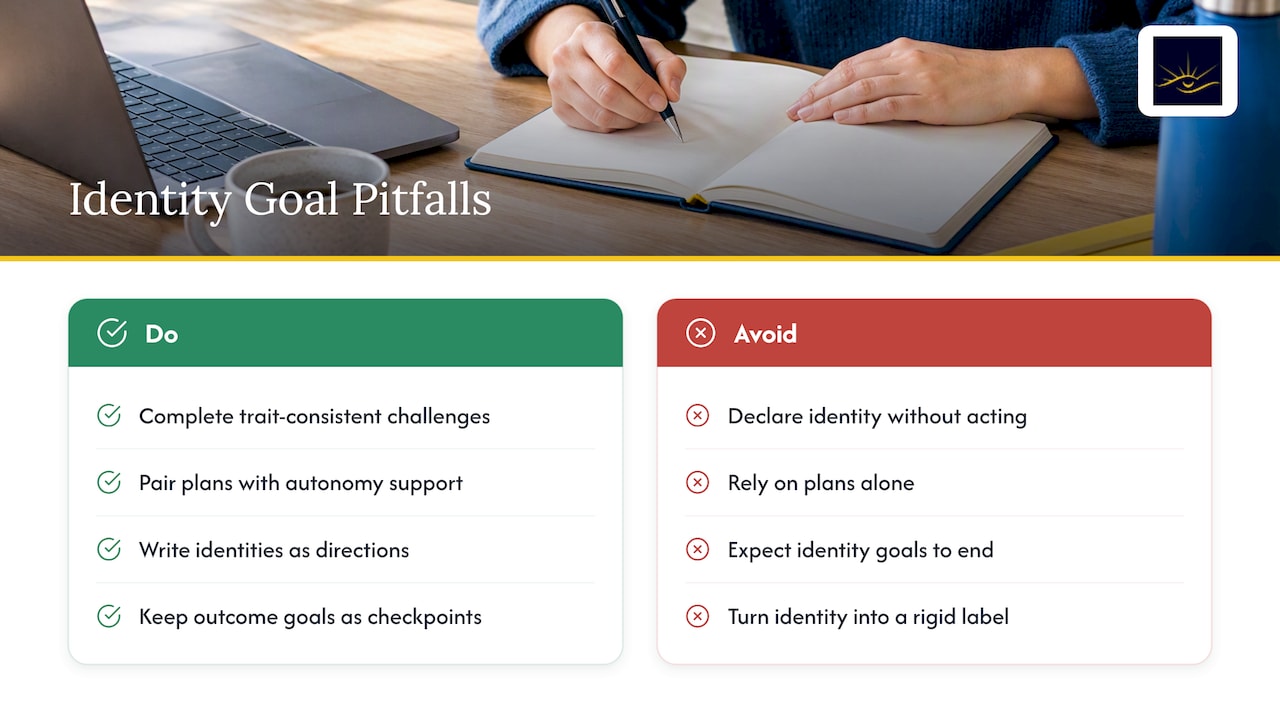
Treating the identity as a wish. Hudson and colleagues ran a 15-week intensive study and found that merely accepting behavioral challenges did not predict personality change, while actually completing trait-consistent challenges did. Declaring “I am a bold leader” changes nothing until you do something bold, repeatedly.
Relying on plans alone for long-haul goals. Research on long-term self-initiated goals found that implementation plans alone did not outperform a neutral condition. Plans combined with autonomy support or a boost in self-efficacy produced significantly greater progress. In plain terms: a calendar entry is not enough. You need to want it, and you need to believe you can do it. This is where a coach, mentor or peer who backs you without taking over helps.
Expecting to finish. Identity goals differ from outcome goals because they do not end. Gollwitzer and Kirchhof describe identity goals as enduring because they cannot be completed and are not easily halted by failure, though identity choices still take implementation effort. That can be freeing: a missed week does not cancel who you are becoming.
Turning the identity into a rigid label. “I am a visionary” can become a cage the first time you doubt it. Write identities as directions (“becoming someone who…”) and keep the “yet” in them. Since identity is activated by context, expect it to feel stronger in some rooms than others.
Skipping outcomes entirely. Identity without any measurable markers is hard to steer. Keep one or two outcome goals as checkpoints, and let identity and habits do the daily work.
How coaching can help you apply this
Writing the goal is the easy part. The harder parts are seeing which identity you have outgrown, choosing one that is yours rather than inherited, and staying with the practice when the evidence is slow to arrive. That is the work we do in 1:1 career coaching with Junna: private, personalized engagements that combine deep coaching with practical career and life planning, with real work and accountability between sessions.

If you are testing a direction and want a shorter format, the Career Clarity Coach option is built around 4 to 6 sessions to test a direction. For a longer shift, career transition coaching runs over 3 to 12 months. If you are weighing options, our guide on vetting career identity coaching lists what to check before you commit, and our piece on personal brand coaching covers aligning how you present with who you are. To start the conversation, visit MMDC Alchemy.
FAQ
What is an example of an identity-based goal?
“I am becoming a leader who develops other leaders” is one. It is paired with small actions, such as delegating one decision each week and asking a direct report for their view before giving yours. The identity states the direction, and the actions are the evidence.
Are identity-based goals better than SMART goals?
They do different jobs. SMART-style outcome goals give you a measurable target, and identity-based goals supply the reason and the daily behavior that make you keep going. Research on personal goals suggests meaningful goals paired with concrete plans make more progress, so most people do best using both.
What is the difference between identity-based goals and identity-based habits?
The goal is who you want to become. The habits are the small, repeated behaviors that prove it, such as a weekly strategy block for someone becoming a strategic leader. The habits are how an identity gets built, so one without the other tends to stall.
Can identity-based goals help with burnout?
They can help you rebuild a sense of who you are beyond your output, which research on professional recovery has described as part of the process. Begin with a recovery-focused identity, and see a physician or licensed therapist if burnout is affecting your health.
How long does it take to change my identity?
There is no reliable timeline. The research points to repeated, completed behavior as what moves the needle, not a set number of days. Review your evidence monthly and expect the change to build gradually.
Sources
- Identity-Based Habits: How to Actually Stick to Your Goals (James Clear)
- Identity-Based Habits, Medium edition
- QuickStart Guide to Identity-Based Habits
- Mixed Emotions Within the Context of Goal Pursuit
- The interplay of career involvement and goal conflicts
- Developmental Phases in Self-Regulation (Zimmerman and Kitsantas)
- Harnessing Centered Identity Transformation
- Establishing self-concordant goals: a longitudinal study
- Identity-based motivation: Implications for intervention
- Identity exploration among career changers
- Personal values and career-related preferences
- Identify Habits That Will Help You Reach Your Goals (Novak Leadership Institute)
- Attaining Personal Goals: Self-Concordance Plus Implementation Intentions
- Implementation intention and self-concordance study
- Sensemaking study of caregiving professionals (2026)
- You have to follow through: Attaining behavioral change
- Bolstering Implementation Plans for the Long Haul
- The Willful Pursuit of Identity
Recommended
- OKR vs. SMART Goals: Choose Your Team’s 90-Day Goal System
- 3 Steps to Vet Career Identity Coaching for High-Achievers
- Self-Awareness for Leaders: How to Build It and Use It
- Seven Step Career Transformation for Midcareer Leaders: Identity First
This blog is for educational and inspirational purposes only. It is not medical, legal, financial, or mental health advice. Your journey is unique; please seek qualified professional support for decisions that affect your health, finances, or wellbeing.