
A career plateau is when your title, scope, or pay stops growing despite steady tenure and solid performance. If you’ve gone roughly five years without a real promotion, your pay has barely moved, or your work no longer stretches you, then you’re likely on one. The fix starts with a quick career audit or a direct conversation with your manager, not with working harder in the same lane.
TL;DR:
- Nearly one in four mid-career professionals experience a career stall after five or more years without promotion or wage growth, especially in sectors like finance, real estate, and public administration.
- Confirming a plateau involves analyzing your promotion timeline, assessing whether you’re already doing next-level work, and reviewing recent performance reviews for lack of growth opportunities.
- Causes include organizational limitations, internal skills gaps, external promotion systems, and personal constraints like caregiving or values shifts, with traps such as golden handcuffs and visibility failures exacerbating stagnation.
- Breaking through in 90 days requires strategic actions like impact visibility, skill building, case preparation, and testing conversations, rather than working harder in the same role.
- Long-term stagnation can lead to significant wage gaps, credential atrophy, credibility issues in the job market, and erosion of confidence, making early identification and action crucial.
Table of Contents
- What Is a Career Plateau, and How Common Is It?
- What Are the Signs of a Career Plateau?
- What Actually Causes a Career Plateau?
- How Do You Break Through a Career Plateau in 90 Days?
- Should You Stay, Switch Teams, or Leave?
- When Does Coaching Actually Help With a Plateau?
- What Does a Prolonged Plateau Cost You Long-Term?
- What Do Real Plateau Scenarios Look Like?
- A Coach’s Take: Stop Treating the Plateau as a Verdict
- Ready to Move Past Your Plateau?
- Sources
- FAQ
What Is a Career Plateau, and How Common Is It?
A career plateau shows up in three distinct forms, and each one demands a different fix. A structural plateau happens when there’s simply no room above you on the org chart. A job-content plateau happens when your role has stopped teaching you anything new, even if promotions are technically still possible. A personal plateau comes from your own constraints: caregiving, health, a values shift, or simply not wanting the next rung badly enough to fight for it.
This isn’t a fringe problem. Nearly one in four mid-career professionals, 24.2% according to a joint NYU School of Professional Studies and Burning Glass Institute report, experience what researchers call a “career stall”: five or more years without a meaningful promotion or wage increase. The risk concentrates in specific sectors:
- Public administration: 33.4% stall rate
- Real estate: 30.2% stall rate
- Finance: 26.6% stall rate
Plateaus tend to surface around the 5 to 10 year mark of a career or a role, which is exactly when the easy, obvious promotions have already happened and the next move requires deliberate strategy instead of momentum.
What Are the Signs of a Career Plateau?
Confirming a plateau takes evidence, not a gut feeling. Before you decide what to do, gather the facts:
- Map your promotion and pay timeline. List every title change and raise for the past five years, with dates. Flat lines in either column are your first data point.
- Check whether you’re already doing the next-level job. If you’re managing projects, mentoring staff, or making decisions above your pay grade without the title or comp to match, that’s a visibility problem, not a skills problem.
- Notice your learning curve. If nothing at work has genuinely challenged you in the past six months, boredom is doing real damage to your motivation, not just your mood.
- Reread your last two performance reviews. Vague praise with no concrete growth path is a red flag. Reviews that don’t name a next step for you tend to reflect a manager who has no next step in mind.
- Compare yourself to the early-stall pattern. Research on career stalls found that professionals headed for a plateau averaged 1.5 promotions and 45% wage growth in their first decade, versus 1.9 promotions and 66 to 71% growth for peers who kept moving. If your numbers look closer to the first group, treat it as an early warning, not a verdict.
What Actually Causes a Career Plateau?
Some causes sit inside you, some sit inside the organization, and a few are traps that masquerade as bad luck. Internal drivers include a skills gap that’s quietly widened, an identity shift where the job you climbed toward no longer fits who you are, or life constraints like caregiving that limit how much you can chase right now. External drivers include a flat org chart, promotion systems that reward visibility over output, or simply too few open roles above you.
Then there are the traps nobody warns you about:
- Golden handcuffs. Deferred bonuses, unvested equity, or a rich pension can make staying financially rational even when it’s professionally corrosive.
- The visibility failure. Doing excellent work that nobody above you actually sees.
- The grind reflex. Responding to stagnation by working longer hours in the same role, which rarely changes the outcome.
Peer-reviewed research backs the psychological cost here: a study on career plateau and job performance found plateaus are linked to lower performance, though positive psychological capital and a fair, transparent organization can soften the damage substantially.
How Do You Break Through a Career Plateau in 90 Days?
Working harder rarely moves the needle. Practitioners covering the mid-career slump consistently point to a different lever: changing strategy rather than increasing output, through visibility, mentorship, and skill pivots. Here’s a sequence that fits inside three months.
- Weeks 1 and 2: run a three-gap audit. Score yourself on momentum (are you visibly advancing?), negotiation readiness (could you make your case for a raise or promotion today?), and resilience (do you have the energy and support to push?). Whichever gap scores lowest is where you start.
- Weeks 3 through 6: make your impact visible. Start a running document of wins, dated and quantified. Volunteer for one cross-team project outside your usual lane. Mentor someone junior, adopting the senior-led delivery model as a way to demonstrate leadership potential and impact beyond your current role. It’s an underrated move because mentoring signals a competency, talent development, that decision makers associate with the next level up, not just good individual work.
- Weeks 5 through 8: build two or three market-aligned skills. Look at job postings one level above yours and identify the two or three skills that show up repeatedly. Internal mobility built around those skills is powerful. The NYU SPS and Burning Glass Institute report notes that a lateral move, like a programmer shifting into a data scientist role, can cut stall risk by as much as 86% in some cases.
- Weeks 9 and 10: prepare your case. Build a negotiation-ready file: evidence of impact, a specific target outcome (a title, a number, a scope change), and a walk-away point you’ve actually thought through in advance.
- Weeks 11 and 12: test the water. Have the conversation with your manager, or run a low-risk pivot experiment, like informational interviews or a short freelance project in a field you’re curious about, if internal options are genuinely closed.
Pro Tip: Don’t split your energy evenly across all five steps. Scattering focus across momentum, negotiation, and resilience at once is how three months turns into a year of no progress.
If you’d rather work through this audit with someone rather than alone, MMDC Alchemy’s insights collection covers the momentum and negotiation-readiness frameworks in more depth.
Should You Stay, Switch Teams, or Leave?
The decision usually comes down to a net-value calculation you can actually write down. On one side, tally what staying is worth: unvested equity, a bonus that pays out in eight months, a pension that cliffs at year five. On the other side, tally the cost of stalled momentum, lost market relevance, and the compounding wage gap versus peers who kept advancing.
Golden handcuffs create a real behavioral pull to stay put, and a transparent version of this calculation often reveals that staying quietly costs more than it appears to save. Signs staying is the strategic call: a documented plan with your manager, a specific timeline, and evidence that leadership actually wants you to advance. Signs it’s just drift: vague promises, repeated “not this cycle” answers, and no written plan after multiple conversations.
Set a hard decision date, three to six months out, and define in advance what progress has to look like by then:
- A specific title or scope change discussed with a date attached
- A completed skill or credential tied to your target role
- At least one internal or external interview, even informally
If none of those happen by your deadline, that’s your answer.
When Does Coaching Actually Help With a Plateau?
Mentoring and classes teach skills. Coaching does something different: it works on identity, accountability, and the negotiation strategy behind how you present your case. That distinction matters because most plateaus aren’t a knowledge gap. They’re a positioning gap, and positioning can be hard to see clearly from inside your own head.
MMDC Alchemy, founded by executive coach Junna Liao, has guided more than 600 client transformations focused on exactly this kind of stuck point, and its resource on overcoming leadership plateaus walks through the same identity and momentum work in more depth.
The value of coaching isn’t information you couldn’t find yourself. It’s someone who holds you accountable to the negotiation-ready case you keep almost building, and who can see the identity shift underneath a “stalled career” faster than you can see it in yourself.
When evaluating a coach, look for:
- A clear methodology, not just general encouragement
- Concrete outcomes from past clients
- A realistic timeline. Most plateau work shows measurable movement in three to six months, not weeks
What Does a Prolonged Plateau Cost You Long-Term?
The damage from a long plateau compounds in ways that aren’t obvious at year one. Wage growth is the clearest example: professionals who stall accumulate a wage gap that widens every year they stay stuck, since raises typically build on prior raises rather than resetting. A software developer stuck in a stall can face a a cumulative wage deficit of over $40,000 over 15 years compared to a peer who kept advancing.
Beyond the paycheck, a stalled title becomes a credibility problem in the job market. Recruiters and hiring managers read a long gap between titles as a signal, fairly or not, and it can force you into justifying your stagnation in every interview rather than showcasing your growth. Skills atrophy too. A job-content plateau means you stop building the muscle memory that keeps you competitive, and the market-aligned capabilities you had five years ago quietly age out.
There’s a psychological cost that compounds alongside the financial one. Watching peers advance while your own trajectory flattens tends to erode confidence, and lower confidence makes you less likely to advocate for yourself in exactly the moments that would break the cycle. It’s a feedback loop: stagnation breeds hesitation, and hesitation extends the stagnation. Left unaddressed long enough, a plateau can reshape your sense of what you’re even capable of, which is a far more expensive loss than the missed raises.

The earlier you name the plateau and act, the shorter that compounding period gets.
What Do Real Plateau Scenarios Look Like?
The structural plateau: A mid-level manager at a flat, founder-led company spends four years doing director-level work with no director title available because the company has exactly one director role, already filled. The resolution here is rarely internal. It usually means building a negotiation-ready case for a title change tied to comp, or accepting that the ceiling is real and testing the external market.
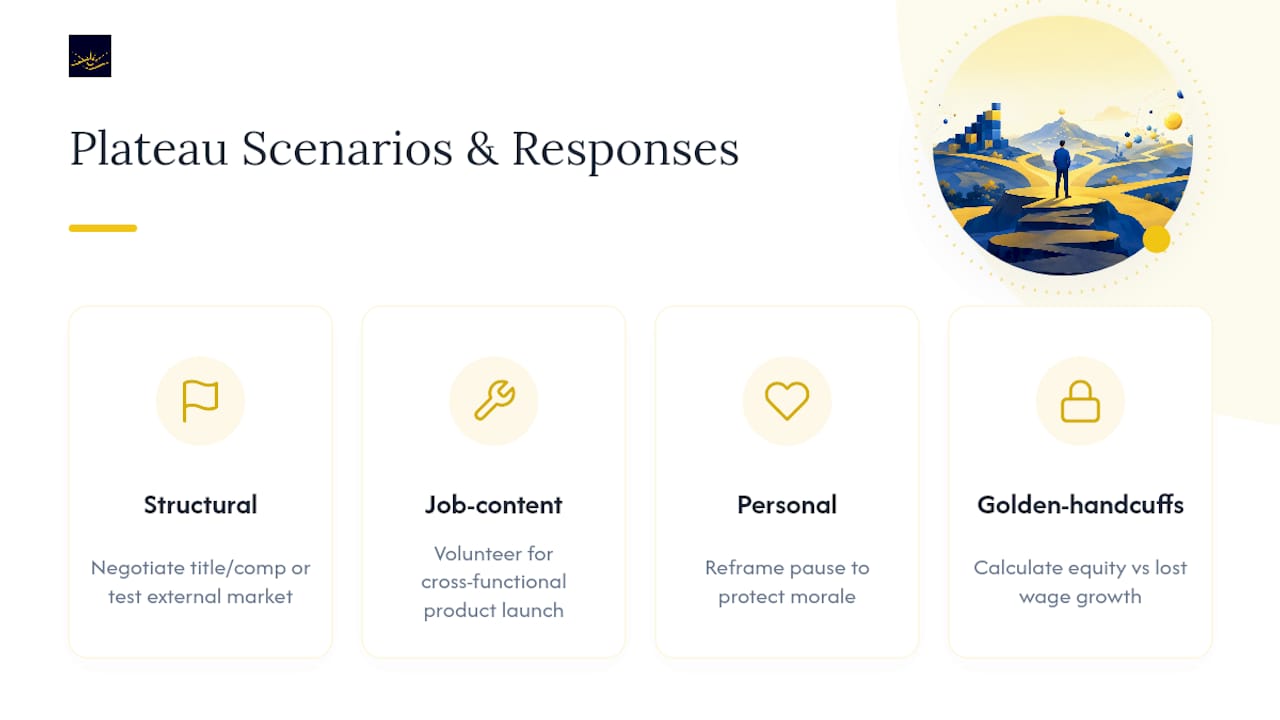
The job-content plateau: A marketing lead has mastered every task in her role and could do it in her sleep. Pay is fine. Title is fine. But nothing has challenged her in two years. Her fix was volunteering for a cross-functional product launch outside her usual lane, a low-cost way to rebuild the learning curve without leaving the company.
The personal plateau: A finance professional deliberately slowed his climb for three years while caregiving for a parent. He wasn’t stuck. He was choosing. The distinction mattered enormously for his own morale, because reframing a deliberate pause as a failure is how personal plateaus turn into identity crises they never needed to be.
The golden-handcuffs case: An engineer with two years left on a large equity grant kept passing on external offers, even as her scope stayed frozen. Running the actual net-value math, equity value against three years of lost market wage growth, showed the handcuffs were costing more than they were worth. She negotiated an internal move instead of waiting out the vest.
A Coach’s Take: Stop Treating the Plateau as a Verdict
A plateau isn’t proof you’ve failed. It’s data. Your career is telling you something specific: the strategy that got you here has stopped working, and that’s a solvable problem, not a character flaw.
Try this right now: ask yourself one question. “If nothing changes for the next 12 months, am I fine with that?” Your honest answer tells you whether you’re in a strategic pause or genuine drift. Set a three-month check-in with yourself, and if you want a guided version of this audit, MMDC Alchemy’s resource on overcoming leadership plateaus is built for exactly this moment.
— Junna Liao
Ready to Move Past Your Plateau?
Reading about a plateau and actually breaking one apart are different exercises. If you’ve run the audit above and found a gap you can’t seem to close alone, whether it’s the visibility problem, the negotiation conversation you keep avoiding, or the identity questions underneath the stalled title, that’s precisely where a structured coaching relationship earns its cost. MMDC Alchemy’s career coaching works with mid-career professionals and executives on exactly this kind of stuck point, combining practical career strategy with deeper identity and burnout work when that’s part of what’s holding you back. If your plateau is tangled up with a recent layoff or organizational upheaval, the layoffs guidance addresses that specific situation. When you’re ready to talk it through, you can book a call directly.
Sources
- One in Four Mid-Career Professionals Are Stranded in Career Stall, According to New NYU SPS and Burning Glass Institute Report
- The influence mechanism of career plateau on employee job performance: the mediating role of organizational justice and the moderating role of positive psychological capital
- The mid-career slump: how to break through when you feel stuck
FAQ
What Is the 3-Month Rule for a New Job?
The 3-month rule refers to giving a new role at least 90 days before judging whether it’s a fit or a mistake, since onboarding, ramp-up, and team dynamics rarely settle before then. It’s a different concept from a career plateau, which involves years of stalled growth, but the same evidence-gathering instinct applies: track concrete signals rather than reacting to a rough first week.
Why Is Gen Z Struggling to Find Jobs?
Entry-level hiring has tightened due to a mix of economic caution, automation of junior tasks, and employers favoring experienced hires for roles that used to train newcomers. This shifts the plateau conversation earlier in careers, since some young professionals now hit a content plateau before they’ve even secured their first real growth track.
At What Age Does a Career Typically Peak?
There’s no single age, since it depends heavily on the field and individual choices, but the data on career stalls suggests risk builds around the 5 to 10 year mark in a role or field, often landing in the mid to late 30s or 40s for many professionals. That timing lines up with when the NYU SPS and Burning Glass Institute research shows stall rates concentrating.
What Is the Number One Reason People Quit Their Jobs?
Stalled growth and lack of advancement consistently rank among the top drivers of voluntary departures, closely tied to feeling underpaid relative to responsibility. A career plateau, especially one paired with a visibility failure where your work goes unrecognized, is often the quiet root cause behind resignations that get filed under “better opportunity” on an exit form.
How Do I Know if I’m on a Career Plateau or Just in a Slow Season?
Check your promotion and pay history over the last three to five years, not the last few months. A slow season resolves on its own within a quarter or two; a genuine plateau shows a consistent pattern of flat title, flat pay, and reduced learning that doesn’t shift without deliberate action on your part.
Recommended
This blog is for educational and inspirational purposes only. It is not medical, legal, financial, or mental health advice. Your journey is unique; please seek qualified professional support for decisions that affect your health, finances, or wellbeing.