
A midlife career-change coach is often the fastest path from feeling stuck to having a clear, actionable plan. Older adults are staying in the workforce longer than in past decades, with 11.374 million Americans age 65 and older employed in 2025, proof that a second act is common and viable. We work with professionals in their 40s through 60s, and this guide covers costs, timelines, and how to evaluate a coach before you commit.
TL;DR:
- Most midlife career pivots take at least three to six months for initial clarity or twelve to eighteen months for a full transition, depending on the scope of change.
- Effective coaching focuses on values clarification, skills mapping, narrative reframing, and small experiments, with outside accountability driving results.
- Clients most likely to benefit are experienced professionals facing burnout, layoffs, or seeking meaningful work, rather than those needing quick job placement.
- Coaching costs vary, but a typical engagement lasts several months, involving weekly or biweekly sessions, and often requires phased planning to reduce financial risk.
- Choosing a coach requires assessing their experience with midlife clients, clear process explanation, transparent outcomes, and avoiding those promising guaranteed results without evidence.
Table of Contents
- What a midlife career-change coach does
- Who benefits most from midlife career coaching
- How coaching helps: methods and evidence behind the results
- How to choose a midlife career-change coach
- What to expect: timelines and costs
- Why trust MMDC Alchemy with a midlife pivot
- A coach’s view on what actually moves the needle in midlife
- Get started with MMDC Alchemy
- FAQ
- Sources
What a midlife career-change coach does
A coach’s job is to turn scattered ambition into a workable plan. The process typically starts with a values and skills assessment, moves into reframing your professional story, and ends with a tested roadmap you can act on.
- Assessment: Tools like the Energy Leadership Index map your current mindset and energy patterns before any job search begins.
- Narrative reframing: You rebuild how you describe your experience so it speaks to a new industry or role, not just your old title.
- Transferable-skills mapping: A coach identifies which skills carry over and which gaps need closing.
- Market testing: Informational interviews and small pilot projects validate interest before you make a full leap.
- Accountability: Regular sessions keep momentum between the insight stage and the execution stage.
Sessions usually happen one-on-one, remotely or in person, on a weekly or biweekly cadence, often facilitated by a coaching platform that helps manage client work efficiently. Clients often walk away with a short list of target roles, a positioning statement, and a transition timeline instead of a vague sense that “something needs to change.”
Who benefits most from midlife career coaching
Coaching tends to pay off most for people who already have deep professional experience but lack a clear next step. Leadership burnout, a layoff, a pull toward more meaningful work, or interest in consulting or entrepreneurship are the scenarios that show up most often.
- Burned-out leaders who have the skills but have lost the motivation tied to their current role.
- Professionals navigating a layoff who want strategy, not just a faster resume rewrite.
- Mid-to-senior experts considering consulting, teaching, or founding something of their own.
If you need a job placed within two weeks or you are looking for free, generic advice, coaching is probably not the right fit; that work is better suited to a staffing agency or self-directed research.
Pro Tip: If you can name three things you want from your next decade of work, you are ready for the coaching conversation; if you cannot, that is exactly where the work should start.
How coaching helps: methods and evidence behind the results
The mechanics of a good coaching engagement rest on a few repeatable steps: values clarification, a skills inventory, narrative development, informational interviews, small pilot projects, and a plan for upskilling and networking. None of these are mysterious on their own, but doing them in sequence, with outside accountability, is what separates people who talk about a pivot from people who make one.

Organizations are backing this approach with real investment. ICF research shows organizations are increasing their spending on coaching as a response to burnout and as support for professional transitions, which signals that coaching is treated as a credible, evidence-backed tool rather than a luxury.
Leadership experts point to a specific barrier midlife professionals face: the shift from measuring success by title and salary to measuring it by meaning and fit. According to Forbes coverage of the midlife pivot, redefining success around current values, not past external metrics, is central to a successful transition.
In practice, this work leads to concrete outcomes:
- A consulting offer built from skills you already had but never packaged as a service.
- A lateral move into a role that uses the same expertise in a less draining environment.
- A portfolio career that combines part-time work, advisory roles, and a passion project.
Our insights on leadership transitions go deeper into how this plays out for specific client situations.
How to choose a midlife career-change coach
Not every coach is suited to midlife work, so vet carefully before you sign a contract.
- Ask how many midlife clients (40s to 60s) they have worked with and what patterns they have seen.
- Ask what their process looks like session by session, not just in broad strokes.
- Ask about credentials or training, including any ICF-aligned coursework.
- Ask for examples of outcomes past clients have reached, in general terms if names are confidential.
- Ask what happens between sessions and how accountability works.
- Ask about session length, frequency, and total program duration.
- Ask what the coach does differently for a 50-year-old executive versus a 28-year-old first-job seeker.
- Ask what happens if the plan needs to change mid-engagement.
- Ask about price, payment structure, and what is included.
Watch for red flags: a coach who promises a guaranteed outcome, cannot describe their process clearly, or has no client references at all.
- Generic promises (“I’ll help you find your passion”) with no explanation of method.
- No clear process from first session to final outcome.
- No references or client stories, even anonymized ones.
What to expect: timelines and costs
Plan for a range rather than a fixed number, since scope drives both time and money. According to SUCCESS magazine’s guide to career change, practical pivots typically take several months to over a year depending on how far you are shifting industries or roles.
- 3 to 6 months: Enough time to gain clarity and run a few small pilot projects or informational interviews.
- 12 to 18 months: The typical window for a full pivot, including skill-building and a real job search.
- 18 to 24 months: Needed for major retooling, such as a new certification or an advanced degree.
Coaching engagements are usually structured as 3 to 12 month packages with weekly or biweekly sessions and homework between them; our own coaching programs follow that general shape. To manage cost and risk, consider a phased transition: keep your current role while testing a side project, or take on part-time consulting before leaving full time. Fidelity’s guidance on midlife career change recommends modeling your post-transition finances with a financial professional before you make the leap.
Why trust MMDC Alchemy with a midlife pivot
We built our approach around the idea that a career change at midlife is also an identity shift, not just a resume update. The coaching supports executives and high achievers navigating burnout, transition, and reinvention, with many client transformations reported to date.
- The Energy Leadership Index assessment is used to surface values and energy patterns before any job search strategy begins.
- The approach pairs deep coaching with practical life and career strategy, including accountability work between sessions.
- Engagements run as private 1:1 packages, not group programs, so the plan reflects your specific situation.
If client stories or outcome details would help you decide, reach out and we can share more.
A coach’s view on what actually moves the needle in midlife
Most midlife pivots fail not from lack of ambition but from skipping the values work and jumping straight to job boards. Start with a small experiment and a real conversation with someone in the field you are curious about. If you want a second opinion on your plan, an exploratory conversation costs you nothing but an hour.
— Junna Liao
Get started with MMDC Alchemy
If you are ready to move past the planning stage, our 1:1 career coaching pairs values work with a practical transition roadmap, and our life coaching track supports the identity side of a pivot when burnout or overwhelm is part of the picture. Many engagements begin with the Energy Leadership Index assessment to establish a baseline before any strategy work starts.
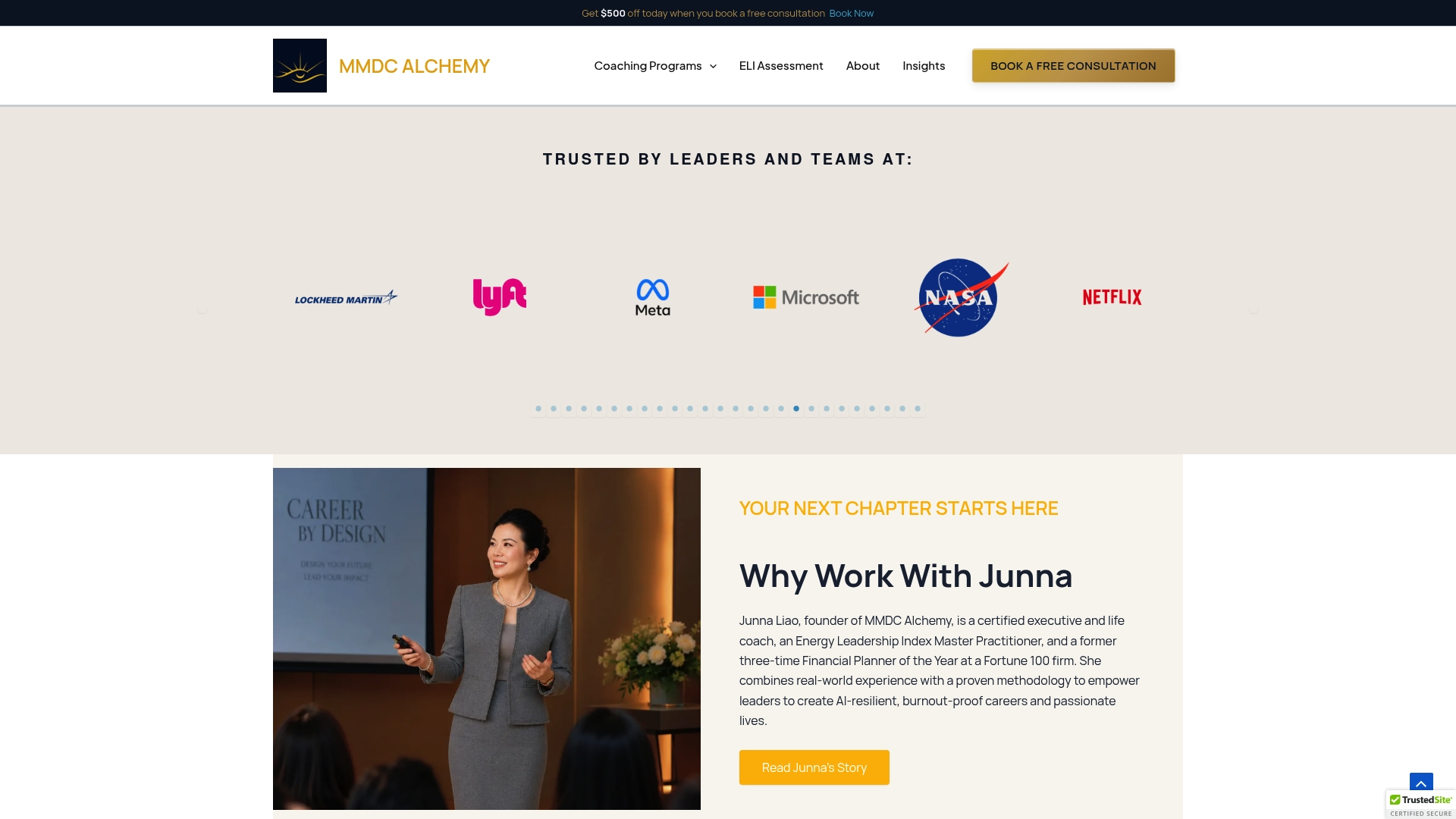
A discovery call is a short, no-pressure conversation where we talk through what is pulling at you and whether our approach fits what you need. Come with a rough sense of what is not working in your current role and what you want more of. You can book a call directly to find a time that works.
FAQ
Is it a good idea to change careers at 58?
Age alone is not the deciding factor. Labor-force data shows older Americans working well past traditional retirement age, and an experienced midlife professional often has more transferable skills and professional credibility than a younger candidate, which can shorten the path to a new role.
How much should I pay for a career coach?
Pricing varies widely by coach experience, program length, and whether sessions are individual or packaged. We do not publish fixed rates for our coaching programs, so the best approach is to ask directly during a discovery call what a specific engagement would cost for your situation.
What is the best career to start over at 50?
There is no single best career at 50; the right path depends on your existing skills, financial runway, and what you actually want from your work. A values assessment and skills inventory, the kind used in midlife coaching, typically narrows the options to a short, realistic list rather than a generic answer.
What are the best career changes for midlife?
Common midlife moves include shifting into consulting using existing expertise, moving into a less demanding role in the same field, or building a portfolio career that blends part-time work with a passion project. SUCCESS magazine’s step-by-step framework notes that phased transitions, like side consulting before a full leap, tend to reduce financial risk during the shift.
Sources
- Nearly one in five older Americans in the labor force in 2025 : The Economics Daily : U.S. Bureau of Labor Statistics
- The Midlife Pivot—When Success Stops Feeling Like You’re Winning | Forbes
- Amid Post-Pandemic Burnout, Organizations Increasing Their Investments in Coaching – ICF
- How to Change Careers at 30, 40 or 50: A Step-by-Step Guide | SUCCESS
Recommended
This blog is for educational and inspirational purposes only. It is not medical, legal, financial, or mental health advice. Your journey is unique; please seek qualified professional support for decisions that affect your health, finances, or wellbeing.