
Delegation for leaders comes down to one move: you hand over the outcome, not just the task, and you stay involved through clear expectations and regular check-ins. Most leaders already know this. What stops them is rarely a missing template. It is the discomfort of watching someone else do work you could do faster, and the quiet belief that your value lives in the doing. This guide covers the frameworks that work, the traps that undo them, and the personal shift underneath.
TL;DR
- Delegate outcomes, constraints and a deadline. Do not dictate every step, because over-specifying turns ownership into compliance.
- Use the 70% rule as a starting benchmark: if someone can do the task at about 70% of your quality, hand it over and treat the gap as development.
- Delegation is not abdication. Hand-offs need feedback loops and accountability, or they fail.
- For many senior leaders the real obstacle is identity, not skill. Letting go of tasks means redefining what you are for.
- Done well, delegation protects your energy, builds your team’s capability and signals trust.
Table of Contents
- Why delegation matters more as you rise
- What delegation actually is (and what it is not)
- The five levels of delegation
- Deciding what to hand over: the 70% rule
- How to delegate in six steps
- Why smart leaders still hold on
- Delegation as a signal of trust
- Communicating change when you hand work over
- Making it stick: time and attention systems
- Common mistakes to avoid
- A 30-day plan to begin
- Our perspective: delegation is a leadership transition
- Working with a coach on delegation and letting go
- FAQ
- Sources
Why delegation matters more as you rise
Every promotion changes the math. Early in a career, personal output is what gets you noticed. At the senior level, your output is what your team produces, and your own hours are the scarcest resource in the building. If every decision routes through you, you become the bottleneck, and the team’s pace caps at yours.
The expectation is explicit in many organizations. SHRM research reported that 91% of U.S.-based HR executives surveyed listed delegation as an expected behavior of leaders. The same piece links delegation to leader burnout: high burnout tends to go with a loss of job control, and delegating is one way leaders regain it.
That last point matters if you are tired. Overloaded leaders often treat delegation as a luxury for when things calm down. Things do not calm down. Delegation is one of the few levers that reduces load without lowering standards, and it is a core part of recovering from executive exhaustion. If you recognize that pattern, our guide to executive burnout recovery in three phases covers the wider picture.
What delegation actually is (and what it is not)
Delegation means transferring responsibility for an outcome to another person, along with enough authority to achieve it. You remain accountable for the result. They own the how.
The common failure is confusing it with abdication. Writing in Inc., Dave Kerpen describes real delegation as an ongoing process rather than handing something off and walking away. The difference shows up in practice:
| Abdication | Delegation | |
|---|---|---|
| Outcome | Vague or assumed | Defined in plain words |
| Authority | Unclear, so people hesitate | Stated: what they can decide alone |
| Check-ins | None until something breaks | Scheduled, light, predictable |
| When it goes wrong | Blame | A conversation about what to adjust |
| Effect on the team | Anxiety | Ownership |
Handoffs of any kind depend on clear owners and a review rhythm. A practical look at routing rules with a regular audit makes the same point for sales operations: rules set once and never revisited drift, and the fix is a standing cadence of review. Your delegations behave the same way.
The five levels of delegation
A useful way to see your own habits is the framework in INSEAD Knowledge’s article on the art of delegation. It describes five progressive levels:
- Task-based: you hand over a single, defined task.
- Project-based: you hand over a bundle of tasks with a clear end.
- Process-based: someone owns a recurring process.
- Goal-based: you hand over an outcome and the team works out which tasks are needed.
- Clairvoyant: the team anticipates what needs doing before you ask.
The guidance is not to skip levels. Trust and skill build step by step. According to the same source, goal-based delegation is where the largest productivity gains and skill development tend to appear.
Most leaders who feel stuck are living at level one. They delegate tasks, then review each one closely, which costs nearly as much time as doing the work. Moving to level three or four is what actually returns hours to your week.
A quick self-check
Look at the last five things you delegated. Did you hand over a task, a project, a process or a goal? Did you also specify the method? If the honest answer is mostly tasks with methods attached, you have found your first lever.
Deciding what to hand over: the 70% rule
The most quoted benchmark is the 70% rule. As one founder-focused guide to delegation frameworks puts it, if a team member can do a task at 70% of your quality, delegate it. For tasks in the 50 to 69% range, invest in a 30-day training plan first. Below 50%, keep the task or restructure it until the team’s capacity grows.
Treat those numbers as a heuristic, not a law. Their value is the reframe. As a CEO-focused guide notes, the remaining 30% gap is a development opportunity for the person, not a failure of your standards. Your 100% version of a task is often a standard nobody asked for.
The rule has limits. Some work should stay with you whatever the percentage:
- Decisions only you can make because of your role or legal accountability
- Sensitive conversations about performance, pay or someone’s job
- Setting direction, values and the few priorities that define the year
A simple sort helps. List what you did last week and mark each item: only I can do this, someone could do this with training, someone could do this now. Delegate the last group this month and build training plans for the middle group.
How to delegate in six steps
This process is built to avoid the most common trap. Kerpen’s piece names over-specifying the process rather than defining the outcome as that trap, and the cure is to give three things: the desired outcome, the constraints and the deadline.
- Choose the person for the work, not the convenience. Match the task to someone’s strengths and to a skill you want them to grow. Handing everything to your most reliable person creates a new bottleneck.
- State the outcome. Describe what done looks like in a sentence or two. Include why it matters, because context lets people make good calls you did not anticipate.
- Name the constraints. Budget, tools, stakeholders to avoid surprising, and anything that is non-negotiable.
- Set the authority level. Be explicit about how much they can decide. For example: research and recommend, then wait for approval; or decide, act and tell me afterward. Different tasks warrant different levels, and naming the level removes guesswork.
- Set the deadline and the check-ins. Agree on when you will touch base, and make it a rhythm, not a surprise audit.
- Close the loop. When the work lands, talk about what worked and what you would change. Credit the person publicly. The debrief is where the capability gets built.
A worked example
Say you lead a regional operations team and you personally build the monthly performance report. It takes you six hours.
Task-level delegation would be: here is the template, fill it in by Friday. You would then spend two hours correcting it.
Goal-level delegation sounds different: leadership needs to know by the fifth of each month where we are against plan and what we should do about it. You decide the format. Come to me with the first draft outline next Tuesday, and I will give feedback once. After that, it is yours.
The second version transfers judgment. The first transfers typing.
Why smart leaders still hold on
If delegation were only a process, a checklist would have solved it years ago. The harder part is internal.
A study of founders, published through Stanford’s undergraduate journal, frames delegation as a shift in identity. Founders often hold on to tasks as a way of keeping control and a sense of self. The most effective ones consciously uncouple from day-to-day operations and move toward strategy and empowering their teams. The study looks at start-up founders, but the pattern will be familiar to any leader who built their reputation by being the best at the work.
Three stories tend to keep leaders stuck:
- Perfectionism dressed up as quality control. You tell yourself that no one else will get it right. Sometimes true, but often a way to avoid the discomfort of letting go.
- Being needed feels like being valuable. If your team can run without you, who are you? That question is real, and avoiding it costs you.
- Fear of the first failure. Early results will be weaker than yours. Expecting that, and planning for it, is part of the cost of scaling.
If you recognize yourself here, you are not undisciplined. You are in a transition. Leaders going through a role or identity change often find that an identity-first approach to career transformation works better than another productivity system, because the system was never the problem.
Delegation as a signal of trust
How you delegate tells your team what you think of them. Research summarized in a 2026 Baltic Journal of Economic Studies article examines how delegation, trust and psychological safety interact. It notes that in many Western settings delegation appears to build psychological safety. The study itself surveyed 157 employees in Albania, where the relationship was less clear-cut, so treat it as a reminder that culture and context shape how delegation lands, not as a universal rule.
The practical takeaway is modest and useful: people read your delegation behavior as a message. Constant re-checking says you doubt them. A clear outcome, real authority and a light check-in says you expect them to deliver. Talented people who are never trusted with real ownership tend to leave or stop growing.
Communicating change when you hand work over
A delegation that touches roles or responsibilities is also a change message, and people hear change through their own worries. When you shift work, say four things plainly:
- What is changing: who now owns what, and from which date.
- Why: the reason in terms of the team and the work, not your workload alone.
- What is not changing: the standards, the goals and anyone’s job security, if that is true.
- How support works: where people go with questions, and when you will check in.
Tell the people affected first, and in person or live where you can. Then invite questions and answer the ones you can. If you do not know yet, say so and say when you will. Leaders who struggle to say these things plainly often benefit from clear communication coaching, because the hard part is usually the conversation, not the plan.
Making it stick: time and attention systems
Readers often ask whether delegation fits with systems like Getting Things Done or time blocking, and how those compare with the Pomodoro technique. They solve different problems. Getting Things Done is a capture-and-sort system: it helps you see everything you have committed to, which makes it easy to spot what you should not be holding. Time blocking assigns calendar space to the work that matters. The Pomodoro technique uses short, timed bursts for focus on a single task.
None of them reduces the amount of work you personally carry. Delegation does. A sensible order is to sort your list, hand off what others can own, then block time for the work that is left. Pomodoro is useful inside a block when you need to concentrate. Use the tools after you have decided what belongs on your plate, not instead of deciding.
If the volume of open loops in your head is the issue, a structured approach to cutting executive mental load addresses what a calendar cannot.
Common mistakes to avoid
- Delegating only the work you dislike. People notice. Share some work that is interesting and visible, too.
- Reclaiming the task at the first wobble. If you step back in, you teach the team that ownership is temporary.
- Delegating without authority. Responsibility with no power to decide creates frustration and delay.
- Skipping the debrief. Without it, the same corrections come back next time.
- Giving feedback only on problems. Note what went well. It tells people what to repeat.
- Starting too big. Begin with a low-risk task, then widen scope as trust builds.
A 30-day plan to begin
Week 1: Track your time and list every recurring task. Mark each as only I can, with training, or now.
Week 2: Pick two tasks from the now group. Delegate each with an outcome, constraints, authority level and deadline. Schedule short check-ins.
Week 3: Choose one task from the with-training group and write a 30-day development plan with the person. Notice each urge to step in, and write down what triggered it.
Week 4: Hold a debrief on the first two hand-offs. Adjust the process, then delegate one process or goal, not just a task.
At the end of the month, ask two questions. What did I get back in hours? What did I learn about why I held on?
Our perspective: delegation is a leadership transition
In our coaching work with executives and senior professionals, delegation rarely shows up as the stated problem. People arrive talking about burnout, a stalled career or a sense that the job no longer fits. When we look closer, they are carrying work that belongs to someone else, and part of them does not want to put it down.
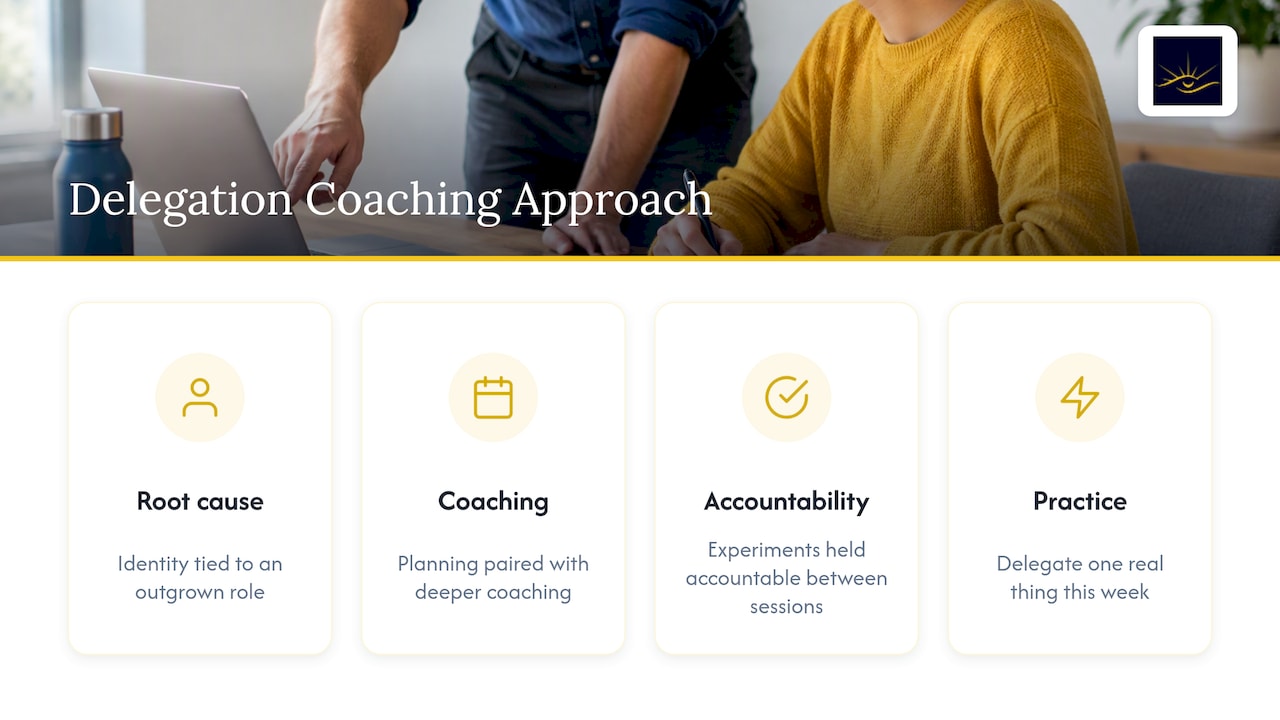
We do not treat that as a time-management flaw. We treat it as a signal that the person’s identity is tied to a role they have outgrown. Practical systems help, but they hold only when the person has also looked at what they gain from being indispensable, and what it costs them. That is why we pair practical planning with deeper coaching and with work between sessions, including accountability for the experiments that come out of the conversation. Delegating one real thing this week and noticing what comes up teaches more than reading about it.
We have worked with more than 600 leaders through transitions like this. The ones who succeed do not become less committed. They become clearer about where their effort has the most effect.
— Junna Liao
Working with a coach on delegation and letting go
If you see yourself in the identity patterns above, one-on-one work can move faster than going it alone. Our 1:1 career coaching with Junna combines practical career and life planning with conscious growth, and we use the Energy Leadership™ Index assessment to help you see how you tend to respond under pressure. You can also book a call to talk about where you are.
FAQ
What is the 70% rule of delegation?
It is a benchmark: if someone can do a task at roughly 70% of the quality you would, delegate it. The remaining gap becomes a development opportunity rather than a flaw. For tasks that fall between 50 and 69%, one delegation guide suggests a 30-day training plan before handing them off.
What is the difference between delegation and abdication?
Delegation transfers ownership of an outcome while you stay accountable, with clear expectations, check-ins and feedback. Abdication is handing something off and walking away. The first builds capability and trust. The second leaves people guessing and usually ends with the task back on your desk.
Which tasks should a leader never delegate?
Keep decisions tied to your accountability, sensitive people conversations such as performance or pay, and the setting of direction and values. Almost everything else can be handed over, sometimes after training. If you are unsure, ask whether the task needs your authority or only your skill.
Why do leaders find delegation so hard?
Some of it is practical: unclear expectations and weak handoffs. A lot of it is personal. Perfectionism, the comfort of being needed and fear of early mistakes all play a part, and research on founders describes delegation as a shift in identity. Naming which story you are telling yourself is the first step to changing it.
Sources
- 6 Ways to Improve Your Delegation Skills as a Leader (SHRM)
- The Art of Delegation (INSEAD Knowledge)
- The 5 Cs of Delegation: How to Stop Being a Bottleneck (Inc.)
- 3 Delegation Frameworks for Operator-Founders
- How to Delegate Tasks Effectively as a CEO
- Evolution of the Founder: Shifts in Delegation (Stanford Intersect)
- Delegation, Trust, and Psychological Safety in Albanian Leadership (Baltic Journal of Economic Studies)
Recommended
- Cut Executive Mental Load in 90 Days with a Five Step CLEAR Plan
- Overcoming Leadership Plateaus: An Alchemical Guide to Sustainable Mastery
- Leadership Boundaries: How to Set Them and Make Them Hold
- Mindful Leadership Coaching: Mastering the Alchemy of Presence and Energy
This blog is for educational and inspirational purposes only. It is not medical, legal, financial, or mental health advice. Your journey is unique; please seek qualified professional support for decisions that affect your health, finances, or wellbeing.