Productivity addiction is the compulsive need to stay productive, so that rest feels like failure and nothing you finish ever feels like enough. It isn’t a formal diagnosis. It is a pattern many driven professionals recognize, and it can lead to burnout, poor sleep and strained relationships if it goes unchecked. This guide explains what the pattern is, how to tell it from healthy ambition, why it takes hold, and what you can do about it.
TL;DR
- Productivity addiction is not a recognized clinical disorder, but toxic productivity is a documented pattern: an obsessive pressure to do more, with guilt whenever you do less.
- The key difference from ambition is compulsion. If you can’t stop, even when stopping would serve you, the work is driving you.
- The costs are real: burnout, insomnia, anxiety and damaged relationships are all linked to this pattern.
- Small, deliberate steps help: scheduled downtime, journaling, breathing practices, and a hard look at what the busyness protects you from.
- If work-related distress feels unmanageable, talk to a licensed mental health professional. In the US you can call or text 988 at any hour.
Table of Contents
- What productivity addiction actually means
- Signs you may be addicted to productivity
- Ambition, engagement or addiction: how to tell the difference
- Why smart, capable people get hooked
- What it costs you
- Our perspective
- How to loosen the grip: practical steps
- When to get professional help
- Where coaching fits
- FAQ
- Sources
What productivity addiction actually means
People use the phrase loosely, so it helps to be precise. Nobody is addicted to spreadsheets the way someone can be dependent on a substance. What people describe is a habit loop: you finish tasks, you feel a hit of relief or worth, and you need to do it again, with a bigger list, sooner.
Harvard Health describes toxic productivity as an obsessive preoccupation with being productive at all costs, along with a false sense of urgency and guilt about not accomplishing enough. It also notes that this is not a diagnosable health condition.
The closest research concept is workaholism. Work addiction is not a formal disorder in the DSM-5-TR or ICD-11, so a doctor can’t formally diagnose it. That doesn’t make it imaginary. Researchers have studied it for decades, and the lack of a label mostly means you have to notice it yourself, or have someone who knows you point it out.
Productivity addiction vs. work addiction
The two overlap, but they aren’t identical. Work addiction is about hours and the job. Productivity addiction can show up anywhere: in your weekend chore list, your fitness tracking, your side projects, even your meditation streak. Plenty of people who leave the office at 5:30 still can’t sit through a Sunday afternoon without a plan. For executives and senior professionals, though, the two usually travel together, because the job supplies an endless list of things to do.
Signs you may be addicted to productivity
Busy is not the same as compulsive. A heavy quarter, a product launch or a promotion push can demand long hours without anything being wrong. What matters is the internal experience, and whether the pattern persists when the demand disappears.
A review of the workaholism literature describes features including hurrying and racing against the clock, a strong need for control, guilt and anxiety when not working, and using work to escape difficult feelings. Translated into daily life, here is what that tends to look like:
- You feel guilty when you rest. A free evening produces restlessness, not relief.
- You work on trivial things to feel done. You clear low-value emails first because ticking boxes feels better than starting the hard, important project.
- Your life has narrowed. One researcher quoted by the BBC describes productivity junkies as unidimensional, meaning the compulsion to work overrides other sources of pleasure, such as friends and social connection.
- Rest no longer restores you. Clinical psychologist Natalie Dattilo of Harvard Medical School notes that toxic productivity can sneak up on people, until a point where downtime stops feeling restorative.
- You need more to feel satisfied. The same output that once felt like a win now feels like the minimum.
- You track everything. Hours, steps, tasks, streaks. Your self-worth rises and falls with the numbers.
A quick self-check
Ask yourself these questions and answer honestly rather than quickly:
- If every task were done by tomorrow, what would I feel? Relief, or emptiness and dread?
- When did I last spend an hour doing something with no output, and enjoy it?
- Do I fill gaps in my day (waiting rooms, elevators, dinners) with work by reflex?
- Would the people closest to me say I’m present when I’m with them?
- Am I busy because the work needs it, or because stopping is uncomfortable?
Three or more uncomfortable answers is a signal to look closer. It is not a diagnosis, and it isn’t a reason to panic.
Ambition, engagement or addiction: how to tell the difference
High performers often resist this topic because they fear that questioning the drive means losing it. It doesn’t. The research draws a clear line between loving your work and being compelled by it.
An academic review from 2024 stresses that workaholism must be distinguished from work engagement: workaholics are driven by internal compulsion rather than genuine volition. An engaged person works hard because they want to, and can stop. A compulsive person works hard because they feel they must, and stopping brings distress.
| Healthy drive | Productivity addiction | |
|---|---|---|
| Why you work | Interest, purpose, a goal you chose | An internal “ought”, fear of falling behind |
| When the work is done | Satisfaction, then real rest | Brief relief, then a new list |
| Free time | Enjoyable, even if you think about work | Anxious, guilty or wasted |
| Relationships | Protected, even in busy seasons | Consistently the first thing sacrificed |
| Output | Aimed at things that matter | Aimed at things that can be checked off |
| Flexibility | You can drop a task when it’s the right call | Dropping anything feels intolerable |
Real progress vs. productive avoidance
There is a subtler trap. Busyness can be a way of avoiding a decision: the career change you haven’t faced, the conversation you keep postponing, the question of whether this role still fits. The BBC piece quotes a consultant who says effort should align with the overarching business strategy rather than create work for work’s sake.
A useful test: at the end of the week, name the one or two outcomes that moved something you actually care about. If your week was full but you can’t name them, you may have been feeding the habit instead of the goal.
Why smart, capable people get hooked
There’s rarely one cause. Several forces tend to stack up.
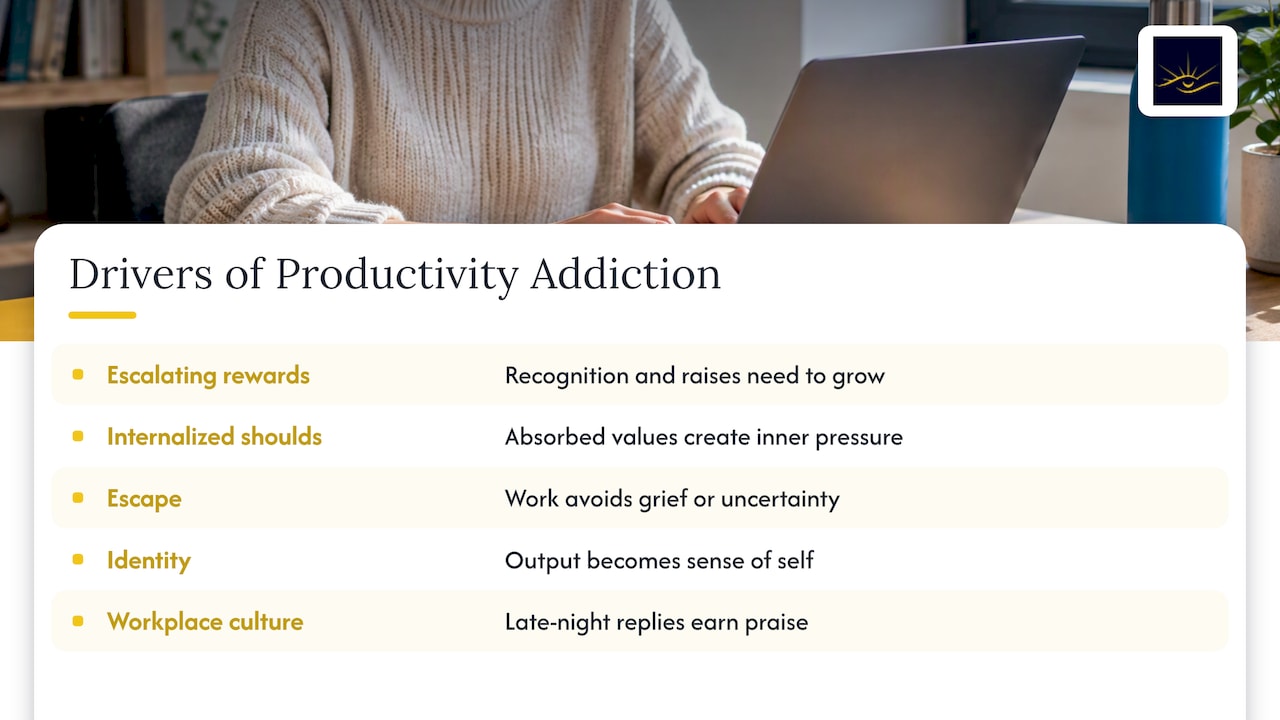
Rewards that keep escalating. The BBC reports that people may fixate on productivity because they crave the recognition or salary increases work can bring, and over time may need more to feel satisfied. Dr. Sandra Chapman of the Center for BrainHealth at the University of Texas at Dallas explains in the same piece that the brain can become addicted to the rewards of productivity, much as it responds to other compulsions.
Internalized “shoulds.” Psychologist Malissa Clark describes workaholism as often driven by introjected motivation: a “pit in the stomach” feeling that you ought to be working, rooted in values absorbed from society. Nobody is standing over you. The pressure lives inside.
Escape. The workaholism review linked above notes that work can be used to escape difficult feelings. For many leaders, a full calendar is a very respectable way to avoid grief, uncertainty or a sense that something is missing.
Identity. When your title and output are who you are, slowing down feels like disappearing. This is especially sharp for executives approaching a transition, a layoff, a promotion or a stage of life where the old measures of success stop satisfying.
Culture. Many workplaces praise the person who answers at 11 p.m. Self-imposed pressure and organizational pressure feed each other.
What it costs you
The price shows up in several places at once.
- Health. Harvard Health says toxic productivity can take a toll on well-being, contribute to burnout, and lead to insomnia, anxiety and depression. The CDC notes that work-related stress is linked to potential negative effects on family well-being and the worker’s own physical and psychological health.
- Burnout. The World Health Organization called burnout, marked by exhaustion and cynicism about one’s job, an occupational phenomenon in 2019, and Harvard Health says toxic productivity can contribute to it. If you’re already exhausted and detached, our guide on burnout vs. depression can help you sort out what you’re facing, and the piece on spotting chronic stress at work covers earlier warning signs.
- Performance. More hours don’t buy more results. The VA’s Whole Health Library cites a study in which executives working about 52 hours a week were more effective than those working over 70. Efficiency isn’t tied to unlimited hours.
- Relationships. When work overrides every other source of pleasure, the people around you get what’s left.
Our perspective
We work with executives and high achievers, and a large share of the people who come to us don’t describe themselves as addicted to anything. They say they’re tired, or that the wins feel flat, or that they can’t remember what they enjoy. When we look closer, the engine is often the same: an identity built on output, and a long habit of using achievement to avoid asking what actually matters.
That’s why we don’t treat this as a time-management problem. Better systems rarely fix it, and they can make it worse, because a more efficient person with the same compulsion simply does more. The work is to understand what the doing is protecting you from, and to build a life and a career that can hold rest without the floor dropping out.
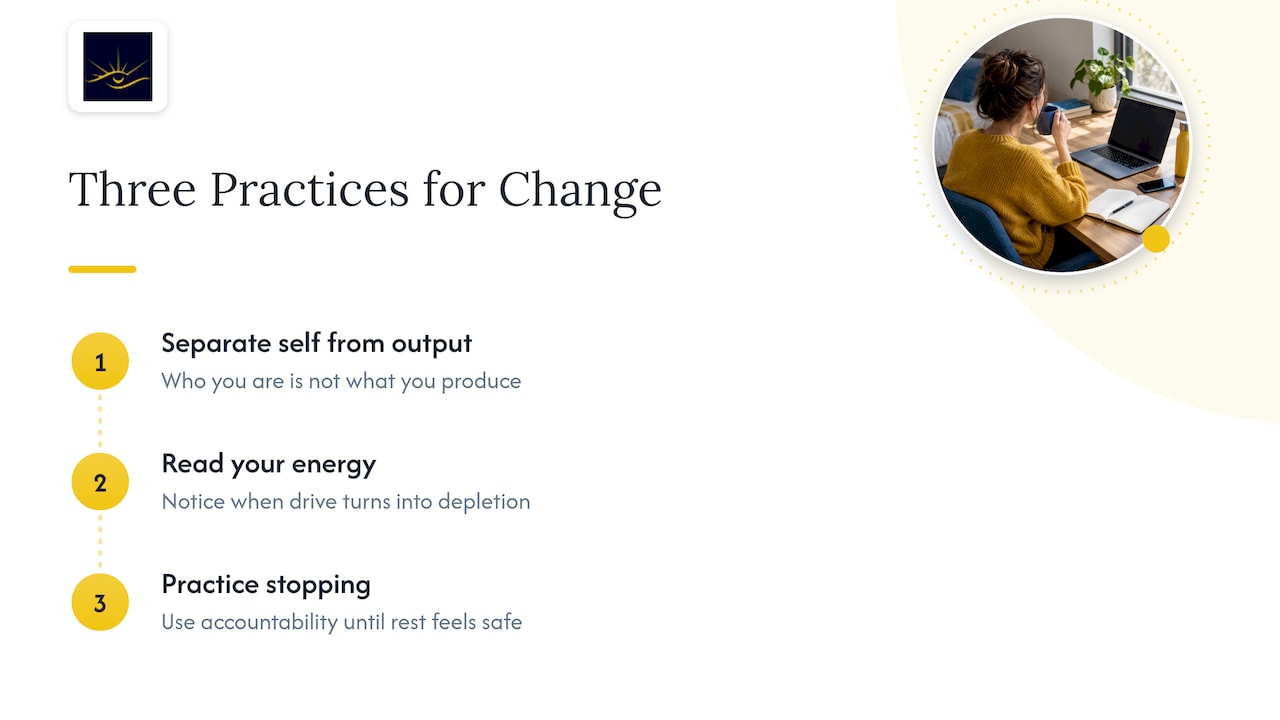
In our experience, three things matter most. First, separating who you are from what you produce. Second, learning to read your own energy, the point at which drive turns into depletion. Third, practicing the uncomfortable skill of stopping, with accountability, until it stops feeling like a threat. None of this asks you to lower your standards. Most of our clients end up more effective, because they’re choosing their work instead of being chased by it.
— Junna Liao
How to loosen the grip: practical steps
Start small. Your nervous system has learned that busyness is safety, so abrupt change tends to backfire.
1. Calm your body first
Harvard Health recommends deep breathing, journaling and intentionally practicing downtime. The word “practicing” matters. Downtime is a skill, and it feels awkward at first. If you want quick, structured options, see these 60-second resets for executives.
2. Schedule rest like a meeting
Put a non-negotiable block on the calendar with no output attached: a walk without a podcast, a meal without a screen, an evening with no laptop. Begin with 20 minutes and extend it. Expect discomfort. That discomfort is information about how much the habit is doing for you.
3. Define “enough” before you start
At the start of each day, write the two or three things that would make it a good day. When they’re done, you’re done, or at least anything further is a conscious choice. People who feel they never do enough need a finish line they set in advance, because the feeling alone will never supply one.
4. Do the important thing first
If you notice yourself clearing easy tasks to feel productive, reverse the order. Spend your first focused block on the one task you’d most like to avoid. Our article on protecting 60 to 90 minutes to reduce cognitive load and the one on context switching fatigue give concrete ways to protect that block.
5. Say no, and watch what happens
Compulsive productivity often hides in overcommitment. Decline one request this week and observe the consequences, which are usually smaller than you feared. See overcommitment at work for team-level fixes.
6. Get curious about the trigger
Notice when the urge to do more spikes. After criticism? After a quiet weekend? Before a hard conversation? Our guide to emotional triggers at work shows how to trace those moments back to what’s underneath.
7. Rebuild the rest of your life
If work has crowded out everything else, put one non-work thing back: a friend, a sport, a creative habit. Choose something you do for no result at all.
What employers can do
Individual habits only go so far in an environment that rewards overwork. The CDC says changing workplace policies and practices is the best way to address burnout, including policies that increase workers’ flexibility and control. It also says burnout can develop when workers face too many demands and too few resources. If you manage others, the way you model your own hours matters.
When to get professional help
Self-help has limits, especially when the pattern is tied to anxiety, depression, trauma or a physical health problem. See a licensed therapist, psychologist or your physician if you experience persistent insomnia, panic or constant dread, if you use work to numb painful feelings you can’t face alone, or if your health or relationships are visibly deteriorating.
The VA’s Whole Health Library says interventions for workaholism may include cognitive behavioral therapy, motivational interviewing, and in some cases support groups like Workaholics Anonymous. A clinician can help you decide which fits.
If you or someone you know is struggling or in crisis, the CDC points readers to the 988 line: in the United States, call or text 988 for confidential, free support, 24 hours a day, every day of the year.
Coaching is not therapy and doesn’t replace it. It fits when you’re functioning, you’re ready to change how you work and live, and you want a structured, honest partner to do it with.
Where coaching fits
When the pattern is tangled up with your identity, a career you’ve outgrown or a leadership role that has swallowed everything else, reading about it rarely shifts it. That is the kind of work we do. Our 1:1 career coaching is built for executives and senior professionals who are burned out, in transition or questioning what success should look like, and it includes real work and accountability between sessions. If you want to start with data about how you operate under pressure, the Energy Leadership Index assessment gives you a concrete picture of where your energy goes. For people whose challenge reaches beyond the job, we also offer life coaching.
If burnout is already here, our executive burnout recovery approach and the guide on returning to work after burnout without relapsing lay out what recovery tends to involve. More reading is on our insights page.
FAQ
Is productivity addiction a real diagnosis?
No. Harvard Health says toxic productivity isn’t a diagnosable health condition, and Medical News Today reports that work addiction isn’t a formal disorder in the DSM-5-TR or ICD-11. The pattern is still real and well described, and it can cause genuine harm even without an official label.
What’s the difference between being productive and being addicted to productivity?
Choice and flexibility. Productive people work hard for reasons they endorse and can stop when it makes sense. Someone addicted to productivity feels driven by an internal compulsion, feels guilty or anxious when resting, and finds that other sources of pleasure fade.
Why do I feel guilty when I relax?
Often the guilt comes from internalized beliefs that you ought to be working, which one psychologist describes as a pit-in-the-stomach feeling rooted in societal values. Over time your sense of worth can attach to output, so rest feels like a threat to it. Practicing short, deliberate periods of downtime helps loosen that link, and a therapist or coach can help if it persists.
Can productivity addiction cause burnout?
Yes, it can contribute to it. Harvard Health lists burnout among the possible effects of toxic productivity, along with insomnia, anxiety and depression. If you’re exhausted, cynical about your work and unable to recover with ordinary rest, it’s worth speaking to a health professional.
How do I stop being addicted to productivity?
Start with small changes: schedule rest, define what counts as enough each day, do the important task first, and say no to one extra commitment. Look at what the busyness protects you from. If the pattern is tied to anxiety, depression or burnout, work with a licensed professional, and consider coaching for the career and identity questions underneath.
Sources
- Beyond the grind: Toxic productivity and how it sabotages your well-being, Harvard Health
- Workaholic: Symptoms, diagnosis, and when to get help, Medical News Today
- Workaholism: A Review, PMC
- When productivity becomes an addiction, BBC Worklife
- Are you a workaholic or just a hard worker?, American Psychological Association
- Beyond the 9-to-5 grind: workaholism and its potential, PMC
- Providing Support for Worker Mental Health, CDC
- Workaholism, VA Whole Health Library
Recommended
- Overcommitment at Work: Team Fixes and Coaching for High Achievers
- Cut Executive Mental Load in 90 Days with a Five Step CLEAR Plan
- Still Performing While Numb? High Achiever Burnout Needs Identity Work
- How to Return to Work After Burnout Without Relapsing
This blog is for educational and inspirational purposes only. It is not medical, legal, financial, or mental health advice. Your journey is unique; please seek qualified professional support for decisions that affect your health, finances, or wellbeing.