
To rewrite your career narrative, stop listing what you did and decide what your career has been about. Name the thread running through your roles. Explain why the next move follows from it. Then put that one story into your résumé, your LinkedIn summary and what you say out loud in interviews. This guide walks through that process, with before-and-after examples and the traps that catch experienced leaders.
TL;DR
- A career narrative is a short, true explanation of the decisions you made, why you made them and what you want next. It is not a job history.
- Find the through line first. Wording comes second, and the résumé comes last.
- Lead with the role you want to be read for. Recruiters scan the top of the page fast, so the story has to live there.
- If your last chapter ended without your consent (a layoff, burnout, a forced exit), process that before you write. A story written from the wound reads as defensive.
- Test the new story out loud with three people before you publish it anywhere.
Table of Contents
- What a career narrative is, and what it isn’t
- Why the old story stops working
- Step 1: Deal with the last chapter before you write
- Step 2: Mine the evidence, not the adjectives
- Step 3: Find the through line
- Step 4: Write the three-sentence core
- Step 5: Put it where it will be read
- Step 6: Handle the hard parts honestly
- Step 7: Test it before you publish it
- Our perspective
- When to get help with the rewrite
- A one-page worksheet to start today
- FAQ
- Sources
What a career narrative is, and what it isn’t
Yale’s career development guide describes your story as how you communicate past experiences, goals and aspirations in a cohesive narrative that explains the decisions you’ve made, why you made them and what you aim for next. That definition is a useful test. A list of titles and dates explains nothing. A narrative answers three questions a stranger is silently asking:
- Why did you choose these roles?
- What do you do better than most people?
- Why is the thing you’re asking for now the logical next step?
A narrative isn’t spin. It isn’t a claim that every move was planned. It is the most accurate account of your career that is also useful to the person listening. Most people who need a rewrite don’t have a bad history. They have a history told in the order it happened, which is rarely the order that makes sense.
Why the old story stops working
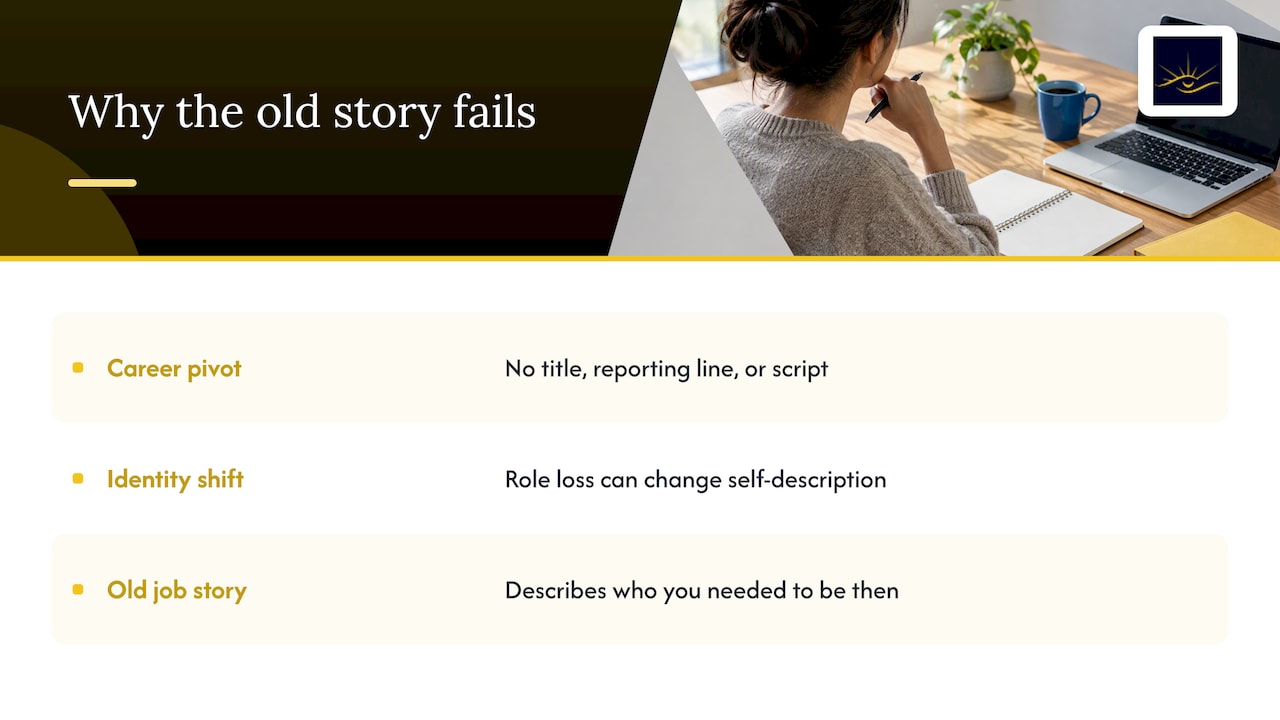
Most leaders reach for a rewrite at one of a few moments: a layoff, a burnout that forced a pause, a promotion that changed what the job actually is, or a quiet realization that the field no longer fits. The old story fails in each case for a different reason.
It was built for a ladder. Researchers at London Business School describe career transitions as often under-institutionalized: they lack the formal structures, norms, timetables and support mechanisms that guide conventional role changes. A promotion comes with a title, a reporting line and a script. A pivot comes with none of them. You have to supply the explanation yourself, and nobody will do it for you.
It is tied to an identity you’ve outgrown. A study of executive derailment, published in a British Psychological Society journal, defines it as unexpected and unwanted changes in an executive career trajectory that can lead to a loss of identity. That small study followed four high-functioning professionals, so it can’t tell you how common this is. It does name something many senior people feel and rarely say: when the role goes, the self-description goes with it.
It answers a question nobody is asking anymore. The story that won your last job described the person you needed to be then. The reader now wants evidence for a different claim.
Step 1: Deal with the last chapter before you write
If your most recent change was not your choice, do this first. A narrative drafted while you’re angry, ashamed or exhausted tends to either over-explain or hide the gap. Both read as unresolved.
A descriptive study of nine executives who were suddenly and involuntarily displaced from roles they considered peak experiences reported that the most forceful findings concerned emotional growth, newfound vulnerability and the need to balance personal and professional concerns. It was a small sample of middle-aged men, so treat it as a window and not a rule. Still, the direction is worth noting: the people in it didn’t recover by polishing their wording. They recovered by working through what had happened.
A practical way to do that is to review the exit the way a good team reviews a failed project: what was in your control, what wasn’t, what you’d do differently, and what you’d repeat. A structured approach such as a blameless postmortem for career decisions separates the facts of the decision from the hindsight judgment you’ve been layering on it since. The point is to leave with a short, calm account you can say in two sentences without your voice changing.
If the exit left you with symptoms that go beyond stress, such as persistent low mood, sleeplessness or loss of interest in everything, talk to your doctor or a licensed therapist. Coaching is not a substitute for that, and a narrative can wait.
Step 2: Mine the evidence, not the adjectives
Set a timer for 45 minutes and build a raw inventory. Don’t write sentences yet. For each role in the last 10 to 15 years, list:
- Three situations where you were brought in to fix, build or stabilize something
- What you actually did, in verbs, not what your title said
- The result, with a number where one exists (revenue, headcount, cycle time, retention, cost)
- Who you did it with, and who you did it for
- What energized you, and what drained you
That last pair matters more than most people expect. Your narrative has to point somewhere you’d actually want to go. If every proud result involved turning around struggling teams, and every draining one involved maintaining stable ones, that’s a signal about your through line. It’s also a signal about what to leave out.
Step 3: Find the through line
Now read the inventory like a stranger. Look for repetition. Common through lines among senior people sound like this:
- “I’m the person who gets a new function from zero to repeatable.”
- “I translate between engineers and the people who pay for them.”
- “I turn around teams that have lost trust.”
- “I build the systems that let a founder step back.”
A good through line is specific enough to exclude things. “I’m a strategic leader who drives results” excludes nobody and persuades nobody. If you can’t find one, you probably have two or three threads. Pick the one that points to the work you want next, and treat the others as supporting evidence.
This is also where identity enters. The question isn’t only “what have I done” but “who am I when I’m doing it well.” Our identity-first approach to career transformation is built around that order for a reason: the vocabulary of a new career is easy to borrow, but a story that isn’t yours collapses in the second interview.
Step 4: Write the three-sentence core
Every strong career narrative compresses into three sentences. Use this skeleton and rewrite it until it sounds like you talking:
- Where you’ve been (the thread): the consistent thing you’ve done across roles.
- The turn (the why): what you learned, noticed or decided that made the next step necessary.
- Where you’re going (the claim): the specific role or problem you want, and why you’re credible for it.
Before and after: an operations leader moving into a chief of staff role
Before: “I spent 14 years in operations at three manufacturing companies, most recently as VP of Operations until my position was eliminated in a restructuring. I’m now looking for new opportunities where I can leverage my leadership skills.”
After: “For 14 years I’ve been brought in to make complicated organizations run predictably, most recently cutting a plant network’s order backlog by half. Each time, the part I valued most was working directly with the CEO on what to fix first, which is why I want to work as a chief of staff or in a COO-track role at a growth-stage company. The restructuring that ended my last role gave me room to make that move on purpose.”
The example figure is illustrative, not drawn from a real client. Notice what changed. The thread is stated. The layoff is one clause and carries no apology. The ask is concrete.
Before and after: a burned-out executive changing the shape of the job
Before: “I’m a senior marketing executive who has hit a wall and is exploring what’s next.”
After: “I’ve led brand and growth teams for 12 years, and what I do best is helping a team decide what not to do. After a stretch of running at full tilt, I’m deliberately moving toward roles with fewer direct reports and more advisory scope, where that skill is the job.”
Neither version hides the truth. The second simply puts a decision where the first puts a symptom.
Step 5: Put it where it will be read
A narrative that lives only in your head does nothing. It needs to appear in four places, in four different lengths.
The résumé
The skimming is brutal. One résumé-review site summarizing recruiter behavior says that on a first pass, recruiters look at your name, current title and company, dates, previous title and education, roughly in that order, and most never get past the top half of the page. That is a single site’s account, not a controlled study, but it matches what most hiring managers will tell you. So the top of the page carries the story:
- A headline that names the role you want to be read for, not only the one you held
- A two- or three-line summary built from your three-sentence core
- Bullets under each role that prove the thread, not every duty you had
An editor writing about how recruiters read puts it differently: some readers look for facts, some for structure and sequence, some for the bigger picture, and some for the people involved. In a piece on why résumés go unnoticed, the author argues you can’t know which of the four is opening yours, so you write for all of them. In practice: give numbers (facts), keep dates and titles clean (sequence), state the thread (the big picture), and name the teams and stakeholders you worked with (people).
The About section is where the narrative can breathe. Write it in first person, 150 to 250 words, starting with the thread and not with “I am a seasoned professional.” Make sure the headline and current-role description match the direction you now want, because that is what a search will surface.
The interview answer
Yale’s career office frames the goal of this work as building a professional narrative that markets all the relevant skills and experiences you bring and gaining confidence telling it. For “tell me about yourself,” speak the three-sentence core in about 60 to 90 seconds, adding one story that proves the thread. Then stop. Senior candidates often keep talking, and the extra minutes dilute the claim.
The networking conversation
Here you use the shortest form, one sentence, and end with a question. “I’ve spent a decade turning around underperforming sales teams, and I’m looking at moves into revenue operations. Who do you know who’s done that crossing?” It invites help because it is specific.
Step 6: Handle the hard parts honestly
Three situations trip up even strong candidates.
A gap. Say it plainly, give it one clause of context, and move to what you did or decided in it. If you used it to recover from burnout, you don’t owe anyone medical detail. “I took time to reset after a demanding stretch and to decide what I wanted next” is truthful and enough.
A layoff. State it as a fact about the company, not a verdict on you. If you want to think through the leadership side of a layoff, we’ve written about leading yourself through uncertainty after layoffs.
A pivot at 40, 50 or later. The risk isn’t the age. It’s a story that sounds like escape. Make the new direction sound like the next step on the same thread, and make the finances boring and solid. Our six-month finance-first plan for a career change at 40 covers that side, and the experiment-first approach to a midlife change shows how to test a direction cheaply before you rewrite your whole public story around it.
Step 7: Test it before you publish it
Tell the story aloud to three people: one who knows you well, one who knows your industry and one who knows neither. Ask each to repeat back, in their own words, what you do and what you want. If the answers differ from what you intended, the story isn’t finished. Listen especially for the stranger. If they say “so you’re in transition,” you’ve told them a condition, not a direction.

Iterate until the repeat-back matches. It usually takes two or three rounds. After that, stop editing. A narrative is a working document, but endless polishing is another form of avoidance.
Our perspective
We see the same pattern again and again with executives and senior professionals. They arrive believing they have a wording problem. They think they need a sharper summary or a better résumé template. Almost always the real issue is upstream: they haven’t yet decided who they are in the next chapter, so any story they write sounds borrowed.
That is why our work starts with identity and energy, not with documents. We use Energy Leadership principles and practical career and life planning together, because a narrative only holds when the person telling it believes it under pressure. If a story is built to impress, it cracks in the third interview. If it’s built from what you truly value, it gets easier to tell each time.
We also don’t think a rewrite should happen in one sitting. The strongest versions come from weeks of reflection, experiments in the real world and outside-the-session work such as conversations, small projects and honest feedback. The story that survives that process is the one that’s yours.
— Junna Liao
When to get help with the rewrite
You can do all of the steps above alone. Some people find the hard part isn’t method but perspective: it is difficult to see your own through line, and difficult to tell a story about a painful exit with a steady voice. That’s where a coaching partner helps.
At MMDC Alchemy, 1:1 career coaching with Junna is a private engagement for executives, professionals and leaders going through burnout, a transition or an identity shift. If you mostly need to test a direction before you commit to it, the career clarity coaching format is shorter. And if you’d like a data point on how you currently show up under stress and at your best, the Energy Leadership Index assessment is one way we start. Pricing isn’t published; you can reach out through the site to talk about fit.
A one-page worksheet to start today
If you do nothing else this week, fill in these lines on a single sheet:
- The three results I’m proudest of, with numbers:
- The verb I use most in describing them:
- The kind of problem I get pulled toward:
- The kind of work that drains me:
- The one thing I’m done with:
- The role or problem I want next:
- Why I’m credible for it (two proofs):
Then turn it into the three-sentence core. Read it aloud. If you wince at a phrase, replace it. If a phrase makes you sit up straighter, keep it. That reaction is more reliable than any template.
FAQ
What is a career narrative?
It is a short, coherent account of your career that explains your choices, your strengths and your next step. It connects your past to a specific future, so a reader doesn’t have to guess how your roles fit together.
How long should my career narrative be?
Have three versions ready. Use one sentence for networking, three sentences (60 to 90 seconds spoken) for interviews and the top of your résumé, and 150 to 250 words for a LinkedIn summary. They should all say the same thing at different depths.
Do I need to rewrite my résumé to change my narrative?
Yes, but last. Settle the through line and the three-sentence core first, then rebuild the headline, summary and top bullets around it. If you edit the résumé first, you tend to rearrange old language and keep the old story.
How do I explain a career change without sounding like I’m running away?
Show continuity. Name the thread that connects your old work to the new direction, and frame the move as the next logical step on it. Then back the claim with one or two concrete results that prove you can do the new work.
Sources
- Career Transition and Professional Identity (Ibarra, Wittman and Smith), London Business School
- Career derailment: Burnout and bullying at the executive level
- Ending a Peak Work Experience: The Impacts of Sudden Termination
- The 6-Second Resume Test: What Recruiters Actually See in That First Glance
- I read resumes for a living, and I know why yours is invisible
- Career Development Guide, Yale School of Management
- Blameless postmortem for decisions
Recommended
- Seven Step Career Transformation for Midcareer Leaders: Identity First
- Career Change at 40: Six Month Finance First Plan. Start in One Hour
- Experiment First Midlife Career Change in Six Months
- Fear of Career Change: What It Means and What to Do
This blog is for educational and inspirational purposes only. It is not medical, legal, financial, or mental health advice. Your journey is unique; please seek qualified professional support for decisions that affect your health, finances, or wellbeing.