
“I lead with curiosity, build teams that trust each other, and measure success by how many people grow under my watch.” That’s a personal vision statement doing its job: present tense, specific action, clear impact, one value underneath it. Use a line like that as a daily filter, not a plaque on the wall, and it will tell you when to say no faster than any pro-con list. The examples below give you dozens of starting points across career, family, health, and creative life.
TL;DR:
- A personal vision statement should be specific, honest, and testable against real decisions within 30 days to ensure authenticity and relevance.
- It is important to tailor your statement to your life stage, whether early career, mid-career, or late career, focusing on influence, contribution, or growth.
- Clear guidance and step-by-step exercises, like values clarification and future-self writing, help craft a powerful and actionable vision.
- Regular testing and coaching are essential to living inside your vision, especially when external pressures challenge your commitments.
- Using templates that specify actions, impacts, and values ensures your vision remains practical and aligned with your true priorities.
Table of Contents
- Personal Vision Statement Examples by Life Domain
- How to Write a Personal Vision Statement Step by Step
- Vision Statement Templates You Can Fill in Today
- Testing and Revising Your Vision Statement Over Time
- How a Coach Validates a Personal Vision Statement
- Vision Statement Examples for Different Career Stages
- Why Authenticity Beats Polish in a Personal Vision
- Turning Your Vision Into a Coached, Accountable Plan
- Sources
- FAQ
Personal Vision Statement Examples by Life Domain
A vision statement earns its place only if you’d actually recognize it in a decision. Below are grouped examples across the domains people write for most, each with a one-line note on who it fits.
Career and leadership
- “I build teams where disagreement is safe and decisions are fast, because trust beats hierarchy.” Best for: managers tired of consensus-by-committee.
- “I turn ambiguous problems into clear plans that others can execute without me in the room.” Best for: operators who want to scale past being the bottleneck.
- “I mentor three people a year into roles they didn’t think they were ready for.” Best for: senior leaders who want their legacy measured in people, not titles.
- “I make decisions with incomplete data and own the outcome, good or bad.” Best for: executives learning to let go of perfectionism.
- “I run meetings that end five minutes early because everyone already knew what to do.” Best for: leaders whose calendars are the problem, not their people.
Career change and entrepreneurship
- “I build a business that pays me to do the work I used to do for free on weekends.” Best for: side-hustlers weighing the leap to full-time.
- “I trade a title for a body of work I’d sign my name to.” Best for: professionals leaving a prestigious but hollow role.
- “I say yes to clients who challenge me and no to ones who just pay well.” Best for: freelancers rebuilding their business around energy, not just revenue.
- “I make my first hire before I make my first excuse.” Best for: solo founders stalling on delegation.
Family and relationships
- “I am fully present at dinner, phone in another room, because my kids only get one childhood.” Best for: parents rebuilding attention after a demanding job.
- “I call my parents every week, not out of guilt, but because I want to know them as people.” Best for: adult children who let distance become neglect.
- “I fight fair with my partner: no scorekeeping, no silent treatment, just honesty.” Best for: couples working through a rough patch.
- “I show up for my friends’ hard days, not just their celebrations.” Best for: people whose friendships have gone quiet under work pressure.
Health and well-being
- “I move my body daily, not to look a certain way, but to feel strong at eighty.” Best for: anyone whose exercise motivation collapsed once appearance stopped mattering.
- “I protect eight hours of sleep like it’s a client meeting I can’t cancel.” Best for: high achievers who treat rest as optional.
- “I eat in a way that gives me energy for the people I love, not just the mirror.” Best for: people escaping diet culture for something sustainable.
- “I say no to the fourth commitment this week so I have something left for myself.” Best for: chronic overcommitters heading toward burnout.
Creativity and learning
- “I write one page a day, published or not, because the habit matters more than the audience.” Best for: creatives stuck waiting for permission.
- “I learn one genuinely hard skill a year, just to remember what it feels like to be a beginner again.” Best for: experts craving humility and fresh challenge.
- “I make things that are honest before I make things that are polished.” Best for: perfectionists who never ship.
Community and service
- “I give one Saturday a month to a cause that has nothing to do with my career.” Best for: professionals whose giving has become purely transactional.
- “I mentor someone earlier in their path than I ever got mentored myself.” Best for: people who succeeded the hard way and want to shortcut it for someone else.
Research and academic
- “I generate research that reshapes how clinicians treat early-stage disease, and I train the next cohort of scientists to ask better questions than I did.” That statement pairs a concrete contribution with a broader purpose, which research on academic vision statements finds keeps scholars motivated through the slow, uncertain parts of a research career. Best for: academics whose motivation dips between publications.
How to Write a Personal Vision Statement Step by Step
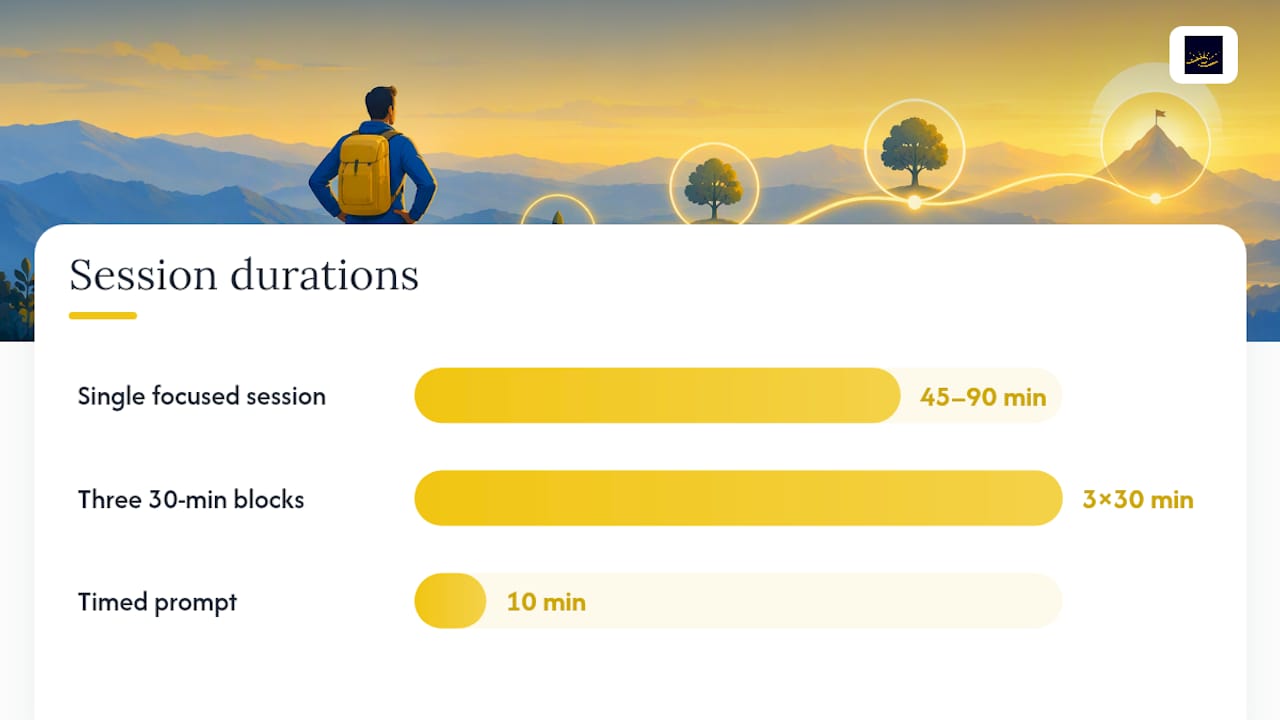
You don’t need a retreat for this. A focused 45 to 90 minute session, or three 30-minute blocks across a week, is enough for a working draft, according to guidance from personal vision-script coaching. Here’s the sequence that works:
- Clarify your values first. Write a short paragraph using five words that describe how you want to operate, not what you want to achieve. This becomes your filter for every later step.
- Run a vision interview. Answer five to ten questions in the voice of your future self, five or ten years out: what are you doing on a Tuesday morning, who’s around you, what problem did you finally solve?
- Write a future-self letter. A short letter from that future self to you today, describing one specific moment, tends to surface language you’d never generate by brainstorming abstractly.
- Name the impact, not just the action. Ask what changes for other people if you live this vision. A vision without a “why” tends to feel hollow the moment things get hard.
- Draft in present tense and read it aloud. If it sounds like a corporate values poster, cut every abstract noun and replace it with something you’d actually say to a friend.
Try this timed prompt: set a timer for ten minutes and finish the sentence “In five years, on an ordinary Tuesday, I am…” three different ways. Pick the version that made you sit up straighter.
Pro Tip: Write the first draft too specific rather than too vague. You can always soften language later, but a mushy first draft rarely sharpens itself.
Vision Statement Templates You Can Fill in Today
A coaching formula many practitioners lean on: action plus impact plus values. Fill in the blanks below, then trim until it sounds like you, not a mission statement generator.
- Template 1: “I commit to [action or way of being] so I can [impact], guided by [value].” Example: “I commit to speaking up in the first five minutes of every meeting so I can shape decisions early, guided by courage.”
- Template 2: “I build [what you create] that helps [who benefits] [do what].” Example: “I build products that help small teams ship faster without burning out.”
- Template 3: “I am the kind of [role] who [specific behavior], because [value].” Example: “I am the kind of parent who shows up to every recital, because presence is love.”
- Template 4: “By [timeframe], I [specific outcome], measured by [how you’ll know].” Example: “By 2028, I lead a team that promotes from within twice as often as it hires externally.”
- Template 5: “I choose [priority] over [competing priority], every time it counts.” Example: “I choose depth over breadth in my friendships, every time it counts.”
Keep the final version to one or two sentences, written in present tense. Anything longer starts reading like a plan instead of a compass.
Testing and Revising Your Vision Statement Over Time
Draft it, then test it for 30 days before you touch it again. After that, a quarterly check-in and an annual rewrite keep the statement honest as your life actually changes, rather than as a fossil of who you were last year.
Three quick tests to run:
- The read-aloud test: if it doesn’t make you feel something, it’s still a draft, not a vision.
- The decision test: would this statement have made you say no to your last bad opportunity?
- The value-alignment test: does it clash with anything you consider non-negotiable in how you live?
Ask a peer or coach two specific questions: “Does this sound like me?” and “What’s missing?” Soliciting outside feedback catches the blind spots you can’t see from inside your own head. Common traps: too vague (“I want to make a difference”), too corporate (“optimize synergies”), or too crowded with five goals stitched together. Fix each by cutting to one clear image.
Pro Tip: If your vision statement could describe half the people you know, it’s not specific enough yet. Specificity is what makes it usable.
How a Coach Validates a Personal Vision Statement
A short vision interview, run solo or with a coach, takes 10 to 15 minutes and asks pointed questions: what does a good day look like in five years, who’s affected by your work, what did you stop tolerating to get there? Coaches then translate the answer into two or three measurable actions, like a monthly check-in on time allocation or a quarterly review of whether your calendar still matches your stated priorities.
A vision statement that never gets tested against a real calendar or a real decision is just a nice sentence. The value shows up when someone holds you to it.
MMDC Alchemy, founded by executive coach Junna Liao, has guided this kind of work through hundreds of coaching engagements, often pairing it with an Energy Leadership Index assessment to connect the statement to measurable energy patterns and behavior.
Vision Statement Examples for Different Career Stages
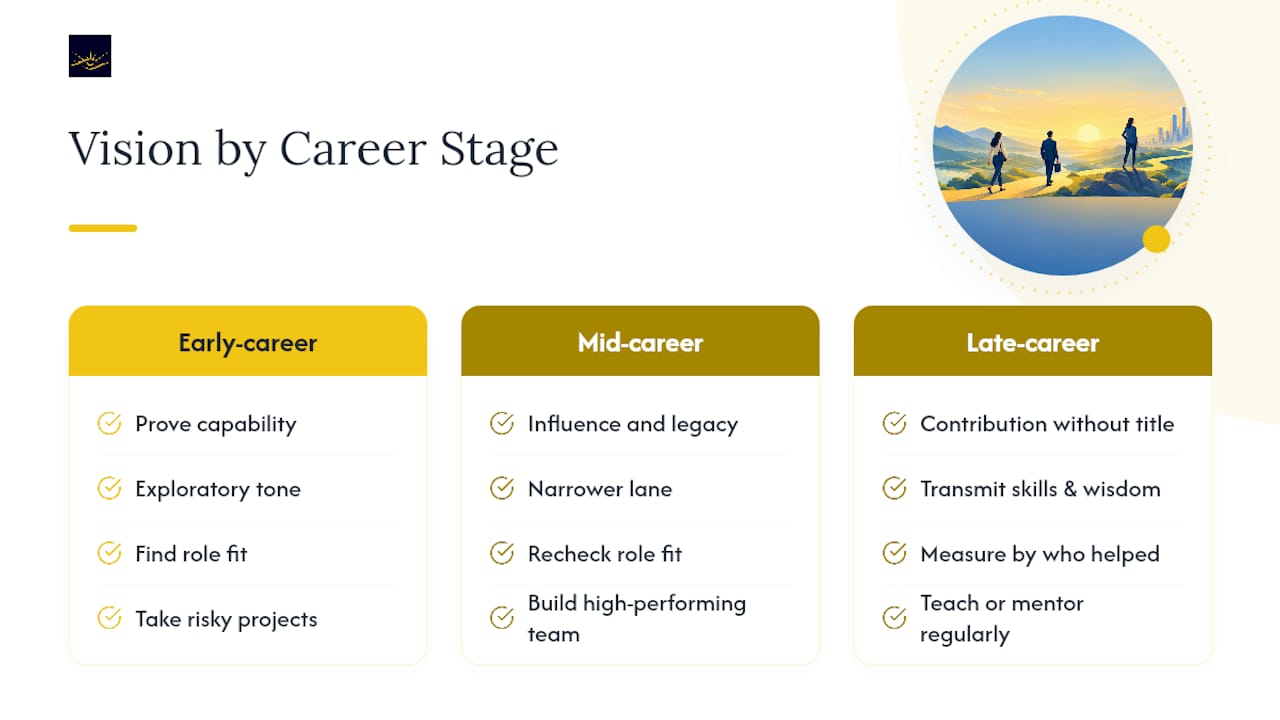
A vision written at 26 reads differently than one written at 55, and it should.
Young professionals tend to write vision statements aimed at proving capability and finding fit: “I take on the projects nobody else wants, because that’s where I learn fastest and get noticed.” The tone is often exploratory, testing which kind of work energizes them before they commit to a specialty.
Mid-career professionals shift toward influence and legacy inside a narrower lane: “I build a team that outperforms mine from three years ago, and I take less credit for it than I used to want.” Burnout and identity questions often surface here, which is why mid-career vision work frequently doubles as a check on whether the current role still fits.
Retirees and late-career professionals often write toward contribution without a title attached: “I spend my Tuesdays teaching what took me thirty years to learn, and I measure my week by who I helped, not what I billed.” The vision moves from performance to transmission, passing skill and perspective forward rather than accumulating more of either.
Each stage needs its own honest draft. Borrowing someone else’s stage-appropriate example without adjusting it to your actual situation is how vision statements end up sounding aspirational but empty.
Why Authenticity Beats Polish in a Personal Vision
The clients who break through fastest aren’t the ones who write the most eloquent sentence. They’re the ones who write something a little rough, a little too honest, and then actually test it against a real decision within a week. Polish comes later, if it comes at all.
Your vision statement will change. That’s not failure, that’s evidence you’re paying attention to your own life. Pick one template from this article, write a version today, and give it 30 days against real choices before you decide whether it needs a rewrite.
— Junna Liao
Turning Your Vision Into a Coached, Accountable Plan
Writing the sentence is the easy part. Living inside it when your calendar, your boss, or your own doubt push back is where most people quietly drop the vision within a few months. Coaching services exist for that exact gap: one-on-one coaching that turns a vision statement into a working plan with actual accountability, instead of a note that sits in a journal until next New Year.
The work centers on 1:1 career coaching for professionals navigating a transition, and life coaching for anyone integrating a vision across more than just their job. Both often start with the Energy Leadership Index assessment, which gives you a concrete read on the energy patterns behind your current choices, not just your stated intentions. This fits mid-to-senior professionals, executives, and leaders who are personally investing in change after burnout, a stalled career, or a vision that no longer matches who they’ve become. If your vision statement is sitting untested, book a discovery call and find out what it actually takes to live inside it.
Sources
The exercises referenced above draw on Michael Hyatt’s personal vision script method for timing and the future-self letter, AWIS’s guidance on soliciting feedback, and a values-to-goals worksheet for the five-values exercise. Consultants refining a public-facing vision may also find SEO positioning guidance for consultants useful for translating personal purpose into professional messaging.
- How to Build a Personal Vision Script — Michael Hyatt
- Create Personal Vision Statement — AWIS
- Lost in research? How vision statements transform academic productivity — Research Masterminds
FAQ
How do I make a vision for myself?
Start with five core values, then answer a short vision interview in the voice of your future self five or ten years out. Draft the answer in present tense, read it aloud, and revise until it sounds like something you’d actually say, not a corporate slogan.
What are good personal vision statement examples?
Good examples name a specific action, a clear impact on someone else, and one guiding value, like “I lead with curiosity and measure success by how many people grow under my watch.” Vague statements like “I want to make a difference” fail the test because they could apply to anyone.
What are some examples of vision, broadly?
Vision statements range from career-focused (“I build teams that outperform mine from three years ago”) to personal (“I am fully present at dinner because my kids only get one childhood”). The strongest ones across every domain link a concrete “what” to a deeper “why,” which research on vision statements in academic and research settings finds keeps people motivated through difficult stretches.
What is the best vision for yourself?
There’s no single best vision. The best one for you is specific enough to fail a “would I say no to this opportunity” test and honest enough that you’d feel a little exposed reading it aloud. Test your draft for 30 days against real decisions before deciding if it needs a rewrite.
Can MMDC Alchemy help me turn my vision statement into an actual plan?
Yes. MMDC Alchemy pairs 1:1 coaching with the Energy Leadership Index assessment to translate a vision statement into measurable actions and ongoing accountability. Current pricing for coaching engagements is available on the site rather than published here.
Recommended
- Leadership Blind Spot Assessment for Clearer Growth
- The Alchemy of Mastery: Choosing the Right Individual Leadership Growth Program
This blog is for educational and inspirational purposes only. It is not medical, legal, financial, or mental health advice. Your journey is unique; please seek qualified professional support for decisions that affect your health, finances, or wellbeing.