
Career downshifting is the deliberate choice to take a lower gear at work: fewer hours, a smaller scope, a lower rung on the ladder or a lower-paid role, in exchange for health, time or meaning. Researchers describe it as a discretionary move made to improve life satisfaction, not only a reaction to bad circumstances. Done well, it can end a long stretch of exhaustion. Done badly, it leaves you with the same workload on a smaller paycheck and a quiet question about who you are now.
This guide is for experienced professionals and executives who are weighing that move. It covers the forms downshifting takes, the traps that make it fail, the identity side nobody warns you about, and a practical way to decide.
TL;DR
- Downshifting is an intentional step down in hours, scope, status or pay. It is not quitting, and it is not a collapse.
- The most common failure is cutting hours without redesigning the job, so full-time expectations get squeezed into part-time time.
- For high achievers, the harder part is often identity: losing a title can shake your sense of self even when the move was your idea.
- Test the change before you commit: run a small experiment, run the numbers, and have the conversation with your manager early.
- If you want a thinking partner through the decision, one-on-one coaching can help you sort what you want from what you are escaping.
Table of Contents
- What career downshifting actually means
- Why leaders are looking at it now
- Downshift, leave or fix: which problem are you solving?
- The trap that undoes most downshifts
- The part nobody plans for: identity
- Perspective: what we see with leaders who want to slow down
- Run the numbers before you run the conversation
- Test the change before you commit
- A step-by-step path
- When coaching helps, and when it doesn’t
- Working with us
- FAQ
- Sources
What career downshifting actually means
The word comes from driving. You shift to a lower gear to get more control, not to stop the car. In a work context it means slowing your career on purpose.
It usually shows up in one of these forms:
- Reduced hours. Moving from full-time to part-time, or to a four-day week.
- Reduced load. Keeping a professional role but with a redesigned, smaller set of responsibilities.
- A step down in level. Leaving a management or executive seat for an individual contributor or advisory role.
- A change of work model. Freelance, project-based, remote or hybrid work that removes commuting or constant availability.
- A lower-paid, more meaningful role. Moving to a field or mission that matters more to you, accepting less money.
The definition used in HR literature covers all of these: a voluntary move down the hierarchy or to lower pay to prioritize meaning, health or well-being. What matters is the word voluntary. A demotion or layoff is something done to you. Downshifting is something you choose, and that difference changes how you plan for it and how you feel afterward.
Why leaders are looking at it now
Burnout is the loudest driver at the senior level. In January 2026, TopResume research reported by HRO Today found that 38% of senior leaders had considered leaving their roles in the previous 12 months, and 25% of them cited burnout and stress as the main reason. For these leaders, the desire for better work-life balance (32%) had overtaken salary as the leading reason to want out.
Meaning is the other driver. A 2025 Gallup analysis of purposeful work reports that employees with a strong sense of purpose at work are 5.6 times more likely to be engaged. Only 13% of them report feeling burned out very often or always, against 38% of those with low work purpose. Gallup also reports that 45% of U.S. employees work mainly to collect a paycheck.
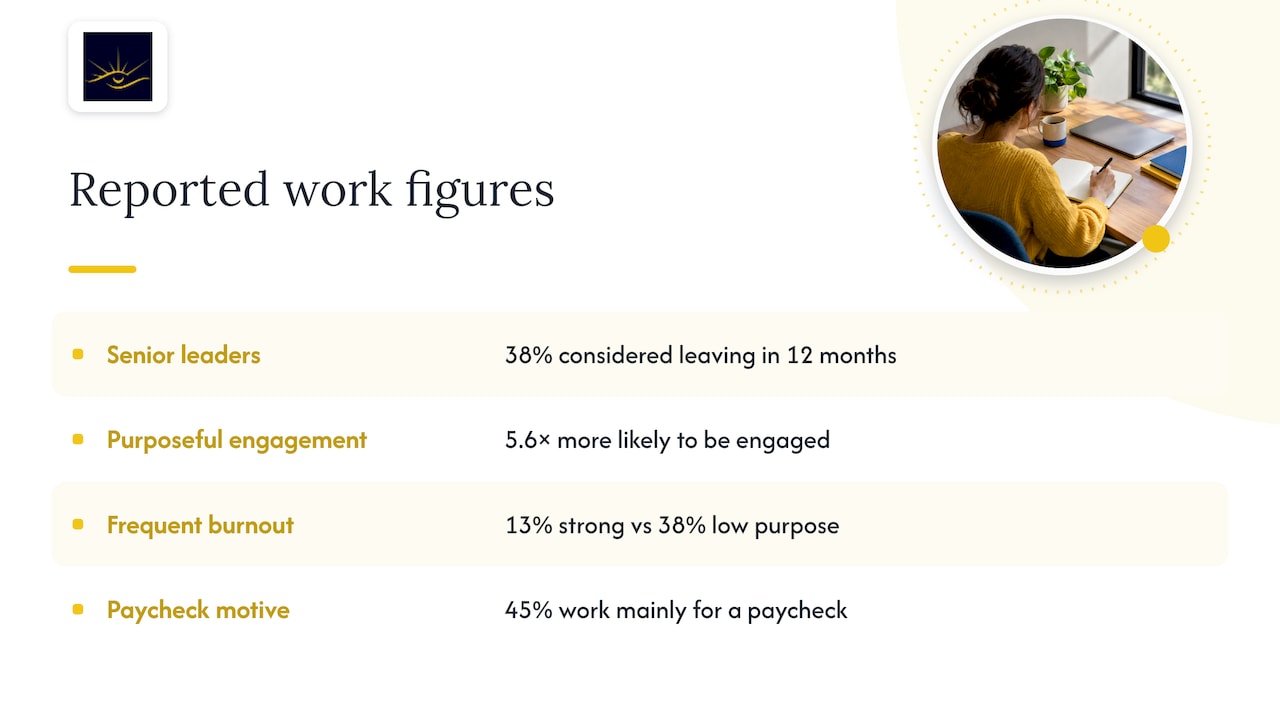
Read those numbers together and a pattern emerges. Many senior people are not tired of work. They are tired of work that no longer fits. That is why the useful first question is not “how do I do less?” but “what, exactly, is draining me?”
Downshift, leave or fix: which problem are you solving?
Downshifting is one answer among several. Before you pick it, name the problem.
| If the real problem is… | A better first move might be… |
|---|---|
| Too many hours, but the work itself still interests you | Reduced hours or a redesigned load in your current role |
| The role’s politics, pace or culture, but the field still fits | A move to a different employer or team, at the same or lower level |
| The work no longer feels meaningful | A deeper career change, tested through small experiments first |
| Exhaustion that has built up for years | Recovery first, then decide. Big choices made at the bottom of burnout often miss the mark |
| A sense that you have outgrown your identity as “the executive” | Identity work before any structural change |
If you are unsure whether what you feel is burnout or something heavier, we wrote about how coaching handles burnout versus depression. A coach is not a clinician. If you have symptoms such as persistent low mood, loss of interest, or trouble functioning day to day, talk to your doctor or a licensed mental health professional first.
Some people find they do not need to leave anything. Our approach to executive burnout recovery while staying in your role is built for the person who wants relief without a dramatic exit.
The trap that undoes most downshifts
The classic failure looks like this. You negotiate 80% time and 80% pay. Nothing else changes. The same projects, the same meetings, the same expectations. You now do five days of work in four, and you are paid for four. Stress goes up, not down.
Purdue University researchers who studied reduced-load work in professional jobs describe this clearly. In their paper on redesigning professional jobs for reduced-load work, they describe reduced-load work as a full-time job redesigned to cut both the hours and the workload, with a pay cut. Their point is that the redesign is the whole thing. The professional works with the manager to craft the job tasks together, so a reduction in hours is matched by a realistic reduction in output expectations.
In practice that means you do not just ask “can I work fewer hours?” You bring a proposal:
- List what you do now. Every recurring responsibility, standing meeting and reporting line.
- Sort it into keep, hand off, pause and drop. Be specific about who takes what.
- Define outcomes, not presence. What results will you own at the new level?
- Set the availability rules. Which days, which hours, and what counts as urgent.
- Agree on a review date. Ninety days is a sensible point to look at whether the new design works.
If your employer will not redesign the work, that is information. It may mean the downshift needs to happen somewhere else.
The part nobody plans for: identity
Most downshifting advice stops at the logistics. The harder side is psychological, and it hits high achievers hardest.
If you have spent twenty years being the VP, the founder or the person who runs things, that label does quiet work for you. It tells other people who you are, and it tells you too. Take it away and many people feel a drop in self-worth, even when the decision was voluntary and clearly right.
The research supports this. A study of former owner CEOs who voluntarily left their companies found that a common pitfall was not leaving enough time to prepare for the shift in identity that follows. Many experienced a diminished sense of self at first, before moving toward a more authentic one. A qualitative study of mid-career accounts of changes in career path makes a related point: career shocks are the norm, not the exception, and plans built on the idea of a fully controllable career are unrealistic.
What does that mean for you?
- Expect a wobble in the first months, and do not read it as proof you chose wrong.
- Decide in advance what you will say when someone asks “what do you do?”
- Find something other than your title that you can point to as evidence of your value.
- Tell a few people what is happening, so you are not managing it alone.
This is also where support makes a measurable difference. A study of executive coaching during leadership transitions found that coaching gave leaders room to work through the emotional turmoil of the move. The researchers describe it as a way to turn a threat of derailment into an opportunity for growth. The study looked at transitions into C-suite roles, so it is not about downshifting directly, but the mechanism, a space to make sense of an identity shift, is the same one downshifters need.
Perspective: what we see with leaders who want to slow down
We work with executives, senior professionals and leaders who have usually been good at everything they were asked to do, and are exhausted by it. Across more than 600 client transformations, one pattern repeats: the request that arrives as “I need to do less” is rarely only about workload.
Underneath it we usually find one of three things. Some people have outgrown a role that once fit. Some have been running on a definition of success that was never really theirs. Some are depleted, and any decision made from that state would be a reaction rather than a choice.

So we do not begin with a structure. We begin with energy and identity: what gives you energy, what drains it, and who you are when the title is stripped away. We use the Energy Leadership™ framework and its assessment to make those patterns visible, and then we turn the insight into a practical plan for your career and your life. A downshift can be a fine outcome of that process. So can a different role at the same level, or a redesigned version of the job you already have. We do not steer anyone toward a particular answer.
The other thing we insist on is work between sessions. Insight that stays in a conversation changes nothing. The experiments, the conversations with your manager, the money model and the boundaries all happen in your real life, with accountability, and that is where the change takes hold.
— Junna Liao
Run the numbers before you run the conversation
A downshift that looks wonderful on a Sunday evening can look different after you open the spreadsheet. Do the arithmetic before you say anything to your employer.
- Know your real monthly floor. Add up the spending you cannot cut: housing, insurance, debt payments, dependents.
- Model two or three pay levels. For example, a 20% cut, a 40% cut and a part-time or contract version. See how long your savings last in each.
- Check what you lose beyond salary. Employer health coverage, retirement matching, equity vesting and bonuses can all change when hours or status change. Ask HR how your benefits are tied to hours, and read the plan documents.
- Consider the long game. One thread in the career forums that rank for this topic raises the point that stepping down can leave you more exposed to mid-career layoffs and can weigh on retirement savings. Weigh that honestly. A financial planner can help you stress-test the plan.
This is the stage where we most often see people choose a six-month plan, not a leap. If you are in your 40s and weighing a bigger change, our six-month finance-first plan for a career change at 40 shows how to put numbers first.
Test the change before you commit
You do not have to guess what a slower career feels like. You can sample it.
- Try a trial period. Ask for a pilot, such as four months of a four-day week, with a review at the end.
- Take on a small project in the new direction. Freelance, advisory or volunteer work shows you whether the day-to-day suits you.
- Explore different work models. Some professionals look at commission-based or self-directed paths where they set their own hours. Insurance sales is one example, and it is worth reading the details of any such role carefully, because income can vary widely and flexibility comes with trade-offs.
- Talk to people who did it. Ask what they wish they had known in the first six months.
This experiment-first logic is the backbone of our approach to a midlife career change in six months. Small tests tell you more than a thousand hours of thinking.
A step-by-step path
- Name what you are solving. Hours, culture, meaning, health or identity. Write one sentence.
- Recover enough to think clearly. If you are depleted, get rest and support first.
- Define what “enough” looks like. Income, schedule, responsibilities, status you can live with.
- Model the money. Two or three scenarios, with benefits included.
- Design the role, not just the hours. Prepare the redesign proposal described above.
- Run a pilot. Time-boxed, with a review date.
- Plan the identity shift. Decide how you will describe yourself and who will support you.
- Review at 90 days. Adjust, extend or try another route.
That sequence mirrors the identity-first approach in our seven-step career transformation for midcareer leaders. If you are unsure how to evaluate help, our three steps for vetting career identity coaching lay out what to ask.
When coaching helps, and when it doesn’t
Coaching is a good fit when you are a mid-to-senior professional who can see more than one path and wants a structured, honest partner to work through it. It is a fit when your career has become tangled up with your identity, and when you want accountability to carry decisions into real life.
It is not a substitute for therapy, medical care or financial advice. If you are in crisis, see a licensed professional. If your question is mostly about taxes, retirement accounts or benefits, a fee-only financial planner is the right person.
Working with us
We offer one-on-one work, not group programs. Our career coaching with Junna is for leaders who want to rethink their path, including whether a downshift is the right one. If you want to look at the whole of your life rather than the job alone, there is life coaching with Junna. Many clients begin with the Energy Leadership™ Index assessment to see their energy patterns clearly before they decide anything. Engagements typically run three to twelve months, and you can read how that works in our overview of career transition coaching for mid-career professionals.
FAQ
Is career downshifting the same as quitting?
No. Downshifting means staying in the workforce while deliberately reducing hours, scope, status or pay. Quitting means leaving a job, often without a plan for what comes next. Downshifting is usually a planned, negotiated or designed change.
Does downshifting always mean a pay cut?
Usually, yes. HR definitions describe it as a move to reduced hours or a lower-paid role. Some people offset the cut by moving to freelance or project work, but you should model a lower income and treat any offset as a bonus.
Will downshifting hurt my career?
It can change your trajectory, and you should plan for that honestly. A step back may slow promotions and can leave you more exposed in a layoff. Many people also report that the trade is worth it. The Purdue research suggests the outcome depends heavily on whether the job is genuinely redesigned.
How do I know if I am burned out or just need a change?
Burnout tends to follow you into any role, while a poor fit improves when the work changes. If your exhaustion comes with persistent low mood or trouble functioning, see your doctor or a licensed mental health professional before making big decisions. A coach can help you sort the career side once your health is looked after.
How long should I plan for the transition?
Plan on several months, not weeks. Allow time to model the money, redesign the role, run a pilot and prepare for the identity shift. The executive-transition research flags too little preparation time as a common pitfall.
Sources
- What is downshifting? (PeopleForce HR glossary)
- One-Third of Senior Leaders Have Considered Quitting (HRO Today)
- Purposeful Work Boosts Engagement, Few Experience It (Gallup)
- Desperately Seeking Sustainable Careers: Redesigning Professional Jobs for Reduced-Load Work (Purdue)
- Voluntary transition of the CEO: owner CEOs’ sense of self (Frontiers in Psychology)
- From Shock to Shift: Accounts in Mid-Career About Changes in the Career Path (PMC)
- Executive coaching during leadership transitions into C-suite roles
Recommended
- Seven Step Career Transformation for Midcareer Leaders: Identity First
- Experiment First Midlife Career Change in Six Months
- Career Change at 40: Six Month Finance First Plan. Start in One Hour
- Keep Your Job While You Pivot: Midlife Career Change Coach for 40s–60s
This blog is for educational and inspirational purposes only. It is not medical, legal, financial, or mental health advice. Your journey is unique; please seek qualified professional support for decisions that affect your health, finances, or wellbeing.